Note: You may have to wait a bit for the images to load.
Also, on your Mac, you can see enlargements of any single images by right clicking on the photo and choosing ‘Open image in a new tab’. Gallery images can be enlarged just by clicking on any one of them.
If you’re using an iPad, it’s best to turn it sideways to landscape view…. Also, try viewing in Reader Mode! Available only with Safari web-browser as far as I know….
In an earlier post (November 2021) I wrote that Homher the Intersex Mallard (Anas platyrhynchos) had ‘magically’ reappeared after being ‘away’ for the summer from both Belmont Pond and Thomson Marsh. I was overjoyed to see her again.
Well, I’m happy to report that the other two iDucks I first identified in the January 2021 have also showed up again in their separate locations in November 2021. First, Muncie on November 13 at Munson Pond/Park, and then on November 19 near Teal Pond in the SE sector, Thomson Marsh, the one I call Socratease showed up. As well, another duck I am able to eyedentifye — er, identify — by her blondness and beige ‘beads’ at the back of each eye and below the eye-line, a ‘regular’ female I call Molly also graced us with her presence! (Added 2024: Homher, Muncie, and Socratease all have ‘beads’ similar to ones Molly sports!)
First, then, Muncie at Munson Park about 3.6 km northeast of TMarsh where her ‘cousins’ reside.
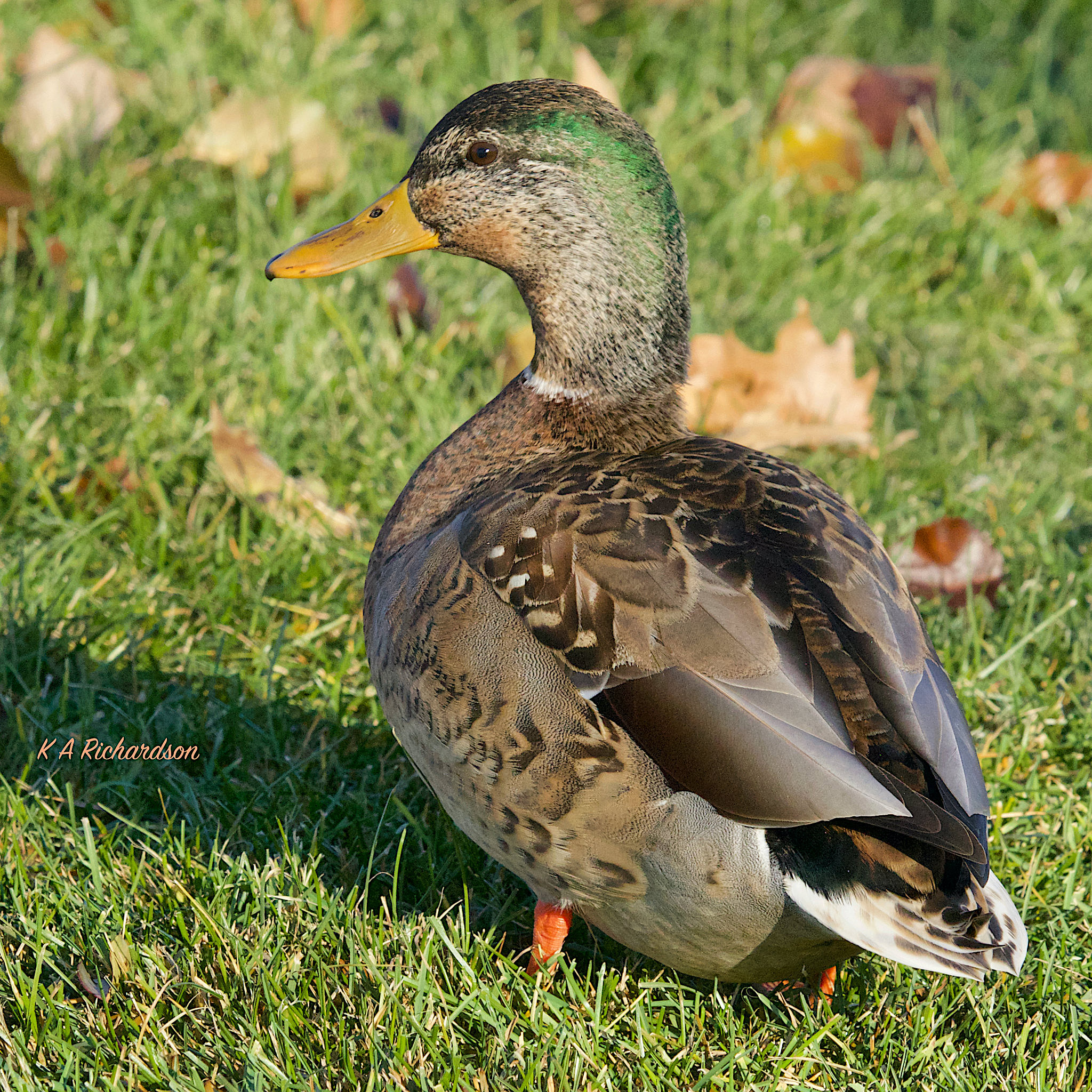
December 2021: Muncie, the Intersex Mallard (Anas platyrhynchos) of Munson Park, Kelowna, returns after being ‘away’ all summer! She appears to be in fine fettle as we used to say!To my surprise Muncie has white ‘beads’ behind both of her eyes, just like the second and third ducks in this post, especially Molly the blonde hen. You can enlarge the images by right clicking and choosing to Open image in a new tab.
Then (below) Socratease, as she appears now, on the left, and as she did a year ago, on the top right.
Above: The bottom right image shows her foraging in December 2021. While her bill is less like a Mallard hen’s than Homher’s and Muncie’s, there’s no doubt that Socratease is an Intersex Mallard, too. Click on any gallery image to see the photos enlarged.
Finally, Molly Mallard, who despite hanging out in a wintering flock of more than 100 ducks, stands out first as one of the blonde hens, and then because of a unique white ‘bead’ behind each eye. Below the photos of Molly are some further observations about this detail.
Molly Mallard, a blonde hen has a distinctive ‘bead’ at the back of her eye not seen on other blonde hens in the large flock of wintering Mallards, some ‘regulars’ in the area, and some just winter migrants.
Here’s Molly from her other side, with the ‘bead circled’:
A uniquely marked Mallard (Anas platyrhynchos) hen that I discovered last spring, which has returned for the winter of 2021-2. Rather independent, she eschews company as she goes about her ‘shopping’…. Her most distinctive mark is a white ‘bead’ just behind her eye (on both sides), circled in this image. I haven’t seen this feature in any of the other ‘blonde’ hens in the winter flock….
Now that snow covers our area, it will be more difficult to keep track of these individuals, but you can be sure I’ll try….
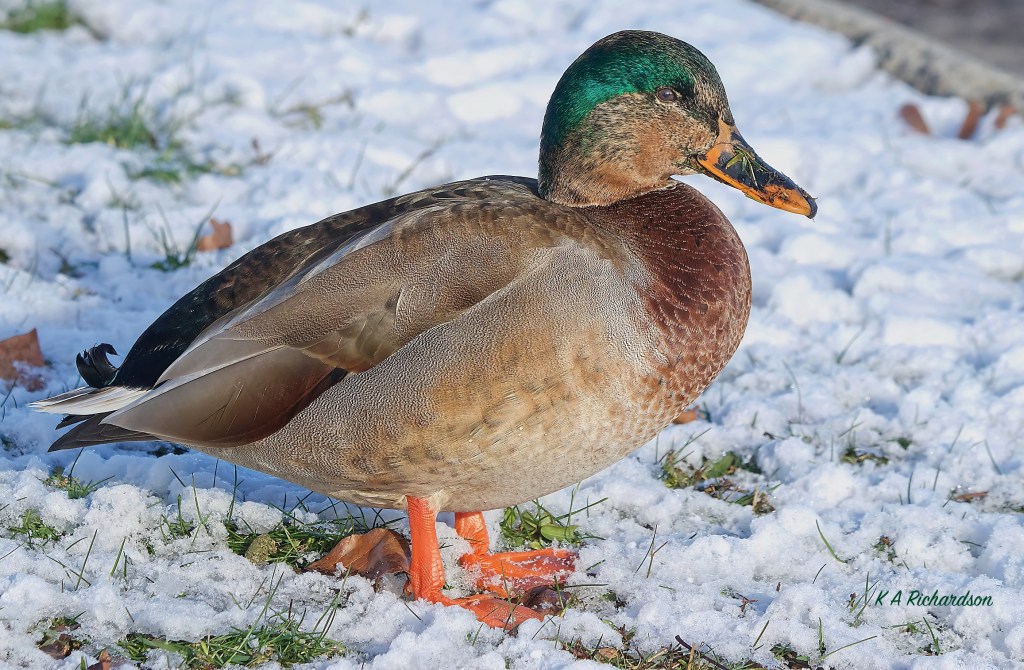
Below, Homher, the iDuck that started all my research: December 2021 after an early snowfall:
Homher doesn’t mind the snow as much as she does the ongoing documentation of her existence….
Here’s another photo of Homher with Molly (taken February 7, 2021):
Molly the eye duck with Homher the iDuck, SE sector, Thomson Marsh, Kelowna, BC. It was a coincidence that she crossed paths with Homher; they don’t necessarily hang out together….
It’s nearly impossible to differentiate “normal Mallards” by appearance. Molly is an exception! Her creamy complexion and the “bead” at the back of each eye enable me to pick her out of the large flock quite readily….
In progress: Added February 2022. I am working on the blonde Mallard hens in the large flock wintering in the SE sector, Thomson Marsh, Kelowna, BC. A coming post illustrates what I’ve ‘discovered’.
After disappearing for the summer, the most interesting duck in Thomson Marsh over the past year and a half (since March 2020) has suddenly reappeared along with some of the ‘winter mallards’ that make Teal Pond and its vicinity their home from November through April. Please give the images time to load!
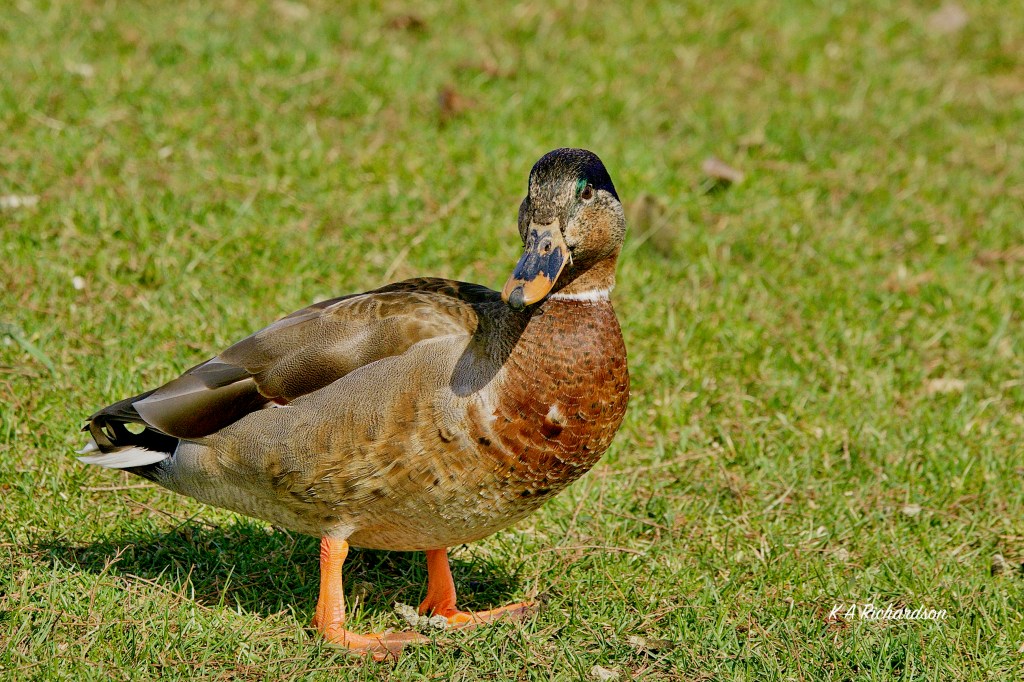
Homher the Intersex Mallard (Anas platyrhynchos), discovered in the area in the spring of 2020, comes and goes with the seasons. We’re very happy to have her back again in Thomson Marsh, near Teal Pond.
For those who don’t know, an intersex mallard is a female that, over many years, has taken on many characteristics of drake Mallards from some green in the head to dark breast plumage and the curly black over white tail feathers. For the story of how I came to realize that Homher is an iDuck and not a hybrid or an eclipse drake, please check out my very lengthy account here: https://birdsandmusings.wordpress.com/2021/02/05/its-not-a-hybrid-after-all/
I had last seen her nibs in June 2021. As I had several times throughout the previous year, I doubted that I would ever see her again. But here surprise! Surprise, in November 2021, she’s back, the picture of good health — no sign of the limp that bothered here last winter.
Hope you enjoy these photos from October 27. I saw here again on Nov. 4, but as it was nearly dark, I have no photo to prove it….
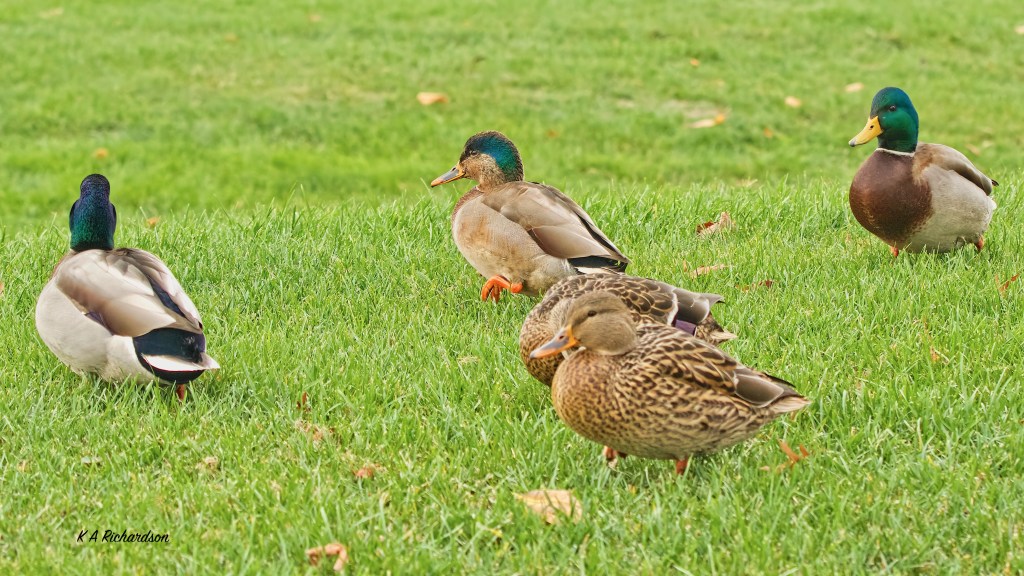
Not a great photo, but it illustrates how Homher differs from both drakes and hens in the ‘normal’ Mallard range. While the other ducks tolerate her, there’s no close connection. She wanders around with them and goes back and forth between Teal Pond and this grass area near Kelowna Rec Field, Kelowna, BC.
“So why is she called Homher,” you ask. Well, when I first saw her in Belmont Pond, about a km west of where she resides now, one of the first things I noticed about her, besides her obviously female bill, was her white eyelid. For some unexplainable reason, I thought of Homer the blind poet. And, as I thought she was a male, most likely a hybrid of some kind, I named it for the great Greek storyteller. Eventually (see the link above), I learned that our odd duck was a female, and had to adjust the spelling from Homer to Homher. These photos illustrate how her eye is an important part of her ‘iDuckness’….
Homher with her eyes open.Homher with her eye closed.Homher squinting….
And finally, Homer in her higher def portrait for this day. Expect updates as the winter moves in…. She’s in our thoughts daily!
ADDED IN 2026: Homher has continued to be in the area into May of this year, primarily at Belmont Pond where I first saw her in 2020. Sadly, however, I have not seen her since June….
An old dog learns something new…. Does the term “intersex duck” intrigue?
Please note: some of the photos are high resolution and take extra time to load on a slow computer. ALSO: IF YOU’RE VIEWING THIS ON AN iPad,I recommend that you turn it sideways to landscape view then tap the AA at the top of the toolbar and choose Show Reader: I think you’ll enjoy the enhanced reading experience! If you’re using a Mac from 2020or newer, I also recommend that you click on the reader view icon on the left side of Safari’s address bar. I have no idea whether you can get enhanced reading from other systems on non-Apple devices….
Large Belmont Pond, March 23, 2020.
Unusual Mallard, Large Belmont Pond, Kelowna, BC. Check the female bill on this otherwise male-looking duck….
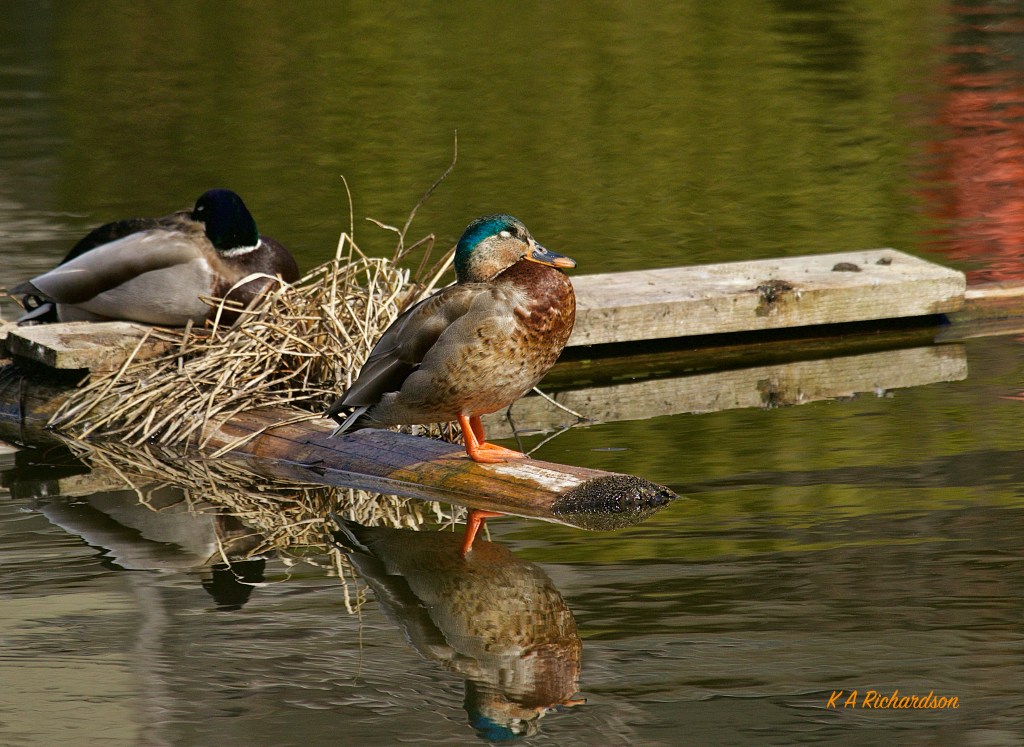
I noticed a strange looking duck, resembling a Mallard drake, sitting calmly on the south-end raft where various species, but mostly Mallards, preen and sun themselves from Spring through Autumn. As there were other Mallards in the pond, it was easy to compare/contrast. What I noticed first was this one’s “white eye,” or more accurately, its closed white lower eyelid.
The plumage wasn’t quite right, either, but that’s not unusual as we move from Spring through Summer. Of course, on this day, we were just at the official beginning of Spring! Remember, too, that this was the first Covid year….
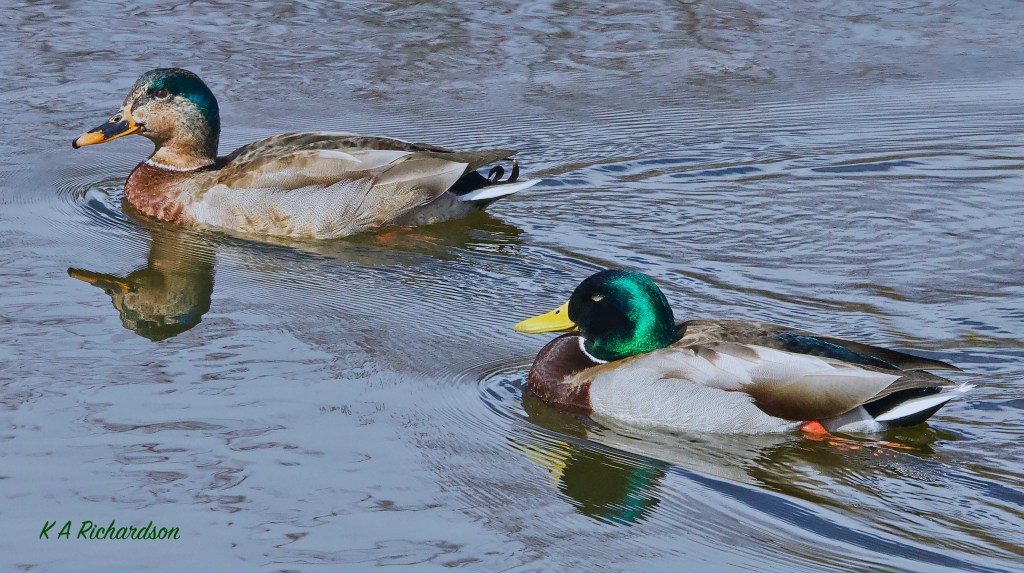
Above is what I thought was (foreground right) aMallard (Anas platyrhynchos) and (upper left) a hybrid Mallard-Gadwall (aka Brewer’s Duck so named by Audubon in 1822) in the Large Belmont Pond, Kelowna, BC. Umm, I got the ‘Mallard’ part right….
Then I noticed the newcomer’s bill: orange with black streaks or spots, like a Mallard hen’s. The head was streaked only on the top side with the green that completely covers other Mallard drakes’ noggins. And the new duck’s sides resembled both a female’s and a male’s.
At the time, I was very puzzled by the combination of male and female physical characteristics. I had nothing in my lexicon to describe it. On my way home, I recalled having seen a reference somewhere to a “Brewer’s Duck” that Audubon had named sometime back in the 1800s that had eventually been shown to be a hybrid of a Mallard and a Gadwall. At home, I looked up BD on the Internet, and found this:
Audubon’s Brewer’s Duck, which he first identified in 1822 as a “Bemaculated Duck,” a misspelling of ‘bimaculated’ and named in honour of the same ornithologist for which the Brewer’s Blackbird and Brewer’s Sparrow are named, Thomas Mayo Brewer.
Then I did what no effective birder, student of Nature, or anybody, really, should do:I jumped to a conclusion without asking enough questions / doing sufficient research. The bird with the fake blind eye (I had already named it Homer, in honour of the blind Greek poet/historian) was, I surmised far too easily, a Brewer’s Duck — a Mallard-Gadwall hybrid! After all, I had seen Mallard hybrids before, particularly a Mallard-Northern Pintail cross that I’d observed in 2013 in White Rock (South Surrey), BC. And I’d learned at that time that Mallard hybrids are not rare, in fact not all that remarkable, really, except for their “enhanced appearance.”
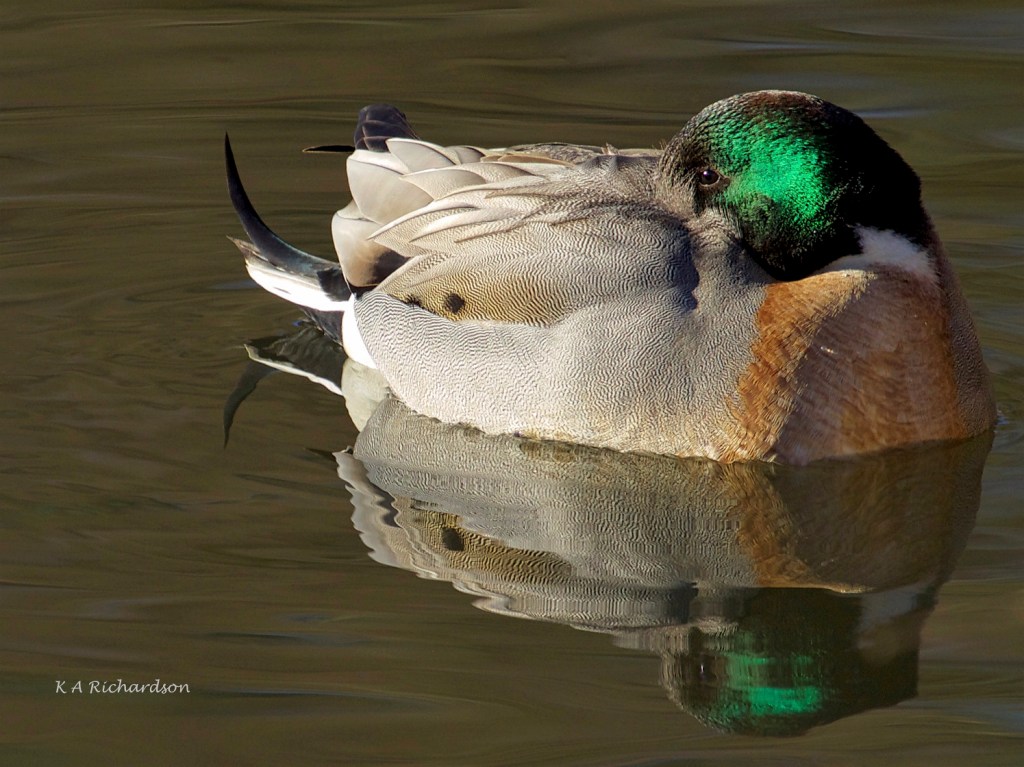
Mallard-Northern Pintail hybrid, January 31, 2014, South Surrey, BC.
Still, Brewer’s Ducks, my research showed, were certainly uncommon. I noticed that Homer didn’t fit perfectly the description of BD’s I was reading, but blithely chalked that up to the idiosyncrasies of hybridism. And then, as I am wont to do (!), I began “sharing the news” of my discovery — on Flickr, and with friends and acquaintances who live in the area and likely to see Homer themselves.
For that impulsive transgression, months later, I humbly apologize. In a moment, you’ll be picking up on the fact that from here on pretty much every use of the male pronoun appears in quotation marks. If you haven’t guessed already, soon you’ll understand why….
‘Homer’ hung around Belmont Pond for a week or so and, even with the sudden onset of Covid-19, friendly neighbours on the east side of the pond allowed me access to their back yard on the pond’s east side to photograph ‘him’ at closer range than in my first encounter.
The original comment, below, turned out be NOT TRUE!! “Mallard-Gadwall hybrid, aka Brewer’s Duck, named by Audubon in 1822. A rare find and a welcome addition to the large Belmont Pond, Kelowna, BC. “ (‘Homer’ was the original spelling; the name has since been adjusted to reflect more recent ‘information.’ Read on!)
Then suddenly, as April arrived, ‘he’ was gone from Belmont Pond. Forever, I suspected; off with the other Mallards to Northern destinations for the breeding season.
I was very pleasantly surprised, therefore, when I “rediscovered Homer” in a channel of Thomson Marsh on April 4 and again on the grass near Teal Pond during the week of April 13.
The main core of my daily beat….
The April photos included extreme closeups that have become very important parts of an historical record. By mid-April, “Homer” had “disappeared” once more. Forever, I thought, again(!).
‘Homer’ in the Channel just north of Teal Pond, Thomson Marsh, April 9, 2020.
Naturally, I celebrated the find, anyway, and persisted in trumpeting the re-arrival of the “Brewer’s Duck.”
Not who I thought ‘he’ was…. But certainly very friendly in this ‘new’ location….
By May, however, Homer was no longer to be seen, at least by me. Not until Autumn, October 29, 2020, when ‘he’ magically reappeared in Belmont Pond, then, as in the spring, in the Southeast Sector of Thomson Marsh, between Teal and Raptor Ponds.. Imagine my surprise!
” ‘Homer’ returns. I had observed this duck in the Spring of 2020 and was surprised and delighted to see ‘him’ again in Belmont Pond in late October 2020. No doubt about ‘his’ being the same bird!”“Gettin’ back to my roots….”
Soon, others were noticing and photographing ‘him’, too. Still, no one I knew ever had a “better” identification of ‘him’ than mine. Then one day, on an umpteenth Flickr post, the late Paul Anthony Baker, a colleague from The West Coast, wonderful photographer and birder who went by the handle “ebirdman,” whom I’d known since 2013* , wrote a simple question/comment in a response: “Lovely shot, Keith! Have you ever done any reading on intersex birds? This bird looks very much like an intersex Mallard. Take a look (at this link) and see what you think. https://www.inaturalist.org/projects/intersex-ducks” And that kind prodding, as we say, changed everything! *(Very sadly, Paul passed away in January 2021: https://www.flickr.com/photos/ebirdman/51842381242/in/dateposted/ For much of a year, we did not know what had happened, until his son chose to update his blog. Paul is deeply missed!)
Here’s what turned up, in part, on the site Paul referenced: Note on iNaturalist website by Reuven Martin (project createdon January 26, 2018): “Intersex” birds are those that show plumage and bare-parts colour seemingly intermediate between male and female. This is commonly seen in Mallards and is also known to occur in other ducks and perhaps other birds. Such birds are often confused with hybrids. As far as I know, the phenomenon is not well-understood or studied. I use “intersex” in quotes because the term has quite a different meaning to how it’s used in humans.
Reuven continued: This project is for any ducks thought to be or to possibly be “intersex”. I’d like to get a better handle on how their plumage can vary. Other interesting questions: * Can these birds reproduce, and if so which sex are they? (Generally thought to be female, but I’m not sure how well-supported that is). * Is behaviour and voice typically more male-like or female-like? * Does the plumage remain consistent over the birds life? (The answer is at least sometimes yes.)
The screen shot below shows some of the locations of interest to Reuven on the iNaturalist blog….
I had written “Homer, the Brewer’s Duck (Audubon, 1822), a Mallard-Gadwall hybrid near Teal Pond, Thomson Marsh, Kelowna, BC, shows how to clip the grass with precision…. “Not so fast,” my friend Paul replied. “Have you ever done any reading on intersex birds?”
As I probed for information on the Internet, I was overwhelmed by what I found. The earliest data I encountered came from a cooperative website, Bird Hybrids http://birdhybrids.blogspot.com (apparently coordinated by Dave Appleton from North Elmham, Norfolk, United Kingdom). It enabled me to find the site of another Flickr member in Sweden, Carl Gunnar Gustavsson, that is also devoted to hybrids and birds that might be mistaken for hybrids, such as the duck below that so resembles “Homer.” Mr. Gustavsson’s post is dated December 27, 2008! And these are his images:
Under his photos, he had written: _63I8334 Mallard Intersex 1 “Malmoe, Sweden 27 December 2008. This is the most masculine out of 2 or possibly 3 individuals at the same pond today. At two other ponds there were only normal birds. I saw this one also about 2 weeks ago when it was accompanied by a normal male and a normal female. Today it seemed to be accompanied by a female only when it at times separated from the flock. I presume that this is a pure mallard with poor sex definition alternatively a masculinised [sic] female. Arguments in favour of other origin?? I uploaded this picture because I think it might add something to the discussion if a bird is a hybrid or an abnormal individual of a pure species.“
While clearly NOT “Homer,” Carl Gunnar’s duck in Sweden 12 years ago certainly represented the same natural phenomenon I’ had’ been viewing in Kelowna, BC, Canada!
Besides his own photos I found a useful opinion Mr. Gustavsson had offered on on someone else’s work, as well, that sets out his criteria of judgment in the hybrid vs intersex argument (quote copied and edited to remove Internet links that no longer work): “I [d]on’t think it is a hybrid at all but what we call an intersex, i.e. a pure Mallard with both male and female features. Odd but not too uncommon. This one is the most extreme that I have heard of [dead link removed]. It was ringed [banded?] as a typical female but 10 years later looked like a rather typical male except for the bill which is still of a female type (it is the bird in the front I am talking about!!!!!!!!!!!). Some other examples, mainly my own [dead links removed]…. As you can see there are different degrees of masculinity and I think yours is rather typical. Black on the bill like in a female, green on the head green from the eye and backwards/downwards reminding on an american wigeon [sic], a mixture of male and female feathers along the side of the body and more or less obvious male type “hooks” on the tail.Moulting [eclipse] male birds is the big pitfall but should not be a problem at this time of the year, [as they] do usually not have black on the bill or only a black mid rib on the culmen [upper ridge of a bird’s bill] and usually have a more mixed pattern of colour on the head — not the typical limited one that your bird has.” [bold face and square brackets – [ ] – are mine – KAR]
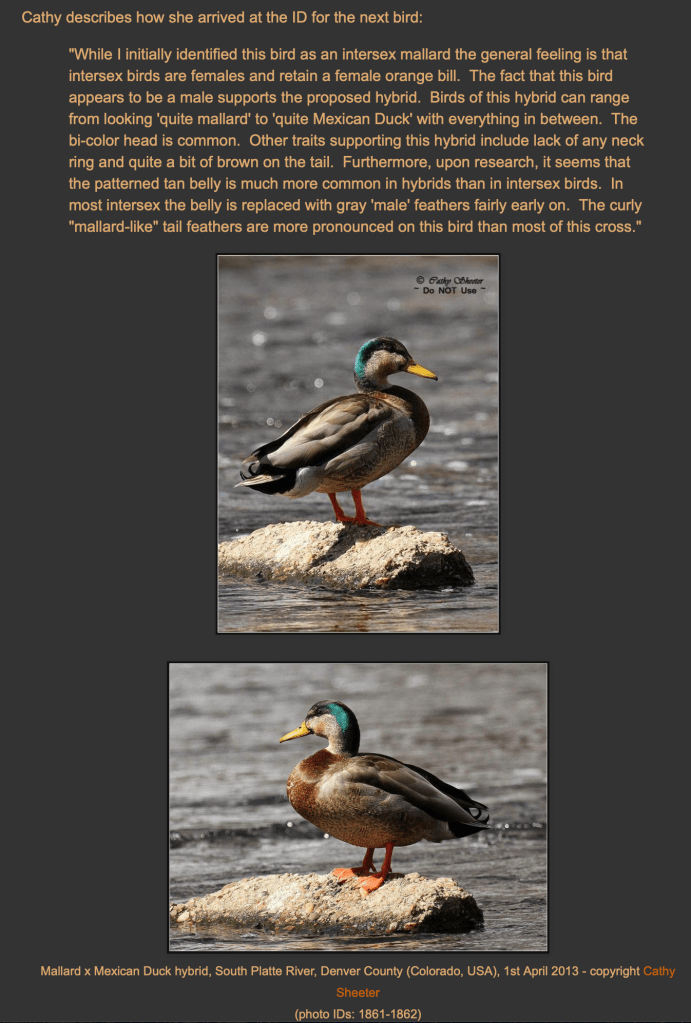
As I delved deeper into Dave Appleton’s Internet page on hybrids vs intersex ducks, I came across other opinions. One of the most interesting is authored by Laura Erickson, a birding expert and writer from Duluth, Minnesota. One of her first references to “intersex ducks” appeared on her Flickr site on February 3, 2009. [https://www.flickr.com/photos/lauraerickson/3251558114] where it attracted a comment from Joern Lehmhus. (He is still actively chasing this issue as shown by his comment on one of my Flickr posts in December 2020 pointing out that I had found an intersex duck, not a Mallard-Gadwall hybrid!) In 2009, Mr. Lehmhus was questioning whether the duck Laura had labelled “intersex” was perhaps a Mallard-Black Duck hybrid. It was not as we learned from yet another post by Cathy Sheeter, another Flickr member who discussed the Mallard-Mexican Duck hybrid vs iDuck issue on Appleton’s Bird Hybrid’s site on April 1, 2013 (and no, I don’t think there’s an April Fools prank involved here!). https://birdhybrids.blogspot.com/2014/04/mallard-x-mexican-duck.html
Cathy’s duck, she concludes,isa hybrid, not an intersex. This discussion continues below the sidebar in red below.
SIDEBAR! This “hybrid/intersex/eclipse drake distinction” became important to me when I came across a second duck at Thomson Marsh on December 1, 2020, that was also difficult to identify, one I eventually named Socratease. More on her (shown just above) later..
In her piece, Cathy Sheeter emphasizes the importance of the appearance of the bill. When I suggested that Socratease (above) is an intersex Mallard, my Flickr friend Jody Wells, on Vancouver Island, challenged me, claiming that it was just an eclipse drake, using the bill and other features to explain why he thought so. At first, I was inclined to agree. Over time, and having managed a couple of times to find Socratease again, I became more sure of my judgment. Jody was apparently unfamiliar with intersex ducks at that time, and is learning about this phenomenon along with me…. Eventually, I concluded that Socratease is also an iDuck!
Now back to C Sheeter’s case for why the duck in the photos below is NOT an intersex Mallard: (Note: as I cannot copy the individual photos, I’ve had to use a screen shot from her site.)
This discussion shows how easy it is for some of us to mix up hybrids and intersex ducks….
I also want to return to Laura Erickson’s blog from Minnesota for a moment. Although she first discussed intersex Mallards on herFebruary 2009 podcast, she returned to that story in her blog post of February 13, 2016 where the audio has been transcribed. I encourage anyone interested in this story to read it here: https://blog.lauraerickson.com/2016/02/intersex-mallard.html. Part of what makes it interesting to me is her attempt to link aging to sexual characteristics, not just in Mallards, but in other birds, and even people.
To hearthe original 2009 podcast click the link below then follow my instructions. Her audio podcast is a bit hard to get to, but worth the effort: https://www.lauraerickson.com/radio/?year=2009 Scroll down and click 2009 (on the list on the left), AND THEN in the next window, scroll down again to the February 4th entry – “Intersex Mallard” and click the audio link THERE to hear her short and fascinating podcast:
PLEASE NOTE: as time/opportunity permit and more information and thoughts develop, I am continuing to update this post and add others related to it!
These are the main areas I go to; there are many others as well. This map is included to show the distance between Belmont Ponds / Thomson Marsh and Munson Pond and Park.
UPDATE: In January 2021, at Munson Park, as the ducks fly, about 3.6 km north of where Homher resides, I found a third iDuck. To keep things simple, I named her Muncie. She was hanging out with a pair of mooching Mallards near a well-known bird feeding station catering to passerines. The ducks help clean up the spillage. The drake of the pair was somewhat mean towards Muncie, but she handled his harassment cleverly and found efficient, somewhat sneaky routes back to the treats. I  observed her several times through the remaining winter of 2021. At one point, she had met a single Mallard drake whom she was dominating!
Here is a little gallery tribute (Click on a photo to enlarge it and enter the gallery; to close it, click the x in its top right corner.)
In the fall of 2021 she appeared again and is still to be found in the same location in February 2022 and in Spring 2023:
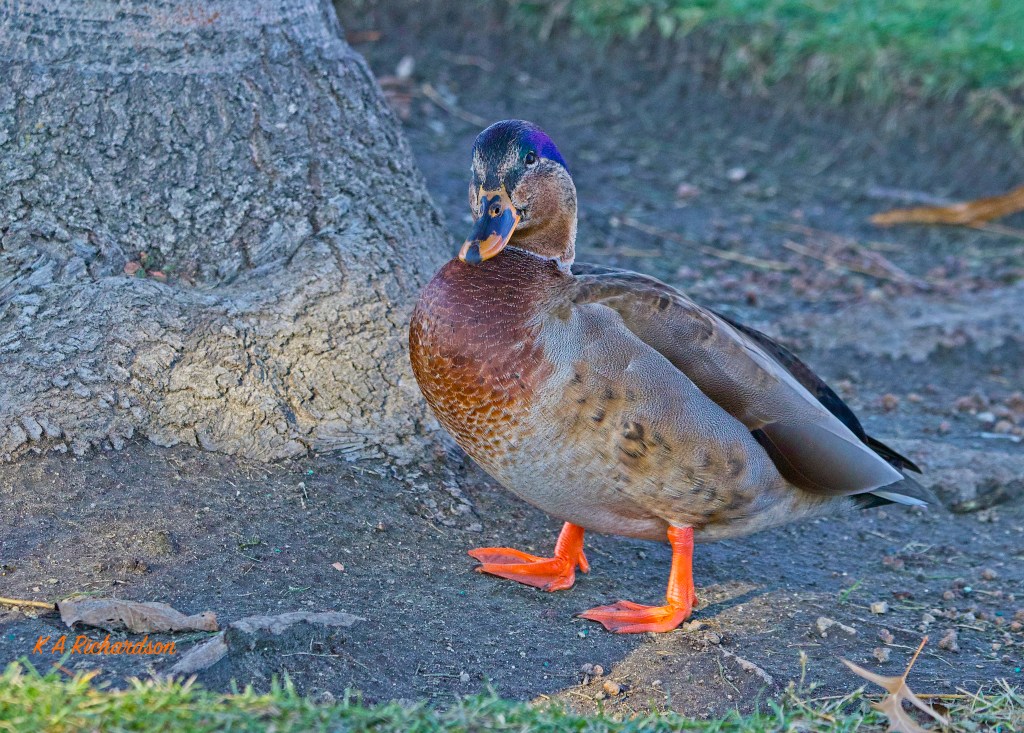
Another Intersex Mallard, I believe! A little over 3.4 kilometers (2.1 miles( northeast of where Homher resides. “Had I known you were coming, I’d have cleaned my bill, and made one for you!”Muncie the iDuck of Munson Park, 2021. My last ‘spring photo’ of her at Munson Park was taken March 1. However, on a visit to the feeding station there on November 13, 2021, a very dull afternoon, I found her again — literally ‘same time, same station’! I have since seen her in January and February 2022 and 2023. I did not follow up in 2024, unfortunately.Muncie the Intersex Mallard (Anas platyrhynchos) of Munson Park, March 1, 2021
For the full record of Homher, the gorgeous iDuck star of Thomson Marsh (below), take a quack at my growing Flickr album of Homher here: www.flickr.com/photos/8666250@N02/albums/72157713743926477 Here’s one of our “venerable lady” in February 3, 2021, and below that three and a half months later, and below that a link to a new post following her through to a full year after that — February 2022.
Intersex Mallard, Homher, SE sector, Thomson Marsh, Kelowa, BC, February 2, 2021.
Update November 4, 2021 Homher disappeared again in April but reappeared on May 18, 2021 at Belmont Pond (where I had first seen her over a year earlier and where she had been seen by another Kelowna photographer, Roberta Snow, as far back as June 2019).
Intersex Mallard (Anas platyrhynchos) Large Belmont Pond, Kelowna, BC, taken May 18, 2021. It appeared that our venerable lady had decided to hang out here for the summer. Latest spring sighting was June 1. After this she went AWOL again — until she reappeared near Teal Pond in Thomson Marsh, over a kilometre to the east on October 27! She continues to hang out there into 2022!




















 birds & musings