Category: *Musings

Media Literacy Matters! Beware Fake News….

UPDATED NOVEMBER 17, 2016: CHECK OUT THIS LINK:

Viral Fake Election News Outperformed Real News On Facebook In Final Months Of The US Election

Last week I wrote, in connection with the US-eh? presidential election, about “news addiction” and the rising spread of “fake news” on the Internet and TV. With only today, tomorrow and 18 hours of Tuesday to go until we learn the outcome of this “unprecedented” democratic exercise, there will be many worried observers biting their nails to the quick.

So, for the record, just a quick followup and an admonition for change.

On November 2, Ahiza Garcia and Justin Lear reported on CNN Money under this headline:

5 stunning fake news stories that reached millions

Each is connected to US politics and the presidential race. Each is well documented. Each shows how vulnerable Americans, and those who follow America’s welfare, are in the face of disinformation presented as fact. Millions of people.

Please read the story above for yourself. Then have a look at this evaluative piece from The Atlantic online that explains as I wrote last week that we desperately need, in the 21st century to become a great deal more media literate, media savvy. Not just kids in school; all of us!

Atlantic Magazine online: 
What CNN Got Right About the Presidential Race

b-stelter-plague-of-fake-news“Last Sunday morning on Reliable Sources, CNN’s Brian Stelter asked his considerable audience to be on guard for one of this election cycle’s most ugly features: fake news sites. He accurately them called “a plague” across the internet. He proposed a new rule for social-media users: “Triple check before you share,” and he offered some useful tips on how to do that.I’m not a fan of CNN’s generally atrocious political coverage in the past 18 months, to put it mildly. But I am a big fan of Stelter’s work; he’s currently the beacon of light at the news channel. His don’t-fall-for-fake-news advice, part of a series of commentaries he’s been delivering, is a key reason why.In pieces like the one that ran on Sunday, Stelter has done what the traditional media have largely failed to do: Leading the way in bringing media-literacy skills to the wider public. Given the size of his audience, on TV and online, it is probably no exaggeration to call him, as I did the other day, “America’s most influential teacher of media literacy in the digital age.” 
Had American journalists at every level made media literacy a core part of their mission for the past 50 years or so, I’m convinced there would have been (at least) two laudable results. First, the nation would have been better prepared to handle the Digital Age’s flood of information, so much of which is false or deceptive. Second, media organizations—at least the ones doing their jobs right—would have fostered much more trust in their own work, which would have helped sustain them through the economic upheaval they’re now enduring.
While the first of those points seems obvious, I’m not saying America could have entirely avoided what some have called the “post-truth” era. Not everyone pays attention to news in the first place. And some people will choose to believe lies no matter what the facts say, as we’ve seen so powerfully this year. But if more of us had been deploying some principles I’ve long recommended—being skeptical; using judgment; asking questions; going outside one’s comfort zone; and understanding how media are created and used to manipulate—we’d individually do a much better job of what Howard Rheingold calls “crap detection.” And we’d do more collective pushback against the lies. Those principles add up to critical thinking, something Americans should value more in our society.
Had American journalists at every level made media literacy a core part of their mission for the past 50 years or so, I’m convinced there would have been (at least) two laudable results. First, the nation would have been better prepared to handle the Digital Age’s flood of information, so much of which is false or deceptive. Second, media organizations—at least the ones doing their jobs right—would have fostered much more trust in their own work, which would have helped sustain them through the economic upheaval they’re now enduring.

While the first of those points seems obvious, I’m not saying America could have entirely avoided what some have called the “post-truth” era. Not everyone pays attention to news in the first place. And some people will choose to believe lies no matter what the facts say, as we’ve seen so powerfully this year. But if more of us had been deploying some principles I’ve long recommendedbeing skeptical; using judgment; asking questions; going outside one’s comfort zone; and understanding how media are created and used to manipulate—we’d individually do a much better job of what Howard Rheingold calls “crap detection.” And we’d do more collective pushback against the lies. Those principles add up to critical thinking, something Americans should value more in our society.

We’d also have more demand for quality journalism, I’m convinced, if journalists had been teaching media-literacy principles and tactics these past few decades….

…Ideally, some members of the audience for my organizations’ journalism would better understand what we do and why—and why it’s worth more support than just a few clicks. They’d be more inclined to pay for the value they derive, and that would give us more resources to provide more value….

…An offshoot of the field called “news literacy” focuses, as you’d guess, on helping people understand current events and issues better. Stelter’s efforts may be a closer fit with the latter, but all variants on the topic are essential in today’s world. But media and news literacies, which should be embedded in every school’s curriculum, have unfortunately been seen more an afterthought than essential parts of education. (And it’s safe to say that teaching real critical thinking would be seen as downright subversive in many parts of the country.)


I [Dan Gillmor of The Atlantic] hope Stelter keeps it up. CNN could recover some of its credibility by filling some of its current wasteland with the help people need to deploy critical thinking when it comes to what they read, listen to, and watch. If that spread widely—to national, regional, and local news organizations of all kinds—we’d beef up our collective critical thinking skills. We’d better, and soon.” I couldn’t agree more!!


US-eh, er, Elections—2016

Okay, let me admit off the top that we don’t need any more opinions about the Trump-Clinton Clash dominating news from our neighbour to the south. This isn’t about the simple horror….

It’s about two related things, however: first, the way this event has grabbed our attention, and second, what it’s revealing about all of us—and the age in which we live.

So, I’ll be brief, and simply point you to a couple of recent articles that got me thinking. Not since September, 2001, have my wife and I been so absorbed by an unfolding news story and had so many discussions about the anxiety and mixed emotions it generates in us. Like most people, we don’t see any end in sight, even when the electoral decisions are made on November 8, or whenever they become “finalized.”

The link below helped us realize that we’re not alone. You may want to give it a look, too.

Is America addicted to this election?

electionaddictionillo
Data, information, misinformation, disinformation, deception and lies….

No doubt, there will be further musings in this blog after the votes are counted next week….

My second focus on is an old pet peeve of mine—Internet hoaxes. In my past life as a computer consultant to seniors, I spent a lot of time trying to teach people how to approach with reasonable skepticism “the stuff they find on the Internet,” or more importantly, “the stuff their friends send them via email,” and increasingly, the stuff they read on social media like Facebook and Twitter and so many other outlets.

All Internet users, and seniors, especially, are subjected to diabolical schemes, such as phishing, designed to hurt them, defraud them, steal their identities, and more. For a refresher, check out this link: Phishing and other ‘Net Phrauds

One of the latest threats is called Fake News. For some of us, Fake News that is satirical can be quit entertaining. On CBC (radio and online) there’s a program I love listening to called “This is That.” Here’s how it’s described on that source of all facts holy, Wikipedia:

“The program began as a summer replacement in 2010, returned in the summer of 2011, and was added to the regular schedule in the fall of 2011. It is hosted by Pat Kelly and Peter Oldring, and produced by Chris Kelly.”

this-is-that

 Its “…style has been compared to The Onion, has drawn phone calls from listeners who did not realize that they were listening to a comedy program and took the content seriously; Oldring and Kelly admit to having been surprised that listeners would be fooled.

In June 2010, the National Post reported as fact that CTV purchased the set of the NBC series Friends;[4] this, however, was a satirical story by This Is That.

Two years later, esteemed Canadian journalist Robert Fulford wrote an article for the National Post claiming that the show is “worth tuning in for.”

Also in 2012, Public Radio International reported as fact a This Is That story that dogs in Montreal would have to know commands in both English and French by law.

In early 2013, Harper’s reported as fact a This Is That story in which a Canadian student “sued her university for failing to accommodate her allergies to cactuses, escalators, tall people, and mauve.”

In September of the same year, several media organizations, including USA Today and the Washington Times, reported on a story about an U-11 organization that had decided to play soccer without a ball to remove competition from the game.

In 2014, Jonathan Jones at The Guardian wrote an article analyzing the satire in their story about a New York artist creating invisible art and selling it for millions.[11]

The program has won three Canadian Comedy Awards. Their comedy special “The Christmas Letter” won a gold medal in the category of Best Comedy Special at the 2014 New York Festivals International Radio Awards[14] and their fourth season won a bronze medal in the category of Best Regularly Scheduled Comedy Program at the same awards ceremony.

Clearly a little satire disguised as a news is a dangerous thing…. And this brings me to the second article from the beginning of this week that jolted me to write about it.

Not surprisingly, in view of what I’ve written above, we love to watch Brian Stelter’s Sunday program on CNN, Reliable Sources. It’s great to see a real effort to examine the difficulty in trying to sort out facts from opinions, and opinions based on facts from claims that are pure hyperbole, and the whole gamut in between. Last week’s show, however, included Brian’s highlighting of and warning about Fake News that’s meant not to entertain, but to deceive. Stelter’s Sunday comments were reproduced online in this article on Monday: The plague of fake news is getting worse….

cnn-stelter-fake-news-is-getting-worse-161030

“The rise of social media has had many upsides, but one downside has been the spread of misinformation. Fake news has become a plague on the Web, especially on social networks like Facebook. As I said on Sunday’s “Reliable Sources” on CNN, unreliable sources about this election have become too numerous to count.

So that’s why I recommended a “triple check before you share” rule.

New web sites designed to trick and mislead people seem to pop up every single day. For their creators, the incentives are clear: more social shares mean more page views mean more ad dollars.

But the B.S. stories hurt the people who read and share them over and over again. Many of these fakes reinforce the views of conservative or liberal voters and insulate them from the truth. The stories prey on people who want to believe the worst about the opposition.

A recent BuzzFeed study of “hyperpartisan Facebook pages” found that these pages “are consistently feeding their millions of followers false or misleading information.”

The less truthful the content, the more frequently it was shared—which does not bode well for the nation’s news literacy during a long, bitter election season.”

Stelter goes on to assert:

“Fake news sites and Facebook feeds…traffic in misinformation. My sense is that there are three buckets of these sites:

#1, Hoax sites with totally made-up news headlines that try to trick you;

#2, Hyperpartisan sites that aren’t lying, per se, but are misleading, because they only share good news about your political party and bad news about the other party;

#3, “Hybrids” that purposely mix a little bit of fact and then a lot of fiction.

These sites aren’t going away, so it’s up to Internet users to spot fake news and avoid spreading it.

Fact-checking sites like Snopes can help—they are devoted to ferreting out hoaxes and tricks.

The Sunlight Foundation’s Alex Howard tweeted these tips:

  • Search the source link on Twitter

  • Google it

  • Check Snopes

  • Consider record of source”

So, if you’re addicted, especially to the perils of social media or simply google search results, join the club, and may the force (not the farce) be with us!

Trials at Timmie’s

(October 2016: Having just returned from a three-week bucket-list trip to Atlantic Canada.)

Tim Hortons.jpeg

My line-mate at Timmie’s leans over and rasps, sotto voce, Only in Yarmouth!

I am compelled to observe that, but for three Tim Hortons I can recall, these breadlines inching towards the humourless cashier are the norm, not the exception.

In my daily life, I won’t even enter a TH if there’s a lineup. I’d rather look for coffee elsewhere, or simply go without, than endure the TH shuffle and the inevitable ordering dance when I finally get to the cashier/server. If I am in TH, there’s a special reason, like the one that had me in line in Yarmouth, NS.

My wife and I were just beginning the last leg of a three-week bucket list trip to Quebec and Atlantic Canada, and, with THs popping up everywhere we travelled, it had seemed like a good idea to put prejudice aside and give this venerated Canadian institution another chance to win our support.

“Seemed,” I say.

At Yarmouth, on day 14, and still resorting to Tim’s (or preferably Wendy’s—paired with TH in many places and providing much better service and choices), we were counting the days until we wouldn’t need to.

And it was here that I determined to write something about why my hackles rise whenever I think about my TH experiences—er—biases. To be fair, not everything about TH sucks (as some observers would have us believe). Their Dark Roast coffee (black, unsweetened, if you please) is a huge upgrade on the stuff that most Canadians continue to adulterate with double cream and double sugar. Some of Tim’s baked goods are as tasty as they are unhealthy, and some of their sandwiches and non-pastry items actually contain a modicum of nutrition. But I digress….

What annoys me most is that so many Canadians seem oblivious to TH’s longstanding faults. To begin with, the assembly line approach that turns workers into cheerless, hair-netted robots delivering the same questions, for the most part with little or no recognition that one customer is even a little bit different from the next. Again, to be fair, there are rare exceptions to whom I am immensely grateful for reminding me that biases need always be challenged. The company’s “system” appears designed to create lines as slow as traffic at a horrific accident site, but the fact remains than we can’t have lineups without folks willing to participate in them….

The staple of the takeout side of the business is the paper-cupped coffee with its plastic lid that hasn’t changed in design in thirty years. The flip top “drinking hole,” capable of slicing lips, is worse than any other takeout lid from a dozen different competitors. I once collected lids from various shops for comparison purposes, and TH’s ranked at the very bottom (Subway’s, when the sliding opening still worked, were the most ingenious and efficient; sadly, no longer so).

Then there’s the interrogation game at the cashier.

“I’d like two medium Dark Roast, black, coffees to go, please.”

“What would you like in it?
For here, or to go?
Would you like fries with that?
How many did you say?”

Or something like that…. I don’t blame the cashiers so much as I do the process design or lack of one. Ugly/inefficient design is a great pet peeve of mine. Lines in Starbucks or Waves, in my experience, occur much less often, and, when they do, move much quicker; there’s much greater flexibility among workers, and most of the time a noticeably more enthusiastic and personal touch to service. I’ve often taken the moment in those establishments to compliment workers who have then confirmed, because I asked them, that they were hired in the first place largely for their engaging personalities.

So, now that I’m home again, will I be going to the local Tim Horton’s for the occasional coffee and treat?

Not likely….

For a more humorous take on Timmies, be sure to check out this link:

http://www.macleans.ca/society/okay-canada-its-time-for-the-hard-truth-about-tim-hortons/
Among the many witty observations that columnist Scott Feschuk made in Macleans online 2014, there is this three-paragraph riff:

“…Tim Hortons is not a defining national institution. Rather, it is a chain of thousands of doughnut shops, several of which have working toilets.

Tim Hortons is not an indispensable part of the Canadian experience. Rather, it is a place that sells a breakfast sandwich that tastes like a dishcloth soaked in egg yolk and left out overnight on top of a radiator.

Tim Hortons is not an anti-Starbucks choice that makes you a more relatable politician or a more authentic Canadian. Rather, it is a great place to buy a muffin if you’ve always wondered what it would be like to eat blueberry air.”

If you can stomach language far rougher than anything you’ll read on “Birds and Musings,” you may want to look at this site from 2015, too:

Update on Kelowna’s Celebration Tree…

My second post for this blog discussed a special place that we Lower Missioners held dear on the south side of the Greenway…. Read about the Celebration Tree here: Celebration Tree post 1 .

NOTE: There’s an update to this update at the bottom of this post…. HAPPY MOTHERS DAY!

Well, the winter is over, and Spring brings with it all kinds of changes. The little tree(s) that gave us so much joy are no longer deemed accessible, but as of this writing, it appears that our anonymous Celebrators of Special Occasions have found a new location. Whether it is intended as permanent or not, I don’t know, but here are a couple of shots of the new location on the east side of the Mission Dog Park off Lexington and just east of the Gordon Bridge over Mission Creek:

Thanks, ladies for keeping up the tradition! May others continue to value your contribution as much as I!

Update to the update:
And the latest decoration is for Mothers Day, May 9, 2016. These decorations went up near before the 25th 0f April:

December 2015 — the blog begins….

Quick links for December 2015

Welcome to my first post….

Kelowna Greenway’s Celebration Tree

Merry Christmas to all…

Christmas Angels…and Happy New Year

Christmas Angels and Happy New Year

I wrote this piece in December of 2010 for a January 2011 column in a seniors’ newspaper. The columns were advertising for my tiny private enterprise, MacSeniors Consulting, which I operated from 2005 to 2013.

First, let me wish one and all a new year to remember—for its good health, adventure, and happy encounters. 2010 was pretty good, but it’s time to move on from the Year of Us Acquiring to the Age of Aquarius*, which, according to my Apple’s Dictionary, is “believed by some to signal a period of peace and harmony.” Let’s hope so.

I want to start the year with a column that’s only peripherally about computers, but which connects to something touched on in a previous issue: generalizations and generations.

teens & tech
The days of writing letters, licking stamps, sealing envelopes and driving to the post office seem like ancient history to some….

So here’s the (true) story. I’m at the Pharmasave Post Office about to start stamping my myriad Christmas cards, when a lovely female voice asks, “Would you like some help with those?” Now, I’d like to think I did not look incapable of performing the task myself (the postmistress certainly thought I could!), nor was I experiencing some kind of hallucination. I looked up and saw a lovely face with sparkling eyes and a vivacious smile. A thirty-something perhaps. A Christmas angel, I thought, (and I’m not sure I even believe in angels). I accepted her offer with great gratitude knowing it would save me a few minutes from my busy late afternoon.

She introduced herself as Kristina. She deduced that the cards might be on their way to business clients and mentioned that she remembered having helped her entrepreneurial mom years ago with her Xmas cards. I identified my business and asked her if she used a Mac. She said no, and commented that she didn’t know a lot about computers although she probably should. She mentioned that she had just come from work—at the horse barns (which explained the unusual scent I had been trying to place). We chatted amiably until the task was done, then I thanked her profusely, and we parted as kindred spirits who share faith in “paying-it-forward.”

Christmas Angel #1

All in all, my encounter with K was a highlight of my pre-Christmas season that re-awakened me to the possibilities all around us for happy, indeed magical moments of peace and good will. That is to say, when we’re not busy profiling (I believe we used to say ‘pigeon-holing’) people according to their gender, ethnicity, race, citizenship, politics, employment, appearance, mental capacity, and/or age just for starters.

I’ve written before about how my insights into ‘seniors’ have evolved (I would say improved) since I began business five years  ago. It’s not that I’ve discovered that people of advanced age can be wonderful. It IS that I’ve come to value how unique we all are. That so many are ALSO wonderful is a boon. My clients and senior acquaintances remind me every day that they ‘get’ the blessings of longevity!

So where am I headed here? Kristina is one of the “younger generation.” Does it have a name? Lots was written along the lines of this blog in 2005 about those currently 15 to 35:

“For years, every generation of twenty-somethings has had nicknames. Generation X and Y come to mind. But the latest phenomenon is well-educated, well-financed and not eager to pay dues. In their world of instant communication and instant gratification, having it all can’t wait. Employers, sociologists, and even the media have dubbed them ‘the entitlement generation.’”
The entitlement generation

And that’s pretty polite compared to some of the epithets I’ve heard roll off the lips of my (and the previous) generation. We say such bitter things mainly when we’re generalizing. Yet many, probably most grandparents I know will praise a favourite grandchild, nephew or niece, or other young adult whom they think the world of—as an individual. When it comes to the generation as a whole, however, we’re not always so generous. Maybe we should focus more on the ones and less on the zeroes…

Mean Girls

I want to add an epilogue to the story. The very next day I met angel #2, a bright, well spoken, polite, (and yes, I noticed, beautiful, blonde) 18-year-old who is being home-schooled. We’ll call her ‘Laura.’ She and her mother needed their two Macs adjusted for a mutual problem. Sadly, I’m ashamed to admit that my first expectation of L was low because I initially saw her as a representative of that ‘entitlement generation.’ I couldn’t have been more wrong. At one point, Laura respectfully asked if she could show me how she performed a certain operation. Her demonstration provided me with helpful information. All in all, both ladies left me with a very favourable impression.

When I asked Laura what she was missing most about being out of school in her graduating year, I was shocked as mother explained that daughter has been subject to bullying at school.  L explained with a smile that she had decided to take her most difficult Grade 12 courses at home by correspondence but would “return for the second semester when she could better enjoy the fun stuff.” She did not present herself as a victim, and was very gracious, indeed surprised, when I complimented the wonderful attributes she had repeatedly displayed in the two hours the three of us had been working together, including remarkable and intelligent eye contact, eagerness to learn, and a consistently pleasant and optimistic demeanour. Her mom remarked that outside of home, she doesn’t think L hears a lot of positive comments even from support workers in the school system. Mother and daughter appeared to have a mutually supportive and respectful relationship. I can’t imagine anyone failing to grasp L’s qualities, but apparently it happens.

Christmas Angel #2a

If people like Laura (and perhaps Kristina, too) are being squeezed socially by the very system that is supposed to be preparing us for the Age of Aquarius*, then what hope is there for the world? My hope is that characters like Kristina, Laura, and the billions like them (including an equal number of young men I don’t have space to acknowledge in this column), noticed, yet not always appreciated, will prevail. No amount of technology can create individuals like them. In fact, as we’ll discuss later in the year, technology may be the biggest threat to their growth and survival.

*Click here to learn more about the Age of Aquarius….

Postscript: Now that my wife and I have moved to Kelowna, I’m pleased to say that, daily, I bump into folks, young and older, who epitomize the human qualities this piece tries to appreciate. The post about the Celebration Tree (below) also reflects what I’m talking about….

Kelowna Greenway’s Celebration Tree

I’m trying desperately to stop thinking about the flow of posts here, and just to get some up.
So if you find a lack of sequence, bear with me; that’s sort of the idea of this blog….

A shot of the neighbourhood:

Our neighbourhood 2
Thanks to David Kirk, whom I met last summer on the Thomson Marsh train, for inspiring to go ahead with this story. It developed a little differently from our original notion, but without his encouragement, this account might never have been written….

The Celebration Tree
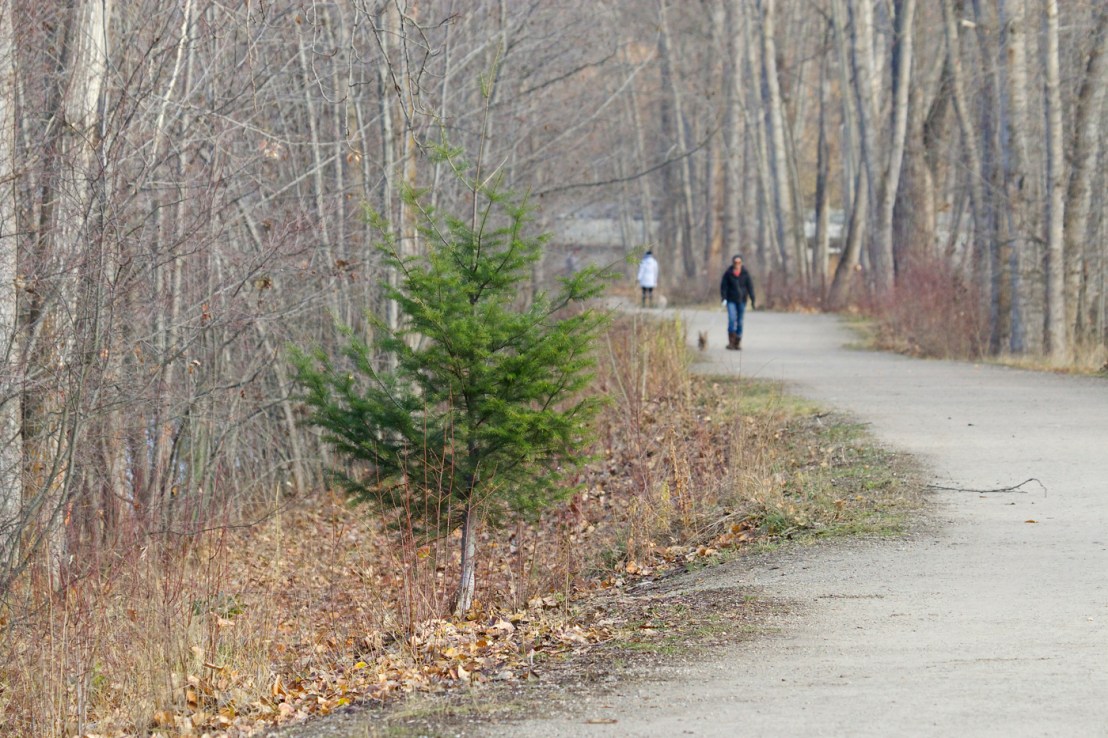
It’s a skinny little fir just off the south side of Mission Creek Greenway, not far from the Casorso Bridge. Most days we walk it by without a glance.

Celebration Tree unadorned
The Little Fir Tree

But come Christmas, Valentine’s Day, or Mother’s or Father’s Day, Canada Day, Back to School Day, Thanksgiving, or Remembrance Day, the spindly shrub is transformed into what I’ve come to call The Celebration Tree.

Celebration Tree BtSchool - 06a
Back to School Celebration

It’s certainly not a secret. Dozens of walkers (with or without dogs), horses and riders, cyclists, joggers, and local photographers pass by it every week. The first time we encounter it, all dressed up in colours and symbols appropriate to the occasion, I think it’s safe to say we feel a glow of gratitude that some thoughtful person or group has undertaken to brighten the day.

IMG_5646
Thanksgiving

The second time, and thereafter, I believe, our appreciation deepens.
When we find someone examining the tree and its icons, we stop to chat.

“Isn’t this great?”

“I wonder who does this—is it a group, school children, some eccentric ‘do-gooder’?”

“Who knows? But it’s something special, isn’t it?”

“Somebody should do a story on it, on the mystery.”

“Find out who’s behind it? I’m not sure we need to know, but it would be nice to thank her/him/them, wouldn’t it?”

Celebration Tree Halloween - 3
Halloween

The day after the holiday, the decorations are gone; the scrawny bush resumes it’s undecorated Charlie Brown’s Christmas Tree persona again.

Not long ago, I encountered a fellow photographer looking for hawks along the perimeter path in Mission Recreation Park. We spoke of how much we love the photo ops in Lower Mission, especially around Thomson and Michaelbrook Marshes and the Greenway. We touched on the friendliness of the other folks who also use the trails here. Eventually, The Celebration tree found a place in the conversation. “I know the people who do it,” my colleague told me, “but my lips are sealed—because that’s the way they want it.”

I realize, too, that The Mystique of the Celebration Tree is a precious part of the Tree’s purpose. We don’t need to know who prepares and nurtures it; we require only a moment to reflect, meditate, and give thanks that we live in a community where such thoughtfulness exists and is so much appreciated.

I look forward to each special day, now, and make a point to visit this extraordinary spot. It never fails to inspire and to remind me that I have landed in a very good place!

Late note: Because of winter construction on the south Greenway, 2015-16, by which the creek’s channel is being redesigned to make it more natural, the dike is closed until Spring 2016.
Will The Little Fir Tree survive? I don’t know.

Celebration Tree uncelebrated - 2a
Here we can see that the Greenway has been lowered by over four feet (compare with the image of the unadorned tree at the top of this post). The tree, adorned with a single Remembrance Day poppy, and its tiny sapling to the right, are still intact….

If it does not survive the creek’s redesign, I don’t think the tradition will die, but it won’t be quite the same either. Already, we’re seeing decorations along the north Greenway Dike in celebration of the 2015 Holiday Season.
Greenway decorations - 1

Good Health, Happy Days, and All the Adventure You Can Handle!

SEE UPDATE ON THIS STORY BY CLICKING HEREUPDATE ON CELEBRATION TREE

**********************************************************
Stories about the tree have appeared in the local press, as recently as November 2015 (http://myemail.constantcontact.com/Naturally-Yours—Winter-Newsletter.html?soid=1103726288256&aid=LRuIRUo_lVU#grant) The article (much of it from a Capital News article in 2002) covers the origin of this custom from 2000 to 2002 and credits Kelowna’s Pearl Jakins (shown below) with founding the tradition.

Pearl Jakins 2001 with Celebration Tree
Pearl Jakins, 2001

It concludes: “These days Pearl isn’t able to get around like she used to, but she still tries to get out to her tree once a week, though she has to drive there now instead of walk. The past couple of years she hasn’t been able to decorate the tree, yet the tree continues to bear decorations thanks to the goodwill of anonymous Greenway users who have grown to cherish the tradition. Pearl would like to meet some of the people who have taken up the torch and express her gratitude that the spirit of the Greenway tree lives on.”


Idle Afternoon Idyl

July 13, 2015 (written to accompany photos of Spotted Sandpipers on my Flickr site.)
[Note: if you see a photo with a hand icon over it—like the map–kids set immediately below, you can click it to enlarge and scroll through the images of its group. To return to the full post, click the x in the top right of the image. Full size images, not in a set, will not show a hand icon….)

With the grandkids safely returned to their home in Yokohama, and us missing them terribly, my wife Nana and I decided to spend the last half of our first empty-nest afternoon at a favourite spot we’d enjoyed with them, Bertram Creek Park, on the east side of Okanagan Lake about 13 minutes south of our home.

We just wanted one of those “idle pleasures” times, where we sit and sip in the shade while enjoying the boaters in the distance and waves wandering in to lap the shoreline.

Of course, I took the camera—just in case the Osprey came around for a feeding as we’d seen her do before.Osprey, eh? - 1It was a lovely afternoon, with wonderfluffy clouds providing sudden moments of relief from the searing Okanagan sun and enabling us to stay put for another few moments before urging us further into the shore-shade up the beach. As the sun slowly rowed its way west, little happened. No Osprey, one distant gull (a “lakegull,” the kids had concluded, since there’s no tide here), a few ants and wasps that for the most part opted for co-existence, and a friendly pair of young Mallards that swam by, only 20 feet away, eschewing entreaties to come in for a chip (I know, I know!) as the lake provides plenty of natural duck food. Bertram DucksEventually, however, we found that we’d moved quite near to where the tiny creek flows into the lake, in the best shade of the day.
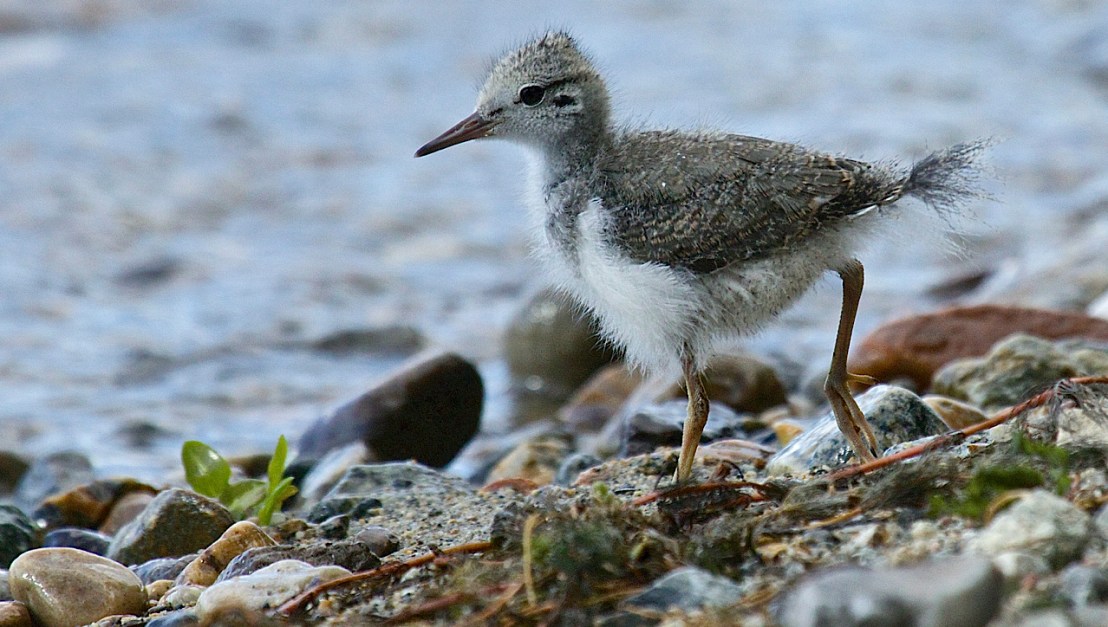
Nana noticed it first and called my attention to a small sandpiper bobbing as it foraged among the rocks on the shore near the creek mouth.

“Spotted,” I said.

“No, I don’t think so,” she replied, reminding me of our grandson who is so precise in his observations and never shy about setting me straight. “It’s so small—maybe a Least?”

I looked more closely. “It’s a chick!” I said. “A Spotted Sandpiper chick. No spots at this age, though.”Spotted Sandpiper chick - 02

I extracted the camera and checked the bird through the lens. “Still a bundle of down. Worth a few shots, I think. Wonder where its mom is.”

While the baby kept a respectful distance, it nevertheless approached within range of my zoom, and I snapped a few shots. When I got up to get a better angle, it turned back towards the creek mouth. I decided to go up and over the creek and approach from the other side. I thought about how much our nine-year-old granddaughter would have loved this moment of the hunt.

That’s when I heard the mom. I wasn’t sure at first, as the peeps seemed to be coming from up in the bushes. “Could be a grey squirrel,” I muttered sotto voce, “or one of those ventriloquist Columbia Ground Squirrels…”. But I think I knew it was the mom.

It took only a few seconds to locate the second bird and to determine that it wasn’t another “peepling.” I watched as the chick withdrew towards the water and mom ventured towards me, squeaking with increasing urgency and doing her best to draw me up the creek, away from the shore.

In the precious late afternoon light, Mom gave me wonderful views both near the creek mouth, then in the shaded vale. I snapped a lot of shots, trying to take advantage without making her too anxious. She was a determined protector; I admired her courage and tenacity.

Spotted Sandpiper mother - 4a

Spotted Sandpiper mother - 9aSpotted Sandpiper mother - 7a

Several minutes later, when I returned to my perch on the shore, Nana spotted the chick again, and we watched as it searched for, then settled into a safe place to wait until Mom returned. It was inspiring to observe its survival skills and a joy to document them.

Spotted Sandpiper chick - 04

This would not have been a particularly remarkable encounter for most birders, I think, but it remains an ephemeral moment that we will hold dear, just as we treasure the three and a half weeks we enjoyed with our own grand-chicks!

N&N arrival Vancouver 1

If you’ve taken the time to read this only to find the ending rather anticlimactic, I apologize, but I hope you enjoyed the photos….