Category: *Musings

2016 Faves—Passerines, part 6: M–N

Trying hard to stick to the plan of highlighting only a very select number of shots of specific species is a challenge for me. So far, so good, I hope…. (Well, I know the writer of this blog, and he’s about to fail big time in this section!) Down alterego, down!

Some species you might expect to find here you won’t—because meadowlarks, out here, are actually Western Meadowlarks, and magpies are Black-billed Magpies. Both are dealt with in the sections featuring the first letters of their names: W and B.

So what have I got for you? Well, how about a species that I covered in some detail in an earlier post about bluebirds, namely the Mountain Bluebird? One of my all time favourites, it’s another western bird that I have seen in various parts of the BC Interior and as far east as Saskatchewan and Manitoba. I love the various shades of blue in the males and blue and grey in the females. As with many birds, their brightness varies with the season and location, the age of the bird and whether or not it’s a dominant member of flock or mix of species in its area.

mountain-bluebird-range-cornell

I like the way Cornell’s website describes the MOBL:

“Male Mountain Bluebirds lend a bit of cerulean sparkle to open habitats across much of western North America. You may spot these cavity-nesters flitting between perches in mountain meadows, in burned or cut-over areas, or where prairie meets forest—especially in places where people have provided nest boxes. Unlike many thrushes, Mountain Bluebirds hunt insects from perches or while on the wing, at times resembling a tiny American Kestrel with their long wings, hovering flight, and quick dives.”


So here they are, a reprise of a male in two poses and a female featured in the earlier post.

The larger image is my favourite MOBL ever. I was so blessed to have his undivided attention for several minutes. The female bird, at a different location and time was equally patient.

NOTE: ALTHOUGH DOVES ARE NOT CONSIDERED PASSERINES, I have included one here because it doesn’t fit into the other broad categories that I’m using. This is NOT intended to be a scientific blog; it’s a highly personal one. Please don’t get too bent out of shape by this issue.

Another “M” bird, though very common up here and throughout the country, is one I’ve come to enjoy since me moved up here. I love their delicate tones, and at various times of the year their friendly interaction. In 2016 I was lucky twice to stumble over a nest brimming with about-to-fledge chicks. The bird is the Mourning Dove:

Some interesting facts about MODOs from Cornell Lab of Ornithology:

“During the breeding season, [we] might see three Mourning Doves flying in tight formation, one after another. This is a form of social display. Typically the bird in the lead is the male of a mated pair. The second bird is an unmated male chasing his rival from the area where he hopes to nest. The third is the female of the mated pair, which seems to go along for the ride.

Mourning Doves tend to feed busily on the ground, swallowing seeds and storing them in an enlargement of the esophagus called the crop. Once they’ve filled it (the record is 17,200 bluegrass seeds in a single crop!), they can fly to a safe perch to digest the meal.

Mourning Doves eat roughly 12 to 20 percent of their body weight per day, or 71 calories on average.

Perhaps one reason why Mourning Doves survive in the desert: they can drink brackish spring water (up to almost half the salinity of sea water) without becoming dehydrated the way humans would.

The Mourning Dove is the most widespread and abundant game bird in North America. Every year hunters harvest more than 20 million, but the Mourning Dove remains one of our most abundant birds with a U.S. population estimated at 350 million.

The oldest known Mourning Dove was a male, and at least 30 years, 4 months old when he was shot in Florida in 1998. He had been banded in Georgia in 1968.”

The next group, the “N” birds, both have a name in common, yet they’re not at all related. That name is “Northern.” There are some ‘Northern’ birds in other categories besides passerines.
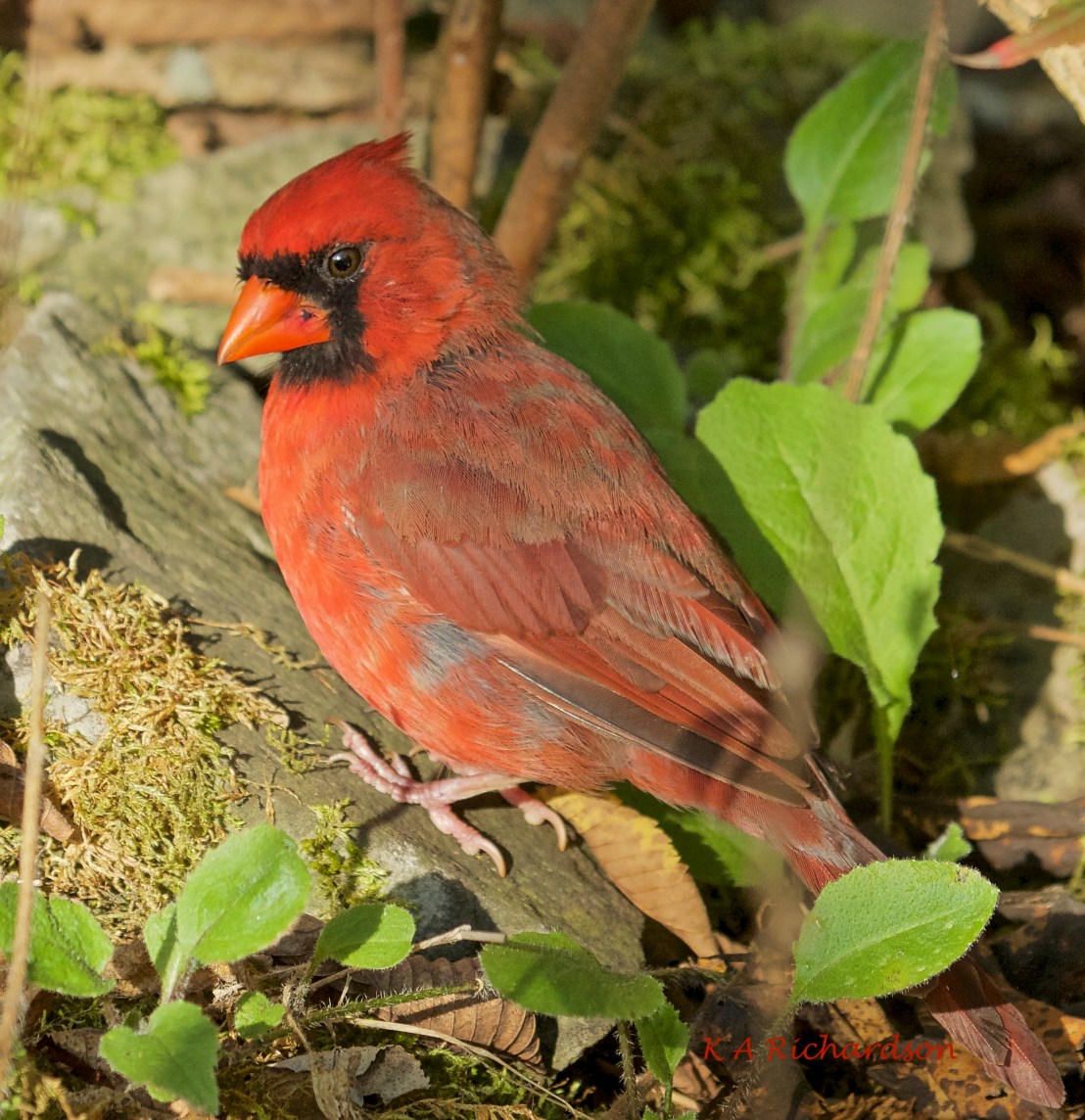
Northern Cardinal male.jpg
Northern Cardinal, a special find far from home in 2016. Click to enlarge.

In autumn 2016 Nana and I flew east and drove from Ottawa to the three western Atlantic provinces and then back to Ottawa via Maine, New Hampshire and Vermont. While birding was not a priority, we did hope to photograph two species, Blue Jays and Northern Cardinals. I covered the Blue Jay in Part 1 of this series. The NOCAs didn’t show up until we were departing Vermont, and I didn’t get the photos I wanted until our final day back to Ottawa, the afternoon before we returned home. Having done some homework and I was ecstatic to find a male and a juvenile right where I expected. And while I came down with a definite case of “buck fever,” I was able to claim this shot at least for my year’s favourites!


NOTE: ALTHOUGH WOODPECKERS ARE NOT CONSIDERED PASSERINES, I have included one here because it doesn’t fit into the other broad categories that I’m using. This is NOT intended to be a scientific blog; it’s a highly personal one. Please don’t get too bent out of shape by this issue.

The second Northern bird is one that, while found across our continent is particularly abundant at home. The Northern Flicker (Colaptes auratus) was once thought to be two different species because it looks different depending upon which part of the country you find them in. Again, from Cornell, “Northern Flickers are large, brown woodpeckers with a gentle expression and handsome black-scalloped plumage. On walks, don’t be surprised if you scare one up from the ground. It’s not where you’d expect to find a woodpecker, but flickers eat mainly ants and beetles, digging for them with their unusual, slightly curved bill. When they fly you’ll see a flash of color in the wings – yellow if you’re in the East, red if you’re in the West – and a bright white flash on the rump.” In addition, the red-shafted variety we see mainly west of the Rockies has a different face and back of the head from his eastern counterpart. Adding to the curiosity is the frequent occurrence, especially here, of Intergrade species with characteristics of both birds; ours still are most likely to have red-shafts. What marks them as Intergrades is the red flash on the back of the head which is characteristic of yellow-shafted birds but not red-shafts.

“Although it can climb up the trunks of trees and hammer on wood like other woodpeckers, the Northern Flicker prefers to find food on the ground. Ants are its main food, and the flicker digs in the dirt to find them. It uses its long barbed tongue to lap up the ants.”

2016 Faves—Passerines, part 5: skip to L….

No Indigo Buntings or juncoes to show, unfortunately. Besides, Juncoes, my nemesis bird up here (oh, there are plenty of them, I just can’t get great shots as I did at The Coast) are actually called Dark-eyed Juncoes, so when I do get a cooperator, (s)he’ll be in Part 2!

So, again, we skip to my Loo! Two of my favourite birds of the spring and early summer are the Lazuli Bunting and the Lewis’s Woodpecker. Both are distinctly western species. Although I often feel we’re shortchanged west of the Rockies and north of the 49th Parallel when it comes to colourful warblers and woodpeckers and even birds with blue, these two help considerably to make up for it:

The Lazuli Bunting is available at The Coast, but it’s really more of an Interior bird. By the way, pronunciation of this name varies among birders. While many say “La-ZHOO-lee,” I prefer “LAZ-you-lee,” as the name comes from the lapis lazuli gemstone of the similar blue colour. To be fair, I used to say LAZ-you-LIE, but that’s not approved, apparently!

It’s taken a while, but I now know where I can reliably look for them here, although the time window is a bit narrow. They’re more likely to be seen in the early breeding season. Cornell’s Lab of Ornithology offers some tips:

“Bushy hillsides, riparian habitats, wooded valleys, sagebrush, chaparral, open scrub, recent post-fire habitats, thickets and hedges along agricultural fields, and residential gardens.” (Don’t find many in town up here, but they’re out there on the periphery.)

When we know what to listen for, we can often hear Lazuli’s before we see them:

“Each male Lazuli Bunting two years of age and older sings only one song, composed of a series of different syllables, and unique to that individual. Yearling males generally arrive on the breeding grounds without a song of their own. Shortly after arriving, a young male develops its own song, which can be a novel rearrangement of syllables, combinations of song fragments of several males, or a copy of the song of one particular older male.

Song copying by young male Lazuli Buntings can produce song neighborhoods, in which songs of neighboring males are similar.” (Cornell LoO)

I am the target text.

NOTE: ALTHOUGH WOODPECKERS ARE NOT CONSIDERED PASSERINES, I have included one here because it doesn’t fit into the other broad categories that I’m using. This is NOT intended to be a scientific blog; it’s a highly personal one. Please don’t get too bent out of shape by this issue.

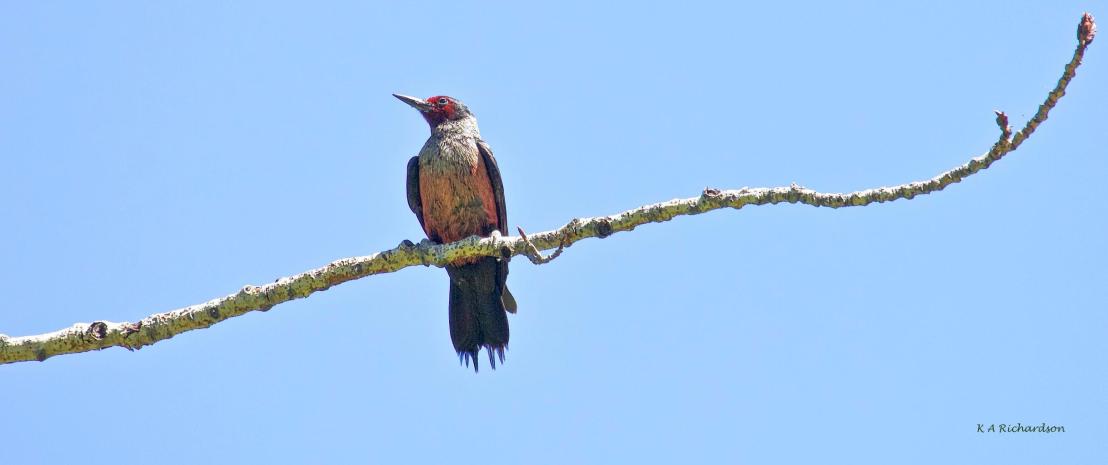
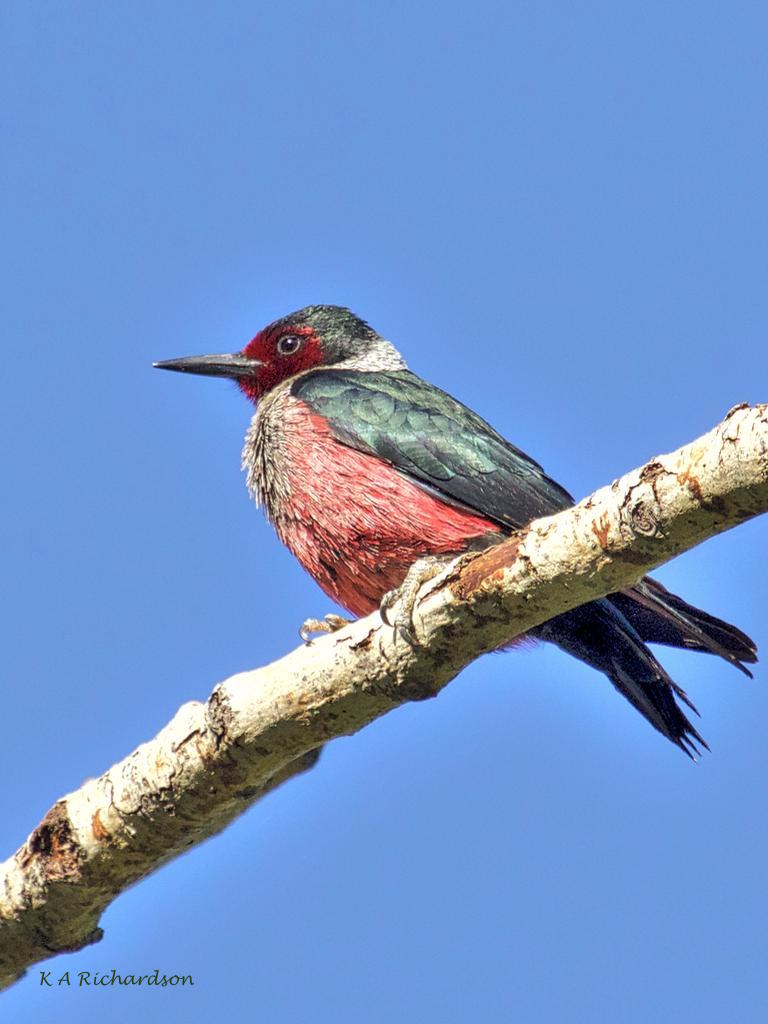
The Lewis’s Woodpecker, on the other hand, is not known for vocalizing, but for its distinctive colouring, and its flycatcher like hawking* (mixed metaphor? see below) of insects. We often see them interacting with other birds that forage in the same range of the food chain. One notable example, last year, involved Lewis’s, Eastern Kingbirds, Yellow Warblers, and Bullock’s Orioles in competition at Okanagan Lake Park, just south of Kelowna. My photo capture of a Lewis’s being dive-bombed by the EAKI are not good enough to publish, but the moment was one to cherish!

lewiss-woodpecker-on-the-long-branch
Lewis’s Woodpecker on the Long Branch
lewiss-woodpecker
LEWO closeup….

*Hawking: a feeding strategy in birds involving catching flying insects in the air. The term usually refers to a technique of sallying out from a perch to snatch an insect and then returning to the same or a different perch. This technique is called “flycatching” and some birds known for it are several families of “flycatchers”: Old World flycatchers, monarch flycatchers, and tyrant flycatchers. Other birds, such as swifts, swallows, and nightjars, also take insects on the wing in continuous aerial feeding. The term “hawking” comes from the similarity of this behaviour to the way hawks take prey in flight, although, whereas raptors may catch prey with their feet, hawking is the behaviour of catching insects in the bill. Many birds have a combined strategy of both hawking insects and gleaning them from foliage. (Wikipedia)

lewiss-woodpecker-range-cornel

The list above does not mention Woodpeckers! But it should mention Lewis’s Woodpeckers which really do exhibit this behaviour!

Last spring, on Beaver Lake Road, we ran into a couple of ardent middle-aged bird watchers from Alberta who had sneaked away from a wedding they were in town for and had found a single Lewis’s in the area. They were ecstatic because this species is very rare where they’re from. And their enthusiasm infected us, as well, for we had never seen one in the BLR area before. How great to learn from the visitors! Seen only occasionally at The Coast, the Lewis’s was one of several birds that brought us up here!


2016 Faves—Passerines, part 4: skip to H….

While there are numerous birds between E and H, none of the ones I’ve photographed fall into the perching / passerines category. AND, to be fair, the first one here doesn’t fit the passerine category either—to begin with, its feet are wrong .

“Most songbirds [passerines] have three forward-facing toes and one backward-facing toe. Most woodpeckers, however, have two toes facing forward and one [or two] facing back. This is known as a zygodactyl foot and allows woodpeckers to easily climb and grasp trees and other structures. Woodpeckers move up a tree by hopping and depend on their especially stiff tail feathers to serve as a prop. They work their way up a tree, peering and poking into every nook and cranny, and then either fly in an undulating fashion to a new area or glide down to a neighboring tree to begin their foraging anew.” (Cornell Lab of Ornithology)

So, for those who prefer bold print:
NOTE: ALTHOUGH WOODPECKERS ARE NOT CONSIDERED PASSERINES, I have included one here because it doesn’t fit into the other broad categories that I’m using. This is NOT intended to be a scientific blog; it’s a highly personal one. Please don’t get too bent out of shape by this issue.

So H brings us three birds, one a well-known woodpecker, a common but colourful finch, and last, but certainly not least, a somewhat drab but very entertaining wee performer.

hairy-woodpecker
Hairy Woodpecker at Harmon Lake, BC.

This handsome Hairy Woodpecker allowed me a front row seat to his excavation at Harmon Lake, BC.  Much larger than the similar Downy Woodpecker, portrayed in Part 2 of this series, the Hairy’s bill is nearly as long as the width of his head. This guy gave me a great look at his endeavours!

house-finch-range-cornell
The House Finch is taken for granted in southwestern BC, and southeastern Canada….

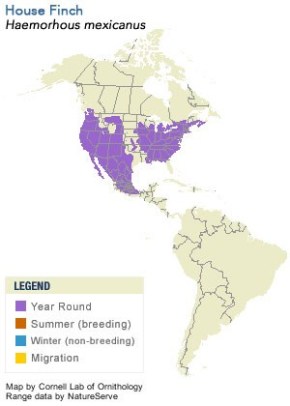
The following account from  the Cornell Lab of Ornithology website betrays an American (i.e. US bias. They’re not found in most parts of Canada.
“The House Finch is a recent introduction from western into eastern North America (and Hawaii), but it has received a warmer reception than other arrivals like the European Starling and House Sparrow. That’s partly due to the cheerful red head and breast of males, and to the bird’s long, twittering song, which can now be heard in most of the neighborhoods of the continent. If you haven’t seen one recently, chances are you can find one at the next bird feeder you come across.”

In actuality, the map may be changing more rapidly than I know. Certainly, HOFIs are common at The Coast and up here in the Okanagan, especially in our exurbs. We are particularly blessed in our neighbourhood where I’ve been able to take scores of photos like these. They are year-round residents, but on the coldest winter days they make themselves scarce. Give us a warm spell, however, and they soon reappear….

Our final “H” bird is the House Wren, which folks where I grew up in Manitoba used call the “Jenny Wren.” More widely distributed in Canada, chances are that you’ll hear one before you see it: Again from Cornell’s website:

“A plain brown bird with an effervescent voice, the House Wren is a common backyard bird over nearly the entire Western Hemisphere. Listen for its rush-and-jumble song in summer and you’ll find this species zipping through shrubs and low tree branches, snatching at insects. House Wrens will gladly use nestboxes, or you may find their twig-filled nests in old cans, boots, or boxes lying around in your garage….

In summer, House Wrens are at home in open forests, forest edges, and areas with scattered grass and trees. Backyards, farmyards, and city parks are perfect for them. In winter they become more secretive, preferring brushy tangles, thickets, and hedgerows.”

Ironically, here in the  Okanagan, I rarely see them in town. There are a couple of reliable locations, however, where they are wonderfully accessible: the amazing Beaver Lake Road area and Bertram Creek Park, both of which have provided many of the photos in this blog.

I’d love to post a lot more shots of each species, but that was not the plan, so I won’t….

2016 Faves—Passerines, part 3: E….

If I have to choose a favourite summer passerine, I would go with the Eastern Kingbird, partly because there are so many to study in the marsh/arboretum near home, but mainly because their so friendly and cooperative. I greatly admire the character of this species—determined yet laid back, excellent mates, and devoted parents. Watching them build their nests and raise their broods between May and July is an annual treat. Less colourful than Robins, perhaps, but elegant and proud to a greater degree. The more I observe them, the better I’m able to identify individual idiosyncrasies that endear some even more than others. Last summer we were treated to four pairs in Thomson Marsh, fairly evenly spaced around the walking path that borders Thomson Brook on the south and eastern sides of Mission Recreational Fields. Three of the four pairs successfully raised youngsters. Sadly, the pair that began the latest and that built what I thought was the most luxurious nest, had it destroyed by predators after the young had hatched. I didn’t see which predator, but I suspect magpies. It was very sad to see the adult birds, completely at a loss the day after the predation, hanging around in the area but too late in the season to make another attempt….

Sometime in the future I’ll write a post that follows the progress of the EAKIs’ summer….

ecdoveexpansion-greene
Eurasian Collared Doves spreading rapidly across North America! (Cornell Lab of Ornithology) …….Click to enlarge in a new tab.

Another “E” bird that is becoming more common in our neighbourhood is the European Collared Dove, an invader introduced into the Bahamas from Asia. When several ECDOs escaped captivity there in 1974, some found their way to Florida. Wikipedia tells the story below, but first, this important admission:

NOTE: Although DOVES  ARE NOT CONSIDERED PASSERINES, I have included one here because it doesn’t fit into the other broad categories that I’m using. This is NOT intended to be a scientific blog; it’s a highly personal one. Please don’t get too bent out of shape by this issue.

“The collared dove is not migratory, but is strongly dispersive. Over the last century, it has been one of the great colonisers of the bird world. Its original range at the end of the 19th century was warm temperate and subtropical Asia from Turkey east to southern China and south through India to Sri Lanka. In 1838 it was reported in Bulgaria, but not until the 20th century did it expand across Europe, appearing in parts of the Balkans between 1900 and 1920, and then spreading rapidly northwest, reaching Germany in 1945, Great Britain by 1953 (breeding for the first time in 1956), Ireland in 1959, and the Faroe Islands in the early 1970s. 

Subsequent spread was ‘sideways’ from this fast northwest spread, reaching northeast to north of the Arctic Circle in Norway and east to the Ural Mountains in Russia, and southwest to the Canary Islands and northern Africa from Morocco to Egypt, by the end of the 20th century. In the east of its range, it has also spread northeast to most of central and northern China, and locally (probably introduced) in Japan. It has also reached Iceland as a vagrant (41 records up to 2006), but has not colonised successfully there.

In 1974, less than 50 Eurasian Collared Doves escaped captivity in Nassau, New Providence, Bahamas. From the Bahamas, the species spread to Florida, and is now found in nearly every state in the US, as well as in Mexico. In Arkansas, the species was recorded first in 1989 and since then has grown in numbers and is now present in 42 of 75 counties in the state. It spread from the southeast corner of the state in 1997 to the northwest corner in 5 years, covering a distance of about 500 km at a rate of 100 km  per year. This is more than double the rate of 45 km per year observed in Europe. 

Interestingly, as of 2012, few negative impacts have been demonstrated in Florida, where the species is most prolific. However, the species is known as an aggressive competitor, and there is concern that as populations continue to grow, native birds will be outcompeted by the invaders. However, one study found that Eurasian collared doves are not more aggressive or competitive than native mourning doves, despite similar dietary preferences. 

Population growth has ceased in areas where they’ve been established the longest, such as Florida, but is still growing exponentially in areas of more recent introduction. Carrying capacities appear to be highest in areas with higher temperatures and intermediate levels of development, such as suburban areas and some agricultural areas.

While the spread of disease to native species has not been recorded in a study, Eurasian Collared Doves are known carriers of the parasite Trichomonas gallinae as well as Pigeon Paramyxovirus. Both Trichomonas gallinae and Pigeon Paramyxovirus can spread to native birds via commingling at feeders and by consumption of doves by predators. Pigeon Paramyxovirus is an emergent disease and has the potential to affect domestic poultry, making the Eurasian Collared Dove a threat to not only native biodiversity, but a possible economic threat as well.”

Eurasian Collared Dove
One of the two Eurasian Collared Doves that have located themselves in Belmont Park.

Finally, another species introduced from Europe that has now spread throughout North America—the European Starling. From a distance, their unattractive profile often provokes the “Oh, it’s just a Starling” response. Occasionally, when a large flock flies as a murmuration, they can be quite entertaining. But every so often, we get close enough to see a mature adult’s special colours and pattern, and we’re reminded that it’s usually a good idea to be fully informed before we jump to conclusions….


2016 Faves—Passerines, part 2: C and D….

For viewing instructions, see Passerines, part 1.

The first bird in this post is NOT one we would normally classify as a passerine or perching bird or song bird. to begin with, its feet are wrong . “Most songbirds [passerines] have three forward-facing toes and one backward-facing toe. Most woodpeckers, however, have two toes facing forward and one facing back. This is known as a zygodactyl foot and allows woodpeckers to easily climb and grasp trees and other structures. Woodpeckers move up a tree by hopping and depend on their especially stiff tail feathers to serve as a prop. They work their way up a tree, peering and poking into every nook and cranny, and then either fly in an undulating fashion to a new area or glide down to a neighboring tree to begin their foraging anew.” (Cornell Lab of Ornithology)

However, the California Quail does perch-er-roost in trees, and it does offer distinctive vocalizations that might, to some folks, pass as songs…. So, we’ll treat it here, for our purposes, as a passerine of sorts, even though it isn’t. Try not to get too bent out of shape about this. 😜

Environment Canada, in its inimitable taciturn prose, tells us this about the bird above:
“Native to Oregon and California, the California Quail is an introduced species in Canada. Most of the Canadian population is in the British Columbia interior, where Breeding Bird Survey data indicate that populations have shown large increases since 1973. Populations on the British Columbia coast are not faring as well. The reasons for the difference between the two population trends are unclear.

The California Quail was introduced to British Columbia several times between 1860 and 1912 (Campbell et al. 1990). Wet springs reduce breeding success (Calkins et al. 1999) and cold, snowy winters can have a significant negative impact on local populations (Cannings et al. 1987). There are no conservation concerns for this introduced species.”

For a far more engaging account (by journalist John Macdonald)  of this wonderful Okanagan transplant (can’t call it an invader if it was brought here to populate the area!) click the link below:
Everything you need to know about quail in the southern interior

CAQUs’ keys to survival here are the relatively dry climate and their prolific breeding—up to three enormous broods a year. Their numbers are held in check by predators, both mammals and raptors that eat them, especially the youngest, weakest members of the brood. Because it’s Nature’s Way, we can appreciate both the birds that survive and the creatures who harvest the non-survivors…. Certainly, visitors to the Okanagan almost always find this species an entertaining surprise!

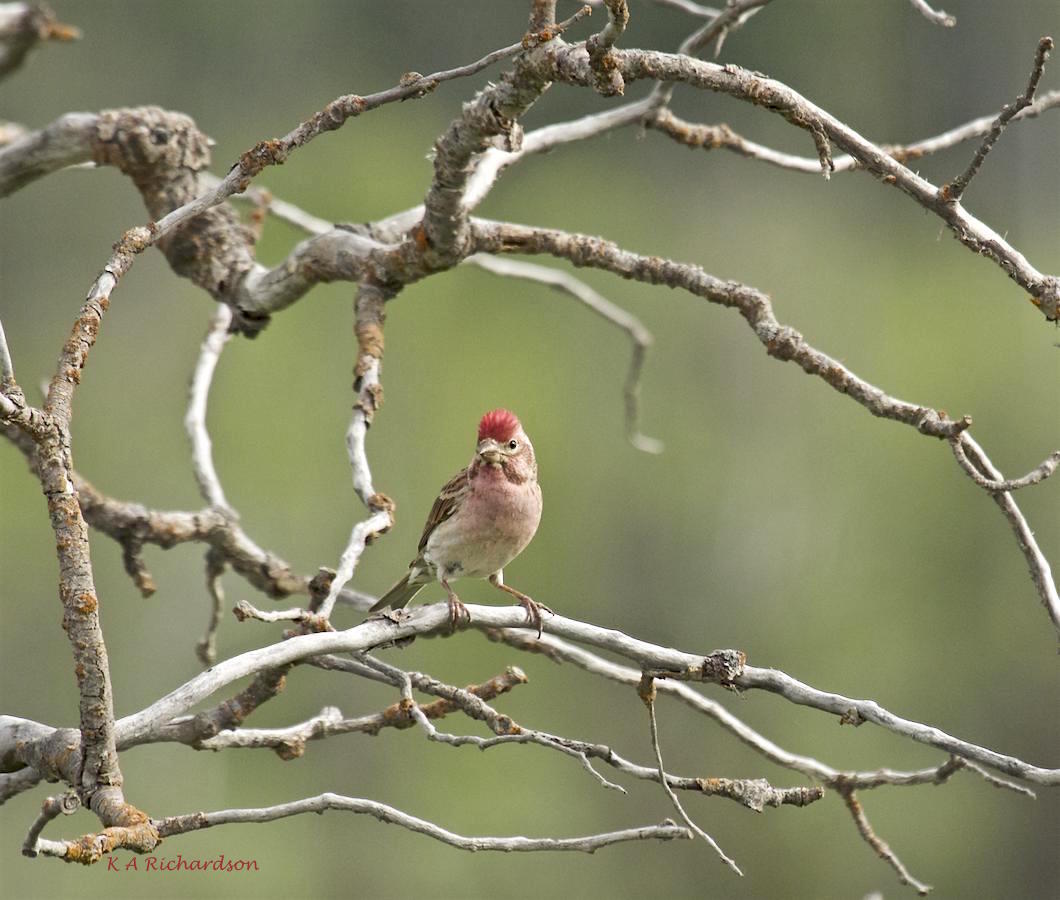
A bird that is less commonly seen, but thrives in the Interior, is a finch that is sometimes mistaken for species more common, the House Finch and the Purple Finch, both of which are quite familiar to British Columbians at The Coast. In my eyes, however, once we’ve seen a Cassin’s Finch in breeding season, we’re unlikely to mistake it for one of its cousins:

cassins-finch-male
Cassin’s Finch in breeding plumage…. It’s all about the cap!

Waxwings, in Kelowna, vary with the season. In winter, we’re blessed with Bohemians, which are a circumpolar species. I’ve covered them in a separate post. In spring, the BOWAs rather quickly give way to the CEWAs, Cedar Waxwings that breed locally and stick around through until their fledglings are ready to head south. Occasionally, one or two will try to stay through the coldest months.

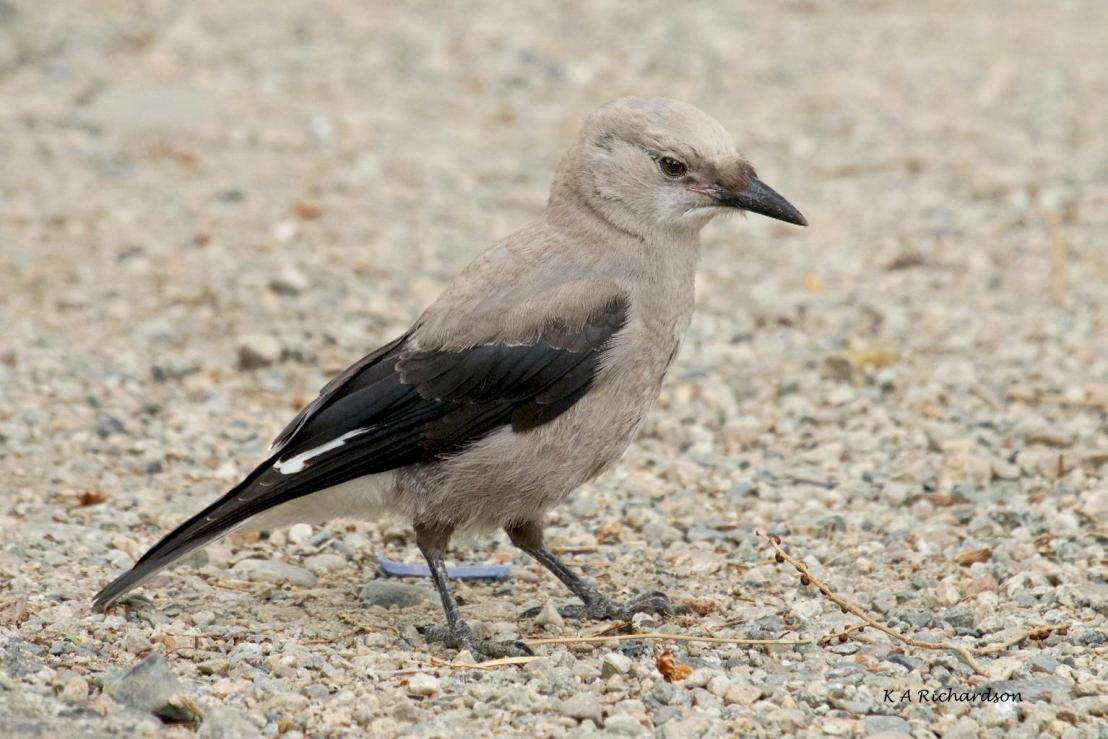
While the next species is found throughout the region and throughout the year, I see it mostly in spring and early summer. A corvid, the Clark’s Nutcracker often shows up in small, noisy flocks, as this individual did at Okanagan Lake Park in June.

clarks-nutcracker
Clark’s Nutcracker, probably a juvenile or second year bird….

NOTE: ALTHOUGH WOODPECKERS ARE NOT CONSIDERED PASSERINES, I have included one here because it doesn’t fit into the other broad categories that I’m using. This is NOT intended to be a scientific blog; it’s a highly personal one. Again, don’t get too bent out of shape by this issue.

downy-woodpeckers
An active pair of Downy Woodpeckers in Belmont Park.

I am the target text.

Downy vs Hairy Woodpeckers

While most of Canada is blessed with an abundance of woodpeckers, there are significant variations in the species east and west of the Continental Divide. Some, like these Downy Woodpeckers, however, are found in virtually all parts of Canada. For some reason, just seeing one makes me happy; when I get to see a pair interacting, cavorting, actually, the thrill is even greater. Males stand out with a flash of red on the back of their head. Downies resemble their larger cousins, Hairy Woodpeckers. A key diagnostic, if one is not sure which species (s)he’s seeing, is the length of the bill, which is less than half the width of the head in the case of the Downy, and much more elongated in the Hairy.

Find photos of other woodpeckers in series parts that contain their first names….
Hairy  ……..
Northern Flicker ……..Pileated

2016 Faves—Passerines, part 1: A and B….

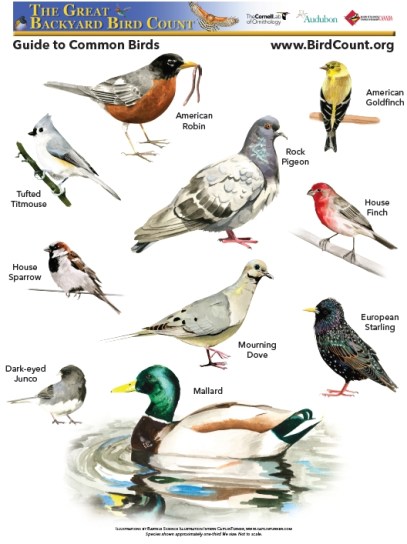
guide-to-common-birds-count
All but three of these are passerines; two might be considered near passerines. One is a waterfowl….

Faves, in my humble opinion, of course. My best efforts OR my favourites—not always exactly the same thing…. They’re in alphabetical order for now. Who knows how this post may change over time?

By the way, the term passerine in the title is not technically correct for all the birds you find in the “Passerines” posts. “Most songbirds [passerines] have three forward-facing toes and one backward-facing toe. Most woodpeckers, however, have two toes facing forward and one facing back. This is known as a zygodactyl foot and allows woodpeckers to easily climb and grasp trees and other structures. Woodpeckers move up a tree by hopping and depend on their especially stiff tail feathers to serve as a prop. They work their way up a tree, peering and poking into every nook and cranny, and then either fly in an undulating fashion to a new area or glide down to a neighboring tree to begin their foraging anew.” (Cornell Lab of Ornithology) There are even some birds that do have the requisite number of toes but are still not considered passerines. As you go through the parts, you find out which….

There will separate posts for “water birds” and “raptors”….

All of these photos, incidentally, can be enlarged just by clicking on them. Where photos are in a group, close the viewer by clicking the x in the upper right. Play around a bit; find a second way of making them even bigger! Look in the lower right!

We begin with a bird familiar to many people across North America, at least the inhabited portion of it, the American Goldfinch. It’s uncommon in Northern BC. but abundant in my neighbourhood in the Okanagan Valley. I’ve selected two brightly coloured males, one a juvenile, in breeding season plumage. They look quite different in winter when we’re still lucky enough to have their presence, especially at home feeders, or on specific tree species like Water Birches.

american-redstart

This American Redstart was a complete surprise. That is, we had hoped to see one about 400 km northwest of this location, then missed the chance to go there because of weather. Here, we were just camping with the grandkids for one night, and when this fella appeared in the low light of the late afternoon, we were ecstatic, even though the photo opp was minimal. He was still around in the very light rain of the next morning. So…this is clearly not a great shot, but a favourite that all four of us who got to observe him will cherish!

Every year, Canadians from coast to coast are treated to a great array of American Robins. Here are few of my favourite takes of those who live in our neighbourhood.

Another of my favourite birds in the Okanagan is the Black-billed Magpie. There are many who do not share my opinion, however. I see them as beautiful and useful scavengers for the most part. Their critics, however, are horrified that they attack the nests and fledglings of other songbirds. I have yet to see them doing so, but even if I did, I would say that they are only doing what they have evolved to do to survive in and to contribute to the ecosystem they share.

I love their social antics, their intelligence and their wiliness…. I’ll feature them in a post sometime in 2017….

Many of our passerines are named for their colours, at least on some part of their anatomy. Interesting to me, two of our blackbirds are named for other colours and one is named for a person, and that’s the one that makes it into this B section of this blog.

Black-capped Chickadees are always fun to work with, I think. Because they’re a pretty plain species, the challenge is find them in an interesting pose with a bokeh that allows them to shine.

Black-headed Grosbeaks are less common in the Okanagan, in my experience, than at The Coast. I felt lucky in the spring, while seizing the opportunity to explore Mill Creek Park while our vehicle was being serviced nearby, to find an adult bird and to coax him down from his treetop perch to something more accessible to the camera. I was even luckier in the autumn, when showing my younger son around Mission Creek Greenway, we came across a juvenile BHGR, a first for both of us!

While the group below are also fascinating to me, I realize that many humans do not share my enthusiasm. Brown-headed Cowbirds are vilified as brood parasites. They lay their eggs in other birds’ nests and expect the other species to raise the offspring, even if it grows faster and larger than the parents’ own chicks. Again, I think we should just accept that this is Nature’s Way, and not attach our own values to species that might have their own misgivings about ours! BHCOs are easily overlooked unless we happen to be in their breeding territory in which case they’ll let us know very vigorously that we’re the problem! I enjoy both of the species in this set for their iridescent plumage and, if you’re lucky enough to see them, their breeding high jinks. The Brewer’s Blackbird, at the bottom of this collage, is often taken for granted unless you see the male in the right light which unleashes the myriad of colours that go into his blackness. Or if you happen to find yourself near a nest which this species defends very aggressively, even against human trespassers!

The final pair of B-birds were a special gift! Although it is possible to see Bullock’s Orioles (the western equivalent of the Baltimore Oriole of eastern North America), they’re not as easy to come across as up here in the Okanagan. My wife and I had been chasing them up here for several summers, gradually finding them closer to Kelowna, but still not easy to get close to. In the fall of 2015, as the trees shed their summer foliage, I happened to notice in a spot not too far from home a number of Oriole nests. As soon as I spotted a BUOR in another area in the second week of May, I went back to where I had seen the nests. Sure enough, there were BUORs galore! I subsequently found them even closer to home, within easy walking distance, but they didn’t stick around long. I hadn’t seen them in this last area the previous spring, but I have my fingers crossed for next year!

So that’s A—B. I’ll continue to work my way through over the next few posts. A great way to spend the worst of the short days of the New Year….

Some things are always changing….

We’ve just begun our third winter in Kelowna. Far too soon to be detecting trends, but not too soon to start wondering….

Take weather and climate for instance. Thanks to the Internet, it’s possible now to do direct comparisons of weather for a particular place from year to year. Kelowna, we’d been told when we arrived, can be counted on for two main weather patterns: extremely hot summers and (by Canadian standards) cloudy but fairly dry winters with temperatures fluctuating from cold to mild through most of December, January and February. Spring and fall would vary, but mostly they’d be very pleasant.

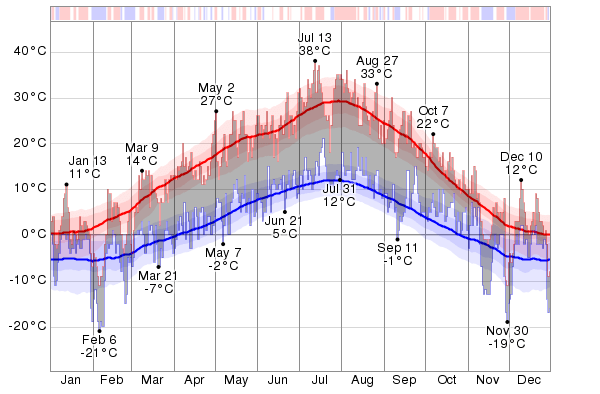
According to its entry on Wikipedia, Kelowna’s climate is summarized in this chart and described below:kelowna-climate-data-wikik

Climate (footnote numbers and links removed, edited for brevity)
“Kelowna experiences a borderline Oceanic/Humid continental climate (Köppen Cfb/Dfb) due to its coldest month having an average temperature slightly above −3.0 °C (26.6 °F), with dry, hot and sunny summers, cold, cloudy winters and four seasons. The official climate station for Kelowna is at the Kelowna International Airport, which is at a higher altitude than the city core with slightly higher precipitation and cooler nighttime temperatures. The moderating effects of Okanagan Lake combined with mountains separating most of BC from the prairies moderates the winter climate, but Arctic air masses do occasionally penetrate the valley during winter, usually for very short periods.

Weather conditions during December and January are the cloudiest in Canada outside of Newfoundland thanks to persistent valley cloud. As Okanagan Lake hardly ever freezes, warmer air rising from the lake climbs above colder atmospheric air, creating a temperature inversion which can cause the valley to be socked in by cloud for weeks on end with no respite. This valley cloud has a low ceiling however, and often bright sunshine can be experienced by driving only 20 minutes or so up into the nearby mountains, above the cloud.

Summers in Kelowna are hot (sometimes extremely hot) and sunny, with daytime temperatures often exceeding 32 °C (90 °F)…. Heat waves may occur in July, August and even June and September on occasion, where temperatures above 30 °C persist for weeks. During summer clear, dry air allows night-time temperatures to fall rapidly.

The city averages about 380 millimetres (15 in) of precipitation per year, with about 1/5 of the precipitation falling as snow, the bulk in December and January; however, June is the wettest month of the year.

…Kelowna has the greatest percentage of “calm” wind observations for any major city in Canada (39% of the time). The four-year average wind measured at the airport has been less than 5 knots on average 10/12 months of the year between 2008 and 2011. …Kelowna has an average high temperature…above freezing every month of the year—exceptionally rare for a Canadian city located inland…. Kelowna’s average year-round high temperature of about 14.6 degrees is also one of the highest in Canada—largely thanks to the rare combination of high summer temperatures typical of continental climates, along with relatively mild winters—a very rare feature of a continental climate.”

So what do recent records show? For the three years we’ve been here, the annual weather summaries provided by weatherspark.com look like this:

kelowna-temps-2014
2014
kelowna-temps-2015
2015
kelowna-temps-2016-so-far
2016 so far….

While the average pattern is similar, there are large discrepancies in the details. None of this is unusual or surprising. Yet, because many cannot accurately remember such apparently picayune facts,  we often conflate them or simply “misremember.”

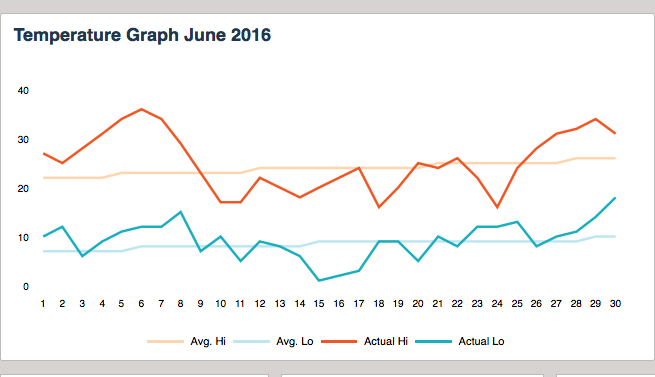
The graphs alone, as enlightening as they should be, are a bit overwhelming for anyone who’s not a fanatic about this data. There are easier ones, like those produced by Accuweather that make it a bit easier to compare individual months:

kelowna-temperatures-june-2015

kelowna-temperatures-june-2016
We can see that mid June 2016 was considerably cooler than the previous June. Also, just because it’s warm at the beginning of the month, it doesn’t mean the whole month is going to be a scorcher….

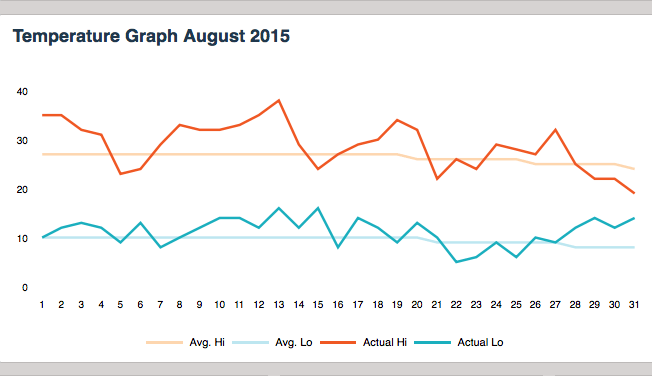
How about July and August for those two years?

kelowna-temperatures-july-2015

kelowna-temperatures-july-2016

July 2016 was, like June, considerably cooler than July 2015.

kelowna-temperatures-august-2015

kelowna-temperatures-august-2016
August was similar in both years, but a little warmer at the end in 2016 than in 2015.

How the temperatures play out has a lot to do with how we feel about a place, I think.
While many were disappointed that the summer of ’16 was a little chilly, I was delighted. The scorcher of ’15 was much harder to take. I wonder if wildlife felt the same way….

CLICK MAP BELOW TO ENLARGE in a new tab.

kelowna-area-map

Because the Kelowna region has suffered some devastating forest fires in the past 16 years, many folks are inclined to believe that there are terrible fires every year: this is simply not so as the account below (from Wikipedia) shows:

Area seasonal wildfires [Wikipedia] Note: fires on the west side of Okanagan Lake are in blue; those on the Kelowna proper side, east of the lake are in red.

  • On 7 May 1992, a forest fire consumed 60 hectares of forest on Mount Boucherie in West Kelowna across Lake Okanagan from Kelowna proper: no homes were damaged, however.
  • In August 2003, a nearby wildfire destroyed over 200 homes and forced the temporary evacuation of approx. 30,000 residents [mostly in the Upper Mission or Okanagan Mountain areas well south of most of the city]. During the 2003 fire, many trestles of the historic Kettle Valley Railway [near Myra] were destroyed. All the trestles have been rebuilt to look like the originals but using smaller dimension beams.
  • In late August 2005, a 30 hectare fire caused multiple evacuations in the Rose Valley subdivision across the lake in West Kelowna.
  • In July 2009 wildfires destroyed hundreds of hectares of forest and a number of buildings in West Kelowna; 17,000 residents were evacuated.
  • In July 2009, a 100 hectare fire near Rose Valley resulted in the evacuation of 7,000 people. No structures were lost.
  • In July 2009, a 9,200 hectare fire behind Fintry resulted in the evacuation of 2,500 people. No structures were lost.
  • On 12 July 2010, a 30 hectare fire in West Kelowna destroyed one home and caused multiple evacuations.
  • September 2011, a 40 hectare fire in West Kelowna’s Bear Creek Park caused the evacuation of over 500 people.
  • In July 2012, a 30 hectare fire caused the evacuation of the small community of Wilson’s Landing just north of West Kelowna.
  • In September 2012, a late season, 200 hectare fire destroyed 7 buildings and resulted in the evacuation of 1,500 people in the community of Peachland.
  • In July 2014, a 340 hectare fire behind the West Kelowna subdivision of Smith Creek caused the evacuation of 3,000 people.
  • In August 2014, a 40 hectare fire above Peachland resulted in the evacuation of one home.
  • In July 2015, a 55 hectare fire in the Joe Rich area caused the evacuation of over 100 properties.
  • In July 2015, a 560 hectare fire near Shelter Cove caused the evacuation of 70 properties.
  • In August 2015, a 130 hectare fire burned near Little White mountain, [several km] south of Kelowna.”

Not only have there NOT been fires every year, Kelowna itself has been fairly free of this summer devastation through this century. West Kelowna and the west side of the lake, however, have not been as fortunate.

As for what a forest fire in the area looks like, here are some shots of the Little White Fire of 2015 from our home. The second set of photos shows what it looked like from the beach about 300 meters from our condo. And one shot of a water bomber passing over our balcony…. As usual, click on images to enlarge….

Nothing Ever Stays the Same, Part 2….

Kelowna from K's Pk - 2
Kelowna on January 19, 2016 looking northwest from Kuiper’s Peak. CLICK TO ENLARGE in new tab.

Another day, another change. Yesterday’s threat of snow near the valley bottom was not carried out. Thanks to the powers that be. And this morning there are patches of blue peeking through the doughy skies. Lots to do with Christmas only 22 days away….

Want to pick up from yesterday’s theme: “…the environment we’ve plunked ourselves into has only come into its present form in the last 10 to 20 years. And it continues to evolve beneath our feet. Change waits for none of us.” In that post, I implied gratitude to the City of Kelowna and local organizations for having the wisdom and finding the wherewithal to plan for environmental protection and enhancement as the city grows. When I first saw Kelowna in 1969, it was just a large town. Canadian census figures show how it has grown in population in the last half century (three quarters of my lifetime).

Kelowna’s Population Growth
Sudden jumps in numbers reflect times when city boundaries were expanded by incorporating other districts.

1966 17,006 +29.0%
1971 19,412 +14.1%
1976 51,955 +167.6%
1981 59,196 +13.9%
1986 61,213 +3.4%
1991 75,950 +24.1%
1996 89,442 +17.8%
2001 96,288 +7.7%
2006 106,707 +10.8%
2011 117,312 +9.9%

By 2011 (five years ago), “Kelowna [was/is] the third largest metropolitan area in the province and ranks as the 22nd largest in Canada, with a [metro] population of 179,839….”
(https://en.wikipedia.org/wiki/Kelowna)

There are plenty of signs that the trends above are continuing; it will interesting next year to analyze the numbers from the 2016 census.

Much of Kelowna City’s land area on the east side is protected under the province of BC’s Agricultural Land Reserve laws. Those sections outside that sanctuary, however, are seeing continued construction mainly of housing including condominiums and rental apartments, as well as some commercial outlets and industrial properties. Some of this construction will impact the very environmental blessings my wife and I have enjoyed in our two years here.

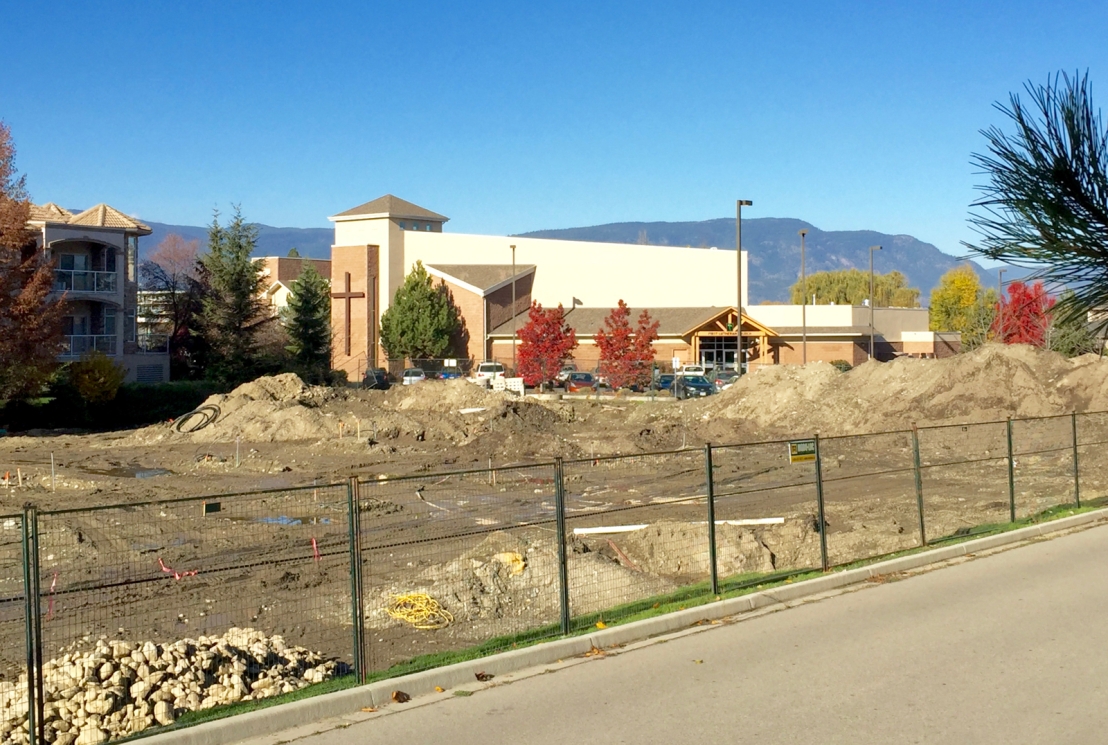
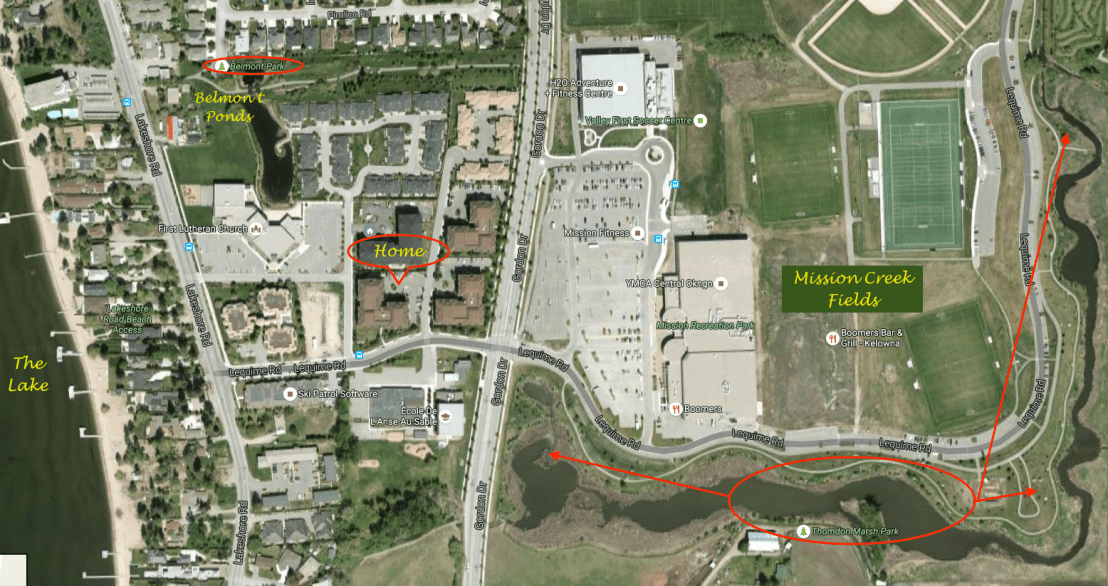
I’ll be brief and very local. The map below shows how two condo construction projects are now underway between our home and Lakeshore Drive, in the area close to Belmont Park and Ponds. The one in the northwest corner of the map is actually an improvement over a structure that was there before. The one south of the Lutheran Church parking lot, closest to our condo, however, for as many years as most people in the neighbourhood can remember, has been a vacant lot. Indeed, earlier proposals to develop the property were effectively opposed by local residents or failed for lack of funds or adverse economic conditions. This fall, however, construction of an 18-unit townhouse complex is underway.

the-neighbourhood-lgscale
From Apple Maps, which, for once, is more up to date than Google Maps…. CLICK TO ENLARGE.

In our two years, here, the vacant lot has been a breeding site for a family of Killdeers.

The stone foundation under our condo has been used by a colony of Violet-Green Swallows that pretty well kept the neighbourhood free of mosquitoes. They would sweep across Belmont Pond and over the vacant lot and enter the small spaces between the large cement foundation blocks to feed their young ones inside.

It will be very interesting to see what transpires over the next six months. The swallows will return in March, well before the completion of the townhouses I believe. Will they adapt to the changes? How will other birds and turtles escaping from the pond be affected by their loss of this land?

Neighbourhood construction on Lequime
The lot is no longer vacant: development, November 2016

Don’t get me wrong! Our own condo development and many of our neighbours’ were constructed after 2001. There was a time, not long ago when there were no homes where Belmont Park is now, where caring families  along the fences support the birds that visit their properties. Indeed, there was no park with its portion of the arboretum that the city put in place around the turn of the century (that’s only 16 years ago!). Belmont Pond, before the trees and cattails grew up around it was just a gravel pit. The fish that sustain Ralph the Great Blue Heron, the Mission Rec Field Ospreys, and the many other waterfowl that feed on them are mostly goldfish and koi that were (thoughtlessly?) discarded there years ago. The Western Painted Turtles likely found the ponds by themselves, migrating from other waterways nearby.

In the last two years, as I’ve watched the cattails get beaten down in fall by our limited snowfall, the Red Osier Dogwoods, Oregon Grape, Virginia Creeper, and various other hedge shrubs and grasses have grown a little taller and thicker. And then in spring, the cattails come roaring back to life even denser and taller and block the view of the pond on the south and west sides. I asked the arborist who trims back the Privet hedge marking the school boundary on the west side to cut some holes in the growing shroud along the pond; he said he’d think about it.

Photos coming

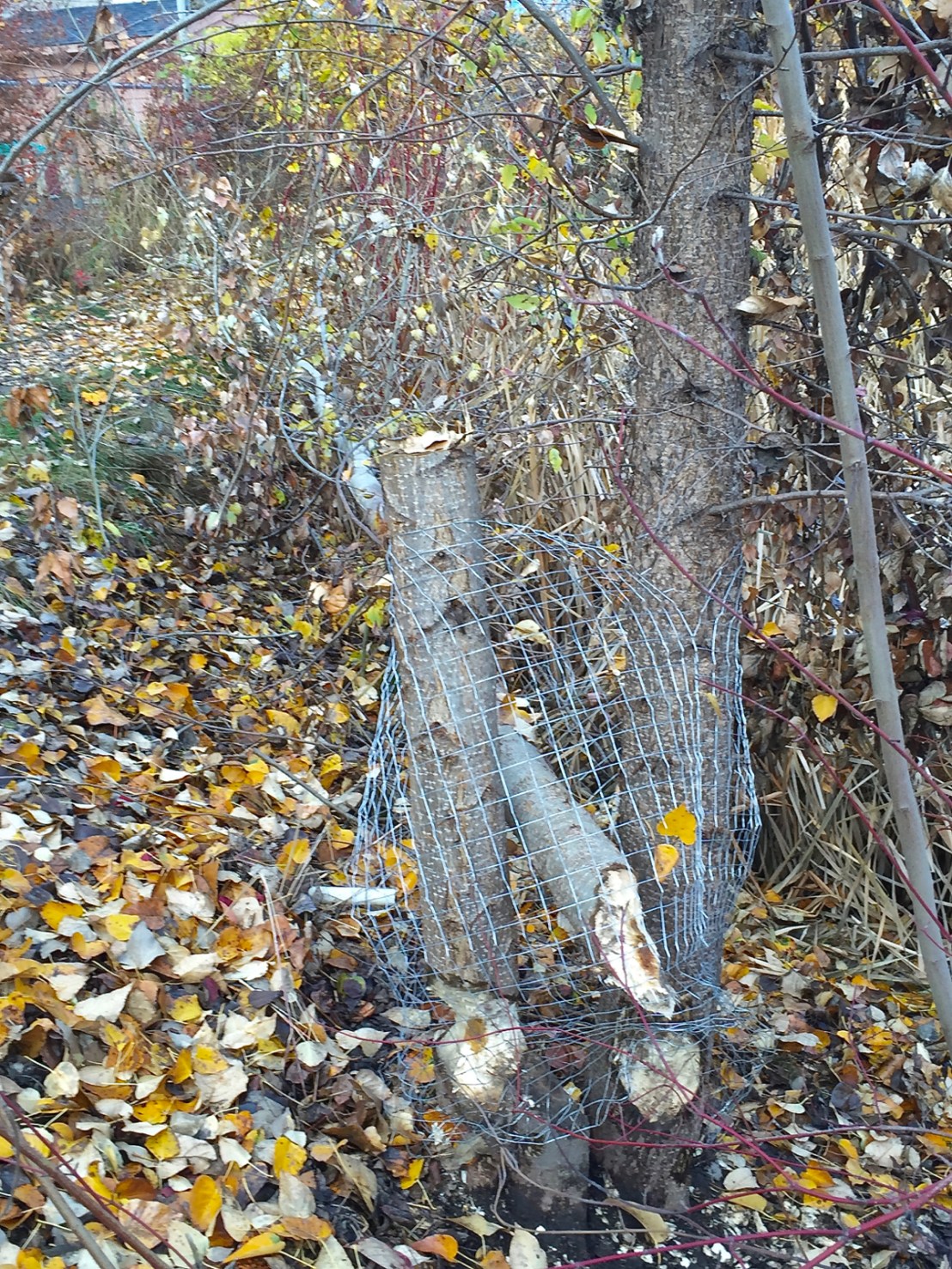
Meanwhile, a beaver has moved into the area and has been doing some clearing that most of us would rather he wouldn’t. Even the wire cages wrapped around the larger deciduous trees on the margin of the pond haven’t stopped him. He just pushes in and gnaws away. Several trees that were well used by warblers last spring are gone! On the other hand, the bushes that once hid the small pond now have a hole in them just like the one I’d asked the arborist to create. I’m thinking I want to train the beaver to be a little more discriminating on the big pond!

Belmont Beaver damage
Whoops! There goes another passerine perch! Beaver damage on the Belmont Ponds path….

The blue holes of earlier in the morning have closed. Now I feel blue….

Nothing Ever Stays the Same, Part 1….

December 2, 2016: Late autumn in Kelowna: another grey sky. Beyond cloudy, actually. It has been snowing overnight—up the valley slopes—for the past several days, and this morning, the foggy line separating white heights from the brown/green bottom is only a couple of dozen meters up the valley from where I sit. A day to stay indoors and catch up on—well—whatever….

I’ve been meaning to write some reflections on how our life has changed in the two years since we moved “up here” from “The Coast.” So much I could cover: traffic oddities like the HOV lane being in the same place as the right turn lane, or how much faster it is to take side roads and avoid Highway 97,(aka Harvey, which coincidentally was my dad’s name)…. Or the inadequate medical care in a city with a first rate hospital and a chronic shortage of GPs. Or the wonderful joys of spring and autumn, and the odd discomfort of searing mid-summer and the tourist invasion, not to mention the occasional flood or wildfire, or the tedium of winter days where the sun is perpetually obscured by sullen clouds. Or the maxim we adopted shortly after we figured it out: stop complaining; you’re in Kelowna; you’ll get used to it—and you’ll love it!

And we do love this city, especially our corner of it so close the Lake and the city’s main recreational facilities. And, for us particularly, great places for birding, photography, or long walks that begin right outside the door.

I must not, obviously, write a post covering so many topics.
I will focus on local amenities, illustrated with some images made since we arrived in autumn 2014.
And how change fits into this picture….

Neighbourhood map:

the-neighbourhood
Click the image to see enlarged map in a new tab.

In the Okanagan Valley, Kelowna (including West Kelowna and West Bank on the other side of the lake) is growing faster than its nearest neighbour cities, each about 50 minutes away by car, Vernon to the north and Penticton to the south. While change is often synonymous with growth, “progress” may also threaten situations or phenomena we hold dear. In the case of the Okanagan Valley, I’d rather live where I do than in either of the other two cities aforementioned. Perhaps I’ll feel differently in five years. Or not, because who knows whether I’ll even be here in five years…. Suffice to say, I realize that we’re enjoying the benefits of growth in the recent past (which I’ll illustrate presently) and simultaneously growing mildly anxious about new developments around us (also to be identified in Part 2) that we may not like so much.

Both my wife and I love hiking along the Greenway that flanks Mission Creek (see map below), and Thomson and Michaelbrook Marshes, or, in the other direction, along Belmont Ponds and Park. Because their development predated our arrival, it feels as if they have always been here. Of course, that’s not true. The Greenway has been developing since 1996. It’s hard to imagine the area as it was back then.

“The Phase 1 Greenway project was announced in 1996 and was the most successful community funded project in Kelowna’s history. Landowners along the Greenway donated in excess of 16 acres of land valued at more than $300,000. Phase 1 project extends from Lakeshore Road to Ziprick Road, a distance of 7.3 kilometres, and was completed in 1998. It is a universal access trail that is well used all year by walkers, hikers, runners, bicyclists, wheelchair users, and equestrians. Usage is estimated at over 1,000 people a day.”
(http://www.missioncreekfriends.ca/about-us/friends-of-mission-creek-history)

Greenway Map: Click map below to view an enlarged image on the Trailmap website.
mission-creek-greenway

Phase 2, commenced in 2005 “after the loss of so many area trails as a result of the 2003 Okanagan Mountain Park fire” added another 9.2 kilometres of greenway to the mid section of the creek. Phase 3 began in 2015 and is ongoing.

In addition to the expansion of the Greenway as a whole, 2015 also marked the beginning of the Mission Creek Restoration Initiative, which aims  in “[Phase] 1 [to] renaturalize floodplain function by realigning a 500-metre section of dike on the south side of the creek between Casorso Road and Gordon Drive. Fish and wildlife stocks will be increased by enhancing their habitats within the expanded floodplain. This includes increased gravel stability within a section of Mission Creek that provides the most valuable kokanee spawning habitat within the entire watershed, as well as improvements to riparian habitat for a wide range of wildlife species.
mission-creek-restoration-phase-1

Spawning KokaneeStage 2 [not yet started, Dec. 2016] will restore important
fish habitat features within Mission Creek, including
meanders, pools, and overhead cover.

This will increase rearing areas for kokanee [image right]
and rainbow trout, and includes areas of refuge from
high temperatures during summer low-flow periods,
and from predators such as osprey, blue herons, ducks, and racoons.

To view enlarged images below, click on each one. To close, click the X at top right of enlarged photo.

As well as restoring fish habitat over time, the dike realignment and resulting floodplain expansion is expected to provide other benefits such as reduced erosion and flood risks, enhanced wildlife migration corridors,improved water quality, recharged groundwater supplies, expanded recreational opportunities, and increased economic impacts.”
The point is that we enjoy tremendously this ongoing development project and look forward to the promised benefits. Whether they materialize or not, of course, depends on time, money, and effective management. Lots of locals are betting on success.

The Greenway is only one of the recent projects that we have become so fond of. In researching for this post, I’ve learned that Kelowna has an even longer history of seeking to protect and enhance the larger community. The Central Okanagan Foundation, instituted in 1977, (Inspiring Others To Give | Central Okanagan Foundation) with city and other support, created in 1990, a land trust that by 2007 had evolved into the Central Okanagan Land Trust [COLT]. (History | Central Okanagan Land and Trust)

In the early 90s, “the Thomson families in the Mission area of Kelowna donated 4.5 acres to the City of Kelowna and requested COLT hold a covenant on the property. This transaction was finally completed in 2006.” COLT has done a great deal more as well, but I’ll focus on Thomson Marsh (see Neighbourhood Map above) as it’s most relevant to us.

“In 1990, Gifford and Brenda Thomson and Ken and Dorothy Thomson decided they wanted to preserve a sanctuary of land surrounding Thomson Brook where it flowed through a portion of their Gordon Road farm which they were selling to the City of Kelowna for a community recreation facility [now Mission Recreation Fields].

They wished to ensure that wetland habitat was preserved undisturbed, for birds and wildlife, in perpetuity. They had a long-time involvement in the Central Okanagan Naturalists’ Club and Brenda was the first President of the Friends of Mission Creek who initiated the Mission Creek Greenway project. She was also a COLT director for a short time.

In 1993, the family made a donation of 4.5 acres to the Trust when the land was sold to the city, but the specific site was not determined until work on the land was complete. In the interim, a receipt was issued by the City, with the idea that the sanctuary would be transferred to COLT when the boundaries were identified. In the end, in lieu of ownership, COLT holds a ‘no disturb’ preservation covenant on the property that was agreed on with the city in 2005.

Today, the watercourse through the property takes up more than the original acreage and the whole length of Thomson Brook is a sanctuary, in addition to the wetland. Adjacent to Thomson Marshes, the City has created an arboretum with a walkway between the access road for the Capital News Centre recreation complex and the waterway and wetland. COLT conducts annual inspections of the sanctuary to ensure the conditions from the original baseline inventory prepared by Biologist Nicole Thomas in September 2004 are maintained”
(
History of Properties | Central Okanagan Land and Trust).

So, to come to the point, the environment we’ve been so lucky to plunk ourselves into has only come into its present form in the last 10 to 20 years. And it continues to evolve beneath our feet. It won’t be the same as it is now in another 10 to 20. Change waits for none of us.