As promised in the previous post on late winter ducks, here’s a look at some ducks that usually arrive a little further into spring: mergansers (Common and Hooded) and Wood Ducks.
To enlarge single photos after the one below, just click the photo.
Heron checks out Belmont Ponds and signals an alternative use for the new nest boxes….
But first, a look at some encouraging signs that we may have some of the COGOs with us a bit longer than usual this year. Over the winter, some of the lads who live along the east side of Belmont Pond got together and built three Wood Duck nesting boxes, or at least that was their intent. Such boxes, however, are also used occasionally by cavity nesters such as Buffleheads, Hooded Mergansers and COGOs. Now that the ice is finally off the pond, all of us duck watchers in the neighbourhood are curious to see which species, if any, make use of the new nesting facilities!
Some birds will use them for their own purposes, do doubt….
Among the first to show up in Belmont Pond Main, now that it’s is no longer a ‘hard water reservoir,’ were a pair of COGOs. The young drake below seemed eager to practise his moves before his lady came by:
(NOTE: IN MULTI-PANE ILLUSTRATIONS, JUST CLICK TO ENLARGE!)
“I’m feelin’ somethin’ comin’ over me…..”
“Oh, what a feelin’!”
“Oh yeah!”
“Hoo—whee!”
“Makes my nictitating membrane just twitch!” (170318)
Keeping Loverboy company was a pair of Hooded Mergansers.
(Lophodytes cucullatus) Belmont Pond, Kelowna, BC. First of the year, still lots of ice on our little pond….
The object of his affection….
And this lad was also showing signs of spryness appropriate for springtime shenanigans!
Yoga workout…:
The Bowling Pin…
The Flippy Flap…
The SlowMo…
and Breathe….
Meanwhile, back at the Fish Pond on the other side of town, where we last watched the Canvasbacks beginning to sense their own need to start preparing for the season, another kind of merganser had found the pond en route to its own rendezvous.
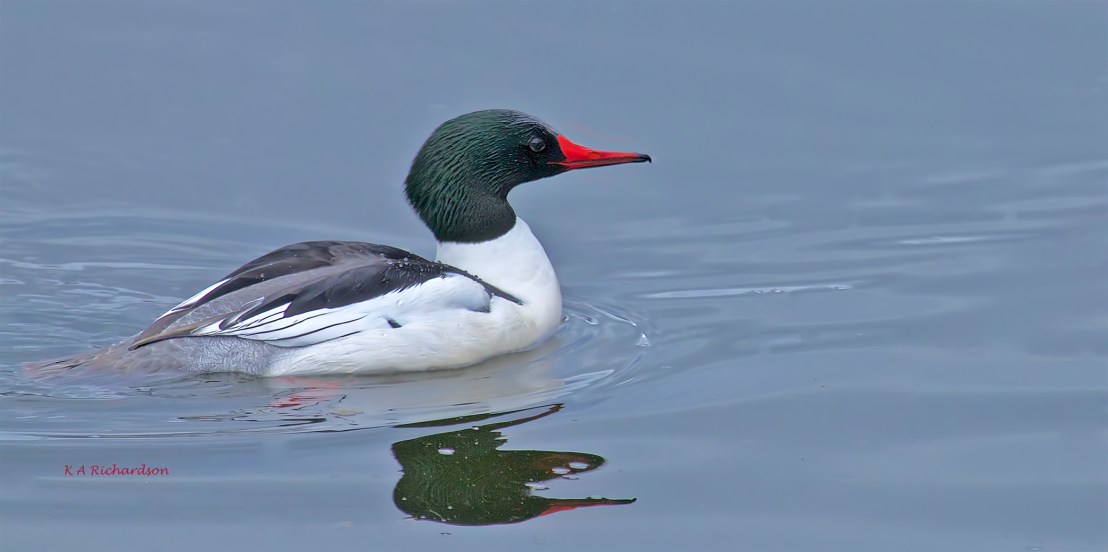
In the Fish Pond….
Green, black, white, and, oh yeah, ORANGE!
In this light, black and white…not really….
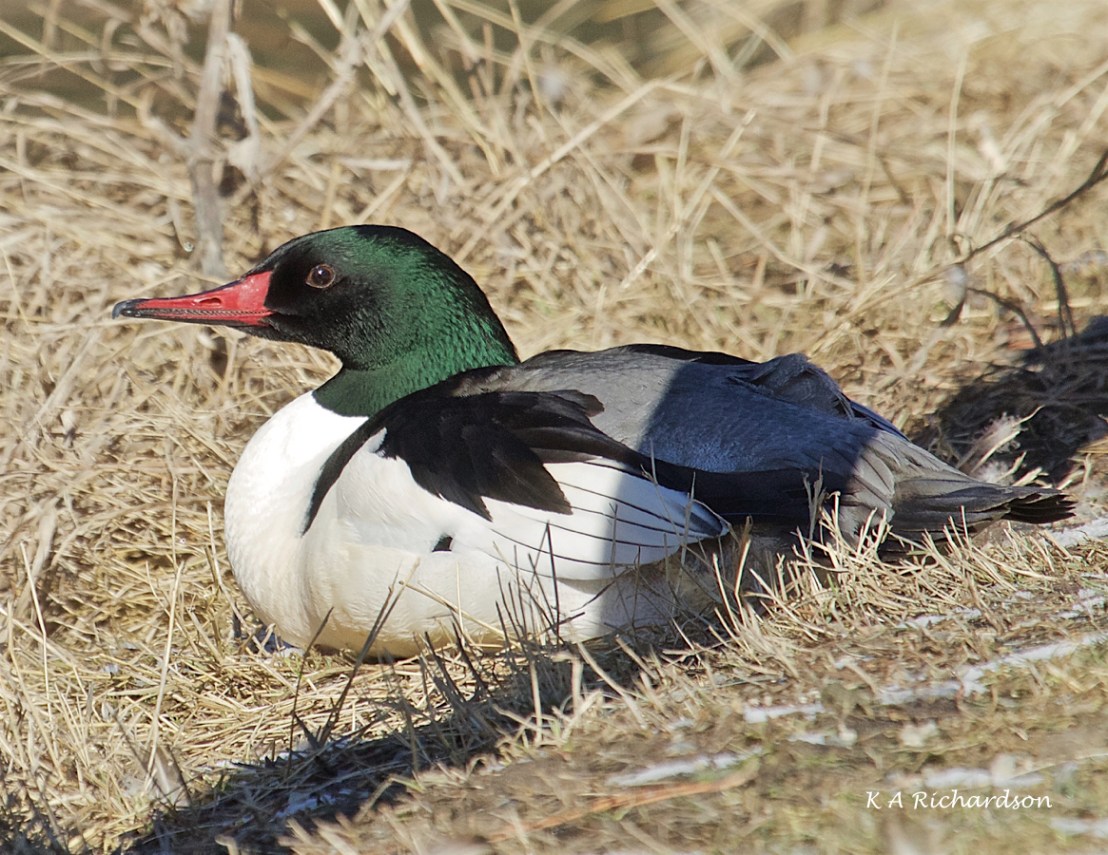
Not one for mixing with the other ducks on the pond, and at this point, the only COME to be seen, he later swam to the south end and pulled up onto the bank for a little sunshine:
Enjoying the sun on the last day of February 2017.
He stayed around for several more days and was eventually joined by another of his kind:
Common Merganser drake buddies, 170328
On March 23, I found yet another COME, this time in Munson Pond where it’s usually impossible to get a closeup shot. However, because that pond was still frozen except for a narrow channel around the shore, I was able to snag a shot of this guy working along the shoreline from 250 meters away towards me. He didn’t see me until after I had captured his soul. Here he has turned around and retreated from my intrusion….
On his way back to less interaction with Homo sapiens….
Mergansers do nest in the area, and I will cover them again, I’m sure! I can hear some folks asking, “But where are the females?” Well that’s covered in a different post, to some extent, but I will offer this group of shots of a female COME taken in February while there was still a considerable amount of ice on lower Mission Creek. The two genders are getting together as I write this and will stay together until the merganserlings hatch….
The Cackling Goose is much smaller than its cousins. There are so many subspecies, even among Cacklers that I can’t tell apart. Click to enlarge in a new tab.
To begin with, let me say that “geese in the Okanagan Valley” is a very controversial subject, with opinions varying from “How nice to have so many of these great Canadian symbols in our back yard” to “Kill off all of these pests fouling [which is different from fowling] our beaches and playing fields!” For a pretty fair assessment of the issue and its debaters, have a look at this article , which explains that, in the first place, Canada Geese are not native to the Okanagan Valley. They were introduced by well-meaning folks in the 1960s and ’70s (according to the article) and have flourished [or dominated] here ever since. Goose management is now a major concern of almost everyone in the Valley.
That said, for birders, there are several varieties of geese, including several subspecies of Canadas, and accidental Snow Geese and Greater White-fronted Geese noted here every year. A few photos will suffice to illustrate what we see….
Snow Goose in autumn
Tundra Swan and Snow Goose share Thomson Farm field.
Greater White-Fronted Geese over Munson Pond in autumn.
Greater White-Fronted Geese, Munson Pond
Snow Goose swims with but is not attached to these Canadas in Munson Pond.
Snow Goose in Spring, Thomson Farm.
Last spring (2016), I was privileged, I felt, to find a Canada Goose nesting just across the brook in Thomson Marsh. Although I kept checking on her, I missed the hatching, and the parents and their offspring either moved to a safer location or suffered predation. One never knows. It was interesting to see the gander a few meters away seemingly keeping watch. He wasn’t there all the time, however, unlike goose pairs I’ve observed in other places. And oddly, one day, there was a Mallard drake stationed only a few meters away from the goose on her nest. Not quite sure what he was looking for…. Click images to enlarge.
Mama CANG on her nest, Thomson Marsh.
She knows I’m there, but not a threat….
The gander takes a gander….
Prying Mallard….
Swans visit the valley in winter, a mix of Trumpeters and Tundras. I didn’t photograph any of the former last year (and not for political reason, I must add, though that might have been a subconscious factor), but got some pleasing images of a young Tundra family in Okanagan Lake near Maude Roxby Sanctuary. Click images to enlarge.
Tundra pair with cygnet in tow….
I like to call this one “Three Eyes”
In the spring, the Snow Goose that stayed for several weeks at the Thomson Farm (just south of the Marsh named for this farm family that donated the land that made the marsh sustainable) was accompanied by this lonely Tundra Swan. It was quite independent yet capable of getting along with the small flock of geese and its white cousin. It will be interesting to see if we have a similar situation this spring…. Click images to enlarge.
Tundra Swan and Snow Goose share Thomson Farm field.
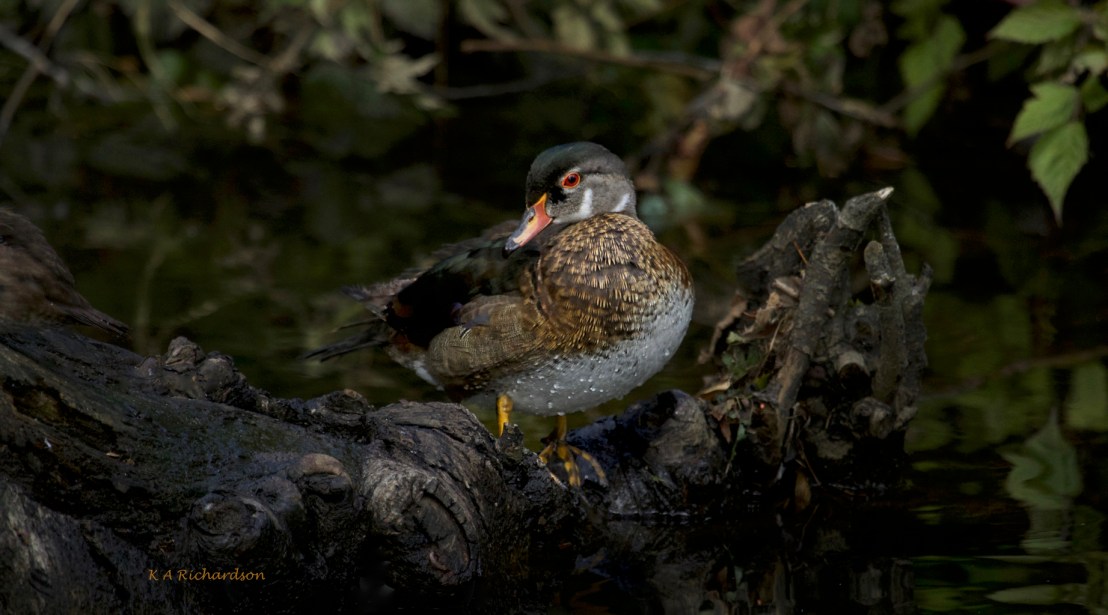
“The Darkling Wood Duck” (juvenile drake), Piper Spit, Burnaby Lake, BC. Click to enlarge in a new tab.
*For teals other than American Green-winged, look under “T.” Similarly, Common Mergansers are found with their Hooded cousins under “M.”
Part 3 looks at some of my favourite water birds shots from 2016 that are not covered in part 2.
We are especially fortunate to have a great selection of species, ducks: both dabbler and diving , as well as two (and on rare occasions three) species of mergansers, and an assortment of others mentioned in the heading….
Late winter, spring and autumn are the prime seasons for ducks here. While there are plenty around in summer, that’s when we focus more on songbirds and Ospreys.
Most of the photos are taken in the Kelowna area, many close to home. Some, however, like the juvie Wood Duck above, were taken in the summer at Piper Spit on Burnaby Lake in the Vancouver area on our trips to pick up and deliver grandkids….
(Anas crecca carolinensis) Thomson Marsh, Kelowna, BC. Folks at The Coast shooting at places like Piper Spit in Burnaby may have no idea what a challenge it is up here to get this close. This fella had attached himself to a small flock of Mallards slightly less fearful of people than he…. ………Click photo for enlarged view in new tab.
As with other parts of this review of 2016, the presentation will be roughly in alphabetical order. And that means starting with the American Green-winged Teal (Anas creccacarolinensis) . Few of us bother with the “American” designation, but as we occasionally see the Green-winged Teal (aka Common Teal, Anas crecca) more commonly found in Europe and Asia, I’m using the AGTE designation here. At Burnaby Spit, in fall, winter, and spring, AGTEs forage very close to the boardwalk are easily photographed up close. Up here, however, these tiny ducks have to fight for their place in the ecosystem and are generally very difficult to get close to—at least in the places where I see them. During our colder, snowier than usual winter 2016-17, I was able to find them in Thomson Brook and with great stealth to get a few shots, but not unobstructed. Getting shots at a distance is not so difficult, but I’m not able or interested in spending thousands of dollars on high powered lenses to overcome this issue…. More teals near the end of Part 3….
“The waterborne American Coot is one good reminder that not everything that floats is a duck. A close look at a coot—that small head, those scrawny legs—reveals a different kind of bird entirely. Their dark bodies and white faces are common sights in nearly any open water across the continent, and they often mix with ducks. But they’re closer relatives of the gangly Sandhill Crane and the nearly invisible rails than of Mallards or teal….
American Coot in Belmont Pond, Kelowna, BC. Always difficult to balance tones! Click to enlarge.
You’ll find coots eating aquatic plants on almost any body of water. When swimming they look like small ducks (and often dive), but on land they look more chickenlike, walking rather than waddling. An awkward and often clumsy flier, the American Coot requires long running takeoffs to get airborne.” (Cornell Lab of Ornithology)
We see rafts of coots in the winter in Okanagan Lake. In spring, however, they move into the brooks and ponds where they raise their young. I have seen them breeding in Belmont Pond, so close to our home, but sadly, the birds moved to a different location to hatch and rear the “cootlings.” (Incidentally there doesn’t seem to be an approved designation for coot chicks; one suggestion I saw—’cootie‘ just isn’t acceptable!! In England, related birds are sometimes called “moorchicks.”) I have photos of the chicks at such a distance they’re not good enough to post. Definitely a challenge for 2017!
Another fascinating “American bird” for me is the American Wigeon. (I used to see their Eurasian cousins in Japan, and EUWI are showing up in increasing numbers in BC these days. Have yet to capture one in the Interior, so will look hard this year.) AMWIs, up here, I thought at first, were very difficult to approach. 2016, however, changed that opinion. Spring in Thomson Marsh seems to be the best time to observe and shoot them (with a camera, of course!) They do stop over in the fall and a few stick around near Okanagan Lake through the winter. In spring, however, they return to marshes and are great fun to watch…. Only the male sports the bald pate and green racing stripe through the eye.
Longer shot in Thomson Marsh
Out of the water the drake strikes a great pose.
Getting the green mask the way I want it can be challenging!
A duck that stands out despite its size is the very active and, in the right light, colourful Bufflehead. I didn’t get a lot of shots of this species in 2016. (Check more recent posts for evidence of my good fortune in 2017.) In the set below, click any photo to enlarge ’em all.
Bufflehead pair, Michaelbrook Marsh.
Female BUFF practising STOL (short takeoff and landing)!
Size comparison….
“We may be small, but we’re show stoppers!!”
There are two species of goldeneyes to watch for: the Common Goldeneye and the one below, Barrow’s Goldeneye. While the females of both species are quite similar though fairly easily distinguished if one can get a clear image of their bills, the males are striking different. Of the two, the Barrow’s, a northwestern-corner-of-the-continent duck to begin with, is rarer even out here, and, in my humble opinion, the more attractive duck with his splatter of white stripes and his purplish head with his quarter moon or teardrop white crescent stripe, take your pick.
Incidentally, the Barrow’s in the name honours Sir John Barrow (1764–1848) who, according to Wikipedia was a long time secretary in the British Admiralty, where he”… was a great promoter of Arctic voyages of discovery, including those of John Ross, William Edward Parry, James Clark Ross and John Franklin. The Barrow Strait in the Canadian Arctic as well as Point Barrow and the city of Barrow in Alaska are named after him.” I used to think the duck was named for one of these far north locations, but apparently, we can reach such a conclusion only indirectly (written my best civilservantese).
I spotted this pair at Robert Lake quite far away, but was able to sneak up and get this medium range image using the technique described below. Click to enlarge.
In my experience, BAGOs prefer wider stretches of water—ponds and lakes—that enable them to stay farther from my camera. Being divers, however, they need to come into the shallows to forage, so they can be stalked sometimes. Take your time, move when they’re really hungry and submerged, but know that once they spot you, there’s a good chance they’ll give up food for privacy. A fellow photographer in Penticton, however, has managed some wonderful closeups of Barrow’s in that town’s wonderful canal. Find the right pond, I guess! I think a Barrow’s side trip (to Penticton, not Barrow’s Strait!) is in the works when I start my south Okanagan region spring birding….
The Barrow’s is northwestern duck…;
for once, we get a handsomer bird that you easterners do!
Common Goldeneyes by comparison are truly common. Still, they’re a pretty duck in winter when they visit Mission Creek to forage on the bottom of the stream.
Female COGO has a black and orange bill. I named this solo resident of Belmont Pond “Dora.”
Common Goldeneyes in winter can be found in small flocks (rafts) on Mission Creek.
Males sometimes have a purplish green cast in their head plumage.
Cornell agrees: “The male Common Goldeneye adds a bright note to winter days with its radiant amber eye, glistening green-black head, and crisp black-and-white body and wings. The female has a chocolate brown head with the same bright eye that gives this species its name. These distinctively shaped, large-headed ducks dive for their food, eating mostly aquatic invertebrates and fish. They nest in tree cavities in the boreal forest of Canada and Alaska; look for them on large rivers, lakes, and Atlantic, Pacific, and Gulf coasts in winter….
Females are best distinguished by head and bill shape (above); also, female Barrow’s usually have more yellow on the bill than female Common.”
Comparison of female bills of Common Goldeneye and Barrow’s Goldeneye.
In our very cold December 2016, Mission Creek froze over in the lower reaches, but fortunately some stretches of mid-stream, ironically, stayed open.COGOs were able to forage, but their numbers were much reduced from the past two winters.
COGO in the very cold Mission Creek, December 2016. Click to enlarge.
in the very mild 2015-16 winter, I was very much surprised to discover a solitary female COGO in the mix of ducks that wintered in Thomson Marsh sometime in mid February. Later that month, this same duck, I believe, moved over to Belmont Pond where she waited patiently, it seemed, for two weeks. Because she was a bit of an explorer, an individualist, I named her Dora. Eventually, she was joined by a single COGO drake that I christened Melvin. They stayed in Belmont Pond for about three days with an assortment of other species I had not seen here the year before, then by mid-March, they were gone, and I never saw them again.
Melvin and Dora in Belmont PondMelvin, Dora’s prince whom she waited for for weeks! You can tell he’s royalty by that purplish tinge added to the green in his crown….
For Gadwalls, Hooded and Common Merganser, Common Loons, and Mallards, check Part 4….
In Part 1, we looked at waders (some of whom, like avocets and phalaropes, float) and shorebirds. In Part 2, we turn to a favourite of mine and many folks (though not my wife’s for some unfathomable reason), the Great Blue Heron.
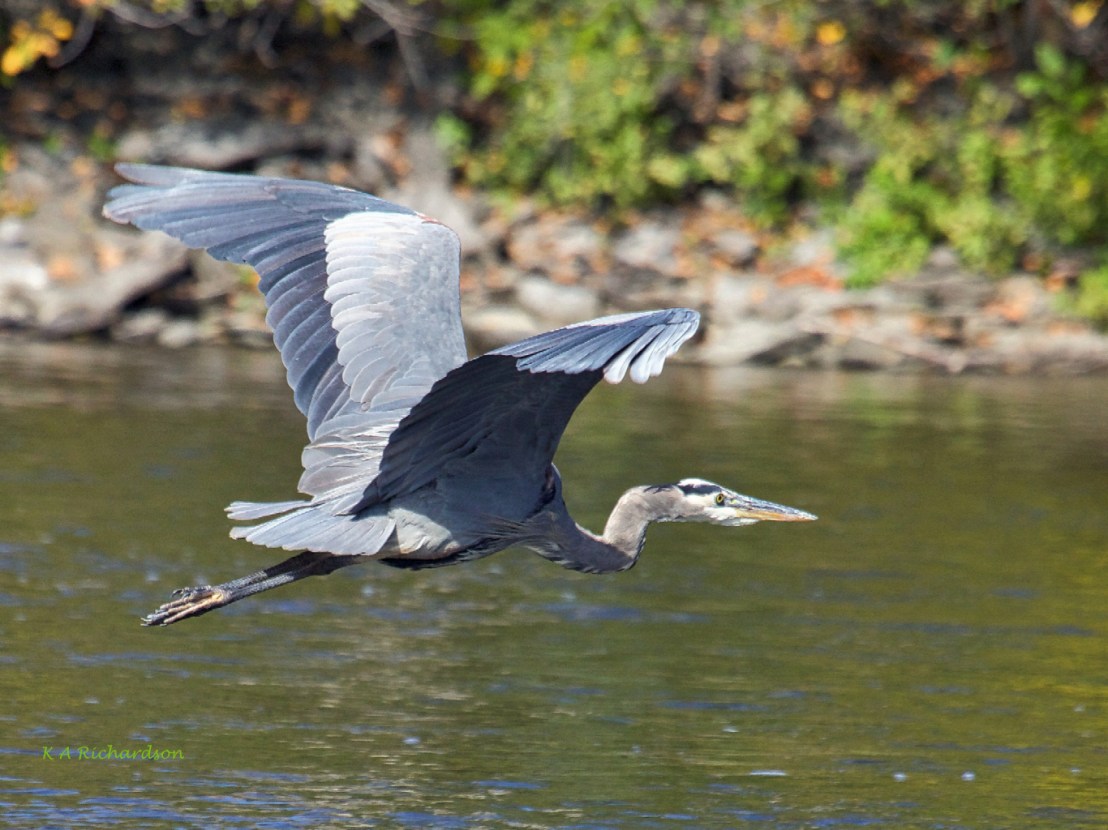
GBHEs are found across Canada, the USA, and Mexico, Central America and the Caribbean and parts of northern South America. But in Canada, they are normally found year round only in BC and along the Great Lakes and St. Lawrence River. Whether their distribution will change as climates warm remains to be seen. The Okanagan Valley is one of the few non-coastal parts of Canada where we can observe GBHEs even in winter. Since coming here, I’ve gained even more respect for these large, almost prehistoric looking birds and their ability to adapt to varied environments. We have quite an assortment; I’m able to identify a few individuals by their favourite hangouts and differences in behaviour….
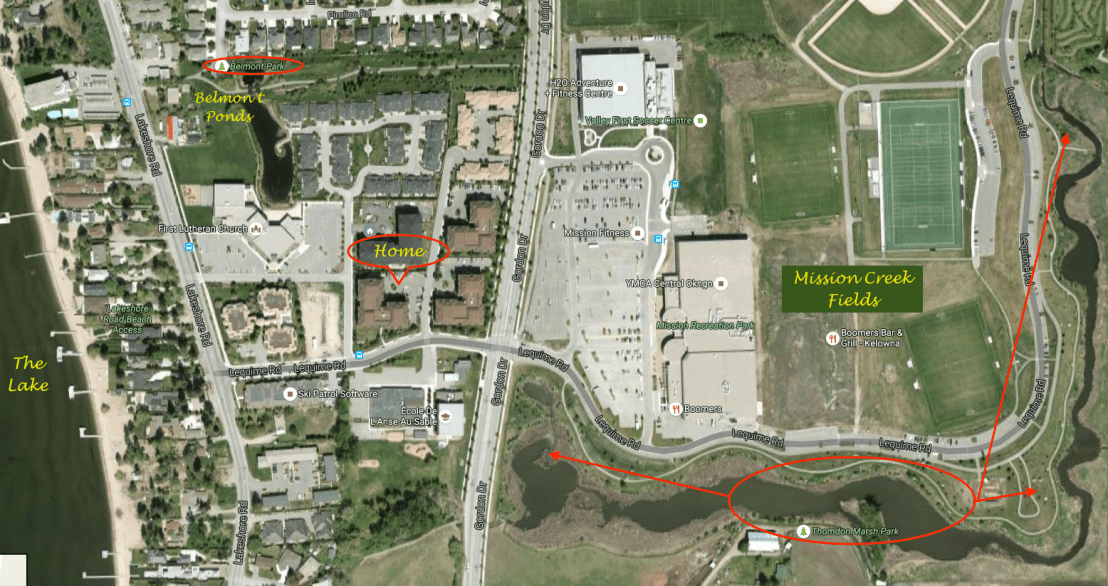
Where I see GBHEs mostly—Belmont Ponds and Thomson Marsh. Michaelbrook Marsh, located off the top right quadrant of the map is frequented by herons from these areas, too. Munson Pond, about a kilometre away, as the heron flies, is home to several individuals who seem to spend most of their time watching the lake from perches high above. Click to enlarge.
Sir Ralph of Belmont Ponde on his logge, facing the sunne in the west….
Let me show you a few shots of these guys/gals (I can’t tell the difference) who never fail to grab my attention whenever I come across one. Let’s begin with Sir Ralph of Belmont Pond. People either praise or vilify my inclination to “name” the character birds I encounter, but in this case, I’m blameless, or almost so, for the name ‘Ralph” had been given by the residents on the Pond to this wonderful specimen before I arrived. But the name feels right, and, in my infinite wisdom, I’ve added the knighthood—I think he’s earned it and hope you agree.
Click image to enlarge in new tab.
Featured fotos of Sir Ralph:
(Ardea herodias) Great Blue Heron above small Belmont Pond.
Sir Ralph in his willow in winter.
Belmont Pond evening hunt…
Other GBHEs I’ve photographed this year: Click images to enlarge them.
Spotted, Hider decides to move to a less visible spot.
Comin’ down….
Hider hopes he’s invisible….
Hider the GBHE of Thomson Marsh West. Very different behaviour from Sir Ralph’s stoicism.
“How do I know one GBHE from another?” is a legitimate question. I do see herons flying from one location to another, certainly, and I understand the issue. Based on their behaviour, however, I suspect some who act similarly within relatively close proximity to be the same bird, but I can’t be sure.
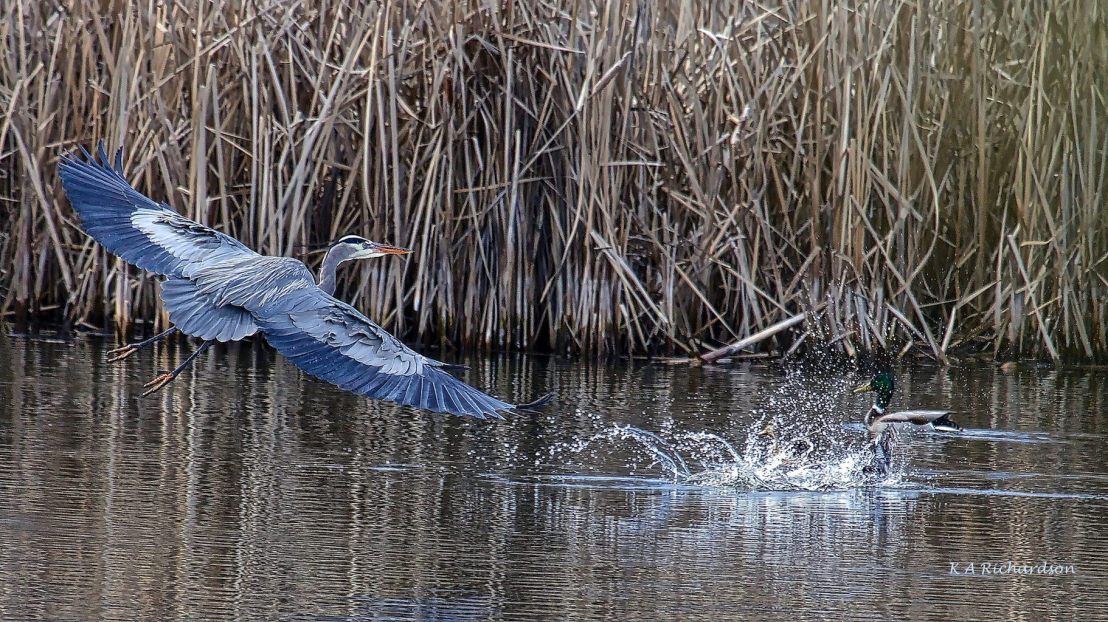
Hider is so named because, unlike Sir Ralph who has no problem with public performances, Hider likes to snuggle in among the reeds and cattails so that he’s just barely visible, a difficult trick because he’s a large one. In the flight shot above, he’s asserting his right to dominate the far west corner of Thomson Marsh, and a wee Hooded Merganser is fleeing without squawking any protest!
This fellow is a frequent visitor to Michaelbrook Marsh, not far from Belmont Ponds. Could he be Sir Ralph on vacation? …Behaviourally, he’s very similar!GBHE heading for Parliament from Mud Lake, Ottawa, ON, taken on our autumn trip there.
In December, at -5ºC, a somewhat small Great Blue I hadn’t (to my knowledge) seen before showed up one afternoon in Thomson Brook on the northeast side of Thomson Marsh where there was still some flowing water. I’d already been alerted to his/her presence by another photographer who’d marvelled at how close he’d been able to approach. I arrived at the spot probably 20 minutes later and (s)he was still hunting and willing to be observed. I was able to get several shots including savouring his/her sushi appetizer….
Stalking….
Savouring…
Surveying….
One regret I have from late 2016 is that I was unable to observe the Green Heron that unexpectedly visited Rotary Marsh along with a couple of out of season/out of place passerines, a Lucy’s Warbler and a Least Flycatcher. I found and photographed the Lucy’s but couldn’t locate the other two. Still, my visit to the “far end of town where the trickle-grass grows” was not in vain, as I got excellent looks at some ducks that appear in Part 3 of this series, and this lovely Great Blue, too!
Below: a Green Heron from another time and another place, just because it’s fun to recall…. A note to those who’ve never seen one, Greenies are much smaller than GBHEs, and much more colourful! Click image to enlarge in a new tab.
Green Heron at Brydon Lagoon, Langley, BC, 2014, helping rid the marsh of invasive bullfrogs….
Last week, I completed my favourite/best photos collection of perching birds (and a few that roost or climb) from 2016.
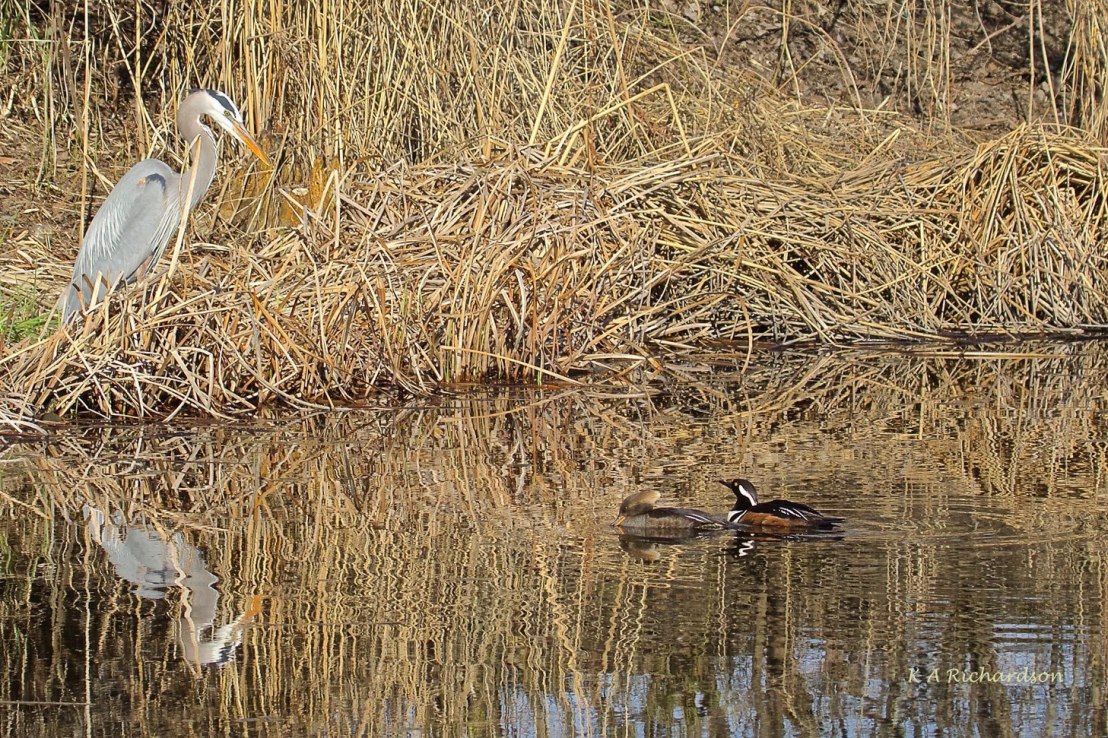
“Greetings, Sir Ralph. It is we, your humble servants, Henry and Hermione Hoodie of the Merganser genus…”
As promised, I’m going to provide separate posts for raptors and water birds, as well as the few mammals that caught the attention of my eye and camera last year. So let’s begin with the waders, which for me means “birds that commonly occur in [and around] reedy areas, shallow waters, ponds and such” (Wikipedia) and, up here in the Interior, this includes mainly two subcategories, herons and shorebirds. Compared to the waders’ catalogues of our most avid birders, mine is considerably smaller. At The Coast, there’s a much greater diversity, especially of shorebirds, and a community that’s deeply committed to it. On the other hand, up here, while there are fewer species (though more than I’ve searched out), some of them are indigenous to our ecosystems and unlikely to appear in coastal conditions; I’m very pleased to be located right where we are. No doubt, I’ll add to my list in years to come….
Among the wader/floaters unique to the Interior, the American Avocet particularly stands out! In fact, the map above shows that while this mostly western species breeds in states that touch the 49th parallel, none breed in BC at all. My photos show the contrary. Click photos to enlarge….
“With its elegant profile and striking coloration, the American Avocet is unique among North American birds. In summer it can be found in temporary and unpredictable wetlands across western North America where it swings its long upturned bill through the shallow water to catch small invertebrates.
In response to predators, the American Avocet sometimes issues a series of call notes that gradually changes pitch, simulating the Doppler effect and thus making its approach seem faster than it actually is.
Nesting American Avocets aggressively attack predators, sometimes physically striking Northern Harriers or Common Ravens.
A female American Avocet may lay one to four eggs in the nest of another female, who then incubates the eggs. American Avocets may parasitize other species’ nests too; single American Avocet eggs have been found in the nests of Mew Gulls. Other species may also parasitize avocet nests. Avocets have incubated mixed clutches of their own eggs and those of Common Terns or Black-necked Stilts. The avocets reared the stilt hatchlings as if they were their own.
American Avocet chicks leave the nest within 24 hours after hatching. Day-old avocets can walk, swim, and even dive to escape predators.
The oldest recorded American Avocet was over 15 years old, when it was found in California, where it had been banded a decade and a half earlier.”
Avocets love the salty environment of Robert Lake near Kelowna.
In our community, Avocets are found at Robert Lake, a saltwater marsh with very limited access for birders (a looooonnnngggg story that I won’t be going into here!) and, oddly, just to the north, in ponds now incorporated into the Kelowna Landfill, including one still referred to locally as Alki Lake — “Alki” because its so alkaline, and “lake” because that may have been true in the past. Although the landfill is a state-of-the-art operation, any landfill is, after all, a complex built with garbage and not a great place to spend the day no matter how many eagles and ravens and hawks and ducks and even avocets and stilts it supports….
Efforts to encourage AMAVs & Black-necked Stilts to relocate have been largely unsuccessful….
Speaking of BNSTs, here’s the best proof that this species is doing well here, too, in the same environment as the Avocets (click to open enlarged image in a new tab):
Juvenile and adult Black-necked Stilts in salty Robert Lake.
The stilts and avocets occupy quite different territories most of the year as the comparison of their ranges (below) shows. We’re very fortunate in Kelowna to be able to enjoy both species in the same locale!
We are very fortunate…
…to have both species in our area!
Other shorebirds (that I have photos of) that grace our Okanagan community:
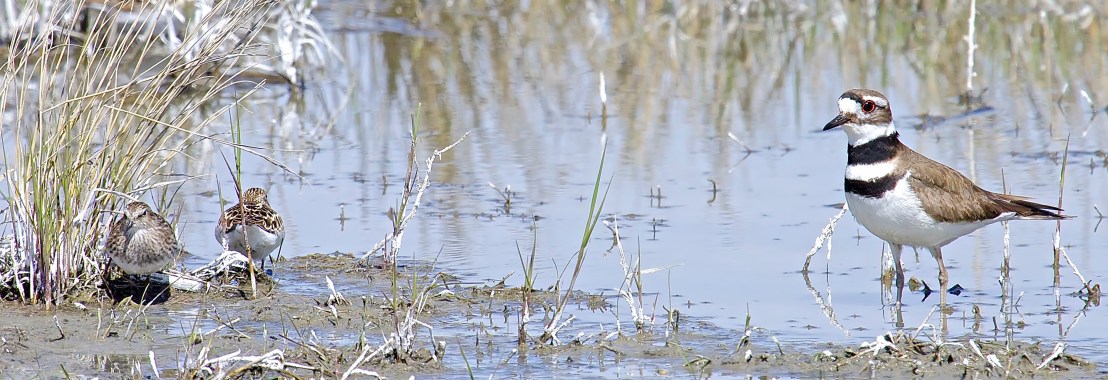
Killdeer are found throughout most of North America.
As males and females look alike,…
…it’s hard to know if this one is male or female….
I’m inclined to believe that the Killdeer above, from Thomson Marsh, is a male. On my walks in spring, while his mate was sitting on eggs, he would pop out of the brush between the path and Thomson Brook and lead me along, regardless of which way I was travelling, away from her. Of course, to me, it felt like I was walking with a Killdeer; his perspective was likely a little different, but as I’m not fluent in Killdeer, I couldn’t always grasp what he was trying to tell me…. To enlarge graphic and photos, just click them!
Robert Lake is a great place to see a wide variety of shorebirds, including Killdeers, but it’s especially great for sandpipers that really prefer salt marshes, such as the Least, Solitary, and occasionally, outside its usual range, PectoralSandpiper.
Found coast to coast in Canada, and North America.
The photo doesn’t prove it, but LESAs are very tiny, yet quite trusting of people—at least at Robert Lake.
At Robert Lake, in 2015, Least Sandpipers in the company of a Killdeer….
I found Solitary Sandpipers in several locations in 2016, including this one in a pond near Upper Mission Creek where it was foraging on a carpet of algae. It took a little work to get a suitable vantage point for the shot, but I think it was worth it….
Solitary Sandpiper on a bed of algae.
We live right on the southern edge of the SOSAs breeding grounds in BC/
From Cornell: “The Solitary Sandpiper is commonly seen in migration along the banks of ponds and creeks. While not truly solitary, it does not migrate in large flocks the way other shorebirds do…. The Solitary Sandpiper lays its eggs in [abandoned] tree nests of several different song birds, particularly those of the American Robin, Rusty Blackbird, Eastern Kingbird, Gray Jay, and Cedar Waxwing….Of the world’s 85 sandpiper species, only the Solitary Sandpiper and the Green Sandpiper of Eurasia routinely lay eggs in tree nests instead of on the ground.“….In migration and winter [SOSAs are] found along freshwater ponds, stream edges, temporary pools, flooded ditches and fields, more commonly in wooded regions, less frequently on mudflats and open marshes.”
Pectoral Sandpipers are being found in BC more often these days although Cornell’s range map for them indicates otherwise. We’re likely to see them, if at all, only during migration. I was lucky to be alerted to this one’s presence and to get this lifetime shot!
A rare visitor west of the Rockies….
but fairly common in the rest of North America
As rare as Pectorals are, the Lesser Yellowlegs below (and its close relative the Greater Yellowlegs) are regular visitors to Robert Lake and other Okanagan wetlands.
LEWA foraging at Robert Lake
Common throughout the Americas!
Most fascinating bird in the marsh
The final entry in this part on waders/shorebirds is actually, like the AMAVs we began with, a floater/swimmer as well as a wader. The Wilson’s Phalarope is one of the most fascinating birds we see in the salt marsh. Unlike most birds we see in Canada, the females are not only more colourful than males; females “court and defend male mates—several per season—while males do most of the work of raising the young.” Imagine that, all you MCP- couch potatoes! Nature does work in mysterious ways…. Besides the unusual gender appearances and roles, WIPHs also utter peculiar sounds—like dogs barking in the distance. Moreover, “Phalaropes are the only shorebirds that regularly swim in deep water. They bob on the surface, often spinning in circles to bring small food items within reach of their slender bills.” (Cornell)
A western bird for the most part, but WIPHs can be found near the Canadian-American border in Ontario, QC, and NB/NS.
Female WIPH, Robert Lake, Kelowna, BC.
Probably a young male WIPH
Part 2 of this series will focus on Great Blue Herons and a few gulls…. Part 3 will cover ducks, grebes, and coots….
The “Y” birds (Y not, you may ask) include three birds whose names begin with Yellow. One, the Yellow-headed Blackbird is a western bird.The other two, warblers, are found across the North American continent and coast to coast to coast in Canada.
Yellow-headed Blackbird puts his foot down!
Yellow-headed Blackbirds return to us from the southwestern US and Mexico in early April. Occasionally, they’ll land on a rooftop on their way further north, but their season starts for us when we see the first males in Thomson Marsh where the Red-winged Blackbirds by this time are already well established. The first few males are very quiet; we’re likely to see them before we hear them. Within a couple of weeks, the situation reverses, and we enjoy the cacophony of the clash of vocalizing RWBLs and YHBLs. As with RWBLs, YHBL females show up a couple of weeks after the males have established their territories.
I confessed in part 3 of this series that my favourite species in the summer marsh is the Eastern Kingbird. The Yellow-headed Blackbird is a close second. The chief difference and factor that makes me lean to the EAKIs is that individual families are much easier to identify among the EAKIs. The pairs are devoted to each other in ways that the YHBLs are not. The YHBLs arrive earlier than the EAKIs and depart earlier, as well, at least the males. By late summer, the marsh is ruled by the RWBLs and the growing EAKI families. But last year, at least, I was able to identify a couple of females that continued hang around. Their offspring seem to become independent fairly quickly. It was surprising to find a couple of female YHBLs still being chased by a fledgling Brown-headed Cowbird that had “conned” one of them into raising. Although they’re not very attractive/photogenic at this time of year, I find “Yellow-heads” an interesting group to study….
Juvenile Male fledgling YHBL, Thomson Marsh, Kelowna, BC.
With a golden head, a white patch on black wings, and a call that sounds like a rusty farm gate opening, [male] Yellow-headed Blackbirds demand our attention. Look for them in western and prairie wetlands, where they nest in reeds [or cattails] directly over the water.
[We don’t get to see them winter in Kelowna, but we do run into migrating flocks in Kane Valley early in the spring.]They’re just as impressive in winter, when huge flocks seem to roll across farm fields. Each bird gleans seeds from the ground, then leapfrogs over its flock mates to the front edge of the ever-advancing troupe.
Yellow-headed Blackbirds breed in loose colonies, and males mate with several females. During the breeding season, they eat insects and aquatic invertebrates. [See map for wintering grounds.] They form huge flocks in winter, often mixing with other species of blackbirds, and feed on seeds and grains in cultivated fields.
Well, we’re quickly nearing the end of this final chapter of Favourite Passerine Fotos of 2017. Let’s talk about two of the warblers that we look forward to every year in Belmont Park and ponds and Thomson Marsh: I’ll take them in the order in which they appear, which means we look first at Yellow-rumped Warblers, another bird that’s distributed across the NA continent and coast to coast to coast in Canada.
“Yellow-rumped Warblers are impressive in the sheer numbers with which they flood the continent each fall. Shrubs and trees fill with the streaky brown-and-yellow birds and their distinctive, sharp chips. Though the color palette is subdued all winter, you owe it to yourself to seek these birds out on their spring migration or on their breeding grounds. Spring molt brings a transformation, leaving them a dazzling mix of bright yellow, charcoal gray and black, and bold white.” (Cornell)
The first year here, I waited expectantly and failed to find many close enough to photograph well. In 2016, however, I learned where to locate them—closer to home, ironically, and am looking forward to similar opportunities this spring. In summer, the Butter Butts pretty much leave town and the heat of the valley bottom for the cooler hillsides. In autumn, in their new camouflage, they reappear along with Warbling Vireos and juvenile Waxwings in various locations, along the Creek, but also among the many weeds now offering their seeds and harbouring insects….
YRWA in autumn, foraging.
Autumn Butterbutt offering a special photo opp along Mission Creek….
These photos are not outstanding, but may indicate the kinds of interesting challenges that Yellow-rumps offer in the waning months of the year. By late October, they’re gone.
The final bird of this long series is the Yellow Warbler. I’ve learned to be patient with this species. It appears in different locations at different times from spring through early autumn. Early and late summer into autumn afford the best photo opps in the Okanagan. YEWAs can be very difficult to capture due their rapid movement and propensity for cover, but I can usually count on excellent chances late in the season….
Two of the shots below are of males. I’ll leave it to you to figure out which is which.
Click the photos to see them enlarged.
Late spring Yellow Warbler
Early summer YEWA
Autumn YEWA
“Yellow Warblers forage along slender branches of shrubs and small trees, picking off insect prey as they go or briefly hovering to get at prey on leaves. Singing males perch near the tops of the bushes or trees in their territory.
As male Yellow Warblers are setting up territories they may perform a “circle flight” in which they fly toward a neighboring male or female in a horizontal, semicircular path. A male may also fly slowly with fast, exaggerated wingbeats away from a female he is courting or a male he is competing with. As these territorial encounters proceed, males start by singing at each other; as the dispute goes on, the songs get quieter or switch to chip notes as the males begin to chase each other.
Yellow Warblers typically form monogamous pairs that sometimes last more than one breeding season and reform the next. Yellow Warblers defend their nesting territories from many species, including other warbler species, chickadees, House Wrens, blackbirds, and Eastern Kingbirds. They may even chase off other warbler species while on their wintering grounds. Common predators of Yellow Warbler nests include garter snakes, red squirrels, jays, crows, raccoons, weasels, skunks, and domestic or feral cats.” (Cornell)
And finally, a note on conservation with regards to YEWAs, again from Cornell:
“Yellow Warblers are one of the most numerous warblers in North America but their populations have been slowly declining, and have decreased by 25% between 1966 and 2014, according to the North American Breeding Bird Survey. Partners in Flight estimates a global breeding population of 90 million with 37% spending some part of the year in the U.S., 15% in Mexico, and 57% breeding in Canada. They rate a 6 out of 20 on the Continental Concern Score and are not on the 2014 State of the Birds Watch List. In the western U.S. the grazing of rangelands can degrade Yellow Warbler nesting habitat, particularly stands of willow trees along creeks. The Brown-headed Cowbird lays its eggs in the nests of many species including Yellow Warblers, and this can reduce their breeding success. Like many migratory songbirds that move at night, Yellow Warblers are at risk of collisions with buildings; they can be attracted to and killed at tall, lighted structures such as TV towers and tall buildings.” We all hope this delightful, beautiful, interactive songster is able to survive in its Okanagan breeding grounds for years to come!
The penultimate page for passerines includes some of the prettiest or cutest species we see up here. Most of them can be seen quite close to home, although a couple require a trip up to Beaver Lake Road.
We’ll begin with one of our most colourful swallows, the Violet-green, which for the two springs and summers we’ve spent here, have nested in the foundation blocks of our condo. With a new three-storey, 18 unit townhouse development under construction on the other side of the lane, I fear that the cruising space our little swallows need to access the foundation will be lost, and they will have to look elsewhere to establish their breeding colony…. I’ll miss them greatly should that fate occur! Who’s going to eat the mosquitos that breed on Belmont Pond?
A male VGSW at one of the nesting spaces in the foundation of our condo.
Surfing the fibreglass waves on the roof of a neighbour’s carport….
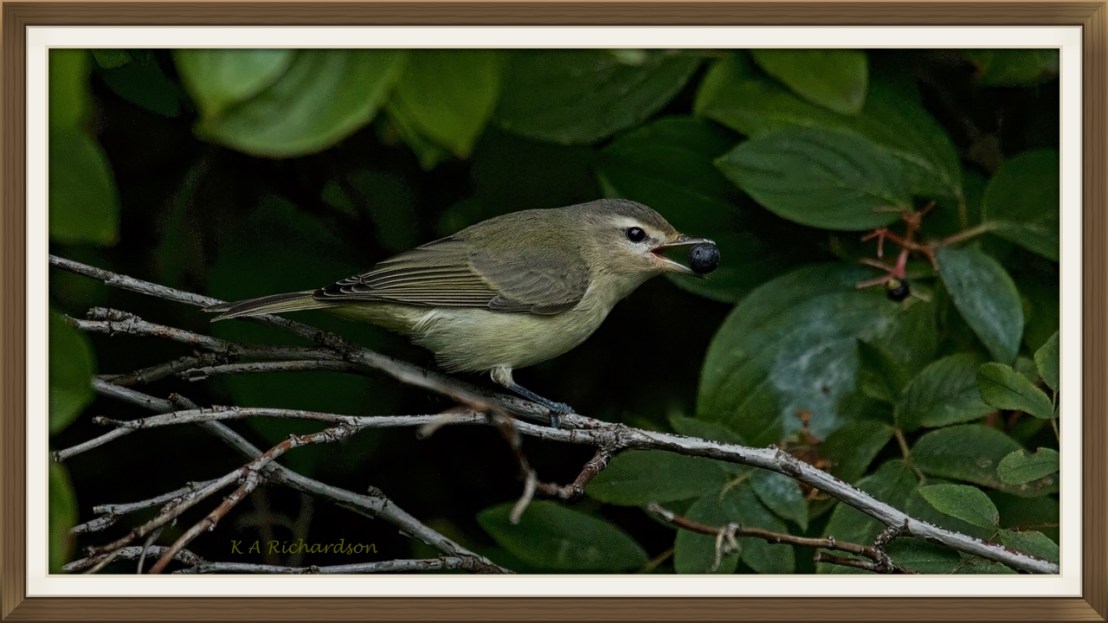
A bird that I know returns to area in May, finds ways to keep out of sight, it seems, until late August and early September when I usually get my photos of them in Thomson Marsh—the Warbling Vireo.
Click to enlarge—open in a new tab. Warbling Vireo with Black Elderberries.
Another drab bird compared to the brighter species so often found in Eastern Canada and so much of the US, it is, nonetheless, one that I love to watch when I get the chance as I did a week apart in the first half of September 2016. I’d almost concluded that I’d missed the quality opportunities of 2015, when suddenly my luck changed on September 7 and I got some shots in the shade, late in the afternoon.
A week later, I spent fifteen minutes or so with a couple of WAVIs and an entertaining troupe of Yellow-rumped Warblers stocking up on energy before the fall migration.
(Vireo gilvus) Thomson Marsh, Kelowna, BC.
(Vireo gilvus) Thomson Marsh, Kelowna, BC.
The “W” category also includes a springtime favourite that can be seen all summer long, the Western Bluebird, which I covered in more detail on my separate Bluebirds post. Here’s one more look at one of my favourites from that presentation a colourful female who posed for several minutes. Photo from White Lake Grasslands Park, west of Oliver, BC.
Western Bluebird female speaking to God….Western Kingbird juvenile pays a brief visit to Thomson Marsh. Click to enlarge.
While we get to observe many Eastern Kingbirds in Thomson Marsh, it’s very rare that Western Kingbirds with their lovely lemon lite hues drop in for a visit, although there are lots off WEKIs in the Kelowna area and in the Okanagan. This youngster surprised me one day, allowed me a couple of photos, then flew off and did not, to my knowledge return.
I have mentioned, several times now, Beaver Valley Road east of Winfield, 30 minutes drive north of home. In Spring, it’s a fabulous location for a great many species, including the Western Meadowlark. Both of these photos were taken there a little over a month apart. There are lots of individuals and plenty of opportunities to capture them in a variety of behaviours. Click the photos to enlarge them in place.
Joy to the world, from this rock near Beaver Lake Road!
This Beaver Lake Rd. fellow gave me the best set of poses from a WEME that I’ve ever had!
White Lake is another wonderful spot to observe Western Meadowlarks in early spring.
While I want this next shot to appear in this post, I have to admit that it’s a bit of a disappointment to me. Click image to enlarge it in a new tab.
Beaver Lake Road, near Winfield, BC.
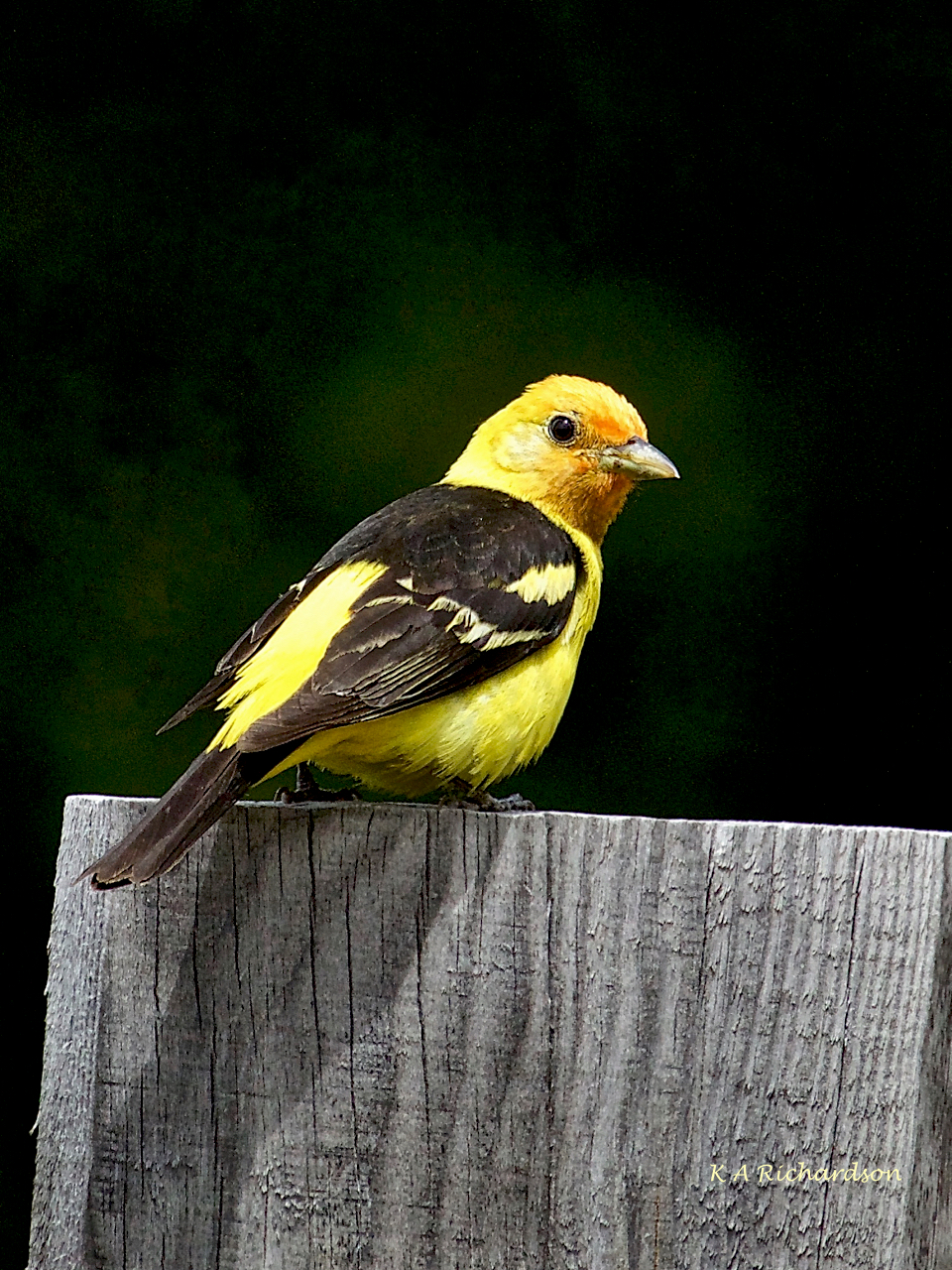
The wonderfully varied hues of a Western Tanager make it a target bird every year. When the grandkids and I unexpectedly came across this one in late June, we were ecstatic; when we got home, our photos all seemed a little below the standard of excellence we aspire to. In part, I suspect, the WETA is just one of those birds, like waxwings, where it’s difficult to capture their plumage as well as we’d like. (Photogenic people are often those who don’t look as great in the flesh as they do in photos, and truly beautiful folks sometimes don’t look as amazing in photos as they do when we meet them.) WETAs are like that, too!)
This one posed in a variety of perches before dropping to the ground to fill up on ants. We had every opportunity to get great shots, yet we didn’t; I dare not say ‘couldn’t.’
Among the “W” species we saw this year was this White-breasted Nuthatch. Not a lifer by listing, it was definitely a first for my camera. We were not surprised to find one, several actually, near Mahoney Lake, but very pleased to have the chance to meet this one, after some careful stalking, up close and personal.
White-breasted Nuthatch doing what nuthatches do!
FromCornell’s Lab of Ornithology: “The White-breasted Nuthatch is normally territorial throughout the year, with pairs staying together. The male has to spend more time looking out for predators when he’s alone than while he’s with his mate. That’s the pattern for most birds, and one reason why birds spend so much time in flocks. But the female nuthatch has to put up with the male pushing her aside from foraging sites, so she spends more time looking around (for him) when he’s around than when she is alone.
WBNUs forage up, down, and sideways over tree trunks and around large branches. They often start high in trees and move down them head first, pausing to crane their necks up and back, toward the horizontal, for a look around.
They probe into bark crevices or chip away at wood to find food. When they find large nuts and seeds, they jam them into the bark and hammer them open. WBNUs often store seeds and insects one at a time, and somewhat haphazardly, under loose bark on their territory. They typically hide the food by covering it with a piece of bark, lichen, moss, or snow.
WBNUs live in pairs year round and chase other nuthatches from their territory. Agitated birds fan their tails, flick their wings, or raise the feathers of the back. A bird backing down from a confrontation typically raises its bill and tail, and droops its wings. In winter WBNUs join groups of chickadees, titmice (not found in BC), and woodpeckers to forage.”
One of our prettiest sparrows out here is the White-crowned Sparrow. Distributed continent-wide, their numbers fluctuate from year to year and season to season as the flocks search for better foraging grounds. In the two and a half years we’ve been here, we’ve been fortunate to have many coming and going in our neighbourhood. Some of the other areas I monitor had very few in 2016. In 2015, I had better photo opps with them than last year, but I’m happy enough with these images…. Click to enlarge.
(Zonotrichia leucophrys) Mill Creek, Kelowna, BC.
WCSP adult foraging on dandelions in Thomson Marsh.
And finally, in the “W” category, we come to a delightful, if, again, “drab looking little flycatcher” (Cornell Lab of Ornithology), the Willow Flycatcher, not to be confused with the Alder Flycatcher, which is not endemic to our section of BC, but does compete with the WIFL in many parts of Canada.
Willow Flycatchers—more west and south…
Alder Flycatchers, more east and north.
Click images to enlarge in a new tab.
Willow Flycatcher, Thomson Marsh.
Cornell offers further details:
Flycatcher songs are innate, not learned like those of most songbirds. Young Willow Flycatchers reared in captivity with Alder Flycatcher tutors sang typical Willow Flycatcher songs.
When the two species are found together, the Willow Flycatcher will keep Alder Flycatchers out of its territory. But it expends more effort to keep out other Willow Flycatchers.
If a Brown-headed Cowbird lays its eggs in the nest of a Willow Flycatcher, the flycatcher may bury the cowbird eggs in the nest lining, or even build a completely new nest over the top of the first one.
Mahoney Lake area, Oliver, BC.
The oldest recorded Willow Flycatcher was a female, and at least 11 years old when she was recaptured and rereleased during banding operations in California.
Willow Flycatcher singing his heart out! Munson Pond, Kelowna, BC.
Lots of stars in this group…. So let’s get to ’em!
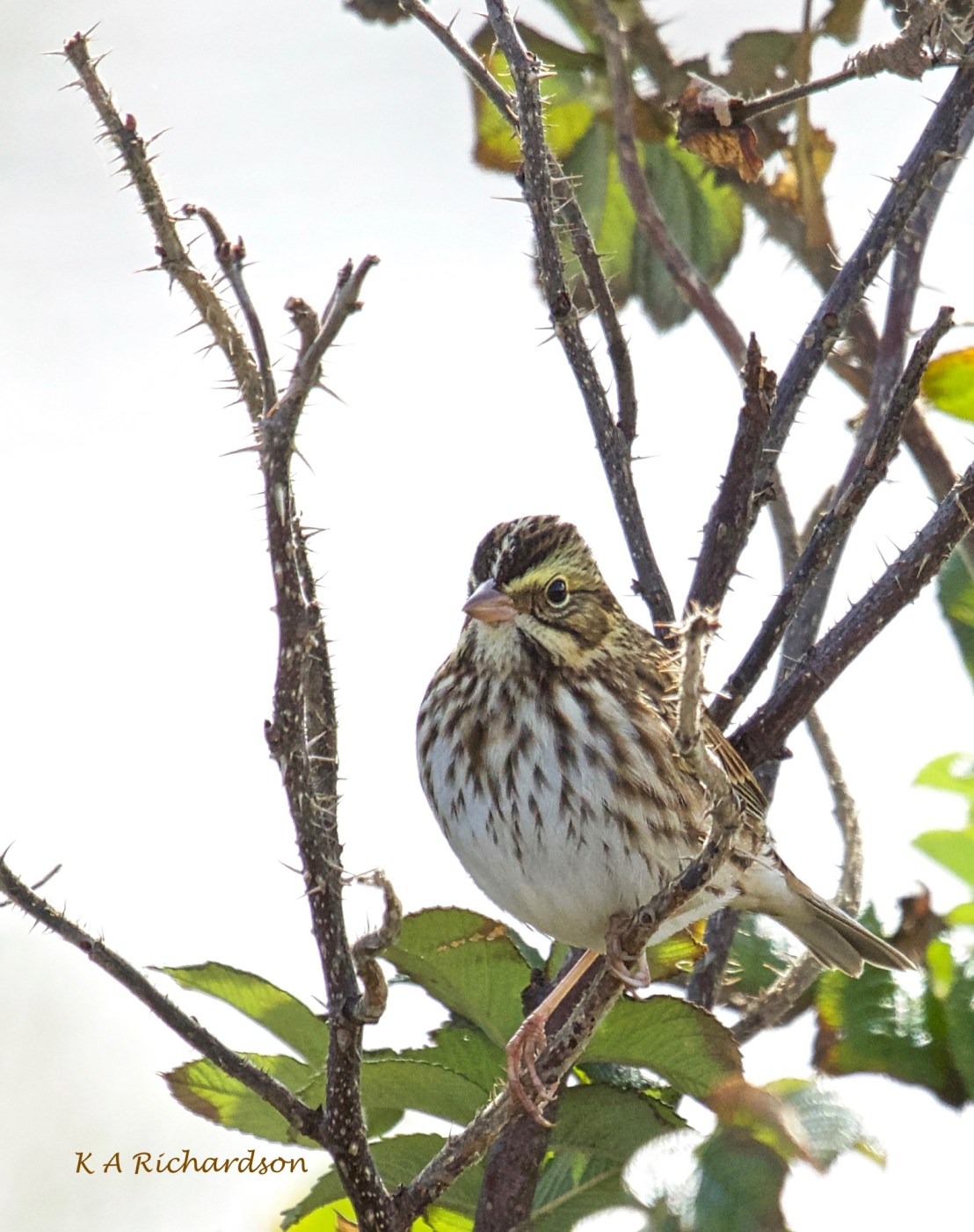
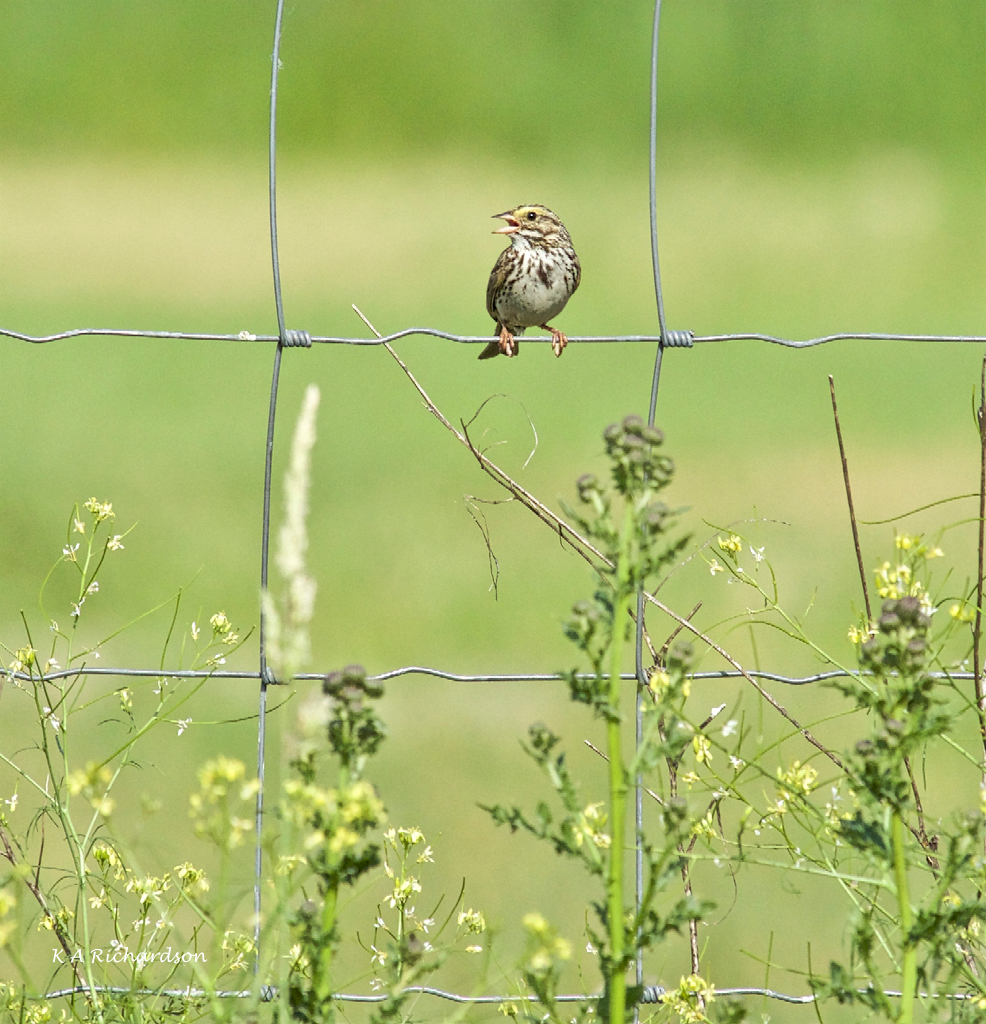
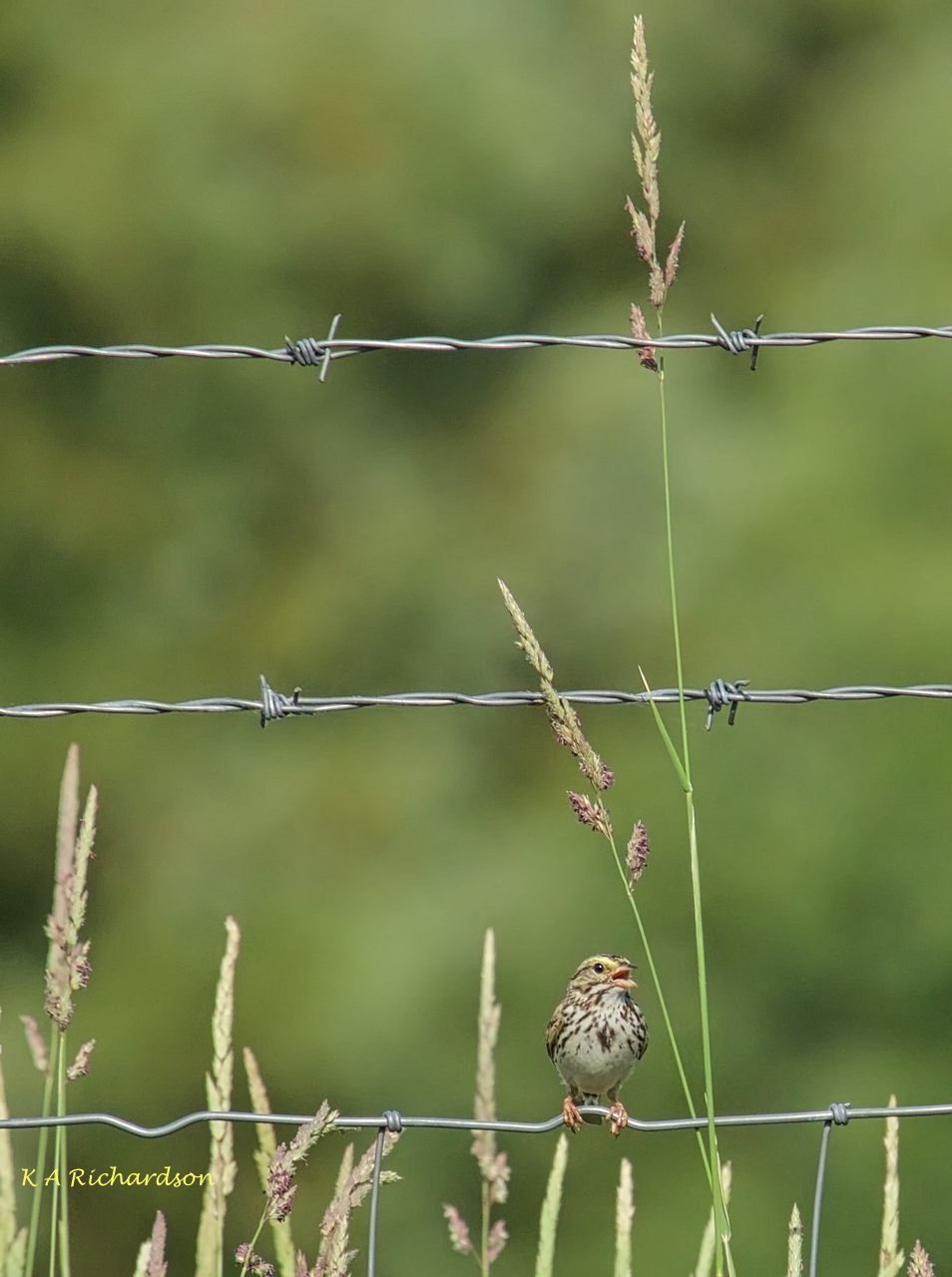
To lead off, a species that stretches from coast to coast to coast in Canada: the Savannah Sparrow. Unspectacular plumage, perhaps, although the one I found (on our fall trip) in Nova Scotia on Digby Neck at Gulliver’s Cove (you have to like the names) did stand out. It was my first real opportunity to get out with my long lens after two weeks of driving scenery shooting. There was a sizeable flock obviously migrating and foraging furiously.
I really appreciated the willingness of the individual below to take a few seconds out of his busy day for this eager birder’s amusement….
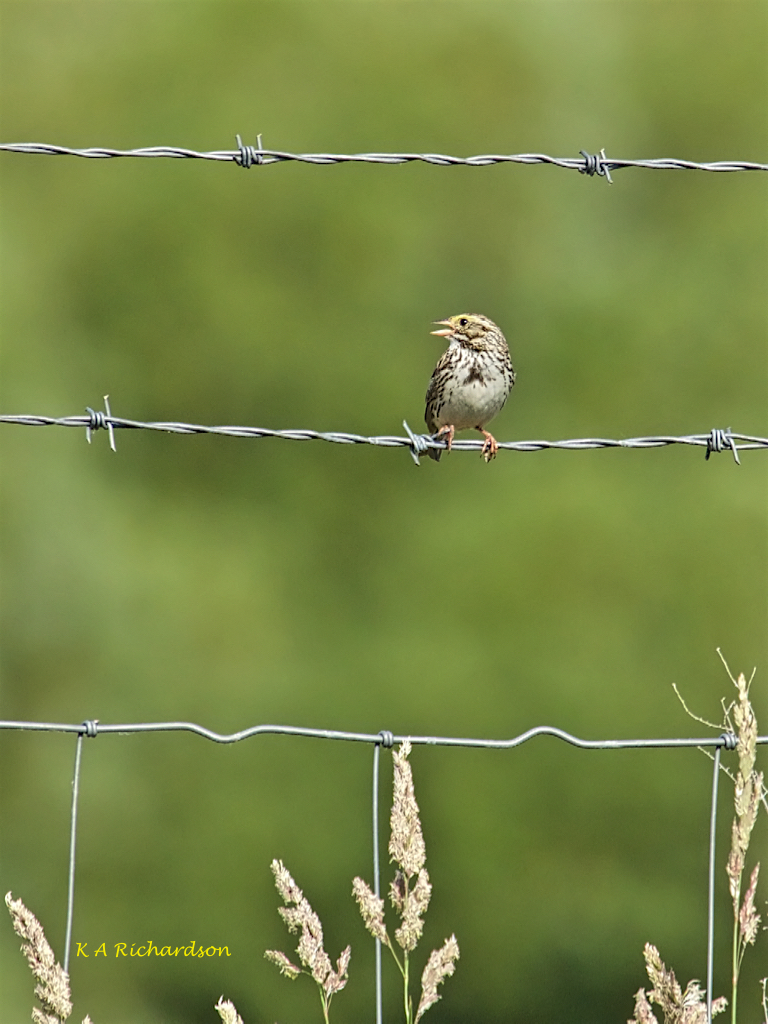
Every year I try to get a few shots in the style of Robert Bateman, where the bird is shown at reduced size in its environment. This bird sitting on the fence above Thomson Brook began at the bottom and slowly worked his way to the top, in accordance with Kelowna work ethic requirements. You, too, can experience this moment by scrolling down, and then back up again!
‘Look sharp, feel sharp!’ I always say!I’m getting so high, I practically have vertigo!I think I’ll start at the bottom and work my way up!
A bird I had searched for over a period of decades on trips west of my childhood home in Manitoba turned out to be very common and observable in the Okanagan, right in our suburb! Click on the images below to enlarge them.
Say’s Phoebe is a western bird!
Lord of the Ring! Say’s in our neighbourhood for the second year in a row….
The Say’s Phoebe could be described as plain looking but charming. Often, up close, it’s less photogenic than it is at a distance. Regardless, when I discovered a pair nesting in the neighbourhood in 2015, I was ecstatic, and able to observe to my heart’s content until they migrated in the fall. In 2016, the SAPH reappeared at the same location on exactly the same day I first saw it the year before. It checked out the old nest but decided not to renew its lease. I got this shot before it “moved” and seldom saw it through the rest of the season. There are other good spots for them; be sure I’ll be watching for them in the first week of April this year!
So common that most birders and bird-photographers eschew them (love that word: es-shoo; sounds like a weak sneeze!). Of course we’re talking about the familiar Song Sparrow, which like many species that span the continent, look a little different from one location, or even one season, to another. Ever since I realized that they were great subjects to practise with, I’ve been changing my opinion. Now the goal is to draw them out, in the right environment and see how artistic an image they and I can create together…. Here are two that I quite liked from 2016:
Not a thief, but a demanding beggar! I had no choice but share my biscuit!
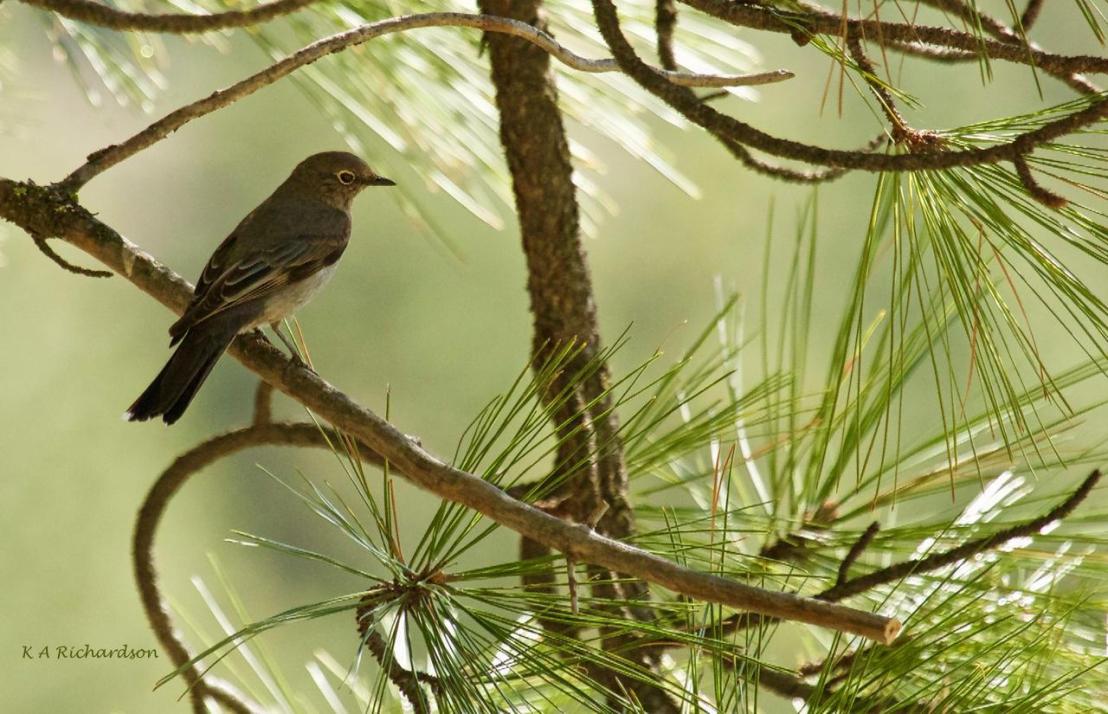
A bird that’s more common up here in the Okanagan than one might expect is the Townsend’s Solitaire. Always fun to find and challenging to do justice to, I pulled this image out of the small pile because I like the light and the lines; it was taken in April near Mahoney Lake, BC.
And finally, no list of T birds is complete without at least a couple of these streamliners:
Tree Swallow in Kane Valley, BC.
(Tachycineta bicolor) Beaver Lake Road, near Winfield, BC.
The Tree Swallow: often more beautiful to the naked eye than the camera can comprehend.
Quails were covered in part 2, as our species is the California Quail, introduced into our fair province many years ago…. So we skip to R, which offered three species last year, including one that I had never photographed before, the Red Crossbill.
Although it’s spread across the continent, many folks have never seen one, and this Cornell note suggests why. “A stocky finch of mature coniferous forests, the Red Crossbill is dependent on the seed cones that are its main food. Its peculiar bill allows it access to the seeds, and it will breed whenever it finds areas with an abundance of cones. It may wander widely between years to find a good cone crop.” When a couple of my colleagues found out I was twitching RECRs, they did their best to help me, as they were having good success at their homes. Eventually, Matyas, a teenage birder who lives not far away, after several attempts to alert me when the flock dropped into the big pines and firs of his neighbourhood, called me and I was able to get these photos. Later, I found them on my own at Bertram Creek Park. Will they return next year? Not necessarily….
Red Crossbill female.
RECR male. Both genders are very acrobatic!
I have seen much better images of this species in a more conventional pose, but was quite happy to come away with these portraits of RECRs fastidously foraging on fir cones!
Having lived here now through eight consecutive seasons, I have photo records that guide my expectations for when to expect species. Although most of our passerines migrate, a few try to hang on through our winter if it’s not too severe (as 2015 and 2016 were not). Red-winged Blackbirds fit this pattern. In the winter, many head for the Landfill at the north end of Kelowna while a few stay close to feeders. Sometime in February, however, we start to see large flocks of male RWBLs and European Starlings descend on the Marsh and the Rec Fields before saying goodbye to those for whom this is there destination for the next six months.
A dominant male Red-winged Blackbird claiming his territory.
Later in the season, Lord RWBL presiding….
The male RWBLs spend up to six weeks establishing themselves before the females arrive to take charge. It’s great fun to watch the males competing for territory and then to become less dominant as the ladies take over. No doubt whose boss by mid June and July! As for the non-dominant males, the “skulkers” I call them, they hide in shrubbery and make plaintive noises as they serve their time in their subordinate roles.
Many people enjoy hand feeding birds, usually Chickadees of various species or the occasional nuthatch. In Ottawa this fall, I had two Downy Woodpeckers eat seed from my hand. But the most fun I’ve had hand feeding has been with RWBLs that are so inclined. I’ve enjoyed this at Jericho and Stanley Park in Vancouver, Iona Beach in Richmond, and in 2016 with grandkids at Piper Spit on Burnaby Lake.
So contented. RWBL on Nana’s hand.
A tough shot, camera in one hand, RWBL on the other….
NOTE: ALTHOUGH HUMMINGBIRDS ARE NOT CONSIDERED PASSERINES, I have included one here because it doesn’t fit into the other broad categories that I’m using. This is NOTintended to be a scientific blog; it’s a highly personal one. Please don’t get too bent out of shape by this issue.
The final “R” species that honoured me with photo opps this year was the Rufous Hummingbird, which I encounter both in urban settings and, happily, in more wild locations. Certainly, it’s easier to get flight shots at feeders or in urban gardens, as the photo below on the left illustrates. But I’m more proud of the two males that I was able to stalk and capture in non-urban environments earlier in the spring.
Rufous female at the Richmond Nature Park in July.
Rufous male at Grey Canal in Vernon, BC. “Somehow, I feel like I belong here!”
RUHU near Harmon Lake, BC, looks like he’s riding some kind of weird three legged device….
This post highlights another woodpecker—NOT technically a passerine (see note when you get to it!), but included here because it doesn’t fit in other unscientific categories, either—our largest and most exciting for many birders, the Pileated Woodpecker, and one of our smallest passerines the Pygmy Nuthatch.
And let’s not overlook the Pine Siskin, a friendly and frequent visitor to our back yards.
Orange Crowned Warbler (inc). Click to enlarge.
But what about Orange-crowned Warblers and Ovenbirds and other birds whose names begin with O? Well, truth be told (and shouldn’t it almost always?) I just didn’t come up with many this year. I saw OCWAs both in spring and autumn, but the results just weren’t good enough. In one case in the spring, when I was having success with Orioles of the Bullock’s variety and a Black-headed Grosbeak, I did find an OCWA. When I got home, the background was so distracting that I tried to turning it into art, and am not sure how well that worked out…. Here’s the incomplete result for what it’s worth. This year (2017) will be better!
Most people know the Pileated Woodpecker by its printed name and its appearance, but not all agree on how to pronounce the name. I’ve heard Piley-ated, which is pretty close to what my Mac’s Dictionary recommends, if you can read the pronunciation guide (ˈpīlēˌātid), but I’ve been taught to say “Pilly-ated.”. So which way is correct? Well, as with so many words in Canada and the US, it really doesn’t matter, it seems. Again, from Cornell, ““PILEATED (Woodpecker) – PIE-lee-ay-tid, PILL-ee-ay-tid (having a pileus or cap). This and the next two are commonly pronounced as the two alternate versions listed from the dictionary. If it bothers you when people say it differently than you do, lighten up. They’re just birds, for goodness sakes, and THEY don’t care what you call them.” http://www.birds.cornell.edu/crows/birdname.htm
If you do take the time to look this up, you’ll find a somewhat clever, entertaining in the style of humorist Dave Barry, take on bird names and pronunciation:
Dr. Language Person’s Guide to Bird Name Pronunciations
by Kevin McGowan (with apologies to Dave Barry)
You say PLUH-ver and I say PLO-ver,
You say pro-THON-a-tery and I say pro-theh-NO-tery,…
If you spend time birding with other people (and you should), you will find that not everyone agrees on how to pronounce certain bird names. The differences can be as obvious as a southern drawl adding a few more syllables than seems necessary, or they can be as arbitrary (and entrenched) as the to-MAY-to, to-MAH-to debate of the old song. (My old doctoral advisor tells the story of how in his first year in Florida from the north he was mystified by the report from another birder of seeing a puh-ray-uh-ree. He spent the next hour looking for this exotic sounding bird, but could only find the common Prairie Warblers.) But even if you get past the disparate accents and regional dialect problems, still you hear many different versions of common birds. Is it “pa-RU-la” or “PAR-u-la”? Is it “PIE-le-at-ed” or PILL-e-at-ed”?
If you’re a beginning birder, you might be afraid of embarrassing yourself in front of other, more experienced birders by choosing the wrong pronunciation. Well you should be; we birders are a pretty snotty lot, never afraid to snigger at a novice’s mistakes. No, that’s not true. Actually, we’re very nice and helpful. But, never fear, Dr. Language Person is here to set you straight about these nagging doubts. I will give you the definitive pronunciations of the most commonly mispronounced birds, as well as some others that you never thought about mispronouncing, just to make you self-conscious so that you’ll make more mistakes, HAH-HAH! No, wait. In keeping with the scholarly tone of this fine publication, I will give you the information as I see it, and then you can make your own decisions.
First, English is slippery language. In fact, all language is slippery. No accepted absolute standards exist, in contrast to official measurement standards, like meters. So you have to rely on either (is that I-ther or EE -ther?) some authority or on common use. Without a widely accepted authority, all language drifts and people begin to subtly change the way they pronounce things. Languages, like populations of organisms, change and evolve over time…. (The article continues this way at length! And because of its Eastern bias, there’s no discussion of Lazuli Bunting, but I covered that in Part 5 of this series….)
NOTE: ALTHOUGH WOODPECKERS ARE NOT CONSIDERED PASSERINES, I have included one here because it doesn’t fit into the other broad categories that I’m using. This is NOTintended to be a scientific blog; it’s a highly personal one. Please don’t get too bent out of shape by this issue.
But you’re here for photos, I hope, so let’s get started: This bird was the star performer for the two weeks of April 2016 in a lovely place for a hike just west of Mahoney Lake in the White Lake Grasslands Park. The framed photo was to be the only one presented here, but when I looked at the shot from a week later where Mr. P was practising his best Usain Bolt impersonation, I couldn’t resist including it as well…. Any day we come across an accommodating PIWO is a great day!
PIWOs are often found on the trunks of trees; in this case the trunk had been exceedingly shortened….
And here he is a week later, on a fallen trunk, posing like Usain Bolt.
In case you’re wondering if he’s really a male, you can be sure because a female doesn’t have the red whisker (malar) stripe on her face. PIWOs are well distributed throughout Canada except in southeastern Alberta, southern Saskatchewan, and southwestern Manitoba.
Hiding his wings!!
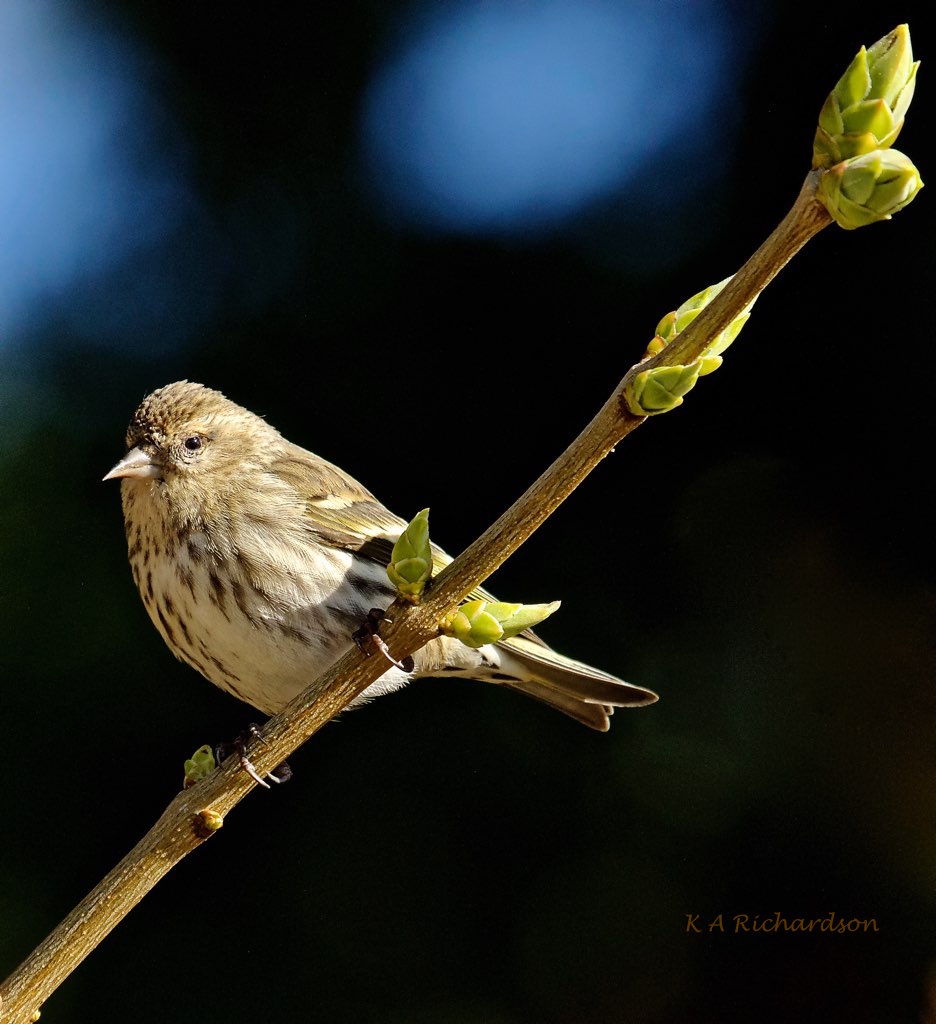
The Pine Siskin is found south of the tundra throughout North America. PISIs “often visit feeders in winter (particularly for thistle or nyjer seed) or cling to branch tips of pines and other conifers, sometimes hanging upside down to pick at seeds below them. They are gregarious, foraging in tight flocks and twittering incessantly to each other, even during their undulating flight.” (Cornell)
I see them often, but find that photographing the male displaying colour in his wings is a challenge that I frequently fail at. Perhaps in 2017!
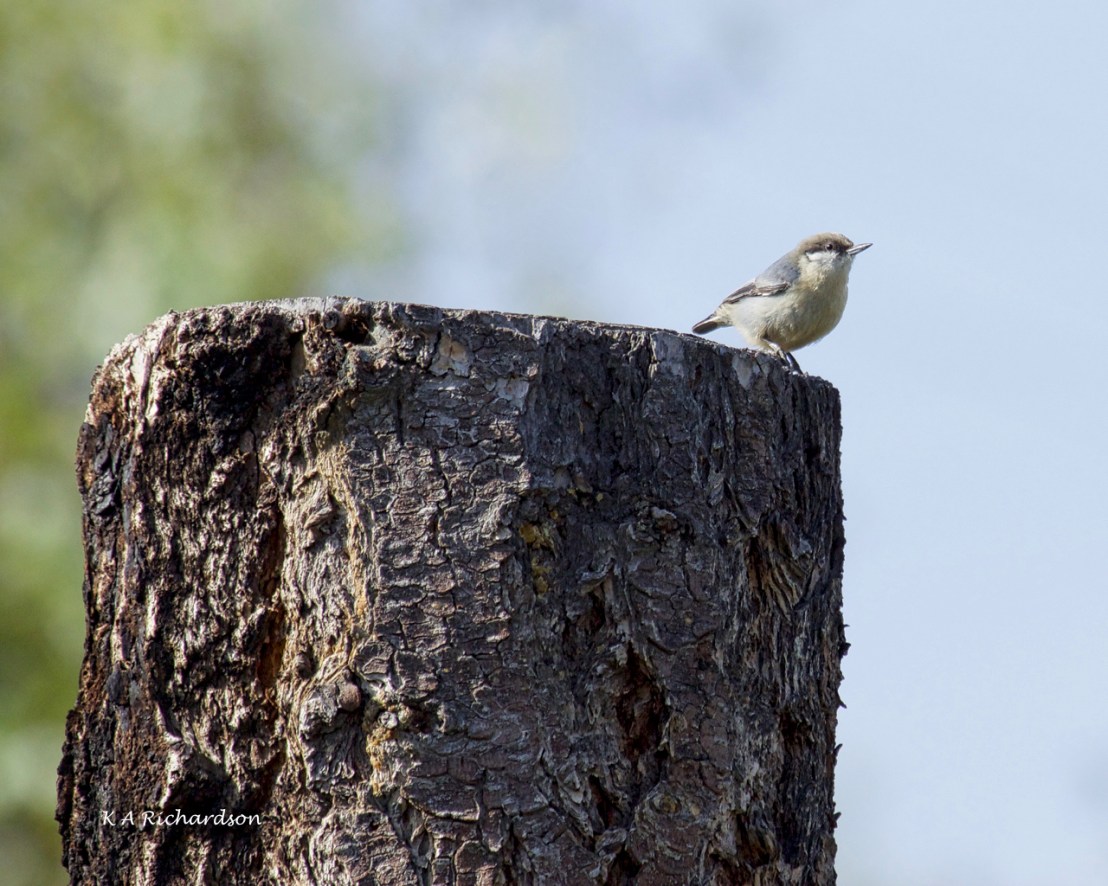
Finally, an Interior Bird that, at various times of the year, and especially in spring, is abundant in the Okanagan, yet notoriously difficult to photograph well because of its size and its hyperactivity, the Pygmy Nuthatch. Smaller even than the Red-breasted and White-breasted species, this wee one is a delight to watch throughout the year. Our best chances to photograph them, in my opinion, occur once mating occurs and they’re settled into creating a nest, often in a burnt out pine tree, Ponderosa, preferably….
Click to enlarge the photos. Once enlarged, scroll down and click again to view full size.
























 Although it’s spread across the continent, many folks have never seen one, and this




 birds & musings