By the end of May, the spring migration has pretty much peaked. This ‘mid-spring’ season always causes some excitement as we wait to see which species return — or don’t —, what patterns are altered, which accidentals surprise. Mating, breeding, and the raising of young by many species provided many comforting diversions as usual.
In late April, as we dealt with our grief after Sean’s death from cancer, we turned to travel first as documented hereand then, later in the month by heading from home east then south along Highways 33 and 3 from Kelowna to Rock Creek, then west to Bridesville and on to Osoyoos before turning north for home.
As we were driving I realized that I wanted to revisit (from a trip in April 2017) the property of fireman-cowboy-preacher Ed Brouwer at Eagle’s Nest Ranch. I had no idea if Ed would be home, or even if he still lived there.
Highway 33 from Joe Rich Creek to Westbridge is mainly moderate elevation fir forest. Nothing special to see or to stop for. South of Westbridge, however, we get into an area that had been ravaged by wildfires in the previous decade. Kettle River Recreation Area is just southeast of where the 33 is on the map above. While some of it had been burned, and some campers’ lives had been in danger, no one had died in the fire of 2015, and much of the park was spared from the flames. We turned into the park and had lunch by the river, one of my late son’s favourites for fishing the eddies where the brisk current is forced by the river’s bends to slow down.
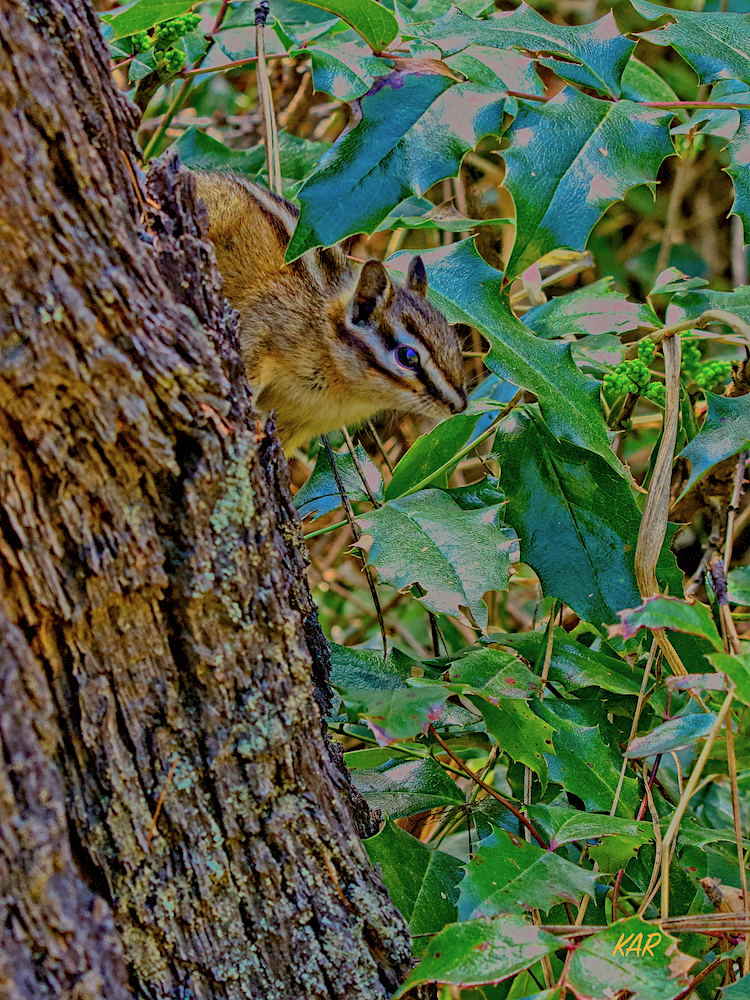
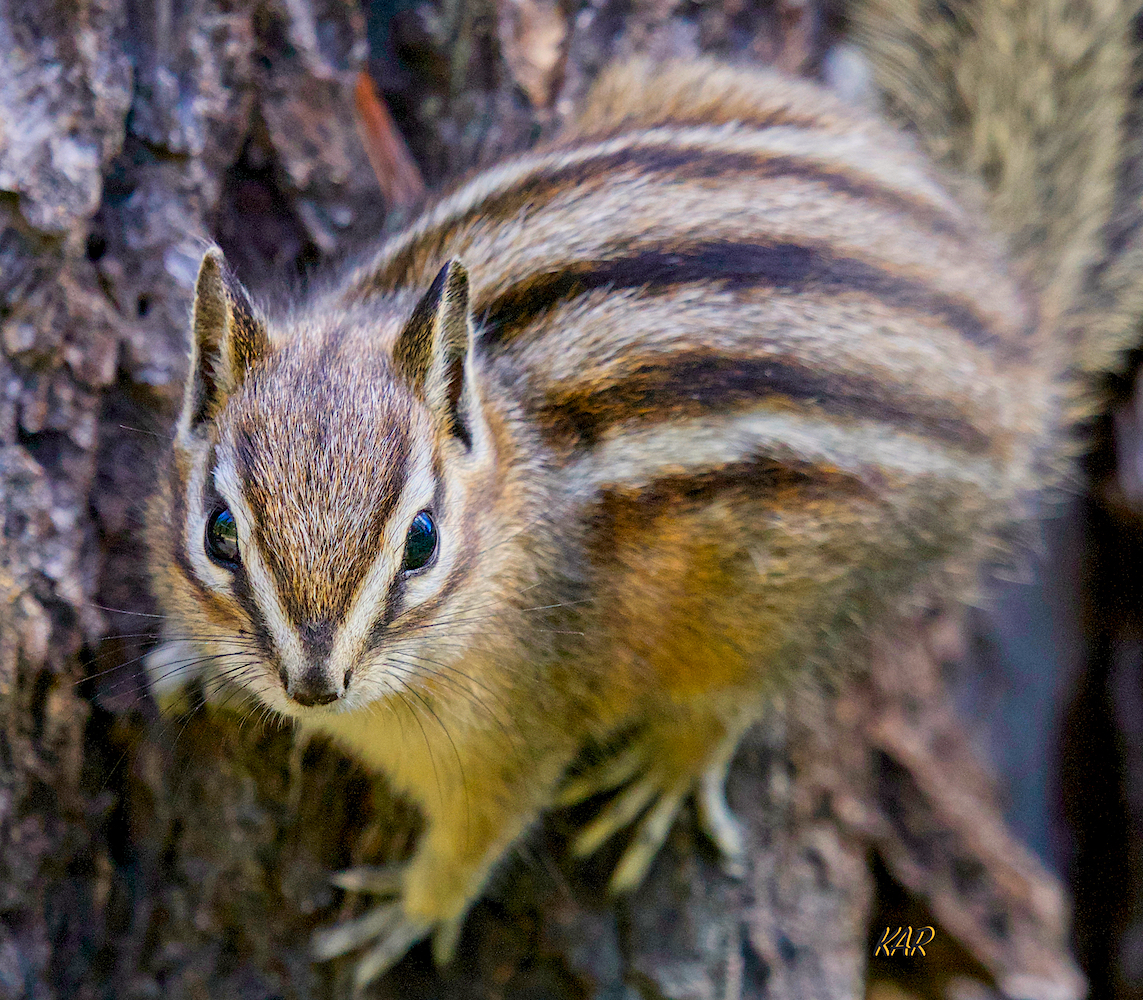
While some lovely Yellow-Rumped Warblers foraged furtively along the shore, we didn’t see much else in terms of bird life. This little Yellow-Pine Chipmunk was a delight to watch as ate our sandwiches. As he got used to us, he moved from shade into better light and allowed me a few fotos.
Yellow-pine Chipmunk (Tamias amoenus) Kettle River Recreation Area Day camping, near Rock Creek, BC.
It was a typical late April day, a mix of sun and clouds, neither warm nor cold; in short a good day to be on the road. Next stop we decided would be Eagle’s Nest Ranch and the Williamson’s Sapsucker Sanctuary that Ed B. had created after our suggestion.
The WISA isn’t bound to stay in any one woodlot, of course, and on this Friday afternoon, we didn’t see any. We did visit briefly with Ed, a retired fireman and now a cowboy-preacher in the area between Bridesville and Osoyoos, the Sidley Road region on the east side of Anarchist Mountain which overlooks Osoyoos (Lake) and the southern Okanagan Valley.
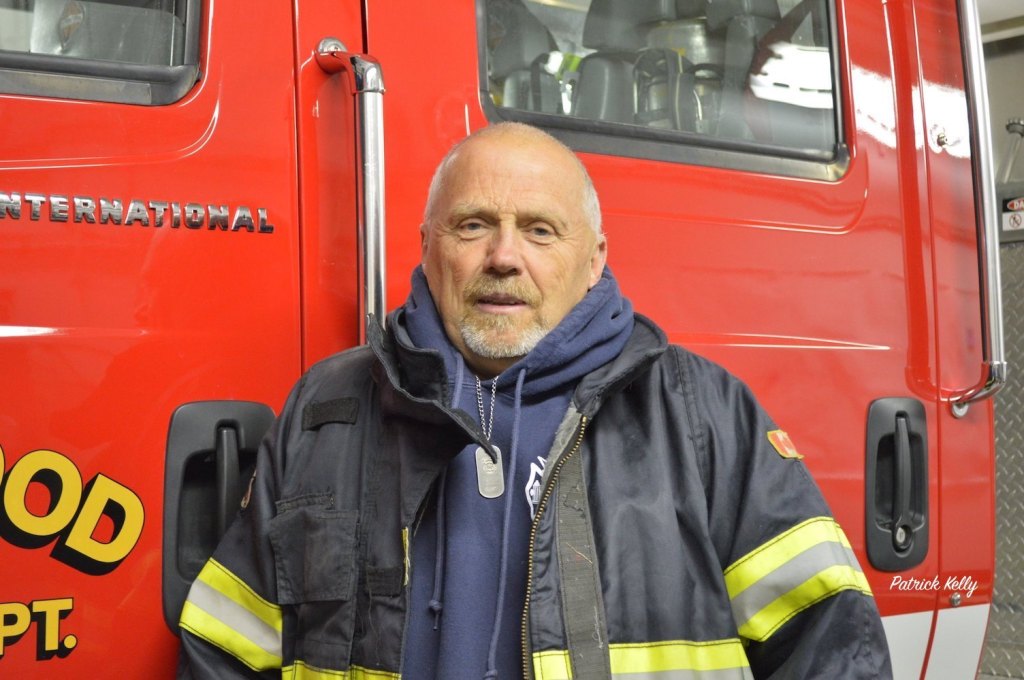
I’ve ‘borrowed’ this image of Ed in his firefighter days nearly a decade ago from the Flickr site of Patrick Kelly. Today, Ed operates his ranch in the Sidley Road region west of Osoyoos, and ministers to local folks there. He is a very kind, compassionate, and down-to-earth gentleman. We talked about my son and he offered to pray for him and us.
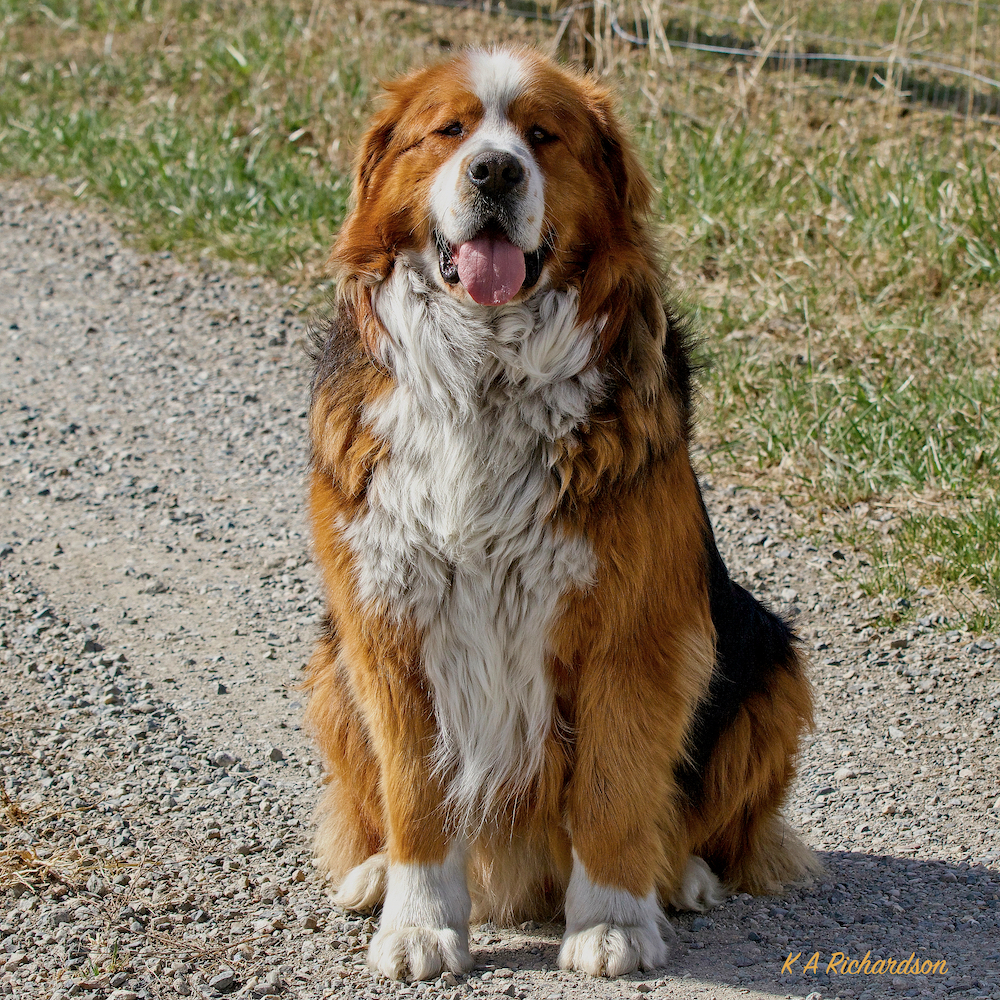
Ed’s dog Washington is a massive St. Bernard with a heart as big as the sky and the demeanour of a saint. I’m sure he sensed our feelings. After greeting me, he went to Nana, who was undergoing cancer treatments at the time, as if to comfort her. He stayed by her side the whole time as we chatted to Ed. It was a remarkable encounter. I hope we get to see both Ed and Washington again.
Here, Washington had followed us out the drive as we were leaving. I stopped to thank him and to take this photo.
Below: We enjoyed watching this young foal frolicking and learning the ropes from his mère.
Looking south across Eagles Nest Ranch, Sidley Road region north of Highway 3, east of Osoyoos.The ranch gate of Eagles Nest. The top of the post reflects Mr. Brouwer’s faith.
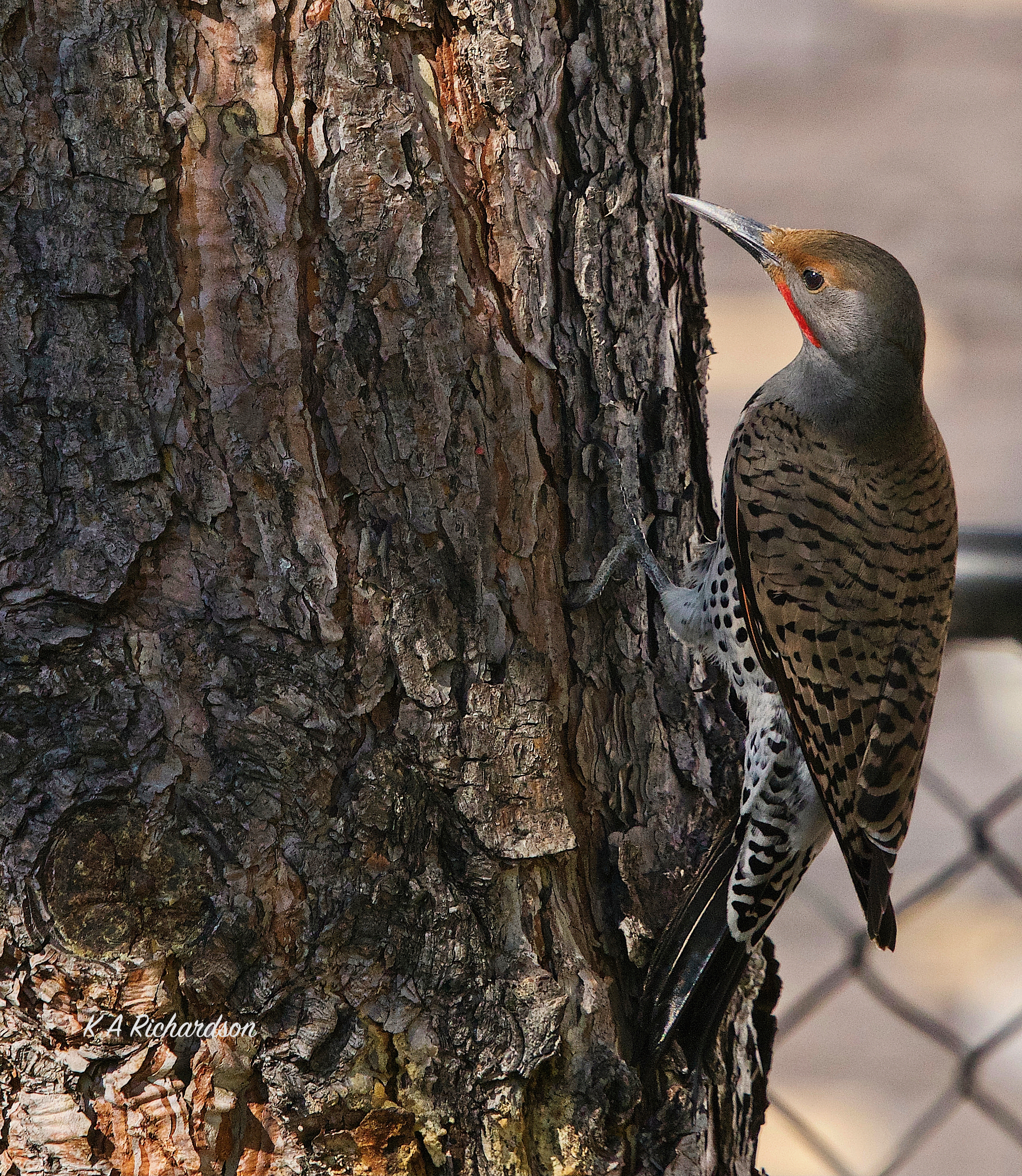
As indicated above, we had found Mr. Brouwer’s property a fabulous spot for woodpeckers. Besides Williamson’s, we had enjoyed great closeups of a Hairy excavating an aspen, and a pair of Pileateds hard at work. While I saw Red-naped, I didn’t get decent shots that time. So on our way out of Eagle’s Nest Ranch this time, I took some scenic shots and managed to find some Red-naped woodies as well.
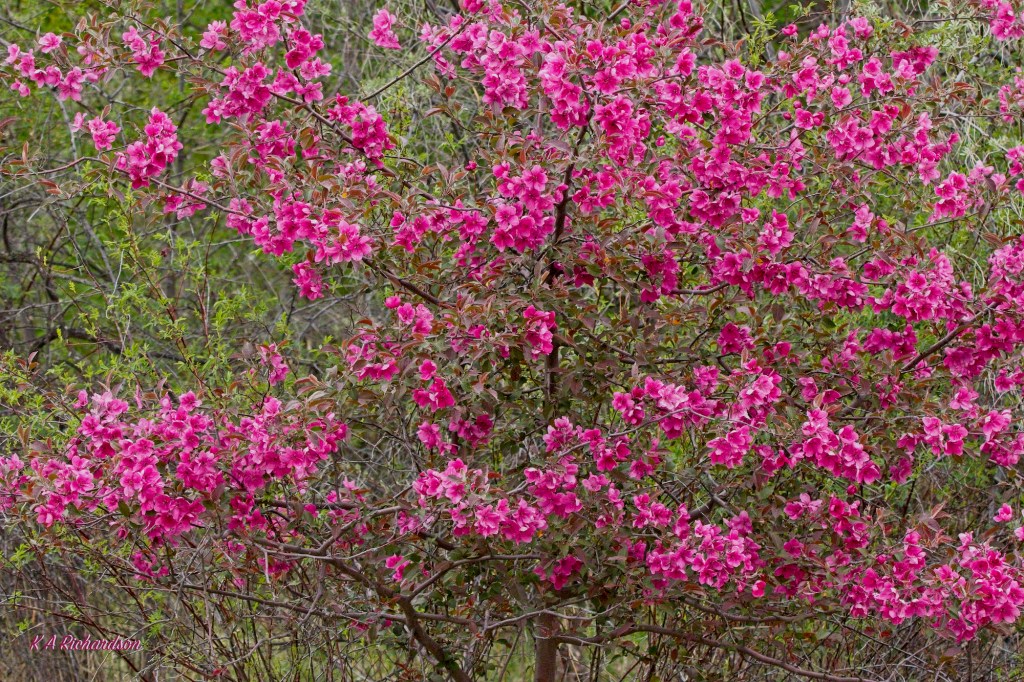
From here, with the afternoon light fading as clouds rolled in, we headed for Osoyoos where we spent some time at Haynes Point Sanctuary, where again we found some Yellow-rumped Warblers, and a beautiful blossoming crabapple tree.
Yellow-rumped Warbler male at Haynes Point Sanctuary, Osoyoos, BC. Late afternoon.
Crabapple tree at Haynes Point Sanctuary, Osoyoos, BC. Late afternoon.
Crabapple blossoms details. Haynes Point Sanctuary, Osoyoos, BC. Late afternoon.
The images of spring were lovely, but the ache in our hearts will remain for a long, long time….
We didn’t know what was coming. Preparing to live with the unchangeable by loving all that can and does change — with or without our consent.
No one expected the week preceding Sunday, April 18 to be Sean’s last. Certainly, he didn’t. He continued to go to work, was eager to get his first Covid 19 vaccination on Thursday the 14th. We talked about it by phone. ‘No problem,’ he said. But his right arm was next to useless and his breathing so laboured that phone calls had to be brief. I planned (in my head) to visit him on Sunday.
In the meantime, I continued to enjoy the fine spring weather, walk my daily beat, and to add to my photo collection. We even travelled to Bertram Creek Regional Park, a few minutes south of our place on the east side of Okanagan Lake. Not much to see at first in the park itself. We wandered down to the observation pier that stretches out into the lake and watched a pair of Common Mergansers keeping their distance from us. Until, that is, this eagle showed up, flying in our direction:
This approaching Bald Eagle did us a great favour by causing the C Merganser pair to flee in the direction of the pier and my waiting camera. Click on photos to enlarge them in new tabs. To return to this post, just close the tab.
Good shots of Mr. Greenhead can seldom be counted on; I got very lucky. Thanks, Baldy!
Closer to home (like in the foundation stones of our condo or in the small walled-in front yard) there was some fun to be had, too, watching our local residents at work and play…. Click images to read captions; to see the photo’s title, click the ℹ️ symbol.
I did travel up to Beaver Lake Road to check on the bluebirds. Only later did I understand that for me this would become the Year of the Female Blues. I usually get much more cooperation from the males than from their mates. That expectation was turned on its head this year — only one of many challenges to custom….
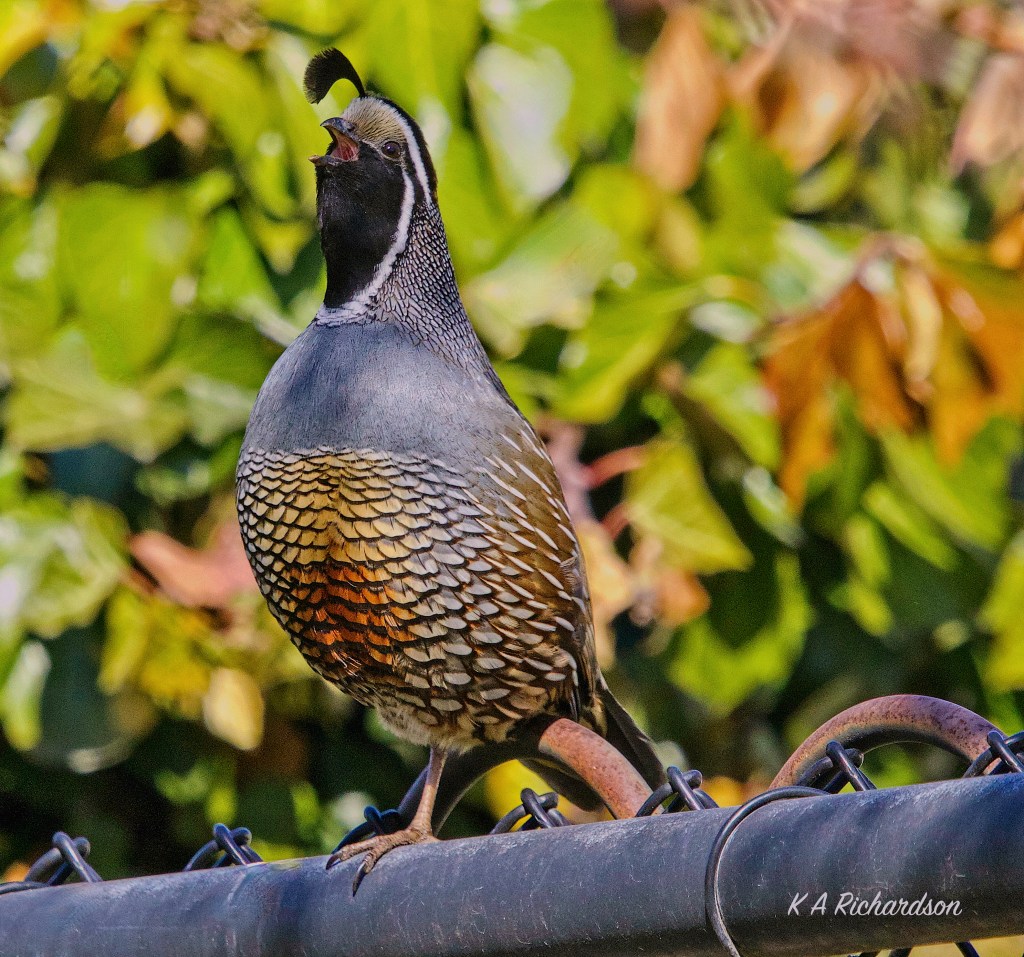
Our part of Kelowna has numerous coveys of California Quail, one of which likes to frolic in Belmont Park a few minutes walk north of our place. On Saturday, the 17th of April, as I took my route in a counterclockwise direction for a change, I heard this fella rehearsing his one note solo. Click the images to see details.
Johnny One Note practises for Spring! California Quail (Callipepla californica) Belmont Park, Kelowna, BC.
Or did I have it all wrong? Was he trying to warn me that my world was about the crumble? My son left this world the next day.…
Before the 18th: Early spring predators & ‘critters’
So far my posts on spring 2021 (up to the time of my son’s passing on April 18) have focused on birds. But I’m also quite interested in non-avian wildlife, and even plants — especially in the equinoctial seasons. So I’m going to include a couple of shots of raptors first and then some of the creatures that have to pay attention to attacks from the sky.
Turkey Vulture over Trapalanda Farm on the northeast sector of my beat.
The earliest of the larger butterflies of spring: the Mourning Cloak. New Growth Area above Crawford Falls (west side), Kelowna, BC.
In the first week of the month, spring temperatures toyed with our expectations, starting high, then falling then rising again. In the second week, however, temps dipped before rising dramatically after the 12th….
Still, for the beginning of April, these conditions felt more or less normal, and I went about, as in previous years, surveying the ponds and brooks and marshes on my beat, looking for ducks that had been more or less ‘away’ all winter.
Ducks are fine, of course, but spring is much more about migratory passerines, especially as warblers and goldfinches add fresh colour among permanent residents still in their winter plumage. I must admit, however, that there were fewer House Finches and warblers than I expected. In fact, the population patterns I’d come to expect over six previous seasons seemed ‘off’ for spring, summer, and fall.
For all that, it seems there’s always an abundance of blackbirds, including, by mid-April females popping up one or two at a time, prompting great excitement among the brightly coloured males in the marshes. We can even begin wondering when the Yellowheadeds will make it back….
One of our favourite spots to visit as early in spring as we think the birds will be back is White Lake Grasslands Park, northwest of Oliver, BC. It’s a great spot for early bluebirds, both Westerns and Mountains, Western Meadowlarks, and Say’s Phoebes. As well, there’s often a chance to see some raptors, even a Golden Eagle if we’re really lucky. And if the birds are uncooperative, perhaps we can inspect some spring flowers.
For enlarged images, click on any one in the gallery.
While my son soldiered on in early spring, we all knew he couldn’t hold out long, as his breathing became more laboured, and he lost the use of his right arm. And yet, we all tried to support him by respecting his courage. I wish I’d said, however, “To Hell with Covid!” and spent some time with him. We spoke frequently by phone, and while he went to work for one-on-one sessions with his golf clients, he didn’t want those of us still circulating among the general public to visit him at home. I should have gone anyway; I’ll regret that choice for the rest of my life.
For the first part of April, life continued fairly normally, Covid restrictions notwithstanding. I could still hike my beloved Thomson Marsh and environs, drive to Munson Pond and Park, or one of the other birding locales like Robert Lake or Beaver Lake Road where I was unlikely to run into many people. I got a lot of satisfying images, including some almost ‘nemesis birds’. I’m trying to focus on diversity here….
In the shot below, the little nuthatch has pulled something out of the bark and is tossing it around before swallowing it.
I have photographed Red-breasted Nuthatches for many years, but much less frequently than I’d have liked.
This spring was a spectacular exception. If RBNUs were found here in springs past, I wasn’t aware of it. But I didn’t know what to listen for. This year I quickly discovered that they make a sound like a tiny tractor backing up — a nasal one- pitch ‘beep-beep-beep’. And once I’d discovered ’em, they became a joy to work with!
More RBNUs below….
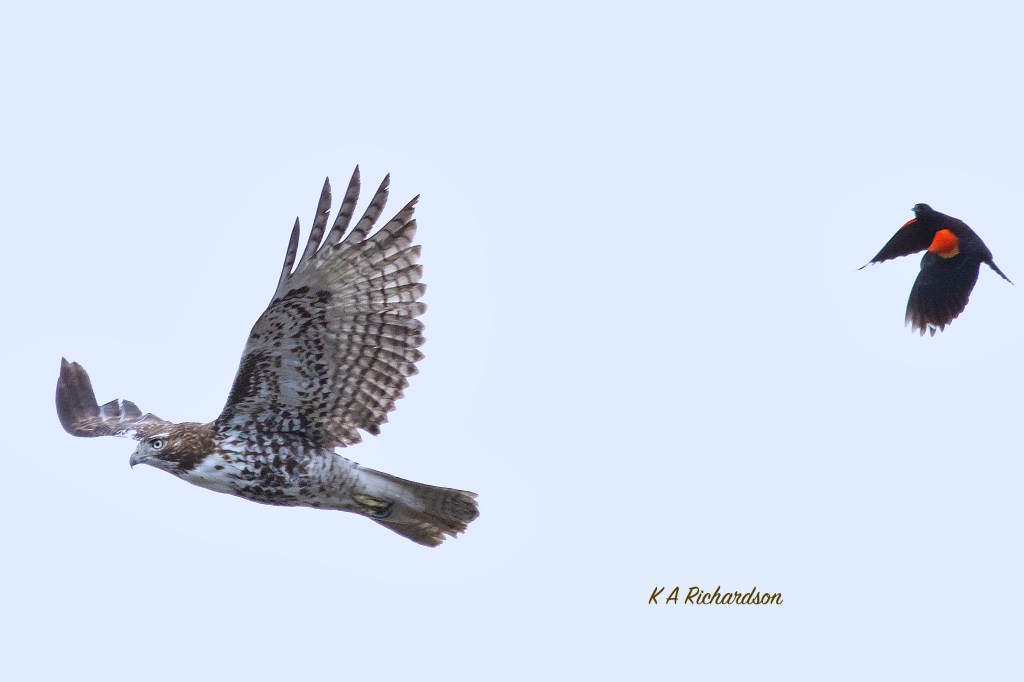
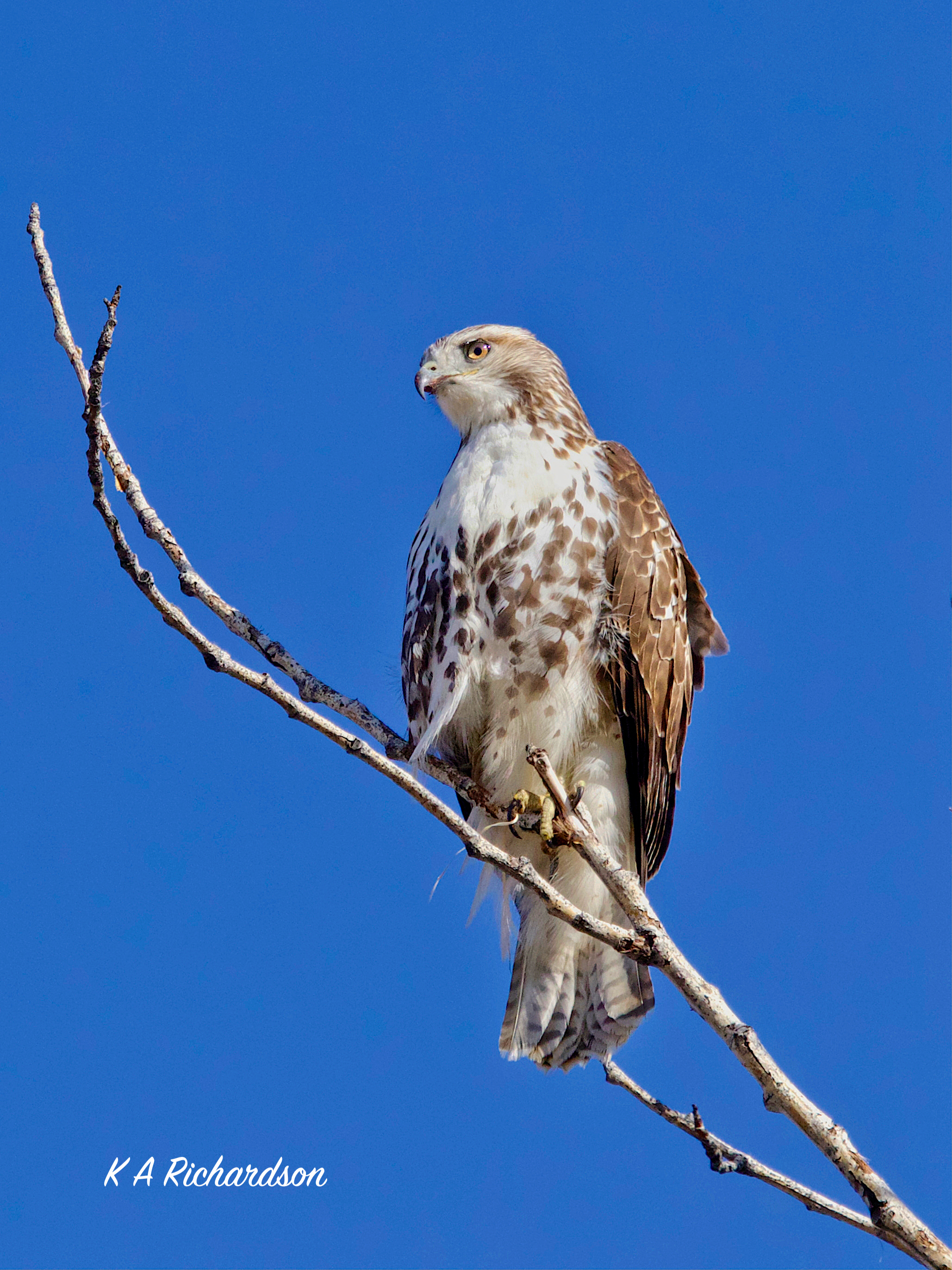
While pursuing a Cinnamon Teal, out of the corner of my eye I caught a Red-tailed Hawk over Michaelbrook Marsh being chased by a RW Blackbird. With no time to adjust my manual set up, I swung the camera up and hoped for the best. Only when I got home did I discover that it was our old friend Ready Eddie (Re’ddy with his white eyebrow and throat, a hawk I’ve been tracking for over 6 years) being harassed as he has been so many times over the years by Red-winged Blackbirds. I first photographed this phenomenon in this area back in March 2016! (Scroll down the post.) In the shot above the RWBL has backed off after successfully sending Re’ddy packing….American KestrelsKessie (right) and Amke (Falco sparverius) near their nesting site on the north side of Michaelbrook Marsh, Kelowna, BC. In the seven springs I’ve lived in Kelowna, Kessie has mated in this northwest sector of her territory every year. Whether her mate is the same one I’m not sure. This has become a rite of spring for me as much as for them.
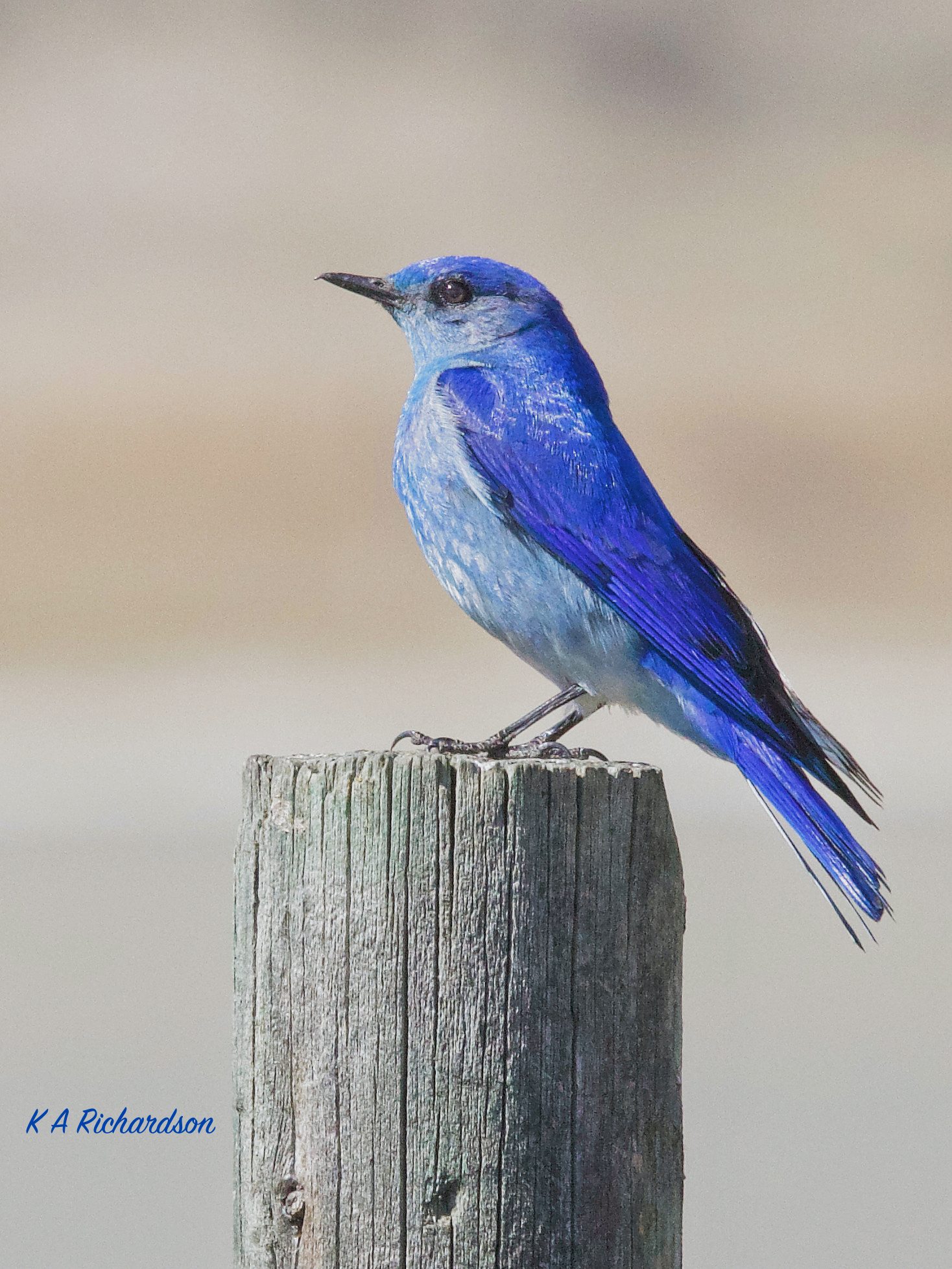
I love Mountain Bluebirds! They are found in many parts of the Okanagan from White Lake Grasslands Park, north-west of Oliver to Beaver Lake Road in Lake Country. In 2020, I discovered them even closer to Kelowna in an area only 15 minutes from home.
While Western Bluebirds also nest in these areas, I find them less photogenic than the MOBLs. Every year there’s a continuing challenge to discover where they will nest and to get the quality of images this species deserves!
In most seasons, I’m most dedicated to the males . In 2021, however, I found a female to give them a run for their — er — feathers. You’ll see later on….
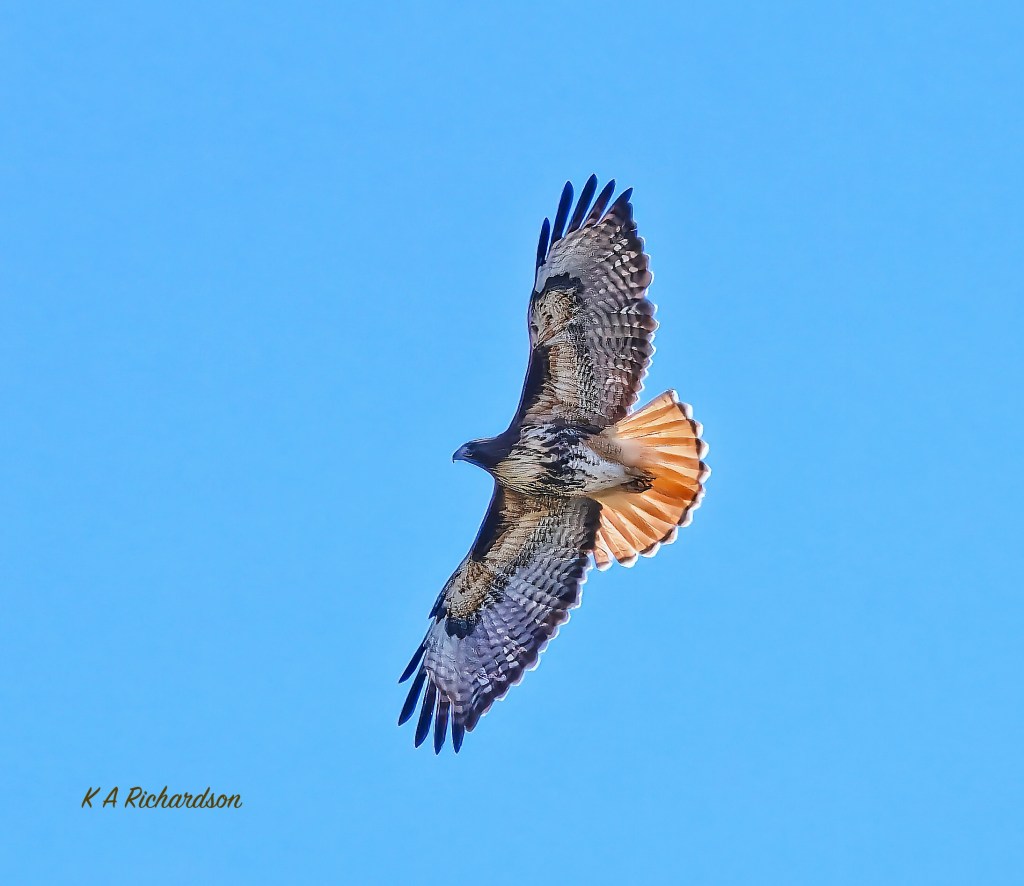
An intriguing feature of this species is the great colour variability among its indvIduals. The harassed fella (posted above the kestrels above the bluebird), as you can see, has a white throat and overall lighter tones including a tail that’s not very ‘red’ compared to the one to the right here, soaring above Beaver Lake Road in Lake Country. This one has classic hues!
Some birds are more difficult to capture than others, of course. Western Meadowlarks are often found in the same areas as our two bluebird species, but I find them much more flighty. Early spring, however, often brings opportunities as it did this April day. Of course, I’d prefer this bird to face me. S/he didn’t, but I would catch up with one more co-operative later in the month.
The Black-billed Magpie is another species I find challenging to photograph despite their relative abundance here. Finding them in the open in just the right light is certainly possible, yet I struggle to get my settings ‘just right’.
While this setting is far from pretty, it’s typical of where this youngster and his relatives hang out. He looks a little guilty about giving me as good an opportunity as even this!
One of our most colourful and controversial species, BBMAs never fail to get a reaction from onlookers. Personally, I like ’em and defend them against their detractors, which doesn’t make me very popular!
American Robins are one of the most familiar birds in North America. For many folks, the ‘first robin’ of a new year marks the beginning of spring.
Many bird photo-graphers I know don’t like to post images of commonplace birds. I, contrarian, love the common birds with which, perhaps, I identify. And, as I’ve learned through travel to and living in ‘foreign lands’, what’s ‘common’ in one place is ‘exotic’ in another!
Pine Siskin (Spinus pinus) Belmont Park, Kelowna. The Siskins in our area seldom pose for closeups. This ‘keyhole shot’ has been edited to remove obstructions.
I must add, too, that, this bird was much lighter in colour than most Siskins.
The images below, while of low quality, were taken in low light as the bird was foraging in a shallow ditch.
On another day, I found a Pine Siskin sipping water from the ditch that runs through this part of Belmont Park. Very different ‘look’ in this spot, I think you’ll agree!
Red-breasted Nuthatches inhabit the same general area of Belmont Park. So, as promised above, here are three more images of them. They were sooo cooperative this year!
For reasons I find difficult to explain, I love Say’s Phoebes, despite their muted hues. Perhaps it’s because they’re a western bird and it took me so many years to learn where they hang out. Regardless, I see several every year, now, and, again, why I don’t know, I have trouble getting the quality of image I want.
This bird was one of a pair nesting in the large back yard of a family dwelling near Vernon’s Swan Lake Nature Reserve.
Note: it will take some time for the photos of this piece to load. If viewing on an iPad, I recommend Landscape View, rather than Portrait….
For my family, April was the saddest month by far in a long, long, time, as my son Sean died on April 18 after a long and recently terrible struggle with cancer. He was three months and two days short of his 53rd birthday, and had been living with the disease since his colorectal cancer was diagnosed in 2016. While we miss him profoundly every day, we take comfort knowing that he no longer has to suffer from disease that, especially in his last months, stole his physical strength and eventually his ability to breathe. Brave and determined to the very end, he set an example for all of us to follow. Writing about him and his amazing life is still a great challenge for me. I’m not going to attempt that journey here/now….
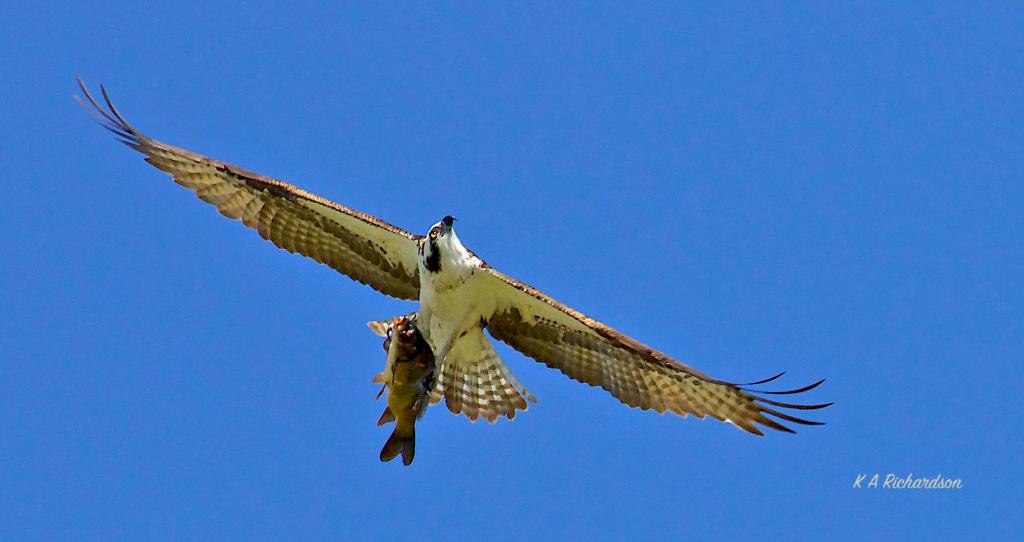
Instead, I will focus on my passion — birding and nature photography. While Sean was much more into fishing and hunting (for food) than I, he was also a capable photographer and a dedicated conservationist. He wasn’t as much ‘into birds’ in general, but he was very fascinated by birds that shared his passions — raptors, especially Ospreys and eagles, and loons….
Bald Eagles (Haliaeetus leucocephalus) live both north and south of Thomson Marsh and often fly over, usually on their way to or from Mission Creek on the northern edge of my beat. Occasionally, they show up in pairs or as rivals riding the thermals, chasing but rarely catching each other or engaging in combat….(Pandion haliaetus) Thomson Marsh, Kelowna, BC. There were a couple of other Ospreys in the area that day as well, flying well above her…. No conflict that I could see, but she was clearly aware of something “up there.”
Click (or right click and choose “Open image in a New Tab”) on photos (or finger stretch them on an iPad or iPhone) to enlarge them.
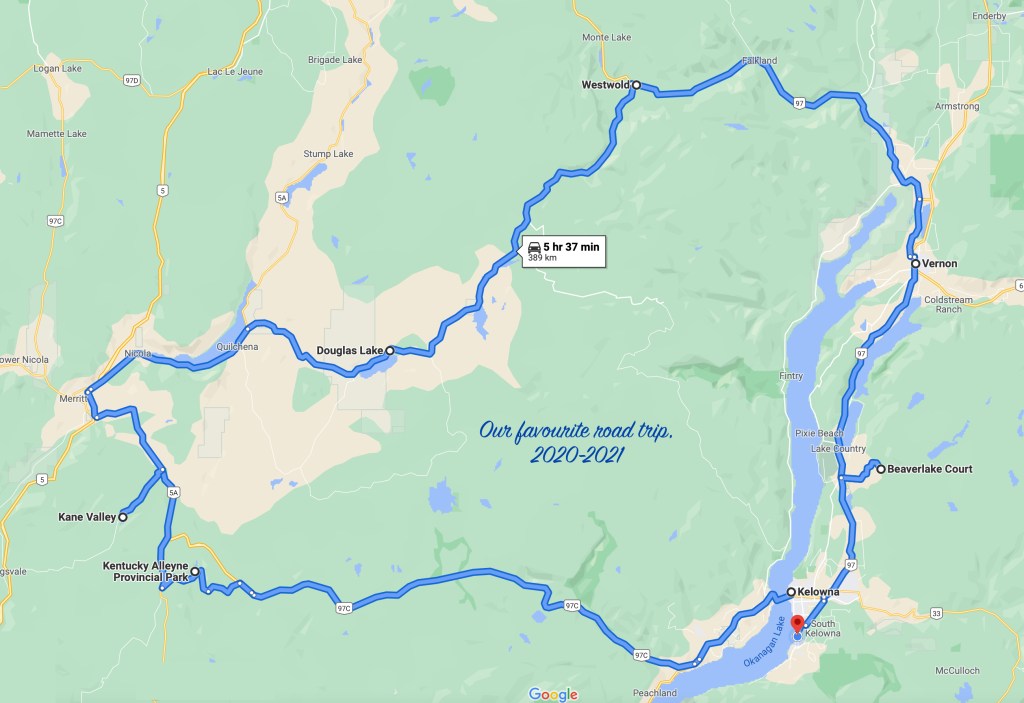
Birding was a great consolation in April. Spending time with my younger son Mike helped, too. My wife Nana, going through her own cancer journey, was a rock of support. Like Sean, she was/is determined to make the most of whatever time she ‘has left’, and to that end, took up kayaking in May. We travelled from Kelowna to one of our favourite provincial parks and its environs several times from April until fire season began at the end of June. These favourite natural settings were immensely comforting to both of us.
The northern of the two lakes at Kentucky-Alleyne Provincial Park near Merritt, BC.Nana & the Loon‘Swoop and snatch!’Alleyne Lake, two days after Sean’s death, as Mike was heading home. Thanks so much to Nana for making sure we have this memento! April 20, 2021Shots from our travels to Kentucky-Alleyne Provincial Park, Spring 2021, April into June.
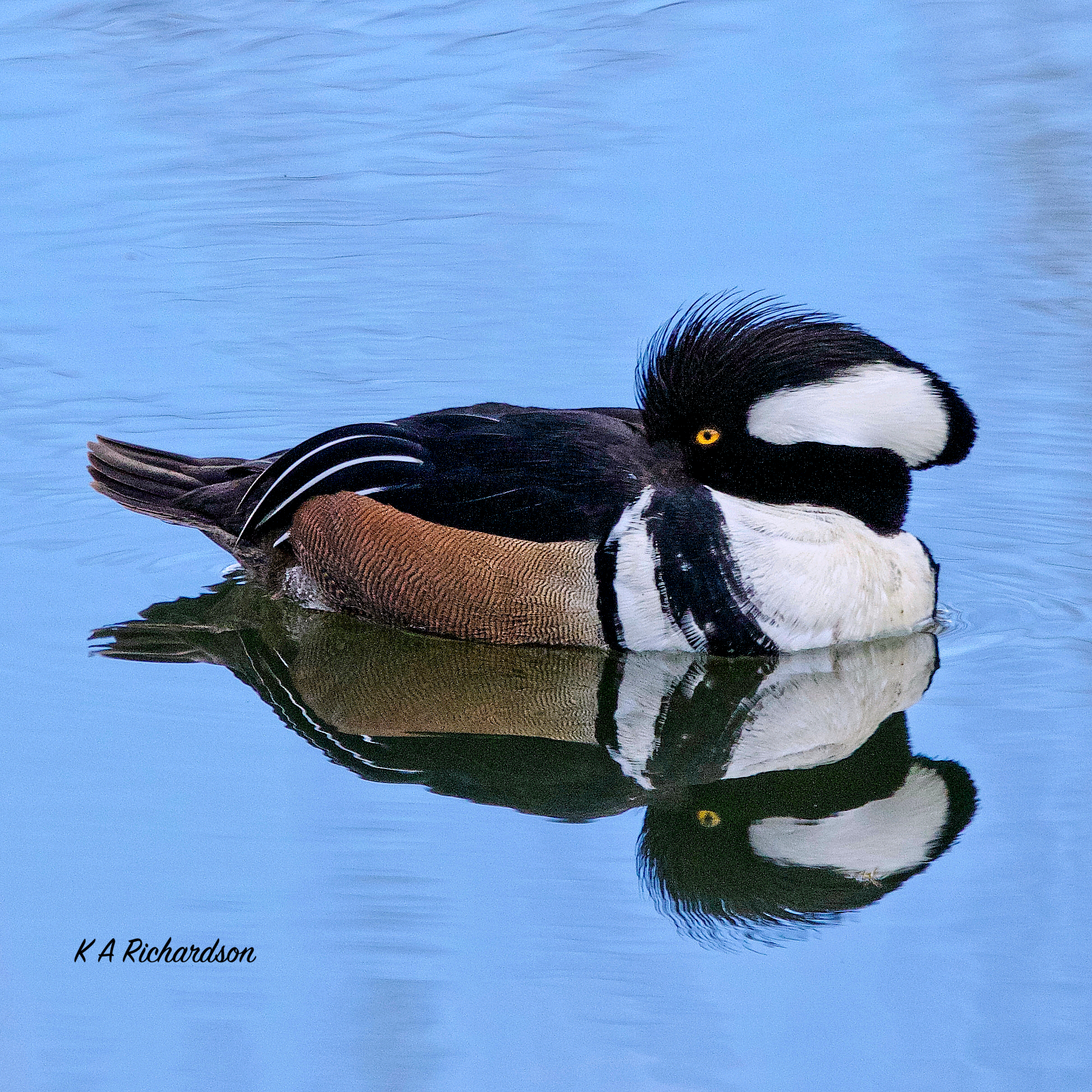
Closer to home we enjoyed great RW Blackbird sightings again this month as well as ducks that we count on getting close to only at this time of year — American Wigeons, AGWTeals and Hooded Mergansers, especially.
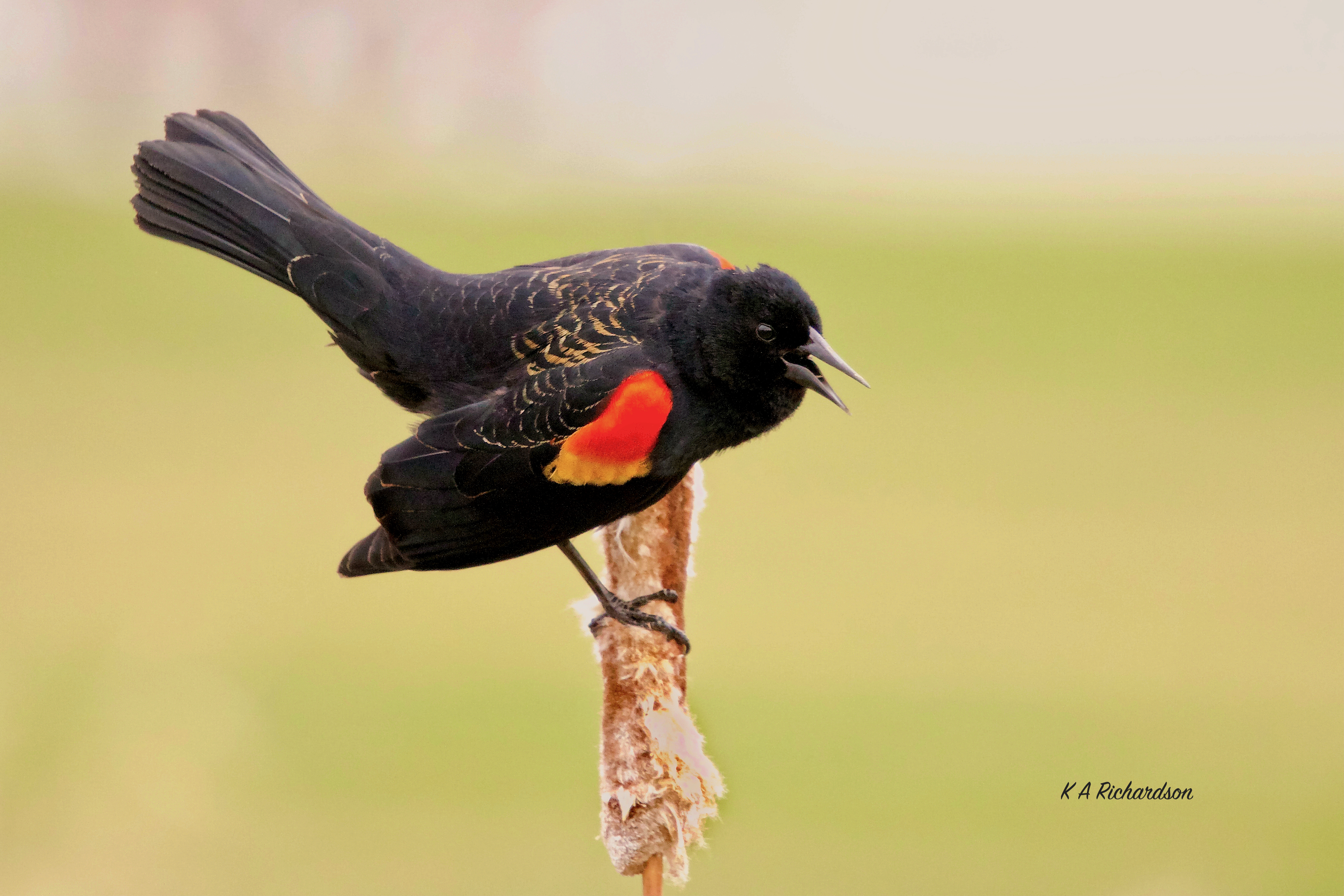
Randy Redwing on April Fools Day plays King Kong!Red-winged Blackbird (Agelaius phoneceus) aroused at Peninisula Pond, Thomson Marsh, Kelowna, BC.Red-winged Blackbird males putting on a show.
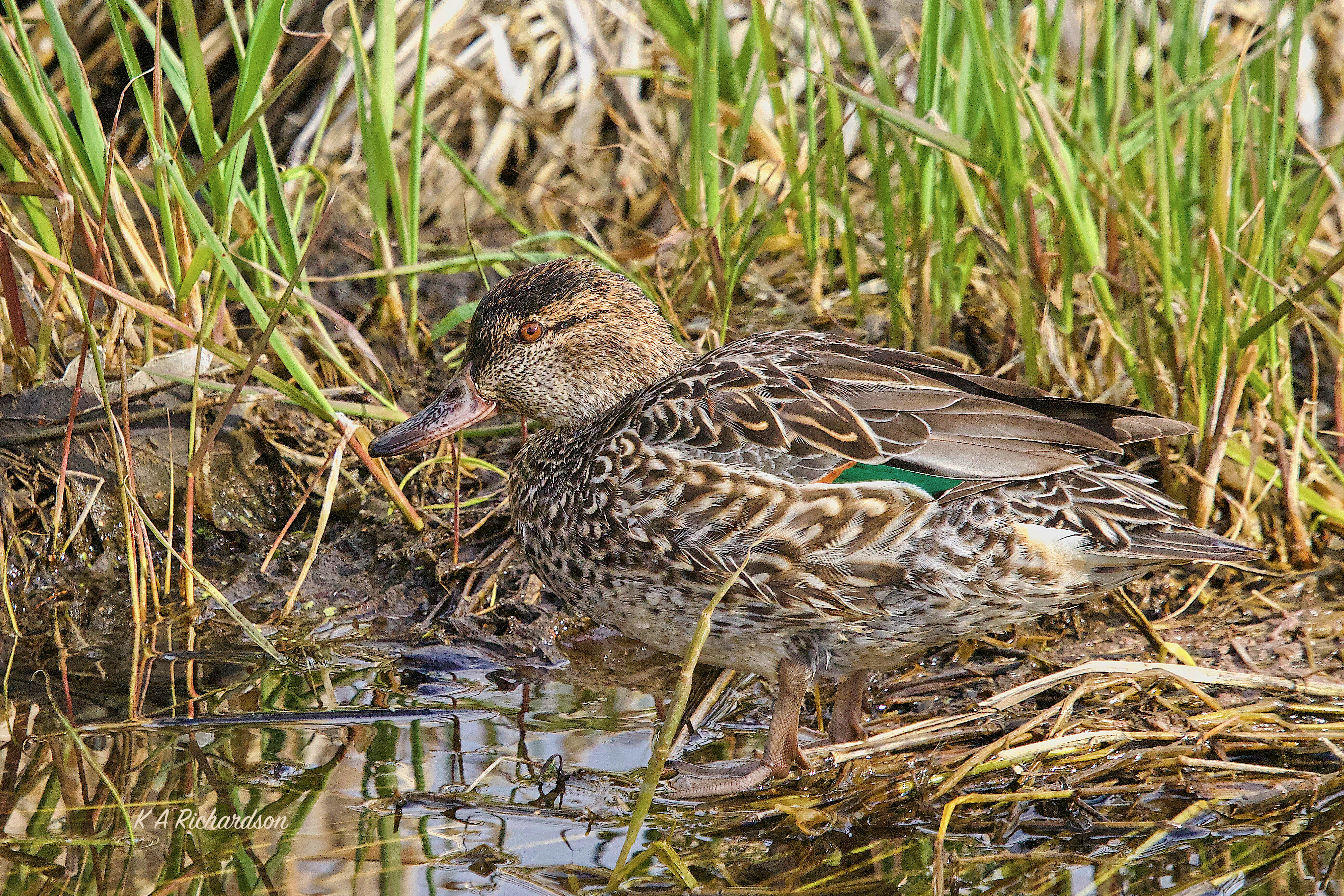
Shakin’ off the winter’s rust!Fluffed up!All calmed down and ready to go!The object of his attention!Spring is the best time of year to get close to our American Green-winged Teals, especially the males!
To keep my posts a little shorter than I have in the past, I’m stopping here. There’s more on April in these posts:
All users and computer users especially: please be patient while the graphics load. I could use lower quality images to speed things up, but I’m not in a rush and I hope you’re not either. While clicking on any image will enlarge it, it will take time to download…. In the multi-image galleries below, you can click on any photo to enlarge all the photos in the gallery.
If you’re using an iPad (best in landscape view), you can enlarge single photos by stretching them with your fingers. For photos in Galleries (collections of images), tap one andwait for it to download. Click the ℹ️ symbol at the bottom of each photo to read the full captions and descriptions.
2021 April 18 was the saddest day of my life so far. My beloved son Sean succumbed to the colon cancer he had been battling so courageously for nearly five years. This post, however, focuses on the happier moments of the year — before April. While the tone is light, rest assured that Sean would have wanted it this way. The details surrounding his passing are posted in a five part series after this one. Rest In Peace, my son!
Part 1 ~ Winter surprises….
The Covid-19 variant first found in India will henceforth be referred to as the “Delta variant,” the World Health Organization (WHO) announced May 31.
Trust me to grab your attention with a phony headline. Rest assured, however, this post is not mainly about the pandemic that has been crushing the world for the past two years.
Rather, this is the first of a series of posts of my birding highlights from the first quarter of 2021, a year that many will remember as Covid hell, but which didn’t hold back my wife and me all that much from our usual routines, including getting out to ‘our beats’. We’re both triple-vaccinated and very cautious about mask-wearing and social-distancing.
Of course, on December 29, 2021 as I begin this post, the Omicron variant is now running wild ‘everywhere‘.
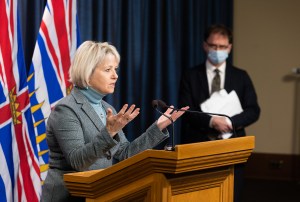
The Omicron variant is reported to be running wild around the world. Three of my eight grandkids have had Covid, including one who’s double vaccinated but has been suffering with the disease through Christmas along with several of her hockey teammates. A younger set of twins have had it twice, months apart and both before and after they were vaccinated. Apparently, however, the second time around (yes, they were tested!) was not so severe. Left: BC health officials tell us about Omicron.
So, I don’t mean to test fate, nor to dismiss the misery that this virus in its multiple variants has wrought and will continue to wring [sic] in the New Year (2022) and beyond! My wife and I have been both very cautious and lucky to avoid the scourge, and we’re most grateful that we’ve been spared — so far.
From a photographer’s standpoint alone, 2021, birding was pretty good here in Central Okanagan. What follows are some of the moments by which I’ll remember the good days….
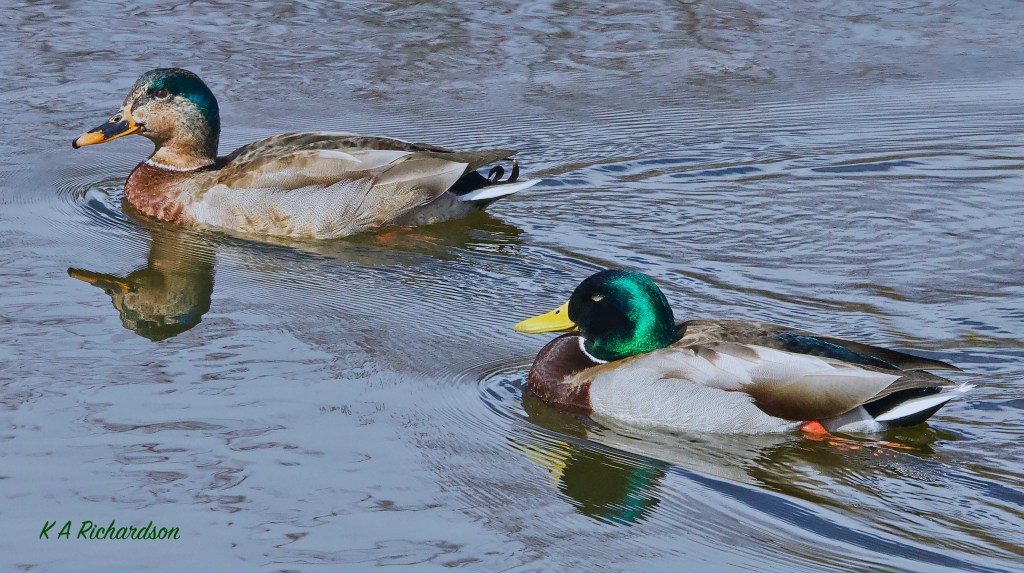
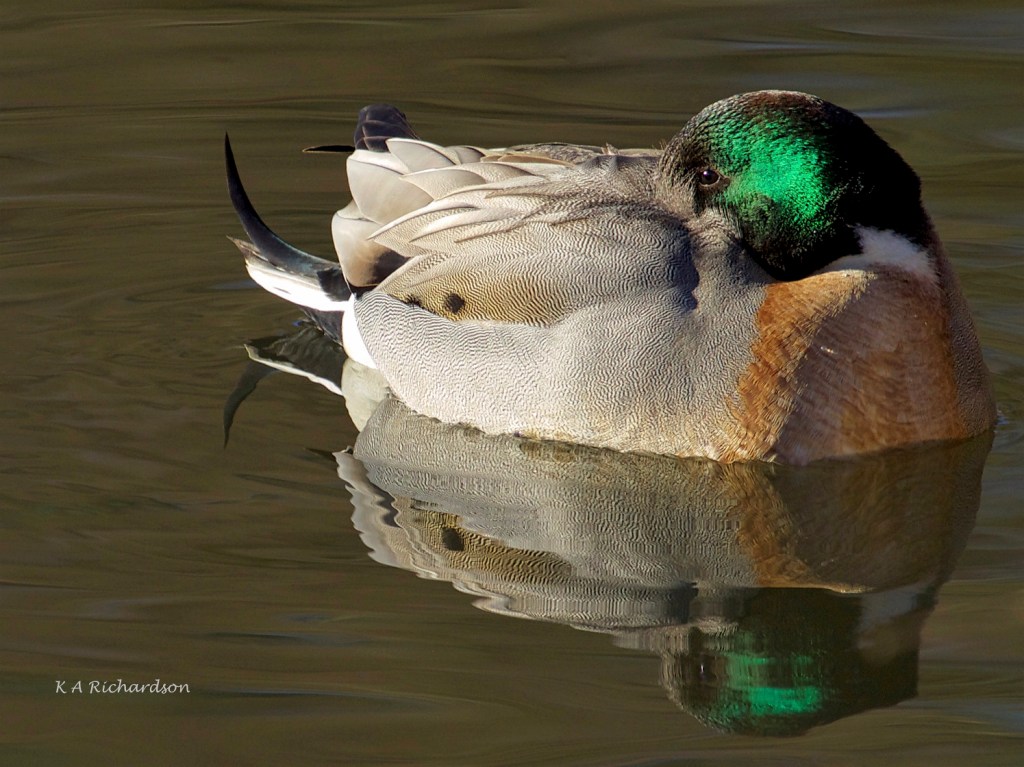
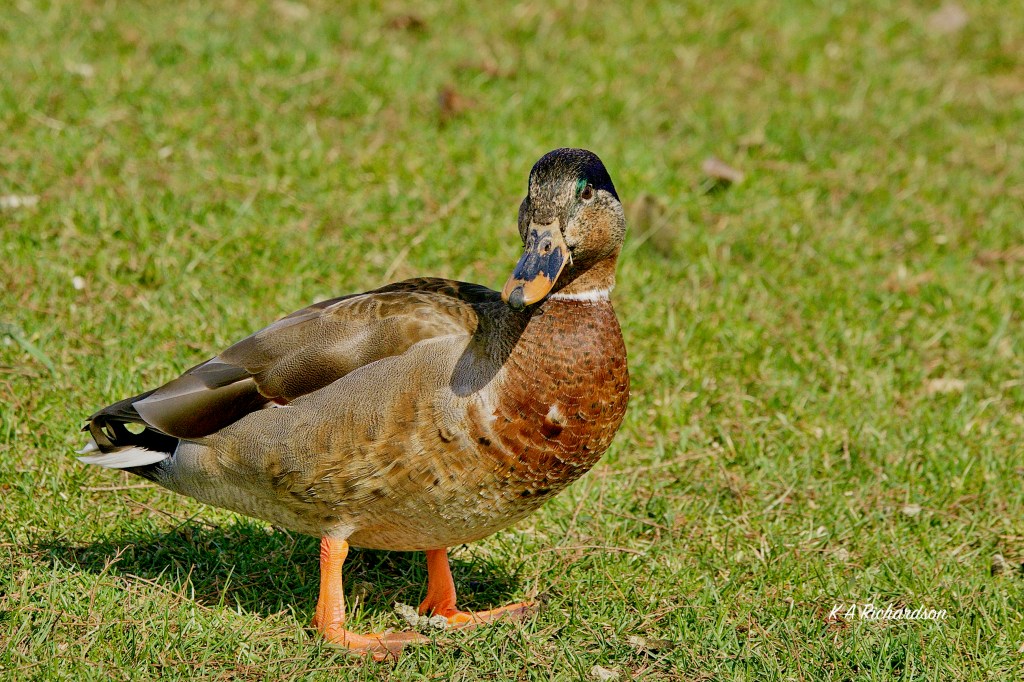
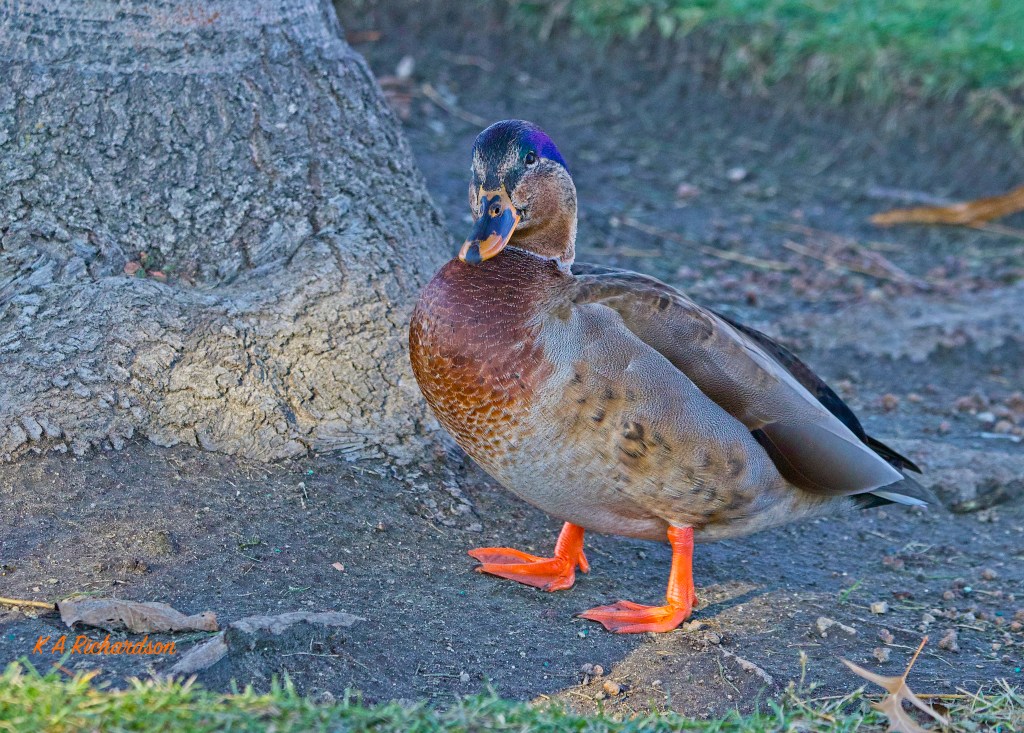
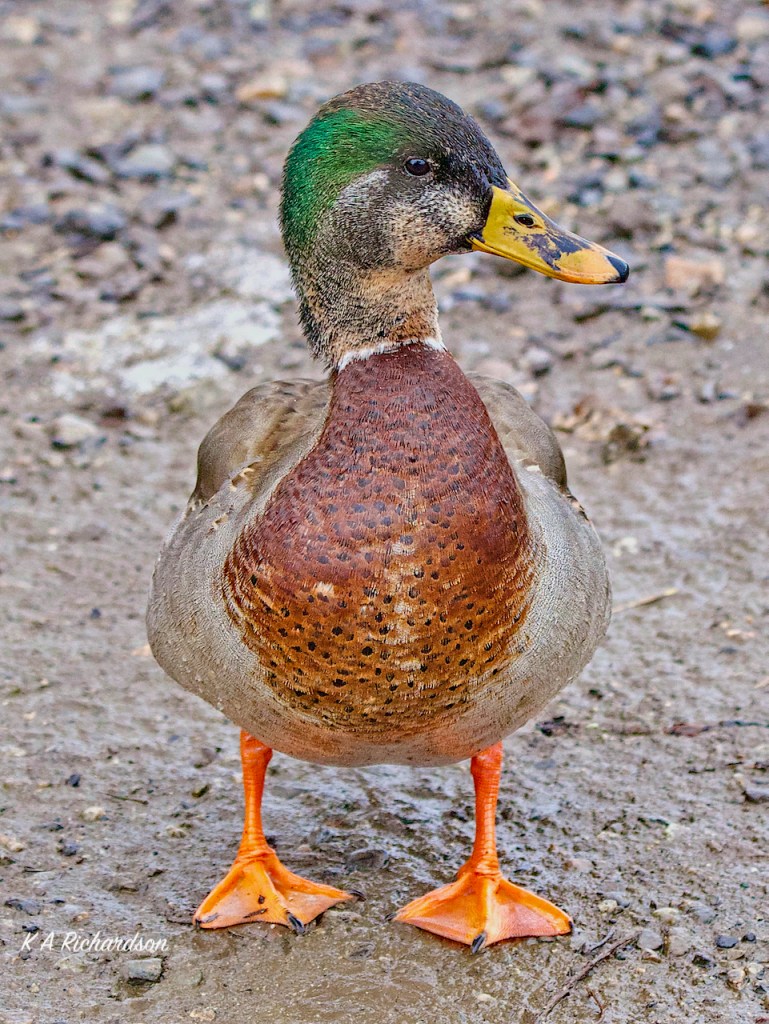
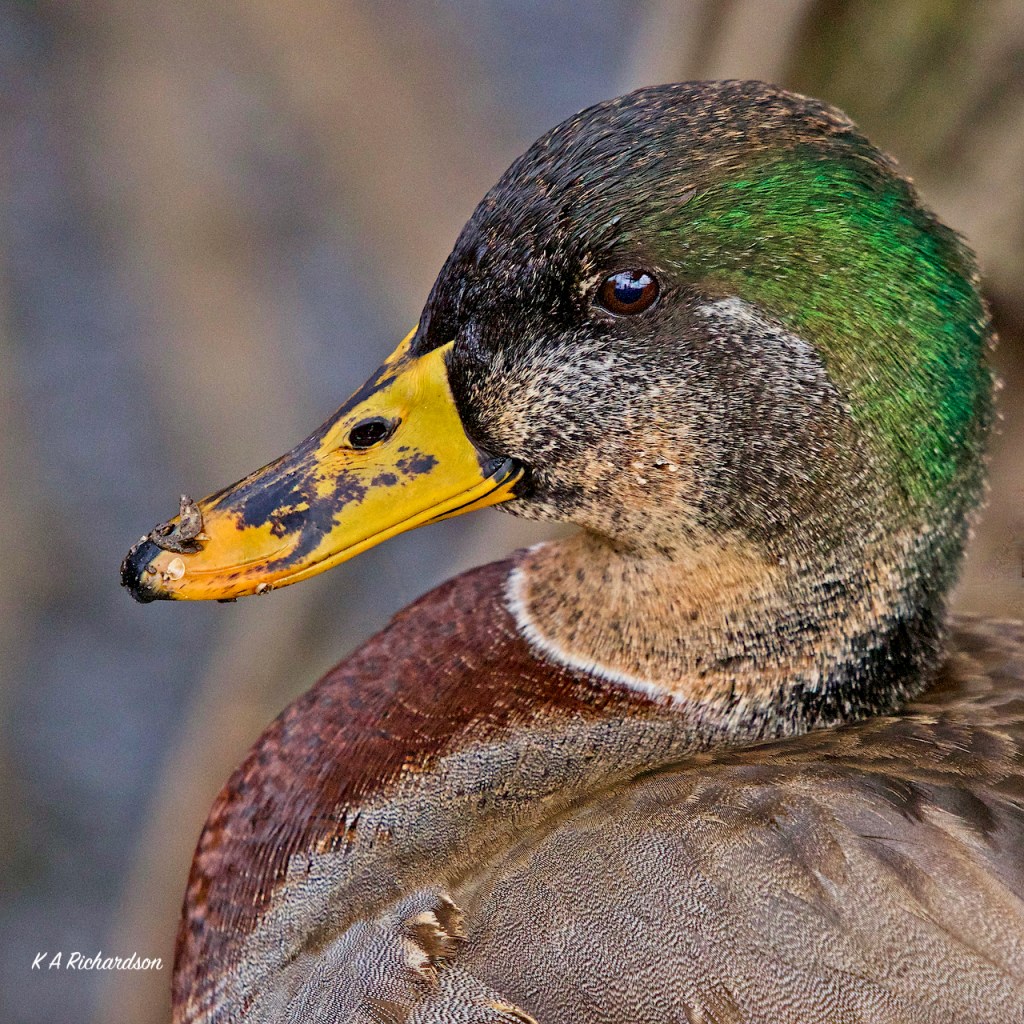
January: More Intersex Mallards (Anas platyrhynchos)! At least three in my territory now as Socratease (at Thomson Marsh) and Muncie (at Munson Park) joined Homer, the first iDuck I stumbled across and wrote about at length. Below, from left to right: Homher, Muncie, Socratease.
But wait (as the hucksters say), there’s more!
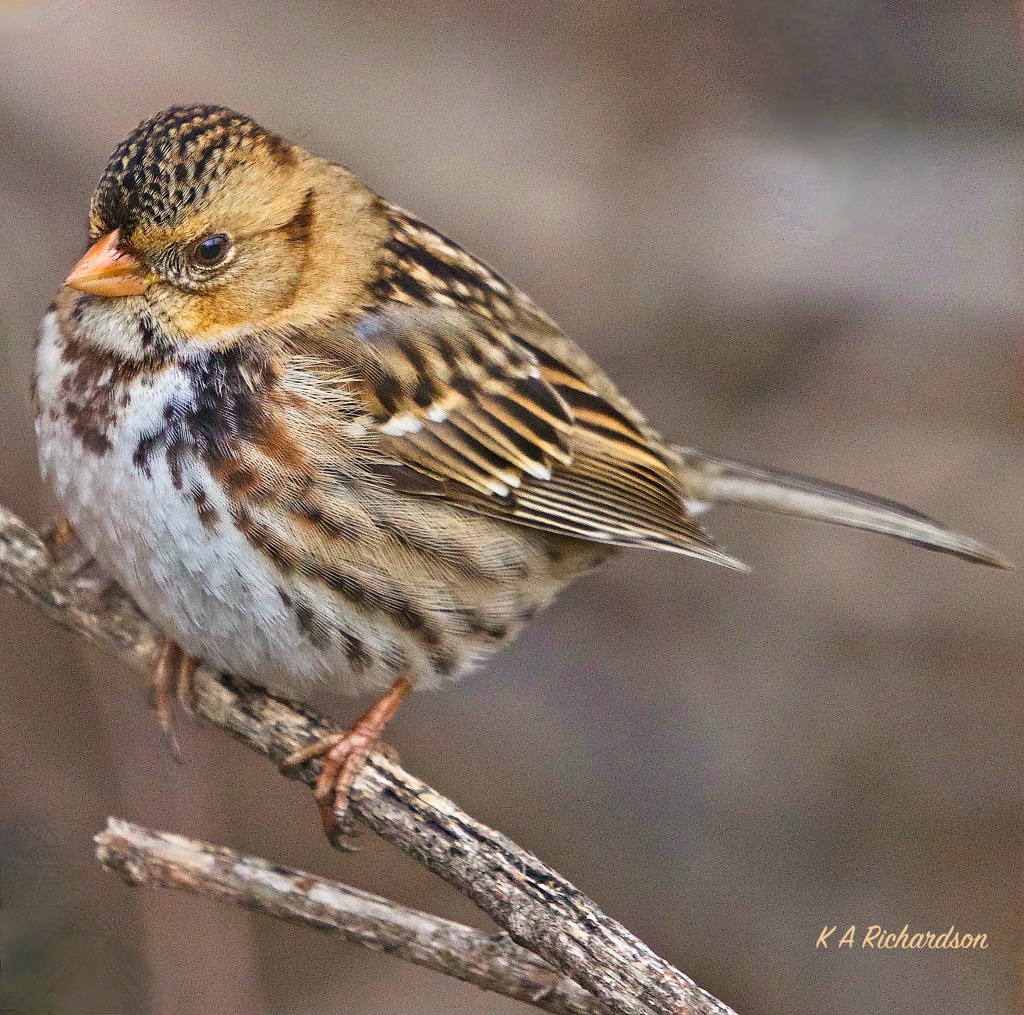
By spending more time over at Munson Park than in previous years, I was able to enjoy great chances to observe this solitary Harris’s Sparrow (Zonotrichia querula) that stuck around well into Spring.
This species, the only one to breed exclusively in Canada, is wintering more often in BC in recent years. It is normally found east of the Rocky Mountains.
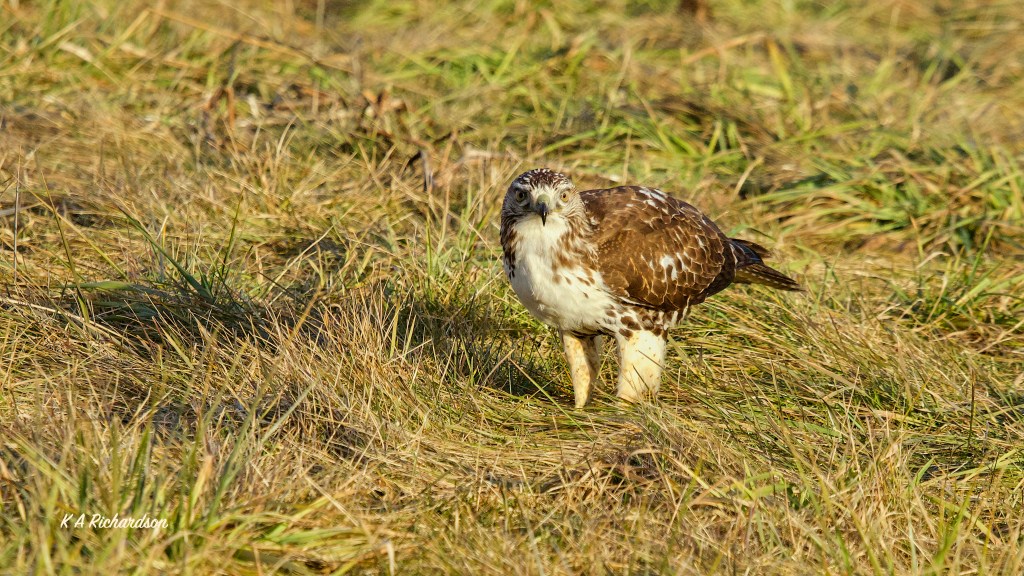
February brought a Harlan’s Hawk (whitish Red-Tail) to Munson Pond/Park. Very similar to Whitey, a Harlan’s that I documented in the winter of 2014-15, I dubbed the Munson visitor ‘Whitey II’. S/he was a great favourite with visitors and photographers for several months.
Whitey II, a Red-tailed Hawk (Buteo jamaicensis), probably a Harlan’s variety, in residence at Munson Park, Kelowna, BC from mid-winter into early spring. Am pretty sure I’ve seen him/her in other areas south of the Park as well. Below you’ll find two more shots of her/him perching.
The Kids’ Fish Pond at Sutherland Hills also provided excellent opportunities to work with a variety of ducks. I’ll post separately about them…. By the end of the month, most of the snow was gone and spring seemed on its way!
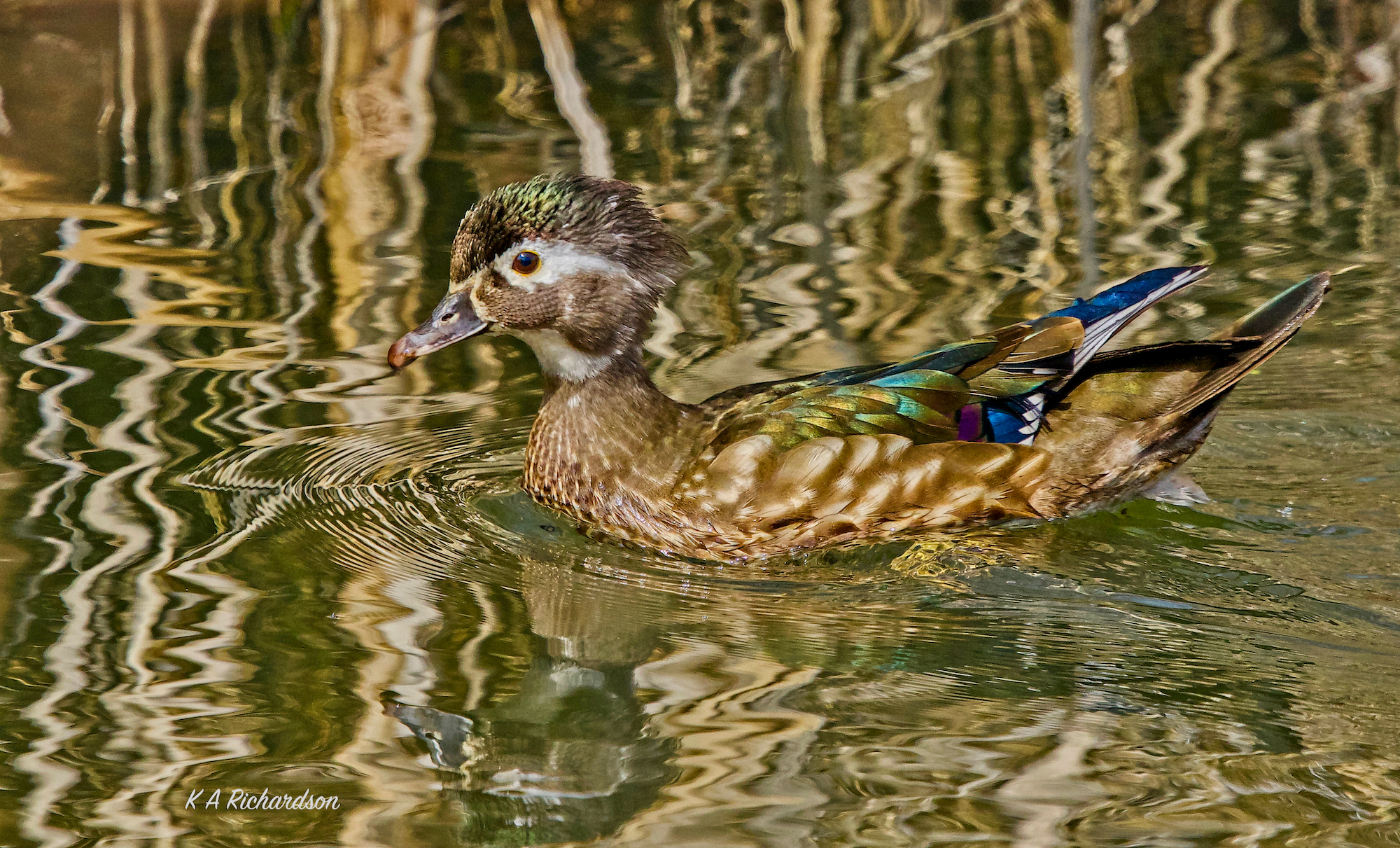
This Wood Duck (Aix sponsa) drake poseur deserves his own post (along with his mate, of course) and will get it in due course!
‘Keepin’ the lads in check…’
This Ring-necked group was especially interesting to study. But there were Hooded Mergansers and Barrow’s Goldeneyes as well! I’ll cover them all in a separate post.
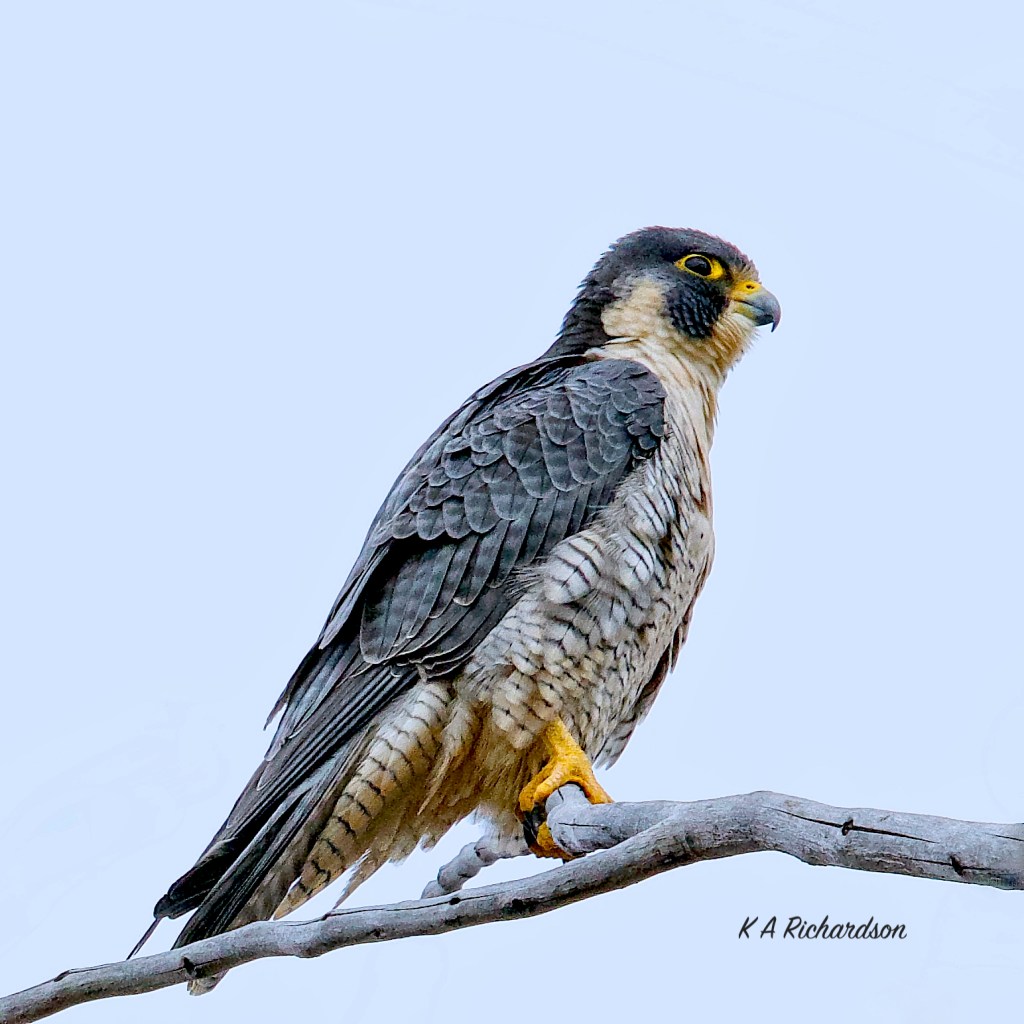
March: a lifer — a Peregrine Falcon showed up at Munson Pond!
Among all my birder/photographer associates, I’m perhaps the last to ‘get’ one of these. Like Whitey II, s/he was enjoyed by many folks over several weeks, but I saw her/him only once. Was very glad to get some shots, which required considerable processing to prepare for presentation!
Not the action shot one wants of a PEFA, but beggars can’t be choosers!
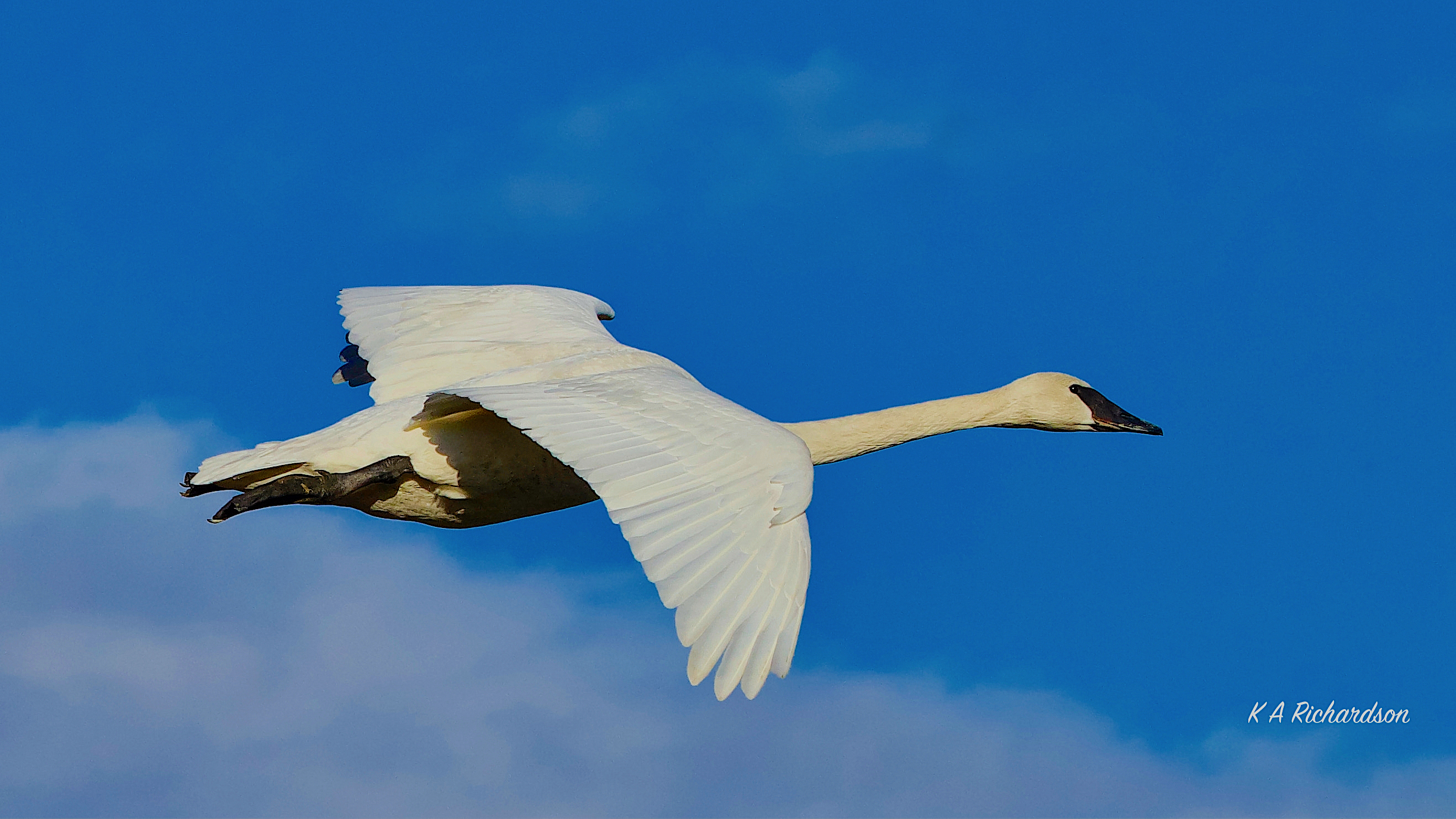
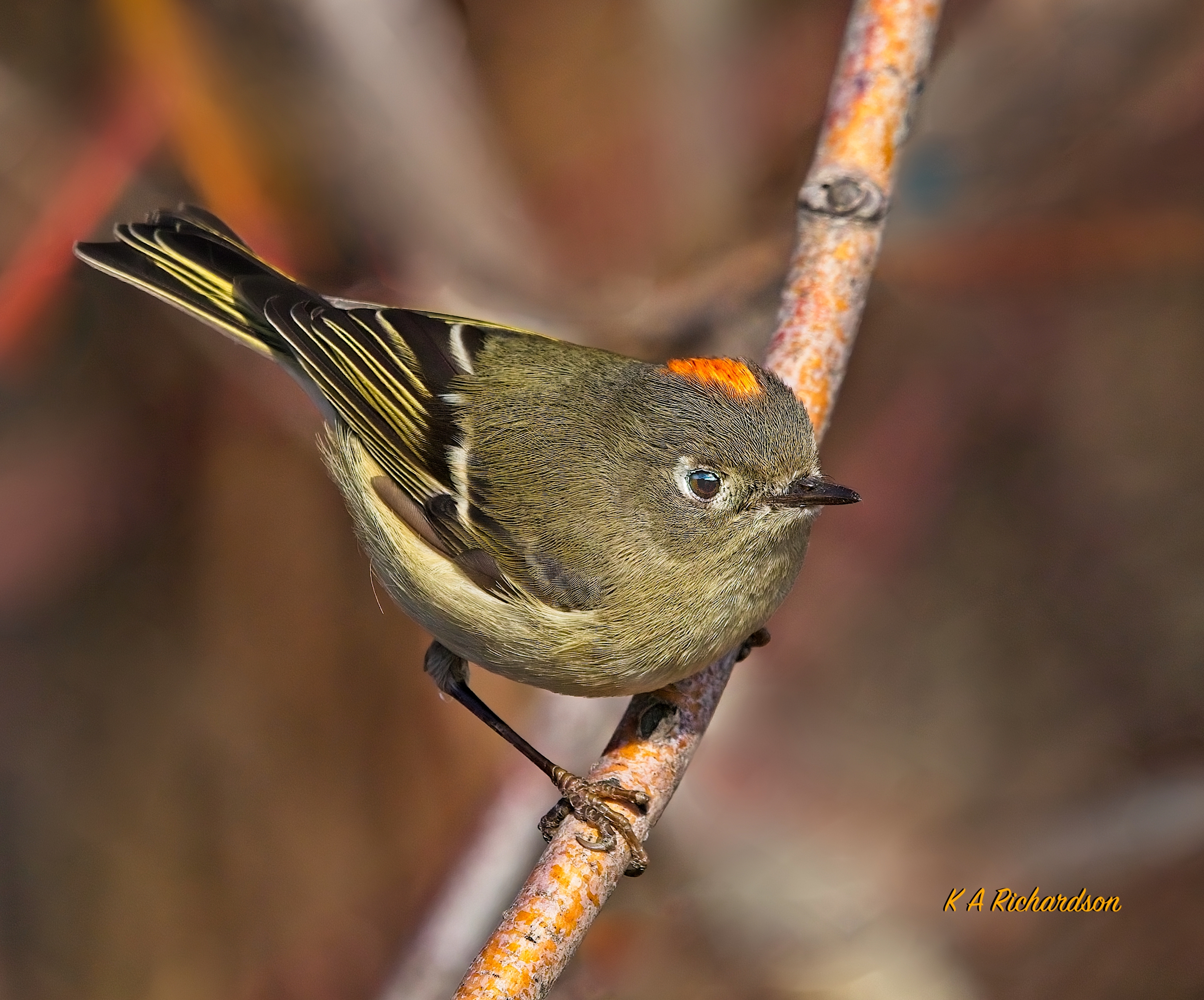
March is usually a great month as the Okanagan begins its transition from winter into spring. While the birds below are not unusual to see here at this time, I was very pleased with the opportunities they provided and the photos obtained: a Pygmy Nuthatch (actually shot at the very end of February), Kessie the kestrel‘s mate ‘Amke‘, a Barrow’s Goldeneye pair in various locations, Trumpeter and Tundra Swans from late February into March at Michaelbrook Golf Course, Red-breasted Nuthatches in Belmont Park, a Pintail Duck at TMarsh, and Great Horned Owls across from the Community Garden, (where they would hang out all through summer), and, of course, Mountain and Western Bluebirds in several places, RC Kinglets up close, and a glorious Spotted Towhee at Mahoney Lake, west of Okanagan Falls.
In the gallery below, you can click on any photo to enlarge all the photos in the gallery. If you’re using an iPad (best in landscape view), to read the full captions and descriptions, click the ℹ️ symbol at the bottom of each photo.
This piece was first published on Flickr and Facebook where I also invited folks to read the posts on the website of The Harvest Golf Course where he had been Director of Instruction since 2013.:
We like to say that children are supposed to outlive their parents. In the case of my son Sean, aged 52 years and 272 days, the ‘normal’ course of life events didn’t happen. The cancer he had been battling since 2016 took him from us on April 18, 2021, what would have been my dad’s 115th birthday.
Our hearts are broken. Sean is no longer with us. We will never again see his impish smile, chuckle at his witty quips, sardonic comments about politics and politicians, or listen to his goofy laugh, which only a handful of his closest friends and family probably got to relish. We will no longer imbibe his delightful instruction and good-natured ribbing, or ponder his philosophizing.
Most folks knew only his gentle, thoughtful, deeply caring and helpful side. By nature, a peacemaker rather than a fighter, when provoked (a very rare occurrence), however, he’d let his opponent know in no uncertain terms. And that foe would have to think about why and whether ever to do THAT again! He did all he could to beat the disease, his worst enemy, but in the end, it took him from us.
Hundreds of people counted him a friend, and he greatly valued those acquaintances. He was attached profoundly to a handful of confidants, most dating back to his schooldays in 100 Mile House, who, along with his family, knew him in both joyful and stressful times. His life was never as simple as some may have thought, especially if you met him only in his maturity after he married Tracy Hansford. The mature Sean was a treasure to the whole community, to those who knew him intimately as well as those who called him a teammate, colleague, coach, fellow fisherman or hunter or conservationist, or public speaker (Here he is at the BC Legislature speaking on behalf of hunting and wildlife conservation: https://www.youtube.com/watch?v=YFLPJ4dk6Ps (11 minutes 35 seconds).
He was a natural leader and diplomat. Here is a post that Sean received in booklet form only days before he died. It details the response of participants in a leadership conference January 28, 2020, where he acted as a leadership consultant to a group of 14 leaders from the international PCL Construction company. It’s worth a read, I think. https://leadershare.ca/encourage-the-heart-blog
For his closest friends and family, his death is devastating. We depended upon him so much for seeing the best in us, bringing us together, leading by example in celebrating life, pushing past obstacles, over hurdles, around paradoxes, and onto a better future. For us who knew what an authentic gem of a human being he truly was, his death is nearly unbearable.
And yet the mature Sean showed us that the ‘unbearable’ is probably ‘manageable’ — that giving up is simply unacceptable. “If something needs to be put aside in order to carry on, then do it,” he’d have said. “Don’t bang your head against a wall, or wail, complain, lash out, or indulge in self-destruction. Find a way to carry on, one step at a time, to find the positive even when the world is roiling with apparent insanity. Calm down, breathe, weigh your options, make the best choice you can in the moment you occupy.” He was no saint, certainly; he didn’t always take his own advice, but more often than not, he did. He led.
That’s how he lived, and how he hoped those he loved would live as well. “You don’t have to agree with me,” he’d have said, “but you have to keep your wits about you. Be the best you can be as much as you’re capable of being.”
There was another section, providing more information about Sean’s life, that I removed after receiving criticism that it was too personal. I am still deliberating about whether or not to put it back up. I have no doubt that Sean would have approved it.
An old dog learns something new…. Does the term “intersex duck” intrigue?
Please note: some of the photos are high resolution and take extra time to load on a slow computer. ALSO: IF YOU’RE VIEWING THIS ON AN iPad,I recommend that you turn it sideways to landscape view then tap the AA at the top of the toolbar and choose Show Reader: I think you’ll enjoy the enhanced reading experience! If you’re using a Mac from 2020or newer, I also recommend that you click on the reader view icon on the left side of Safari’s address bar. I have no idea whether you can get enhanced reading from other systems on non-Apple devices….
Large Belmont Pond, March 23, 2020.
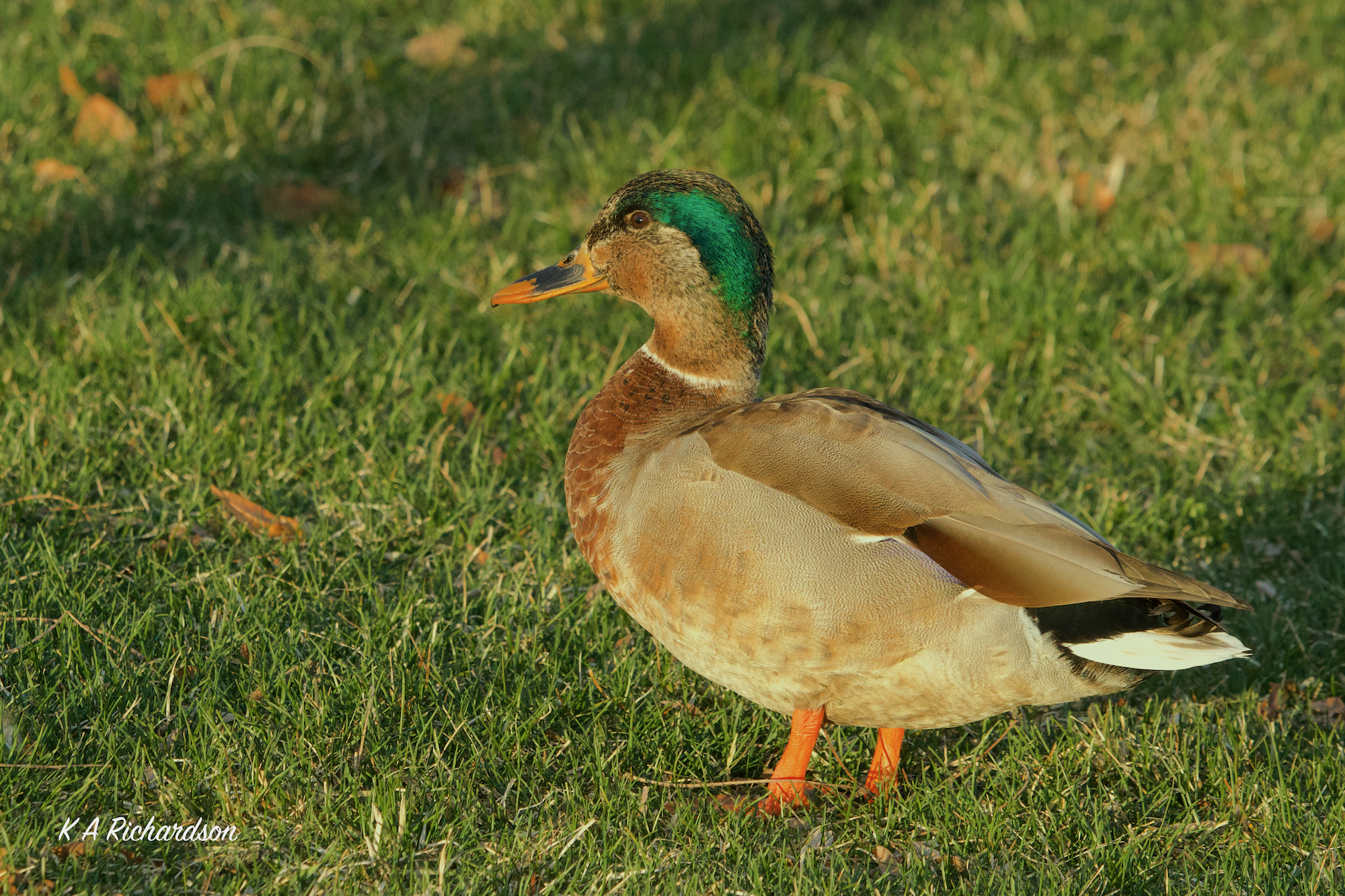
Unusual Mallard, Large Belmont Pond, Kelowna, BC. Check the female bill on this otherwise male-looking duck….
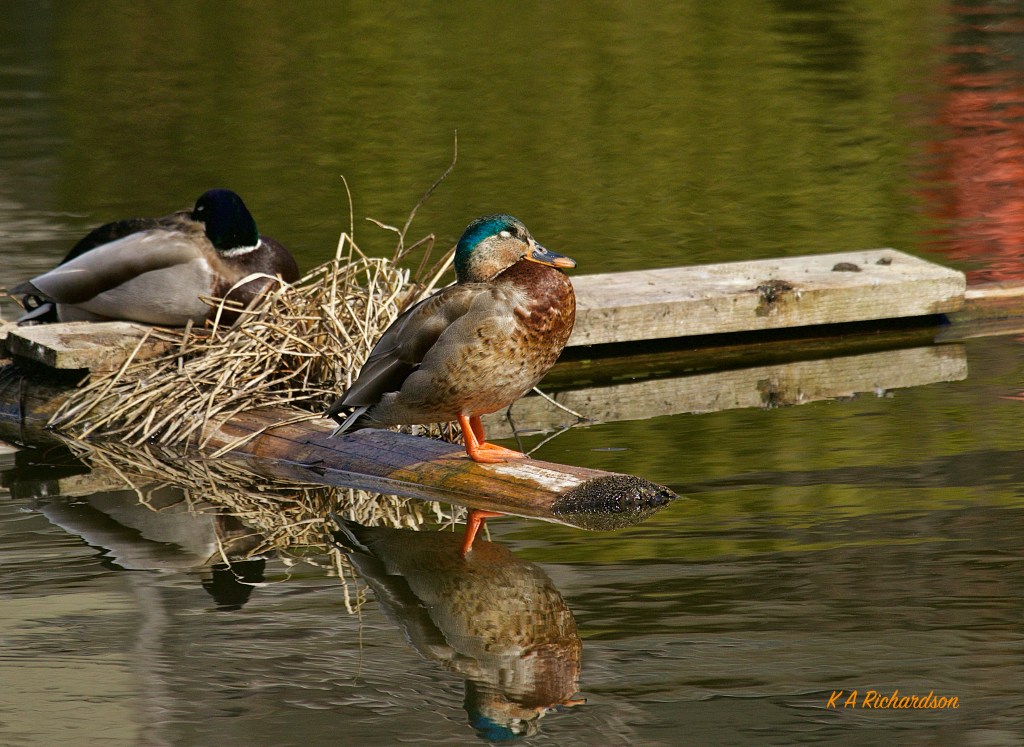
I noticed a strange looking duck, resembling a Mallard drake, sitting calmly on the south-end raft where various species, but mostly Mallards, preen and sun themselves from Spring through Autumn. As there were other Mallards in the pond, it was easy to compare/contrast. What I noticed first was this one’s “white eye,” or more accurately, its closed white lower eyelid.
The plumage wasn’t quite right, either, but that’s not unusual as we move from Spring through Summer. Of course, on this day, we were just at the official beginning of Spring! Remember, too, that this was the first Covid year….
Above is what I thought was (foreground right) aMallard (Anas platyrhynchos) and (upper left) a hybrid Mallard-Gadwall (aka Brewer’s Duck so named by Audubon in 1822) in the Large Belmont Pond, Kelowna, BC. Umm, I got the ‘Mallard’ part right….
Then I noticed the newcomer’s bill: orange with black streaks or spots, like a Mallard hen’s. The head was streaked only on the top side with the green that completely covers other Mallard drakes’ noggins. And the new duck’s sides resembled both a female’s and a male’s.
At the time, I was very puzzled by the combination of male and female physical characteristics. I had nothing in my lexicon to describe it. On my way home, I recalled having seen a reference somewhere to a “Brewer’s Duck” that Audubon had named sometime back in the 1800s that had eventually been shown to be a hybrid of a Mallard and a Gadwall. At home, I looked up BD on the Internet, and found this:
Audubon’s Brewer’s Duck, which he first identified in 1822 as a “Bemaculated Duck,” a misspelling of ‘bimaculated’ and named in honour of the same ornithologist for which the Brewer’s Blackbird and Brewer’s Sparrow are named, Thomas Mayo Brewer.
Then I did what no effective birder, student of Nature, or anybody, really, should do:I jumped to a conclusion without asking enough questions / doing sufficient research. The bird with the fake blind eye (I had already named it Homer, in honour of the blind Greek poet/historian) was, I surmised far too easily, a Brewer’s Duck — a Mallard-Gadwall hybrid! After all, I had seen Mallard hybrids before, particularly a Mallard-Northern Pintail cross that I’d observed in 2013 in White Rock (South Surrey), BC. And I’d learned at that time that Mallard hybrids are not rare, in fact not all that remarkable, really, except for their “enhanced appearance.”
Mallard-Northern Pintail hybrid, January 31, 2014, South Surrey, BC.
Still, Brewer’s Ducks, my research showed, were certainly uncommon. I noticed that Homer didn’t fit perfectly the description of BD’s I was reading, but blithely chalked that up to the idiosyncrasies of hybridism. And then, as I am wont to do (!), I began “sharing the news” of my discovery — on Flickr, and with friends and acquaintances who live in the area and likely to see Homer themselves.
For that impulsive transgression, months later, I humbly apologize. In a moment, you’ll be picking up on the fact that from here on pretty much every use of the male pronoun appears in quotation marks. If you haven’t guessed already, soon you’ll understand why….
‘Homer’ hung around Belmont Pond for a week or so and, even with the sudden onset of Covid-19, friendly neighbours on the east side of the pond allowed me access to their back yard on the pond’s east side to photograph ‘him’ at closer range than in my first encounter.
The original comment, below, turned out be NOT TRUE!! “Mallard-Gadwall hybrid, aka Brewer’s Duck, named by Audubon in 1822. A rare find and a welcome addition to the large Belmont Pond, Kelowna, BC. “ (‘Homer’ was the original spelling; the name has since been adjusted to reflect more recent ‘information.’ Read on!)
Then suddenly, as April arrived, ‘he’ was gone from Belmont Pond. Forever, I suspected; off with the other Mallards to Northern destinations for the breeding season.
I was very pleasantly surprised, therefore, when I “rediscovered Homer” in a channel of Thomson Marsh on April 4 and again on the grass near Teal Pond during the week of April 13.
The main core of my daily beat….
The April photos included extreme closeups that have become very important parts of an historical record. By mid-April, “Homer” had “disappeared” once more. Forever, I thought, again(!).
‘Homer’ in the Channel just north of Teal Pond, Thomson Marsh, April 9, 2020.
Naturally, I celebrated the find, anyway, and persisted in trumpeting the re-arrival of the “Brewer’s Duck.”
Not who I thought ‘he’ was…. But certainly very friendly in this ‘new’ location….
By May, however, Homer was no longer to be seen, at least by me. Not until Autumn, October 29, 2020, when ‘he’ magically reappeared in Belmont Pond, then, as in the spring, in the Southeast Sector of Thomson Marsh, between Teal and Raptor Ponds.. Imagine my surprise!
” ‘Homer’ returns. I had observed this duck in the Spring of 2020 and was surprised and delighted to see ‘him’ again in Belmont Pond in late October 2020. No doubt about ‘his’ being the same bird!”“Gettin’ back to my roots….”
Soon, others were noticing and photographing ‘him’, too. Still, no one I knew ever had a “better” identification of ‘him’ than mine. Then one day, on an umpteenth Flickr post, the late Paul Anthony Baker, a colleague from The West Coast, wonderful photographer and birder who went by the handle “ebirdman,” whom I’d known since 2013* , wrote a simple question/comment in a response: “Lovely shot, Keith! Have you ever done any reading on intersex birds? This bird looks very much like an intersex Mallard. Take a look (at this link) and see what you think. https://www.inaturalist.org/projects/intersex-ducks” And that kind prodding, as we say, changed everything! *(Very sadly, Paul passed away in January 2021: https://www.flickr.com/photos/ebirdman/51842381242/in/dateposted/ For much of a year, we did not know what had happened, until his son chose to update his blog. Paul is deeply missed!)
Here’s what turned up, in part, on the site Paul referenced: Note on iNaturalist website by Reuven Martin (project createdon January 26, 2018): “Intersex” birds are those that show plumage and bare-parts colour seemingly intermediate between male and female. This is commonly seen in Mallards and is also known to occur in other ducks and perhaps other birds. Such birds are often confused with hybrids. As far as I know, the phenomenon is not well-understood or studied. I use “intersex” in quotes because the term has quite a different meaning to how it’s used in humans.
Reuven continued: This project is for any ducks thought to be or to possibly be “intersex”. I’d like to get a better handle on how their plumage can vary. Other interesting questions: * Can these birds reproduce, and if so which sex are they? (Generally thought to be female, but I’m not sure how well-supported that is). * Is behaviour and voice typically more male-like or female-like? * Does the plumage remain consistent over the birds life? (The answer is at least sometimes yes.)
The screen shot below shows some of the locations of interest to Reuven on the iNaturalist blog….
I had written “Homer, the Brewer’s Duck (Audubon, 1822), a Mallard-Gadwall hybrid near Teal Pond, Thomson Marsh, Kelowna, BC, shows how to clip the grass with precision…. “Not so fast,” my friend Paul replied. “Have you ever done any reading on intersex birds?”
As I probed for information on the Internet, I was overwhelmed by what I found. The earliest data I encountered came from a cooperative website, Bird Hybrids http://birdhybrids.blogspot.com (apparently coordinated by Dave Appleton from North Elmham, Norfolk, United Kingdom). It enabled me to find the site of another Flickr member in Sweden, Carl Gunnar Gustavsson, that is also devoted to hybrids and birds that might be mistaken for hybrids, such as the duck below that so resembles “Homer.” Mr. Gustavsson’s post is dated December 27, 2008! And these are his images:
Under his photos, he had written: _63I8334 Mallard Intersex 1 “Malmoe, Sweden 27 December 2008. This is the most masculine out of 2 or possibly 3 individuals at the same pond today. At two other ponds there were only normal birds. I saw this one also about 2 weeks ago when it was accompanied by a normal male and a normal female. Today it seemed to be accompanied by a female only when it at times separated from the flock. I presume that this is a pure mallard with poor sex definition alternatively a masculinised [sic] female. Arguments in favour of other origin?? I uploaded this picture because I think it might add something to the discussion if a bird is a hybrid or an abnormal individual of a pure species.“
While clearly NOT “Homer,” Carl Gunnar’s duck in Sweden 12 years ago certainly represented the same natural phenomenon I’ had’ been viewing in Kelowna, BC, Canada!
Besides his own photos I found a useful opinion Mr. Gustavsson had offered on on someone else’s work, as well, that sets out his criteria of judgment in the hybrid vs intersex argument (quote copied and edited to remove Internet links that no longer work): “I [d]on’t think it is a hybrid at all but what we call an intersex, i.e. a pure Mallard with both male and female features. Odd but not too uncommon. This one is the most extreme that I have heard of [dead link removed]. It was ringed [banded?] as a typical female but 10 years later looked like a rather typical male except for the bill which is still of a female type (it is the bird in the front I am talking about!!!!!!!!!!!). Some other examples, mainly my own [dead links removed]…. As you can see there are different degrees of masculinity and I think yours is rather typical. Black on the bill like in a female, green on the head green from the eye and backwards/downwards reminding on an american wigeon [sic], a mixture of male and female feathers along the side of the body and more or less obvious male type “hooks” on the tail.Moulting [eclipse] male birds is the big pitfall but should not be a problem at this time of the year, [as they] do usually not have black on the bill or only a black mid rib on the culmen [upper ridge of a bird’s bill] and usually have a more mixed pattern of colour on the head — not the typical limited one that your bird has.” [bold face and square brackets – [ ] – are mine – KAR]
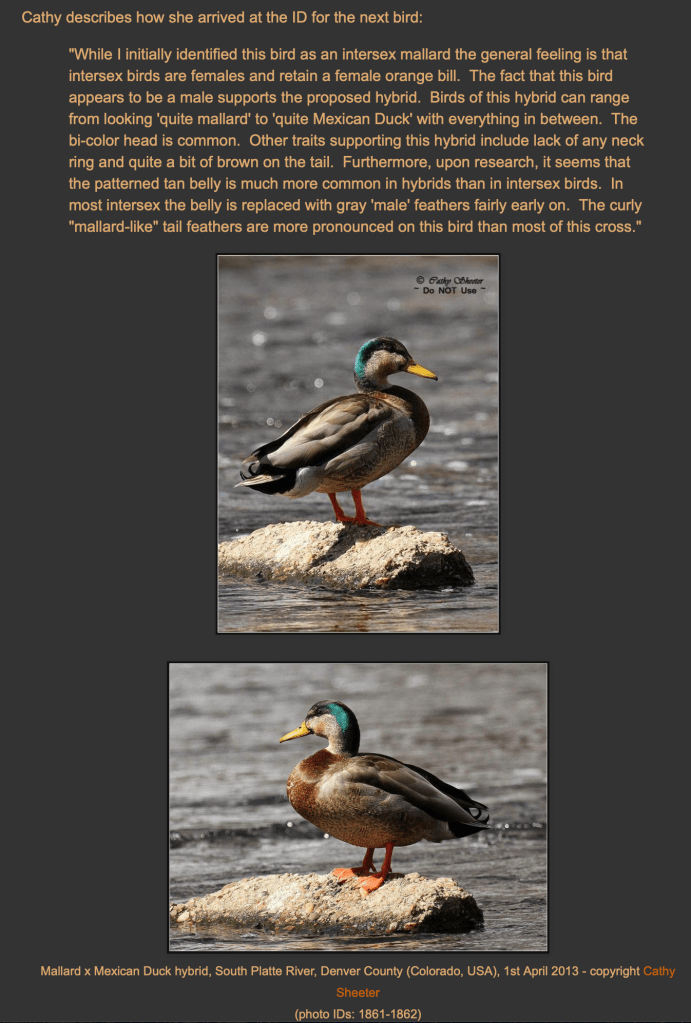
As I delved deeper into Dave Appleton’s Internet page on hybrids vs intersex ducks, I came across other opinions. One of the most interesting is authored by Laura Erickson, a birding expert and writer from Duluth, Minnesota. One of her first references to “intersex ducks” appeared on her Flickr site on February 3, 2009. [https://www.flickr.com/photos/lauraerickson/3251558114] where it attracted a comment from Joern Lehmhus. (He is still actively chasing this issue as shown by his comment on one of my Flickr posts in December 2020 pointing out that I had found an intersex duck, not a Mallard-Gadwall hybrid!) In 2009, Mr. Lehmhus was questioning whether the duck Laura had labelled “intersex” was perhaps a Mallard-Black Duck hybrid. It was not as we learned from yet another post by Cathy Sheeter, another Flickr member who discussed the Mallard-Mexican Duck hybrid vs iDuck issue on Appleton’s Bird Hybrid’s site on April 1, 2013 (and no, I don’t think there’s an April Fools prank involved here!). https://birdhybrids.blogspot.com/2014/04/mallard-x-mexican-duck.html
Cathy’s duck, she concludes,isa hybrid, not an intersex. This discussion continues below the sidebar in red below.
SIDEBAR! This “hybrid/intersex/eclipse drake distinction” became important to me when I came across a second duck at Thomson Marsh on December 1, 2020, that was also difficult to identify, one I eventually named Socratease. More on her (shown just above) later..
In her piece, Cathy Sheeter emphasizes the importance of the appearance of the bill. When I suggested that Socratease (above) is an intersex Mallard, my Flickr friend Jody Wells, on Vancouver Island, challenged me, claiming that it was just an eclipse drake, using the bill and other features to explain why he thought so. At first, I was inclined to agree. Over time, and having managed a couple of times to find Socratease again, I became more sure of my judgment. Jody was apparently unfamiliar with intersex ducks at that time, and is learning about this phenomenon along with me…. Eventually, I concluded that Socratease is also an iDuck!
Now back to C Sheeter’s case for why the duck in the photos below is NOT an intersex Mallard: (Note: as I cannot copy the individual photos, I’ve had to use a screen shot from her site.)
This discussion shows how easy it is for some of us to mix up hybrids and intersex ducks….
I also want to return to Laura Erickson’s blog from Minnesota for a moment. Although she first discussed intersex Mallards on herFebruary 2009 podcast, she returned to that story in her blog post of February 13, 2016 where the audio has been transcribed. I encourage anyone interested in this story to read it here: https://blog.lauraerickson.com/2016/02/intersex-mallard.html. Part of what makes it interesting to me is her attempt to link aging to sexual characteristics, not just in Mallards, but in other birds, and even people.
To hearthe original 2009 podcast click the link below then follow my instructions. Her audio podcast is a bit hard to get to, but worth the effort: https://www.lauraerickson.com/radio/?year=2009 Scroll down and click 2009 (on the list on the left), AND THEN in the next window, scroll down again to the February 4th entry – “Intersex Mallard” and click the audio link THERE to hear her short and fascinating podcast:
PLEASE NOTE: as time/opportunity permit and more information and thoughts develop, I am continuing to update this post and add others related to it!
These are the main areas I go to; there are many others as well. This map is included to show the distance between Belmont Ponds / Thomson Marsh and Munson Pond and Park.
UPDATE: In January 2021, at Munson Park, as the ducks fly, about 3.6 km north of where Homher resides, I found a third iDuck. To keep things simple, I named her Muncie. She was hanging out with a pair of mooching Mallards near a well-known bird feeding station catering to passerines. The ducks help clean up the spillage. The drake of the pair was somewhat mean towards Muncie, but she handled his harassment cleverly and found efficient, somewhat sneaky routes back to the treats. I  observed her several times through the remaining winter of 2021. At one point, she had met a single Mallard drake whom she was dominating!
Here is a little gallery tribute (Click on a photo to enlarge it and enter the gallery; to close it, click the x in its top right corner.)
In the fall of 2021 she appeared again and is still to be found in the same location in February 2022 and in Spring 2023:
Another Intersex Mallard, I believe! A little over 3.4 kilometers (2.1 miles( northeast of where Homher resides. “Had I known you were coming, I’d have cleaned my bill, and made one for you!”Muncie the iDuck of Munson Park, 2021. My last ‘spring photo’ of her at Munson Park was taken March 1. However, on a visit to the feeding station there on November 13, 2021, a very dull afternoon, I found her again — literally ‘same time, same station’! I have since seen her in January and February 2022 and 2023. I did not follow up in 2024, unfortunately.Muncie the Intersex Mallard (Anas platyrhynchos) of Munson Park, March 1, 2021
For the full record of Homher, the gorgeous iDuck star of Thomson Marsh (below), take a quack at my growing Flickr album of Homher here: www.flickr.com/photos/8666250@N02/albums/72157713743926477 Here’s one of our “venerable lady” in February 3, 2021, and below that three and a half months later, and below that a link to a new post following her through to a full year after that — February 2022.
Intersex Mallard, Homher, SE sector, Thomson Marsh, Kelowa, BC, February 2, 2021.
Update November 4, 2021 Homher disappeared again in April but reappeared on May 18, 2021 at Belmont Pond (where I had first seen her over a year earlier and where she had been seen by another Kelowna photographer, Roberta Snow, as far back as June 2019).
Intersex Mallard (Anas platyrhynchos) Large Belmont Pond, Kelowna, BC, taken May 18, 2021. It appeared that our venerable lady had decided to hang out here for the summer. Latest spring sighting was June 1. After this she went AWOL again — until she reappeared near Teal Pond in Thomson Marsh, over a kilometre to the east on October 27! She continues to hang out there into 2022!
IMPORTANT NOTE: ALL PHOTOS IN THIS POST CAN BE OPENED, ENLARGED, IN A NEW TAB. JUST CLICK THE IMAGE!
Sparrow Haven, in The Brush Pile behind CNC, adjacent to Kelowna Rec Field, Kelowna, BC.
After five full years here in Kelowna, I’ve come to realize that every year is different from a birding/photography standpoint. Just when I think I’ve figured out a pattern, something happens to disrupt my generalization. This past winter was a doozy.
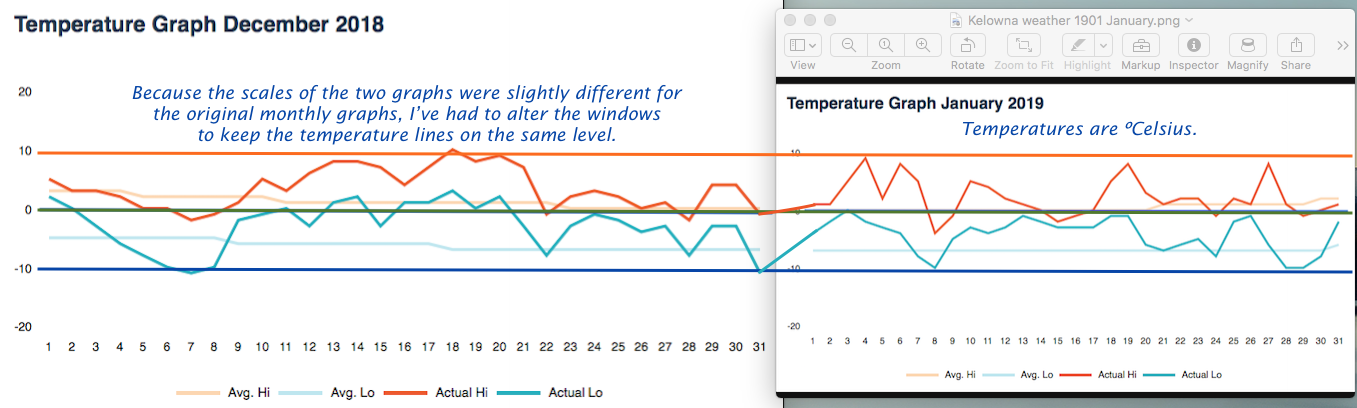
Start with the weather: December and January were wonderful, above average temperatures, no snow to speak of, the Marsh unfrozen: who didn’t appreciate climate warming?! Click on the graphs below to open them, enlarged, in new tabs.
Then February arrived: this graph shows how our Feb. temperatures have changed over the last three years. We had only a little snow in 2019-, but, as you can imagine, it did not melt until mid-March. Click to enlarge.
February has gotten much colder!
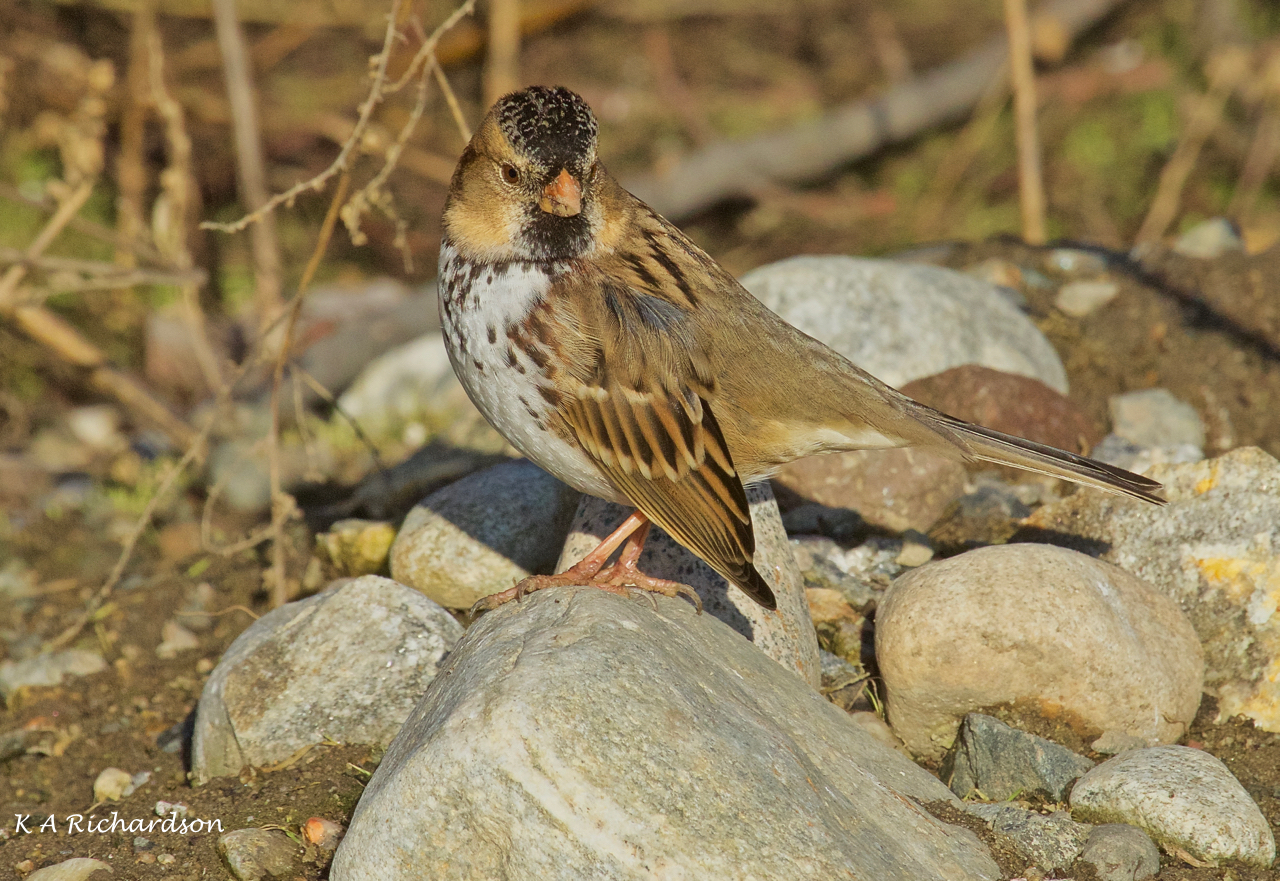
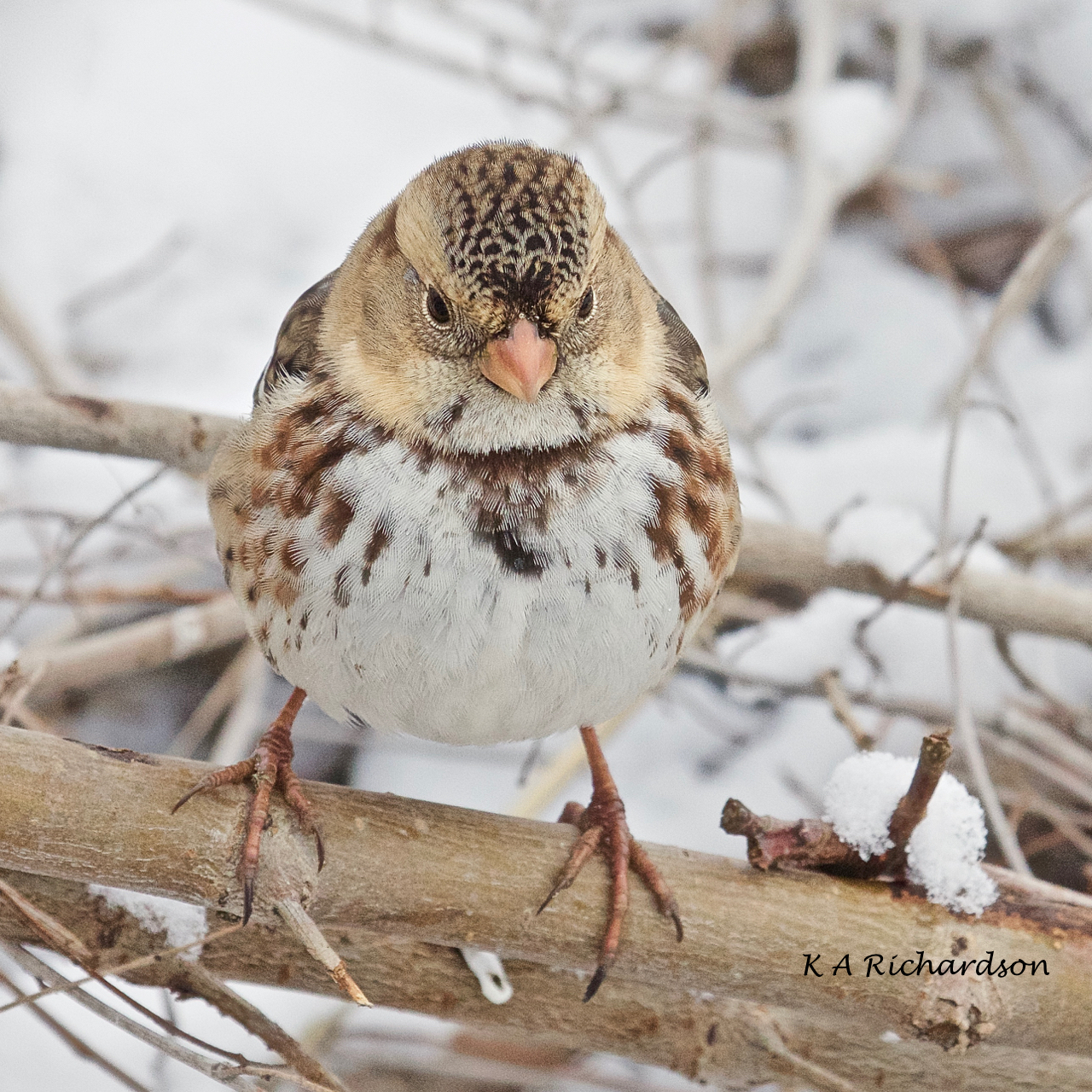
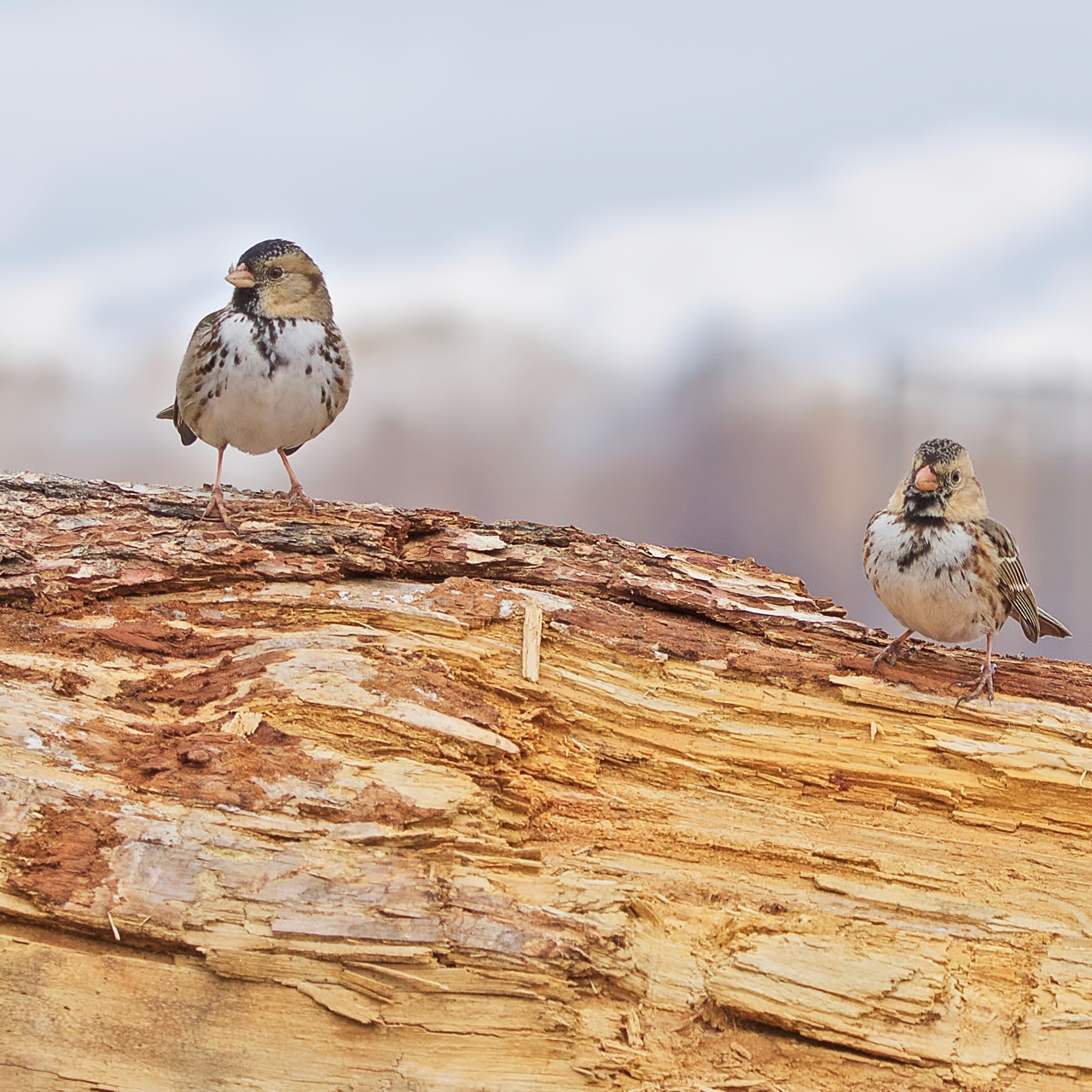
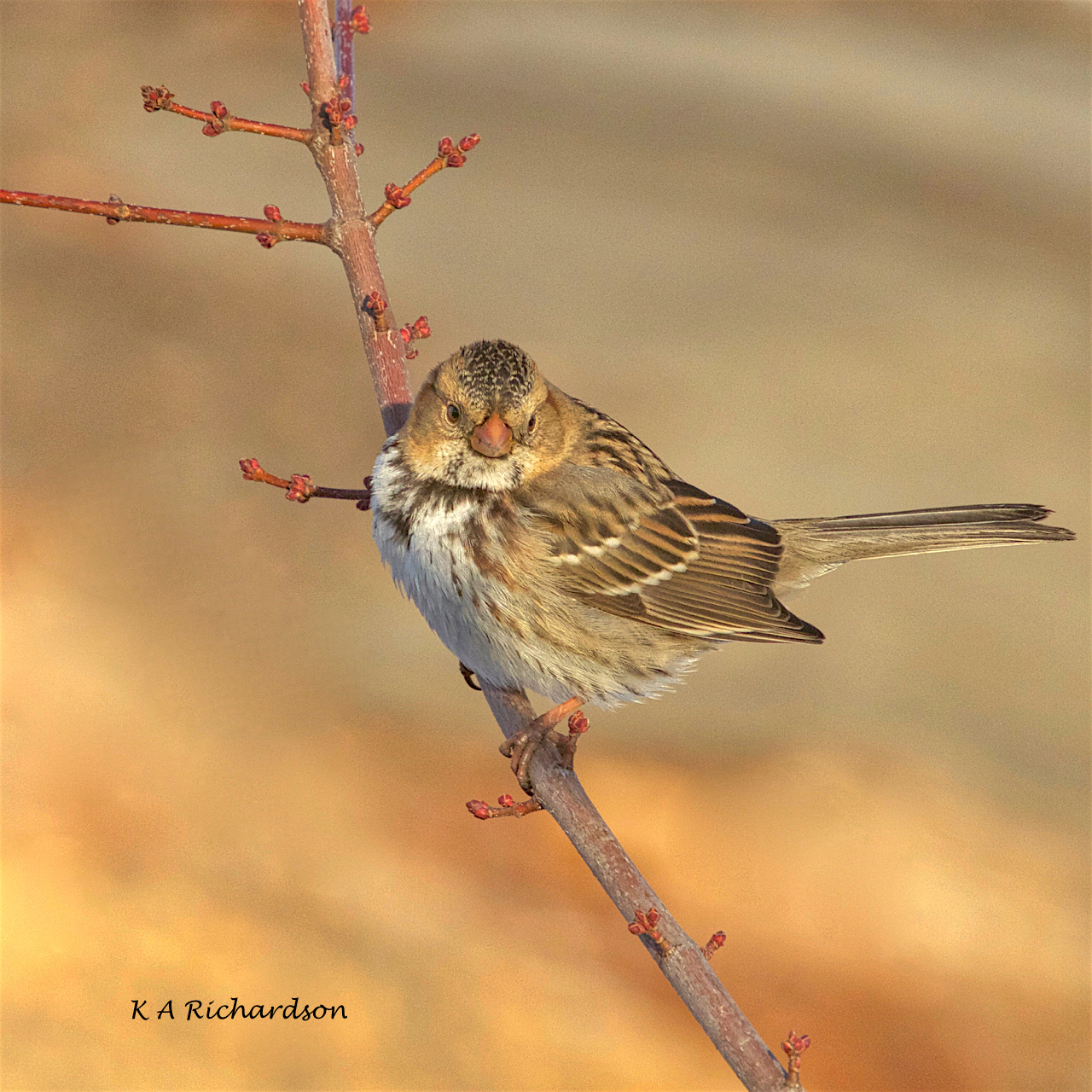
More important, from a birding/photography standpoint, was the accidental creation of an environment that was very much appreciated by our local Song Sparrows and White-crowned Sparrows, and four (some claim five) accidental tourists who normally spend their winters east of the Rockies — Harris’s Sparrows:
Blackbeard, the adult in his/her winter plumage.White Bib, the second most easily identified.Whiskers, more difficult to ID until you know what to look for….Tawny, perhaps the most difficult to spot and identify because she is similar to White Bib and Whiskers — again, until you know what to look for….
So how do we tell them apart? Well, as I indicated, Blackbeard and White Bib are pretty easy to differentiate. I came to know them first:
Blackbeard looks just as you’d expect!White Bib has a a lovely white bib with a well defined Fu Manchu moustache. The black slash on his upper breast runs down and right from our perspective.
Whiskers was so named because in the bib area s/he from the beginning he had some darker streaks unlike White Bib who had none. In time, however, I also noticed two more distinguishing features: a small black dot below each eye and near the back of the bill, and a faint black spot on the breast just below the dark slash, which on Whiskers runs from right to left as we are facing him.
Also note that Whiskers’ black slash on the upper breast runs down and to our left.
Here we can see Blackbeard and Whiskers together:
Blackbeard on the left, Whiskers on the right. The faint spot on Whiskers’ breast (under the dark streak) has become darker as have his/her whiskers!
And finally, Tawny, the most difficult to distinguish from White Bib but easily distinguished from Blackbeard and Whiskers:
Tawny has a bib that’s less white than White Bib’s, but is not nearly as dark as Whiskers’. The crown is not as black as the other Harris’s either….























































 birds & musings