We didn’t know what was coming. Preparing to live with the unchangeable by loving all that can and does change — with or without our consent.
No one expected the week preceding Sunday, April 18 to be Sean’s last. Certainly, he didn’t. He continued to go to work, was eager to get his first Covid 19 vaccination on Thursday the 14th. We talked about it by phone. ‘No problem,’ he said. But his right arm was next to useless and his breathing so laboured that phone calls had to be brief. I planned (in my head) to visit him on Sunday.
In the meantime, I continued to enjoy the fine spring weather, walk my daily beat, and to add to my photo collection. We even travelled to Bertram Creek Regional Park, a few minutes south of our place on the east side of Okanagan Lake. Not much to see at first in the park itself. We wandered down to the observation pier that stretches out into the lake and watched a pair of Common Mergansers keeping their distance from us. Until, that is, this eagle showed up, flying in our direction:
This approaching Bald Eagle did us a great favour by causing the C Merganser pair to flee in the direction of the pier and my waiting camera. Click on photos to enlarge them in new tabs. To return to this post, just close the tab.
Good shots of Mr. Greenhead can seldom be counted on; I got very lucky. Thanks, Baldy!
Closer to home (like in the foundation stones of our condo or in the small walled-in front yard) there was some fun to be had, too, watching our local residents at work and play…. Click images to read captions; to see the photo’s title, click the ℹ️ symbol.
I did travel up to Beaver Lake Road to check on the bluebirds. Only later did I understand that for me this would become the Year of the Female Blues. I usually get much more cooperation from the males than from their mates. That expectation was turned on its head this year — only one of many challenges to custom….
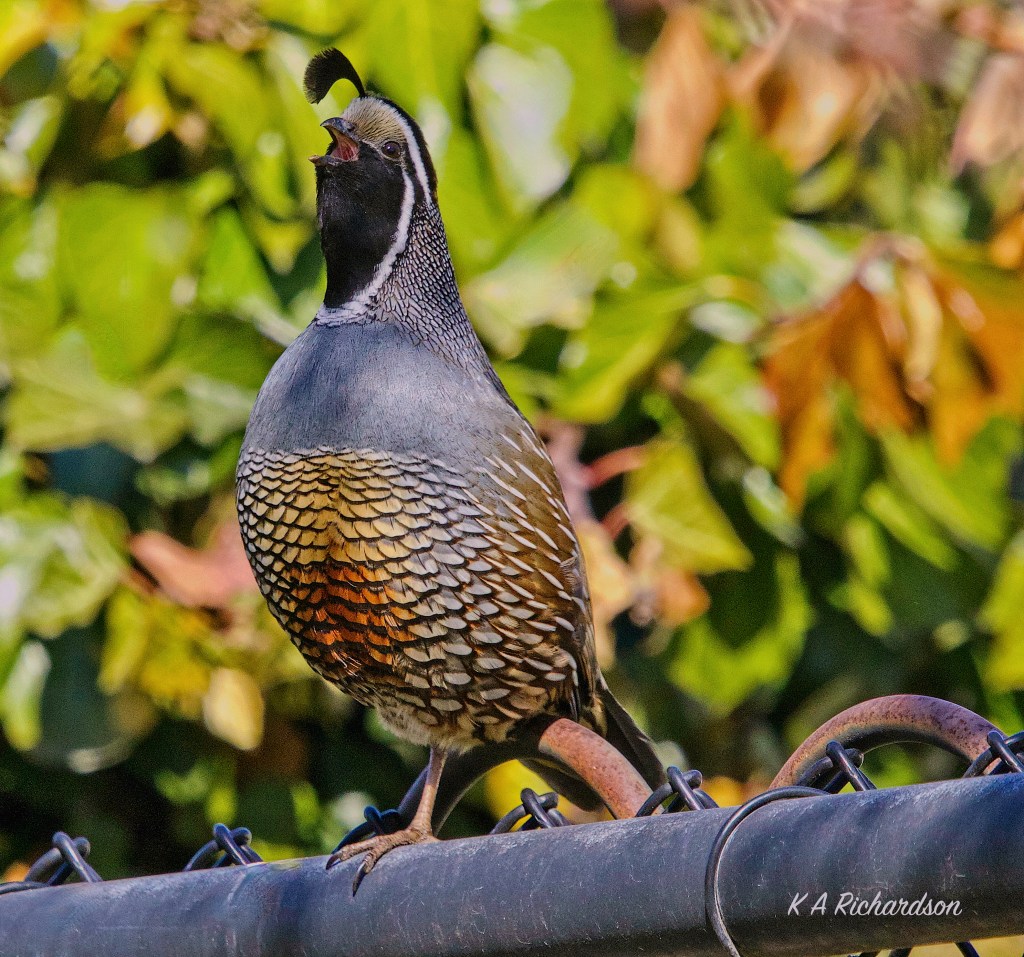
Our part of Kelowna has numerous coveys of California Quail, one of which likes to frolic in Belmont Park a few minutes walk north of our place. On Saturday, the 17th of April, as I took my route in a counterclockwise direction for a change, I heard this fella rehearsing his one note solo. Click the images to see details.
Johnny One Note practises for Spring! California Quail (Callipepla californica) Belmont Park, Kelowna, BC.
Or did I have it all wrong? Was he trying to warn me that my world was about the crumble? My son left this world the next day.…
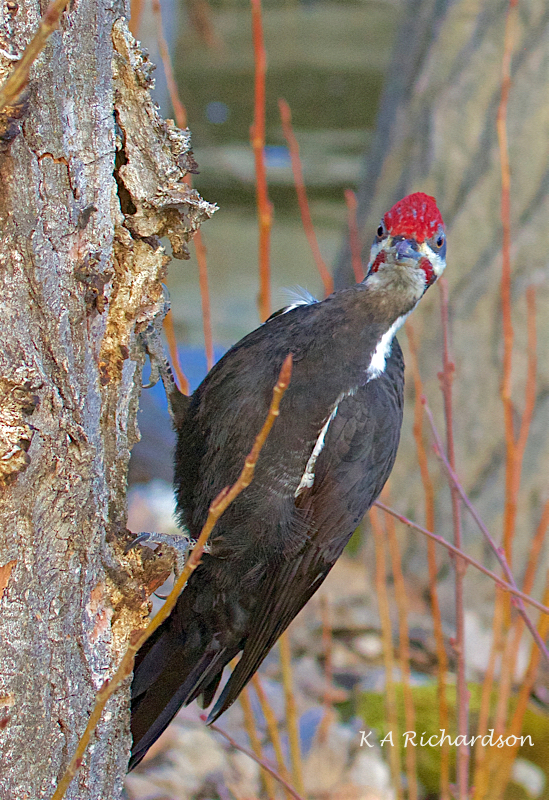
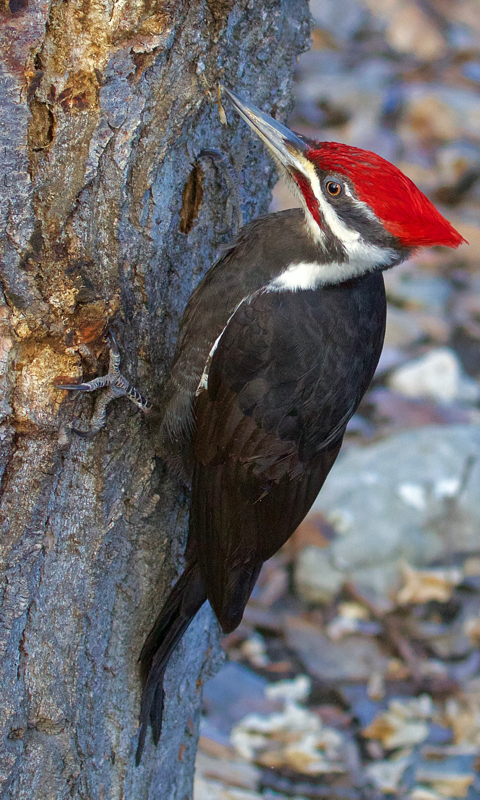
Mission Creek, Kelowna, BC. near Gordon Bridge. Fearless Foz: Click photo to enlarge in new tab.
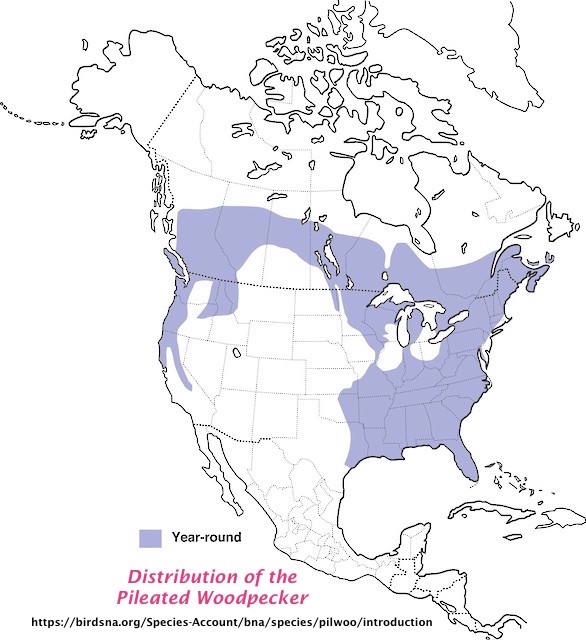
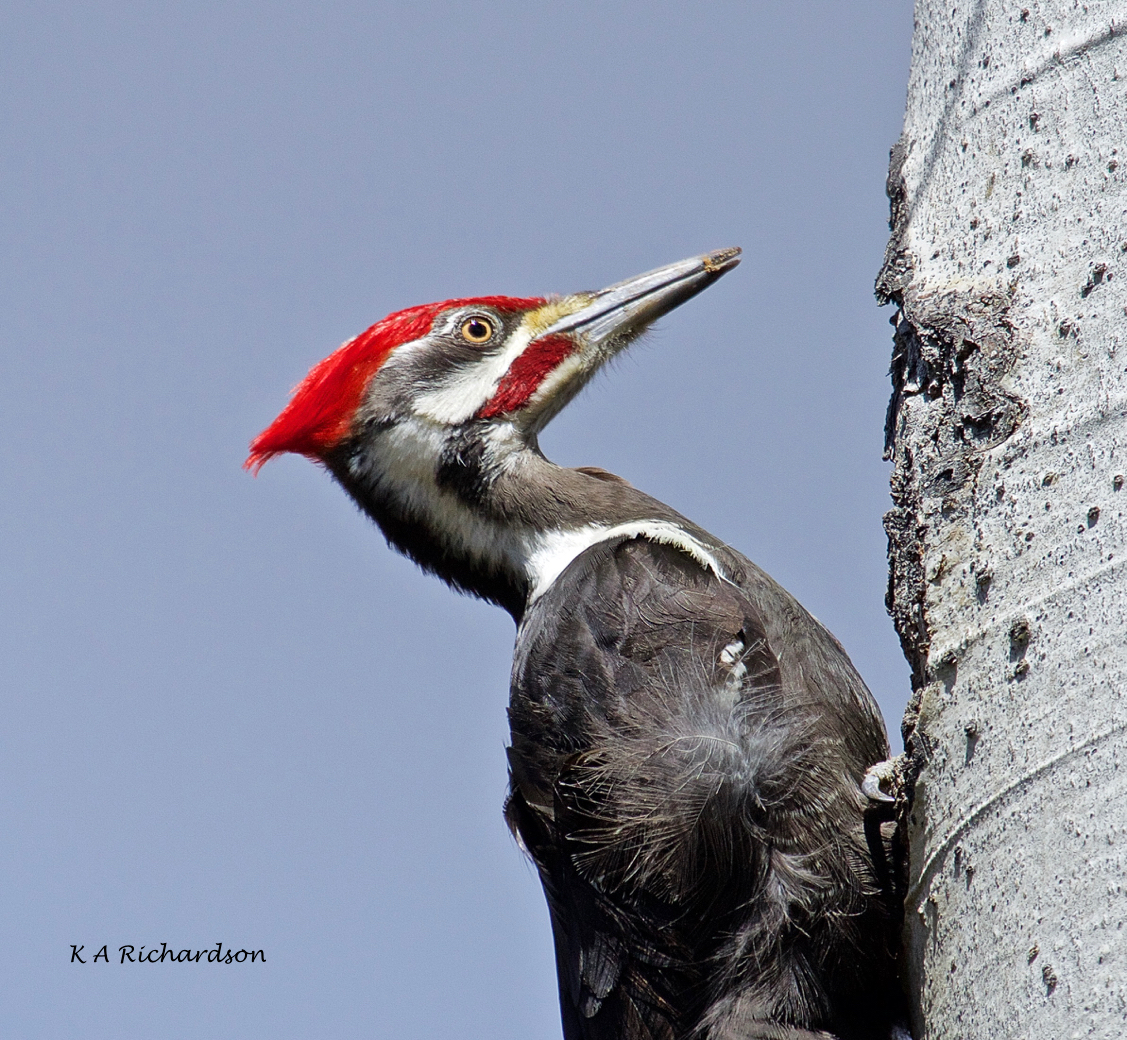
March 2018: For the uninitiated, a PIWO is a PIleated WOodpecker, the largest of the seven species of woodpeckers we see up here most frequently. They’re colourful and industrious and often very willing to be observed and photographed — especially if they’re committed to an excavation!
On Friday, March 9, I was heading home after a walk around my beat. I’d enjoyed a lovely variety of birds, and thanks to a tip from a neighbour, had been able to check out a Bald Eagle that may be returning an old nest above Mission Creek. Although I was unable to get decent photos of it due to the thick branches in the way, I was glad to see him again.
As I approached Gordon Bridge where I would normally head south along the Road back to our condo, I ran into a fellow birder who asked if I had seen the PIWO on the other side of the bridge. It was working down low, she told me.
We parted, and I took a look, but made my search more difficult than it needed to be and would have missed the bird had I not run into to my colleague again not the bridge after I had given up. She just pointed down to the bird at work, and I was on my way….
What follows describes the process of trying to get the shot that you see above — especially when, at first, it seems nearly impossible. Let me give you a hint: success requires effort on the fotog’s part and considerable cooperation from the bird!
One never knows for sure whether a bird will stay put or immediately flee. The second option is the more likely to occur most of the time. Fortunately, this particular PIWO is accustomed to people poking into his private affairs; my task was actually pretty easy. But one only knows this when the encounter is over!
First lookout Fearless Foz: not terrible, but those branches are really annoying!
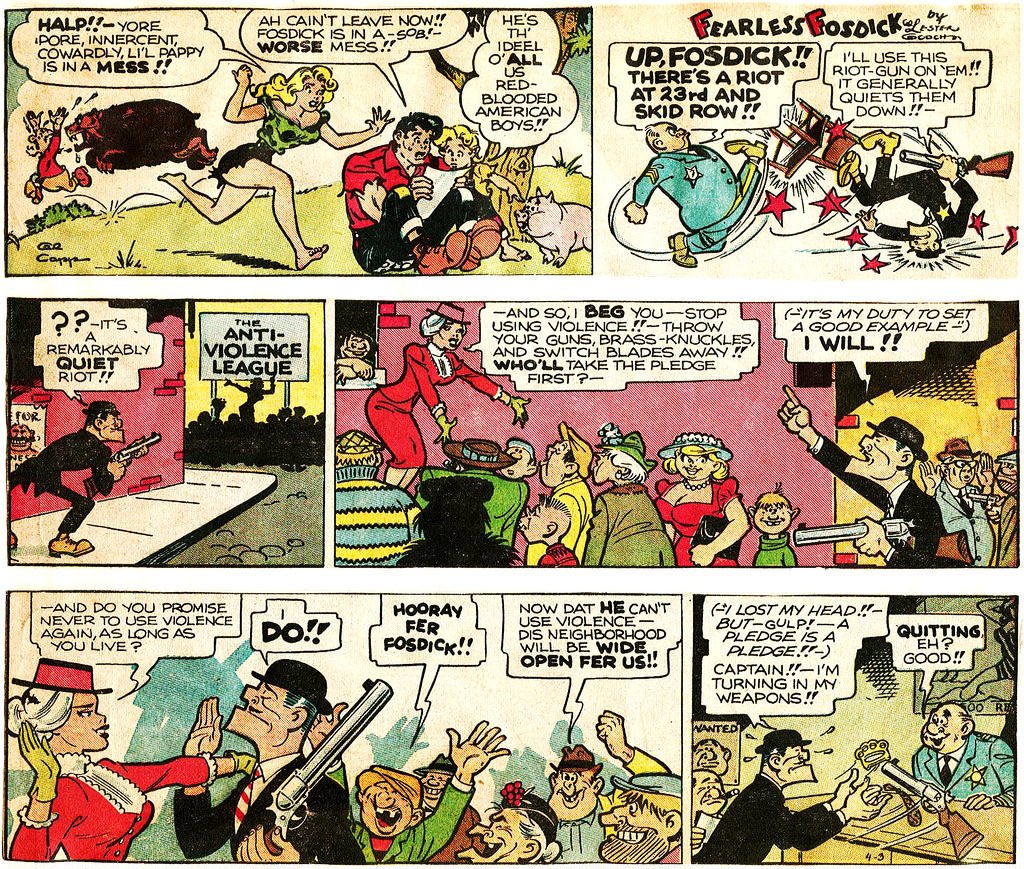
The name, Fearless Foz came to me from a remark my birder friend made about our bird of the day: “He likes people,” she said. “He’s fearless!” And so Fearless he became. Fearless Fosdick came to mind — a flashback from my days reading comics as a kid. You may remember Al Capp’s syndicated cartoon strip, Li’l Abner, which had as a cartoon within the cartoon, a Dick Tracy parody cop called Fearless Fosdick. More on him at the end of this post….
A look one seldom sees. He knows I’m here, yet soldiers on….
Reprise: So how to get this shot from the branchy one above?
Well the trick was simply to get closer than he was comfortable with in the moment, see if he would withdraw to a more favourable location, take a shot, then back off and let him get back to work. All of this assumed, of course, that he wouldn’t simply back off and fly away! Having worked with him 14+ months ago, I bet on his staying focused…. Click any of the images below to enlarge the whole cluster.
Mission Creek, Kelowna, BC. near Gordon Bridge. Fealess Foz
Mission Creek, Kelowna, BC. near Gordon Bridge. Fealess Foz
Mission Creek, Kelowna, BC. near Gordon Bridge. Fealess Foz
In the sequence above, you can see, how after retreating at first to the other side of the tree, he peeks back around again, and slowly finds his way back to the excavation….
He’s almost there. I’m happy to have a good shot of his grasp and his full body. The plumage details worked out well, too.
At this point, I decided I to allow him to get back to his cavity work as I attempted to photograph him at work. This required my moving down the slope, around one large tree, through some saplings, and then resting against another tree, which, had it not been there, would have meant my tumbling all the way down into the creek!
Mission Creek, Kelowna, BC. near Gordon Bridge. Fealess Foz
Mission Creek, Kelowna, BC. near Gordon Bridge. Fealess Foz
Mission Creek, Kelowna, BC. near Gordon Bridge. Fealess Foz
Of course, all my movement meant we had a little more negotiation to complete
before we were both where we wanted to be. I took advantage, continuing
to shoot even as I edged myself into place. He backed off briefly, then, once I was settled, resumed his business, which he continued to work at until I left. Elapsed time for the entire encounter: 12 minutes.
Click any image in the cluster below to open them all in a new tab.
Mission Creek, Kelowna, BC. near Gordon Bridge. Fealess Foz
Mission Creek, Kelowna, BC. near Gordon Bridge. Fealess Foz
Mission Creek, Kelowna, BC. near Gordon Bridge. Fealess Foz
Mission Creek, Kelowna, BC. near Gordon Bridge. Fealess Foz
Mission Creek, Kelowna, BC. near Gordon Bridge. Fealess Foz
Mission Creek, Kelowna, BC. near Gordon Bridge. Fealess Foz
Mission Creek, Kelowna, BC. near Gordon Bridge. Fealess Foz
As you can see above, I was able to persuade him to move a bit from time to time
so we could inspect his work. He was most obliging!
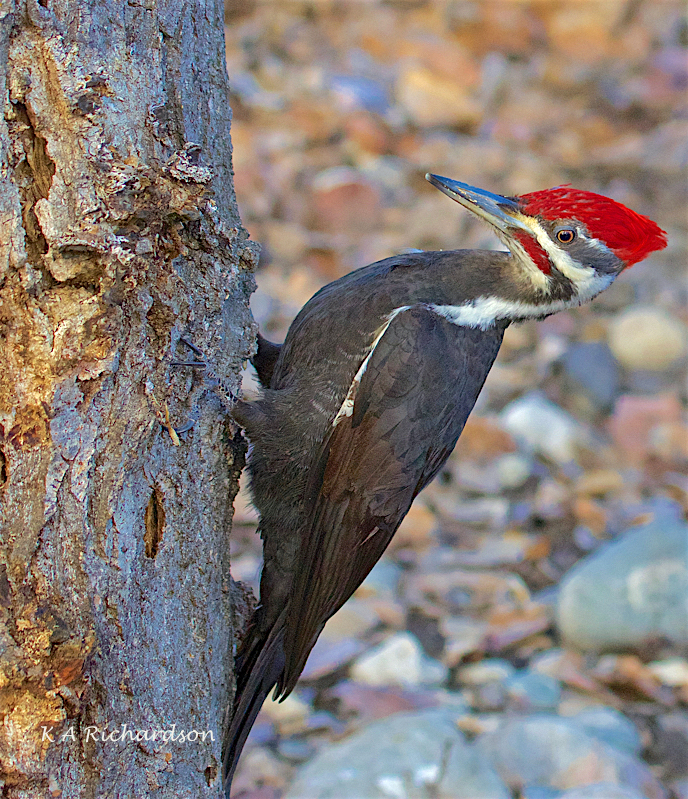
And so we concluded with one parting profile shot on the trunk of the tree.
Click the image to enlarge it in a new tab.
Then it back to work for him and homeward bound for me.
Oh yeah! Almost forgot my promise to show you Fearless Fosdick the first!
See a icon over a photo or link? Click to see an enlarged image or go to another place.
For Woodpeckers Galore, a post based on the same visit to Anarchist Mtn., click here.
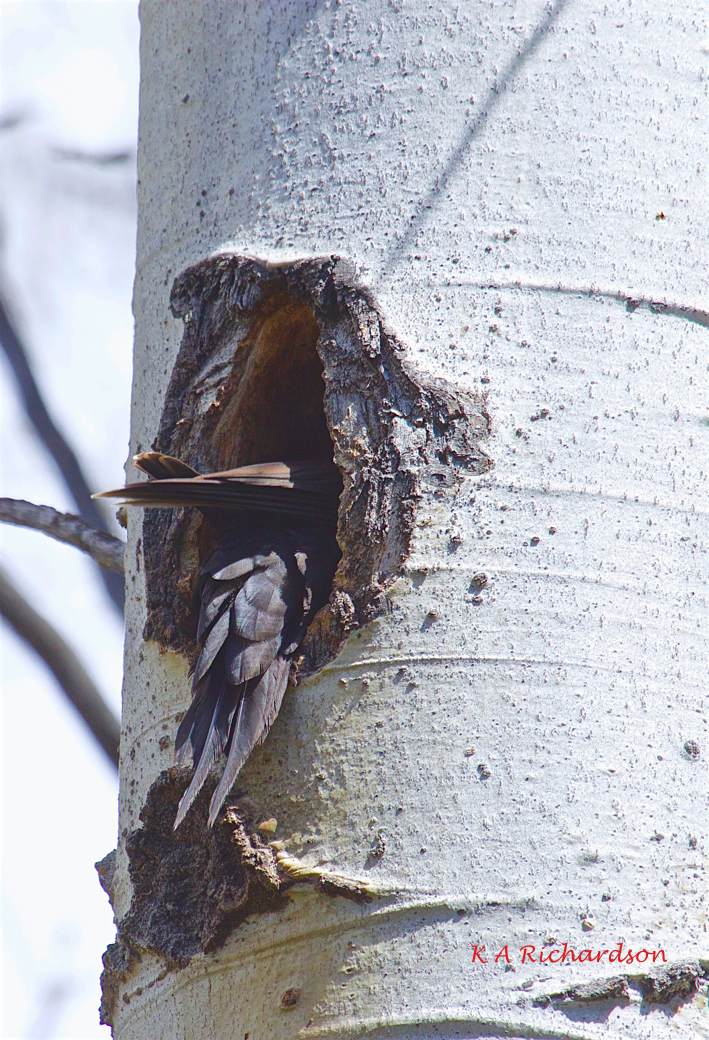
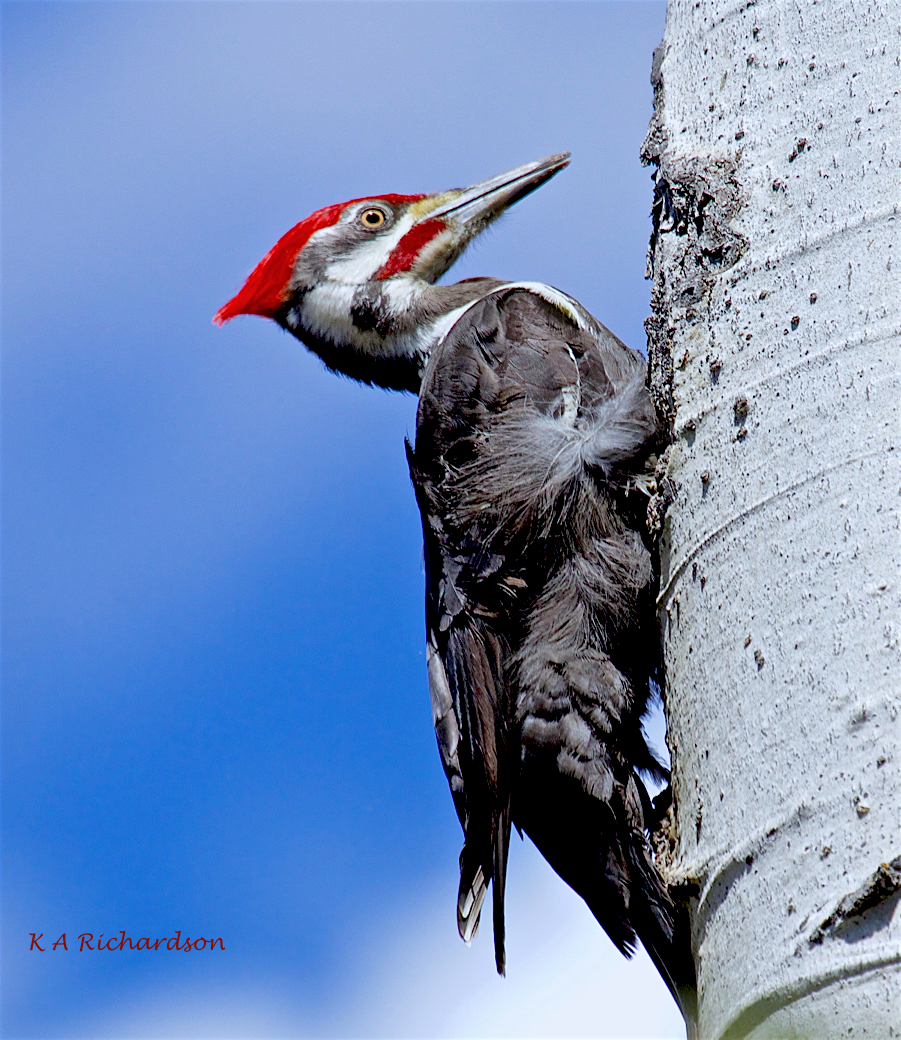
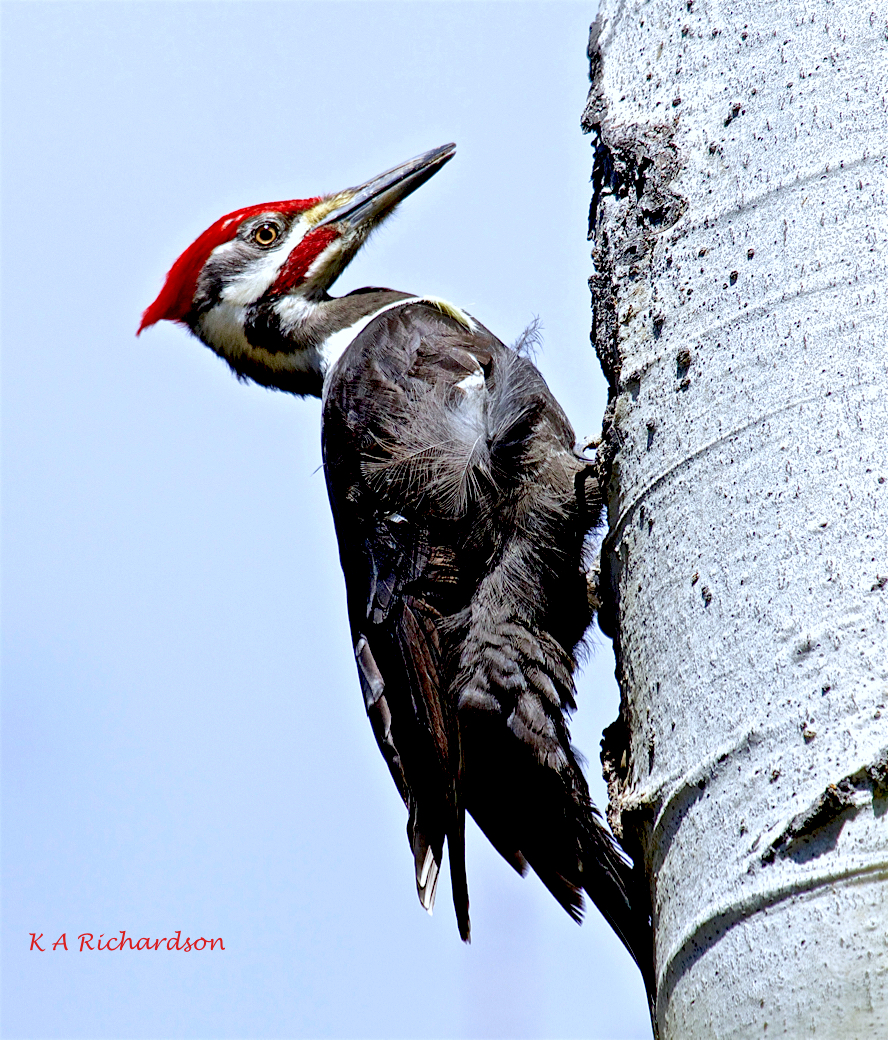
May 1, 2016: As promised at the end of the Woodpeckers Galore post, I want to share photos of one of the most industrious Pileated Woodpeckers I’ve the pleasure to observe. We get so see him in dust covered overalls in the midst of his renovations of an existing cavity that is apparently to be reused. His mate sat quietly in a shady nearby tree about 30 meters away. By the way, we know he’s a male by his red malar stripe.
I have watched PIWOs excavate before, chipping away at huge chunks of a tree mainly in search of grubs living in the wood. The shot below was taken Dec. 31, 2015 in Kelowna.
My best ever Pileated Woodpecker shot; a fine specimen in peak condition, working clean….
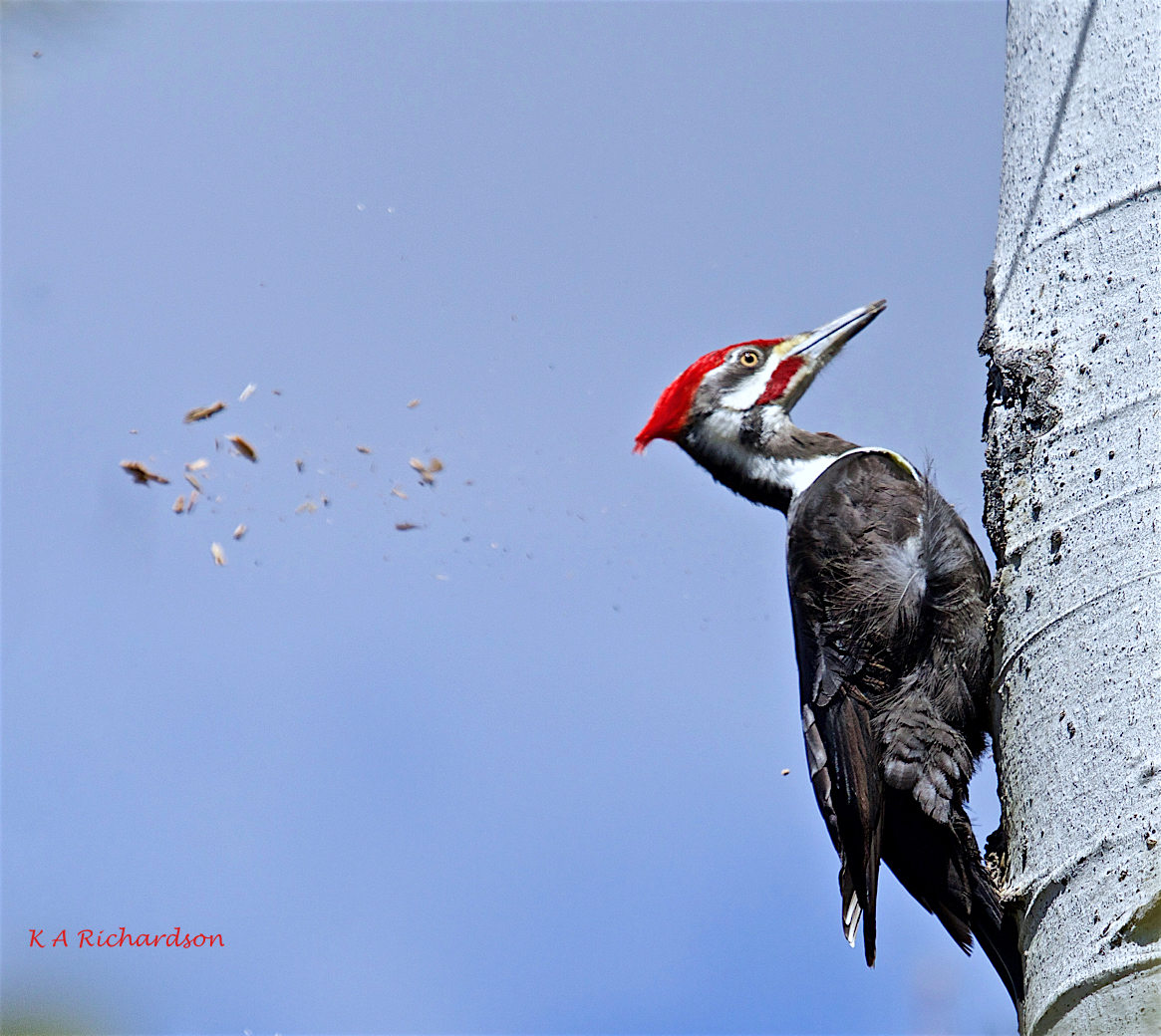
This spring, however, PIWO’s digging reminded me, ironically, of what I saw last year when the smallest of nuthatches, the Pygmy, was working on a nest in a burned Ponderosa stump. There was a steady stream of detritus and dust being flung from the dead tree’s orifice as the shot below shows.
Pygmy Nuthatch in Spring 2016 hard at work: dust and small chips everywhere!
Woody, the subject of this post was in almost constant motion between 12:47 when I took the first shot of him already enlarging the cavity to the last one at 1:05. He had been at it, our ears told us, for some time before we located him, and he wasn’t finished when we withdrew for lunch. Around the time we left, he did take a break to communicate with his mate and to check the area.
Here are the photos. The blurriest betray the constant motion mentioned earlier. In many cases, I had to time my pressing of the shutter button to catch his full profile….
Posterior of a PIWO preparing a place for progeny….
Ruffled feathers but a noble profile, don’t you think? Does he know we’re watching?
In this photo, I think we have the answer. He knows, and he’s okay with our presence….
Doing the job! Click any photo in cluster to enlarge them all….
Extraction…
Gathering…
Flinging over his head…
Dusty work…
and a breather!
This shot shows the dust better and shows the resemblance to the PYNU’s work….
More chunks in motion; shutter speed catches him in the moment….
Checking for his mate…
Listening for her call….
Back to work….
Builder Bob!
I hope to return from time to time to find out whether Woody and Wimsie are successful in raising another generation of these largest of our many fascinating woodpeckers….
The Pileated Woodpecker digs characteristically rectangular holes in trees to find ants. These excavations can be so broad and deep that they can cause small trees to break in half.
A Pileated Woodpecker pair stays together on its territory all year round. It will defend the territory in all seasons, but will tolerate new arrivals during the winter.
The feeding excavations of a Pileated Woodpecker are so extensive that they often attract other birds. Other woodpeckers, as well as House Wrens, may come and feed there. (Interestingly, we saw a House Wren on the day we visited this guy!)
The Pileated Woodpecker prefers large trees for nesting. In young forests, it will use any large trees remaining from before the forest was cut. Because these trees are larger than the rest of the forest, they present a lightning hazard to the nesting birds.
The oldest known Pileated Woodpecker was a male, and at least 12 years, 11 months old when he was recaptured and rereleased during banding operations in Maryland
Food: Insects
“The Pileated Woodpecker’s primary food is carpenter ants, supplemented by other ants, woodboring beetle larvae, termites, and other insects such as flies, spruce budworm, caterpillars, cockroaches, and grasshoppers. They also eat wild fruits and nuts, including greenbrier, hackberry, sassafrass, blackberries, sumac berries, poison ivy, holly, dogwood, persimmon, and elderberry. In some diet studies, ants constituted 40 percent of the diet, and up to 97 percent in some individuals. Occasionally, Pileated Woodpeckers visit backyard bird feeders for seeds or suet.”
Nesting: Nesting Facts
Clutch Size: 3–5 eggs
Number of Broods: 1 brood
Egg Length: 1.2–1.4 in ; 3–3.5 cm
Egg Width: 0.9–1 in ; 2.4–2.6 cm
Incubation Period: 15–18 days
Nestling Period: 24–31 days
Egg Description: White.
Condition at Hatching: Naked and helpless.
Nest Description
“The male begins excavating the nest cavity and does most of the work, but the female contributes, particularly as the hole nears completion. The entrance hole is oblong rather than the circular shape of most woodpecker holes. For the finishing touches, the bird climbs all the way into the hole and chips away at it from the inside. Periodically the adult picks up several chips at a time in its bill and tosses them from the cavity entrance. Pileated Woodpeckers don’t line their nests with any material except for leftover wood chips. The nest construction usually takes 3-6 weeks, and nests are rarely reused in later years.* Cavity depth can range from 10-24 inches.” * This appears NOT to be the case for our bird….
“Considered a keystone species, the Pileated Woodpecker plays a crucial role in many forest ecosystems in North America by excavating large nesting, roosting and foraging cavities that are subsequently used by a diverse array of birds and mammals—for shelter and nesting—particularly the larger secondary cavity users (e.g., Boreal Owl, Wood Duck, and American marten; Bull et al. 1997, Bonar 2000, Aubry and Raley 2002a). Pileated Woodpeckers accelerate wood decomposition and nutrient recycling by breaking apart snags and logs and may facilitate inoculation of heartwood in live trees with heart-rot fungi. They may also be important in helping control some forest beetle populations because their diet consists primarily of wood-dwelling ants and beetle larvae that are extracted from down woody material and from standing live and dead trees.”
April 30, 2017: Among the birds that determinedly “non-birders” can actually name, woodpeckers are popular. Most will at least recognize a Flicker (but don’t ask them to separate Red-shafted, Yellow-shafted and Intergrades, please), perhaps a Hairy or a Downy (though few can identify the differences), maybe a Pileated (although they probably know it better as Woody Woodpecker). Back east, they may have seen a Red-headed or Red-bellied, the former rather obviously named, the latter clearly not. They’ve likely heard of a Yellow-bellied Sapsucker, yet never seen one, or any of the other sapsuckers — the Red-naped of the BC Interior or the Red-breasted closer to The Coast.
But there are many woodpeckers that “cross the border” into Canada that even regular birders have not seen. Lewis’s were new to me only a few years ago; in a way they helped to bring me to the Okanagan (click here for Lewis’s in another page). Acorn, White-headed, and Williamson’s were on my own list. Two of this group still are. Last week, however, the list shrank by 33%.
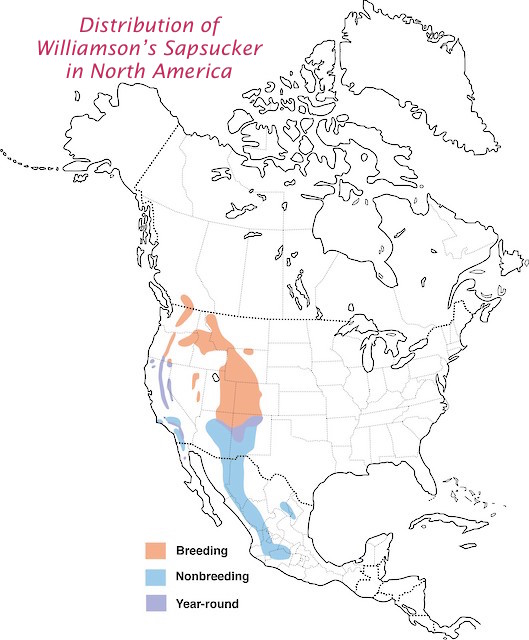
Acting on a hot tip from Richard Kobayashi, a fellow Kelowna birder / photographer, who gave us the exact location we needed, we travelled south to Anarchist Mountain located near the Canada-US border between Osoyoos and Rock Creek, BC. About one kilometre north of Highway 3 on the Sidley Mountain Road, we found our targets right where Richard said they’d be, an engaging pair of Williamson’s, as well as three other species plus the usual bluebirds and wrens and sparrows expected in this region this time of year. We had a fabulous birding experience!
The property belongs to Ed Brouwer, an engaging fellow about whom I’ll no doubt write future posts. Ed was kind enough to allow us onto the property; without that permission, most of these photos would not have been possible. Nana and I are greatly appreciative of his generous sharing of the bounty residing on his land!
Williamson’s are relatively rare in Canada, found only in southern BC. In 2005, in aSpecies at Risk bulletin, the Government of Canada estimated that only 430 birds crossed the border into our country to breed. The report noted that the species was in decline as habitat became threatened. More on that later in this post. Let’s get to the photos:
Williamson’s Sapsucker male near Sidley Mtn. Rd., Anarchist Mountain, BC.
Let me say, right off the top, that the male’s wonderful colours are exceedingly difficult to capture with equipment such as mine. I didn’t fully realize this until I returned home and looked at the quality of my images. Trying to photograph both on an Aspen is a terrific challenge from a white balance / black balance standpoint! The good news is that I have more reason to return and try to improve!
Unlike many of our BC woodpeckers, Williamson’s are sexually dimorphic, so different in appearance that many early observers thought the male and female were different species! The image of the female (below) attests to why: (Click cluster images to enlarge.)
Williamson’s male (low quality shot)
Williamson’s female turned out better.
Pair together; he’s at the nest hole.
As we watched their behaviour, we noticed that both birds kept leaving the big Aspens to visit the bottom five feet of a nearby young Balsam Fir. Closer examination after they left it showed why: (Click cluster images to enlarge.)
Sapsuckers feed here.
Closeup of the sap wells.
Profile of the sap wells.
We were ecstatic about the opportunity to examine their habitat so closely. But the story doesn’t end here. In fact, it was just the beginning. We also were thrilled observing the other woodpeckers of this small forest.
Having seen Red-naped sapsuckers up close four years ago, I decided not to pursue them this time. I will go back for them another time, I’m sure!
Red-naped Sapsucker near Merritt, BC, 2013. My best yet of this species.
Instead, I focused on a very cooperative and hard-working Hairy that allowed me over a seven-minute span (I departed before he did) to observe him drilling a new hole.
(Click cluster images to enlarge.)
First encounter with Hairy at the hole.
Close up; no fear of fotog!
Best shot!
Proud of his work!
“Really into it,” you might say!
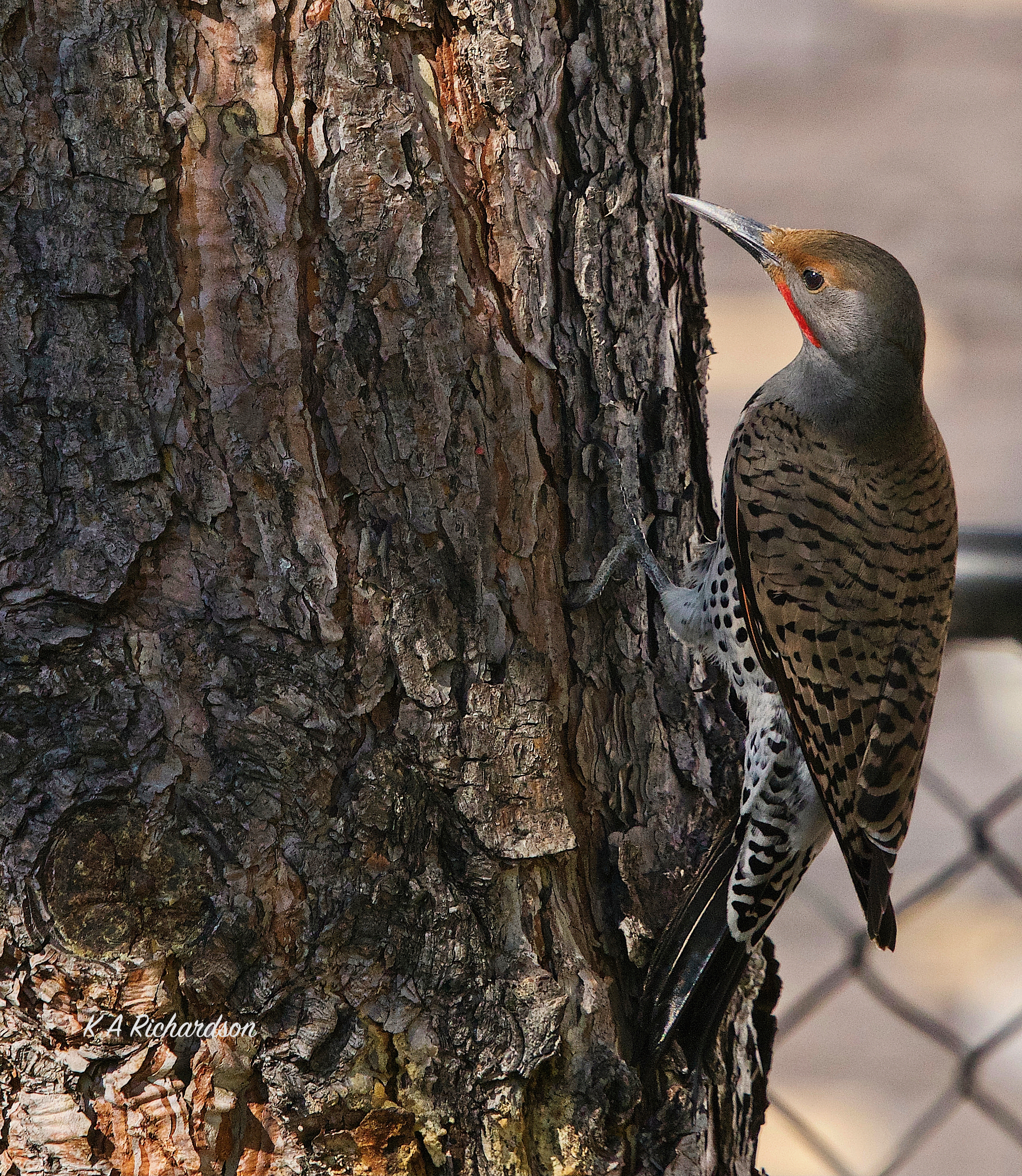
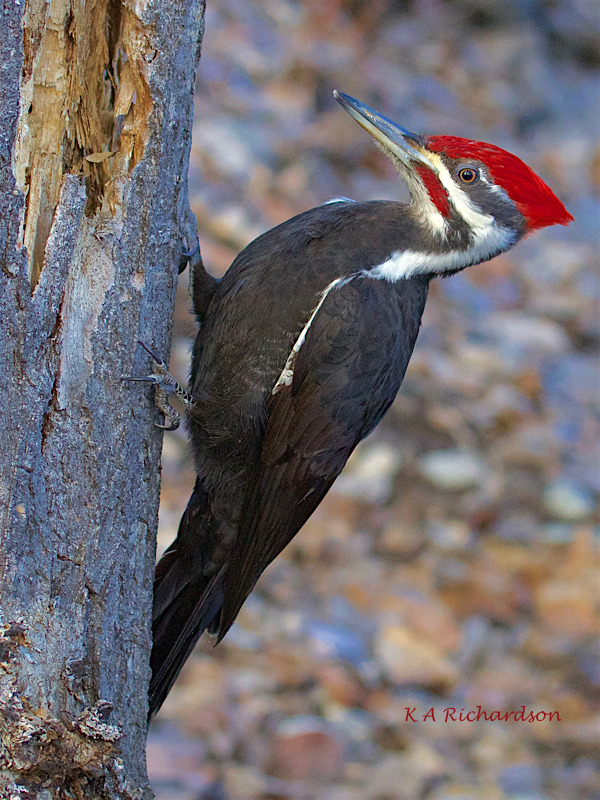
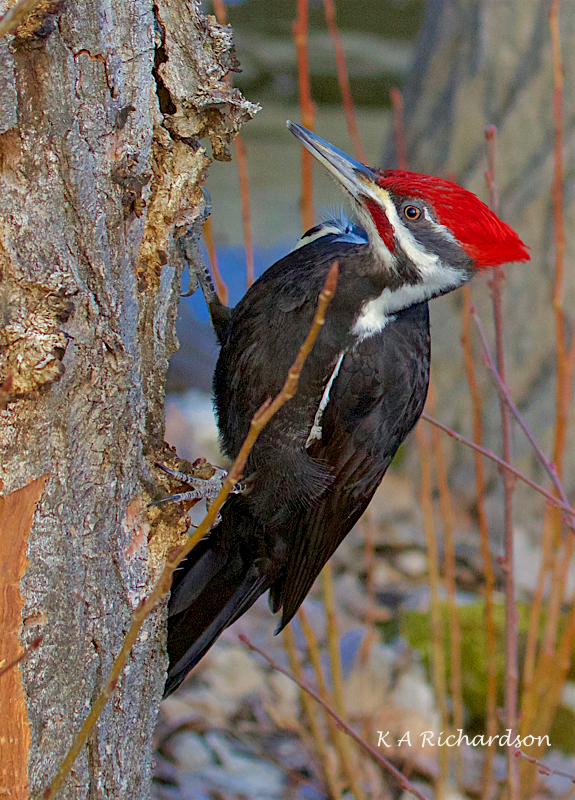
We also got to watch a Pileated male re-excavating a nest hole while his mate observed nearby. That’s covered in a separate post, but here’s a teaser:











 icon over a photo or link? Click to see an enlarged image or go to another place.





 For the Pileated portion, click
 Acting on a hot tip from Richard Kobayashi, a fellow Kelowna birder / photographer, who gave us the exact location we needed, we travelled south to Anarchist Mountain located near the Canada-US border between Osoyoos and Rock Creek, BC. About one kilometre north of Highway 3 on the Sidley Mountain Road, we found our targets right where Richard said they’d be, an engaging pair of Williamson’s, as well as three other species plus the usual bluebirds and wrens and sparrows expected in this region this time of year. We had a fabulous birding experience!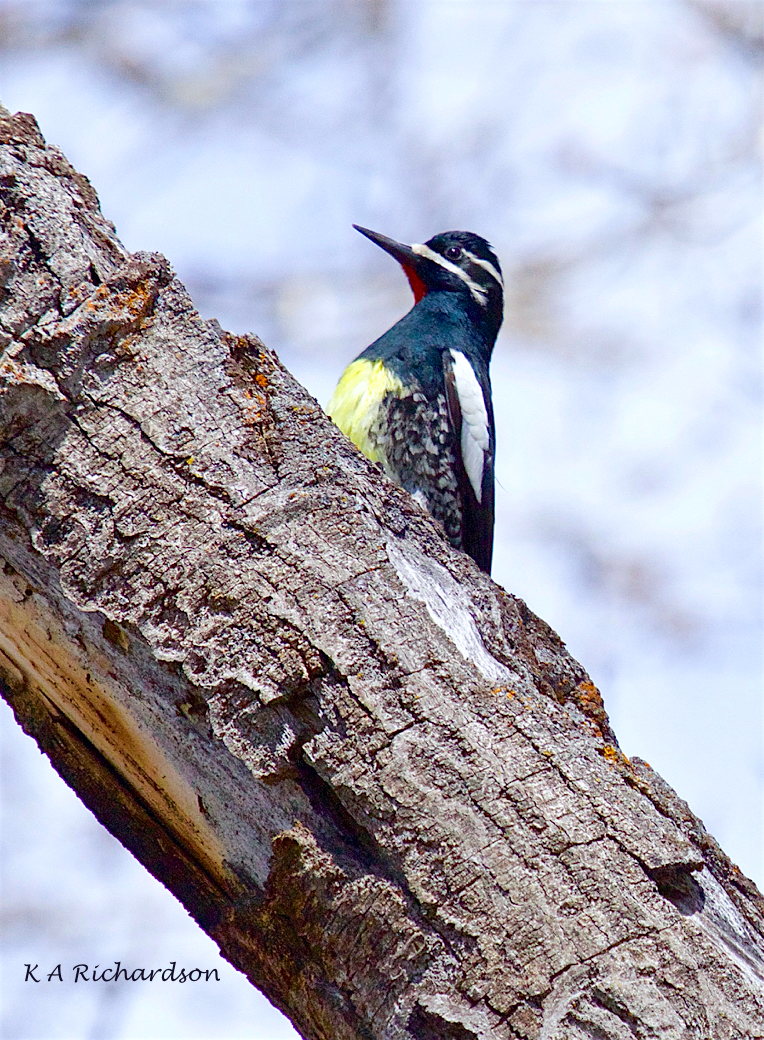




 birds & musings