For those who are really into birds ~
and for those who are not ~

life begins at 70
Category: Birds
For those who are really into birds ~
and for those who are not ~
Well, I hope you enjoyed part one. But that wasn’t the end of the story, by any means.
Having learned how to fly, Railbird and Sal became inseparable companions with quite different learning styles and aptitudes. Sal, as I mentioned in Part 1 of this series, was simply a natural who found growing up easy and generally took the path of least resistance.
Railbird, the maverick, however, developed a knack for doing things his way….
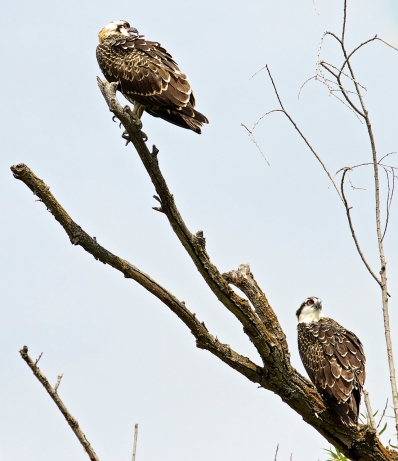
Two days after the up close and personal encounter on August 11, I spotted the two juveniles about 150 meters north of their nest, in a grove along Lexington Road, and just southeast of the Dog Park. Just as I was about to move closer, I got a phone call from my son, and had to tell him I was busy. No telling how many chances like this I’d get.
As I began my approach, both birds were roosting on a strong branch extending out from a large weeping willow. As I drew nearer, I was able to differentiate the two siblings, and noticed that Railbird, on the left, out on the edge of the limb, seemed to be preparing to take off. He also appeared to be communicating something to Sal, who looked less than impressed.
I checked my camera settings and prepared for whatever….
Click on the images to enlarge them.


He’d done it! Literally a pin point landing. Sal may have been amazed, but if so, he wasn’t letting on to his brother….


I moved to the other side of the perch (Lexington Road) for some closer-ups from that side.


Another great afternoon with the twins. Only four days or so since they’d fledged and so much fun to work with! In Part 3, we’ll look at them about a week later as they start learning to fish!
Last February, I wrote a piece about favourites and focused on my favourite raptor, the Osprey. I promised I would say more about a special relationship that developed with the neighbourhood fledglings of 2015. Well, it’s time!
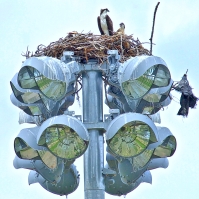
First, let me acknowledge that, after having a completely different experience this year (2016), I appreciate now more than ever how cool it was to get to know Railbird last year. He (I’m pretty certain of Railbird’s gender, not quite so much of his sibling, Sal’s) fledged near the end of the first week of August. I’d been waiting patiently for the big day and was prepared to take photos, but quite unprepared for what transpired with the twins.
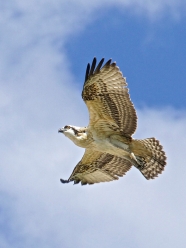
When it came time to fly, Sal had no problems. Fly a bit and return to the nest.
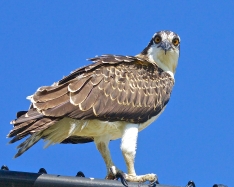
Railbird, on the other hand, didn’t quite get it for a couple of days. He allowed himself to drop down and to perch on the rail fence around the ball park at the base of the huge field light where his parents had nested and reared their pair.
I was surprised;
in fact, I haven’t seen any other Osprey in this location repeat his behaviour—certainly not this year (but that’s another story). The first day, August 8, I approached but didn’t press my luck.
All of my photos were taken at a respectful distance.
Click images below to enlarge them. Close by clicking the small x in the top right.


I took my time, and Railbird took his. He did move to another section of the fence, but clearly wasn’t sure if he could make it back to the nest: Click to enlarge.


I stuck around as long as I could, but eventually, I needed to go back to my own nest, and left my young buddy pondering his options.
Next morning I returned. I’m pretty sure Railbird hadn’t spent the night on the fence, but, as I was to discover over the next few weeks, he was a methodical learner who built on experience. On this day, I was determined to take advantage and see how close he’d let me approach for some intimate closeups. He obliged beyond all expectations! Click to enlarge.


These were, to say the least, the most amazing moments in my birding experience!
Click to enlarge.


I must admit that there was one moment when he turned away from me, and my instincts told me to back up a bit. Good thing, too! His poop stream missed me by a couple of feet!
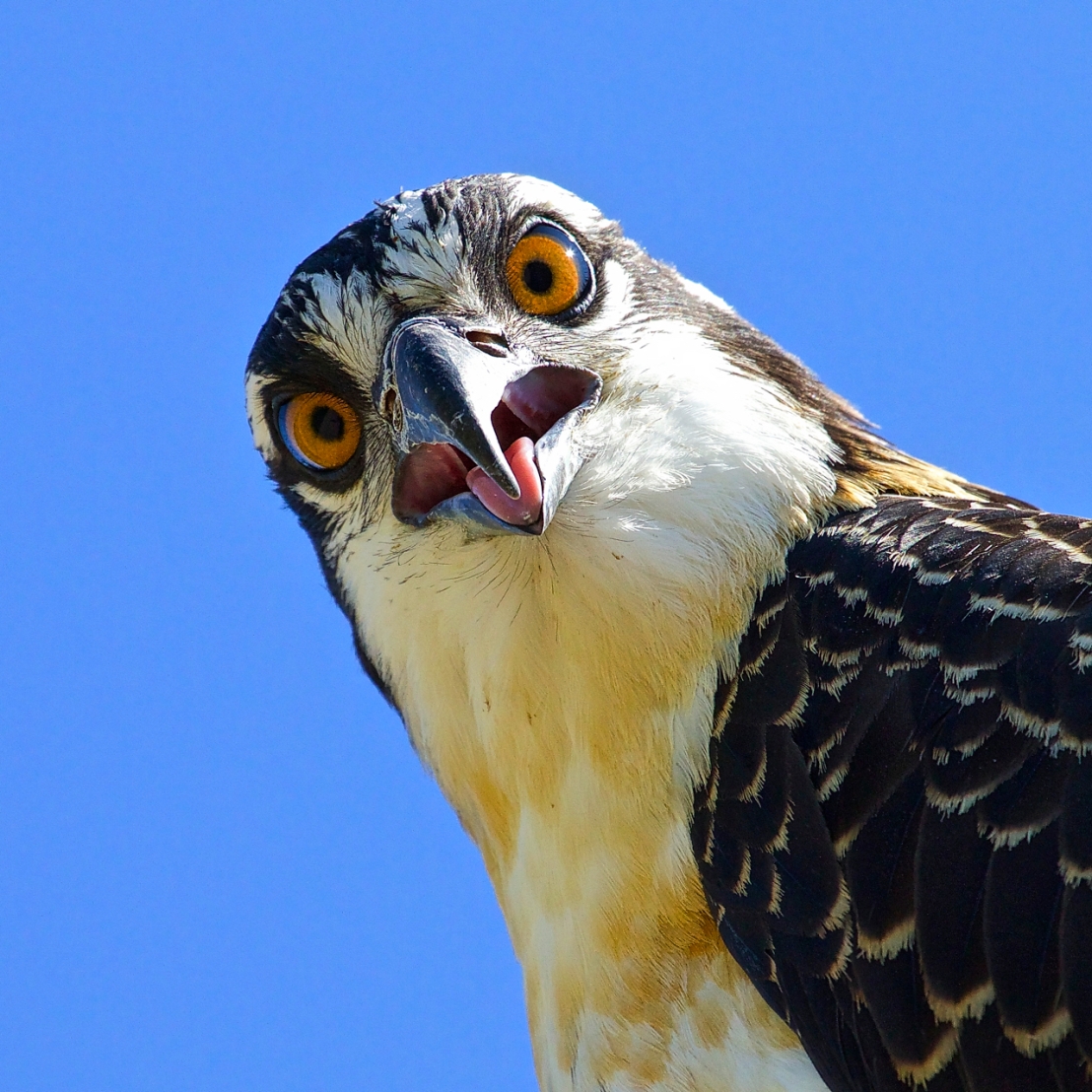
After he gave me the “Railbird salute,” I still got a couple of character shots including the one below.
Our relationship continued, but not so intimately as in those first two days, until, eventually, the whole family headed south for the winter. I’ll add another post on those subsequent developments a bit later with more scientific information about Ospreys.
Let me just add, in conclusion, that I certainly don’t believe any of the anthropomorphic blather I’ve indulged in above, but I hope you enjoyed playing” make believe” for a bit, as I did.
Larger views of the three small photos at the beginning of this post: Click to enlarge.


For Part 2 of this two-part series, click this link.
Recently, on this blog, I confessed.
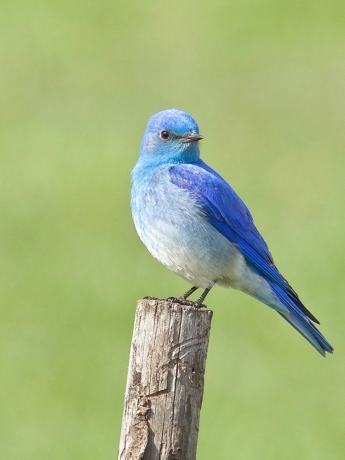
I love blue birds, particularly Western and Mountain Bluebirds.
As the maps below show, these species are at home in the west.
Click any map to enlarge them all in a new tab.
The Eastern Bluebird, which resembles its Western cousin (or is it the other way around?) occupies a different and larger section of the continent.


But there are other birds that pass as blue, too, and I’m going to pay homage to them in this post.
Whether it’s really blue or not, the American Dipper, which often courts low light, sometimes appears to be almost blue. The AMDI is a “west of the Rockies” bird.


While two of the jays that breed in Canada, (not Canada Jays, however) exhibit wonderful shades of blue. Only one is typically found in the west, the Stellar’s Jay. In BC, we enjoy two main subspecies, coastal and interior. The three photos below show interior birds with their distinctive white eyebrows.
Click images below to enlarge.


Two other blue jays sometimes take advantage of special rates on Jayvago to make tourist excursions to our fine province. The Blue Jay, widespread in eastern North America, occasionally shows up even in the Okanagan as one did last January (2016) and another this fall (2016). When Nanae and I travelled to Atlantic Canada this autumn, we saw tons of Blue Jays in many places; what a thrill!


The California Scrub Jay prefers to spend its time south of the border, but occasionally sneaks into BC’s Lower Mainland, indeed into New Westminster where we used to live. (While I’ve seen one there, I don’t have any photos.)
Another bird that has widespread distribution on this continent, and which we saw frequently on our trip is the Belted Kingfisher, a species guaranteed to chase away your blues if you have a chance to encounter one/have them…. We’re well blessed with BEKIs here in Kelowna, and this summer and fall watched a pair enjoying fresh goldfish sushi from Belmont Pond.

Love this description of the BEKI from Cornell’s Lab of Ornithology:
“With its top-heavy physique, energetic flight, and piercing rattle, the Belted Kingfisher seems to have an air of self-importance as it patrols up and down rivers and shorelines. It nests in burrows along earthen banks and feeds almost entirely on aquatic prey, diving to catch fish and crayfish with its heavy, straight bill. These ragged-crested birds are a powdery blue-gray; males have one blue band across the white breast, while females have a blue and a chestnut band.”


Where you find BEKIs, GBHEs are likely not too far away. We have many Great Blues in the area, each with his/her own special personality. Maybe I’ll cover that notion in a later post. For now, here are some captures of this largest avian in the neighbourhood….
Click to open enlarged images in a new tab.


Finally, a blue of a different hue: the Tree Swallow…. Click to—oh, you know!!


No, not Ospreys part 2. That’s still in the works and won’t be ready for a bit….
Instead, I want to confess to my preference for blue birds. My colleague Nick, who lives in Abbotsford, BC, shares this passion; in fact, he probably realized his before I did mine. Regardless, we’re nuts about bluebirds, Blue jays, jays that are blue, and even kingfishers and herons and Dippers that are blue-ish or almost so. In the 12 years that I lived at The Coast, I never saw a bluebird there, so I had to content myself with the occasional Steller’s Jay or Great Blue Heron. When Mountain Bluebirds, Scrub Jays, and the occasional Blue Jay deigned to visit Greater Vancouver, I failed to photograph a single one! But since I’ve moved inland, it has been a different story. Even Nick, who never dipped when coastal accidentals appeared, has admitted that the opps for blues up here are pretty amazing.
So here’s to celebrating the blues!
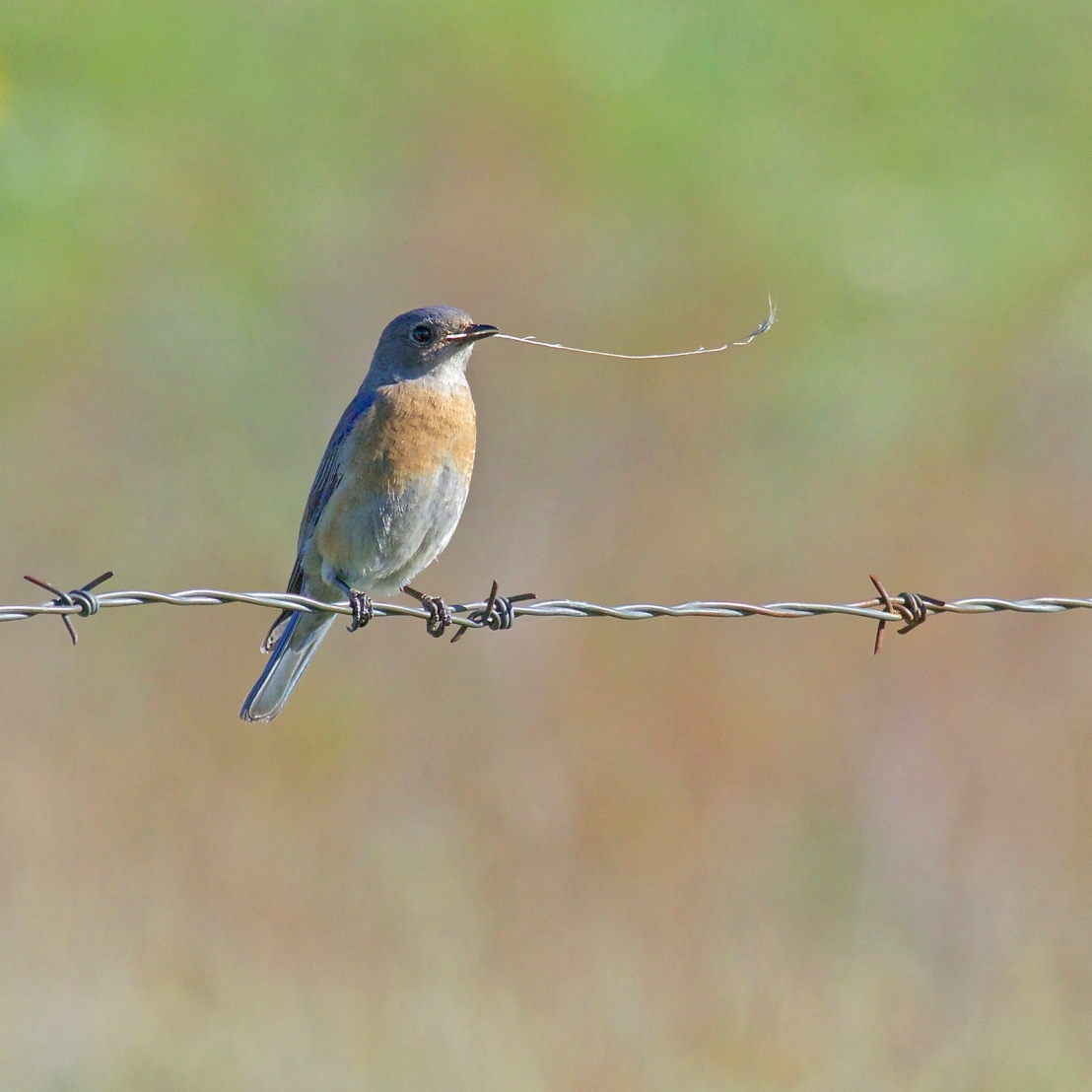
Bluebirds: in the Okanagan we’re blessed to have two species to feast our eyes on—the Western Bluebird and the Mountain Bluebird. Love ’em both, but must confess I’m a little more partial towards the latter. WEBL males are very hard to capture to my standard. I’ve better luck with WEBL females, especially the one featured today who was a great poser. I discovered her at White Lake, west of Oliver, BC, and had two extended photo sessions with her several weeks apart. These shots were taken on the same day….
To see enlarged image, click on it. To return to this page click the x in the top right corner.


The shot below, also a female, was taken northeast of Kelowna along Beaver Lake Road, east of Winfield, BC—a very popular location for both species of bluebirds. Click to open enlarged image in a new tab….
The male WEBL (also at Beaver Lake Road) is much darker in colour:
To see enlarged image, click on it. To return to this page click the x in the top right corner.


Bluebirds, as you may know, are members of the Thrush family, which includes our common American Robin and the somewhat rarer Townsend’s Solitaire. It’s always a bonus to get a twofer, and especially so when they’re different species of the same family.

Mountain bluebirds are found throughout the Interior and are especially available during the immigration in spring and the emigration in fall. My favourite place to photograph them is the Kane Valley, southwest of Merritt, a little over an hour’s drive from home. Beaver Lake Road also provides great photo opps as does the White Lake Grasslands Protected Area west of Okanagan Falls and Oliver.


Well, that’s enough for this post. Will add more blue birds in a subsequent article.
Hope you enjoyed these ones!

Another day, another change. Yesterday’s threat of snow near the valley bottom was not carried out. Thanks to the powers that be. And this morning there are patches of blue peeking through the doughy skies. Lots to do with Christmas only 22 days away….
Want to pick up from yesterday’s theme: “…the environment we’ve plunked ourselves into has only come into its present form in the last 10 to 20 years. And it continues to evolve beneath our feet. Change waits for none of us.” In that post, I implied gratitude to the City of Kelowna and local organizations for having the wisdom and finding the wherewithal to plan for environmental protection and enhancement as the city grows. When I first saw Kelowna in 1969, it was just a large town. Canadian census figures show how it has grown in population in the last half century (three quarters of my lifetime).
Kelowna’s Population Growth
Sudden jumps in numbers reflect times when city boundaries were expanded by incorporating other districts.
| 1966 | 17,006 | +29.0% |
| 1971 | 19,412 | +14.1% |
| 1976 | 51,955 | +167.6% |
| 1981 | 59,196 | +13.9% |
| 1986 | 61,213 | +3.4% |
| 1991 | 75,950 | +24.1% |
| 1996 | 89,442 | +17.8% |
| 2001 | 96,288 | +7.7% |
| 2006 | 106,707 | +10.8% |
| 2011 | 117,312 | +9.9% |
By 2011 (five years ago), “Kelowna [was/is] the third largest metropolitan area in the province and ranks as the 22nd largest in Canada, with a [metro] population of 179,839….”
(https://en.wikipedia.org/wiki/Kelowna)
There are plenty of signs that the trends above are continuing; it will interesting next year to analyze the numbers from the 2016 census.
Much of Kelowna City’s land area on the east side is protected under the province of BC’s Agricultural Land Reserve laws. Those sections outside that sanctuary, however, are seeing continued construction mainly of housing including condominiums and rental apartments, as well as some commercial outlets and industrial properties. Some of this construction will impact the very environmental blessings my wife and I have enjoyed in our two years here.
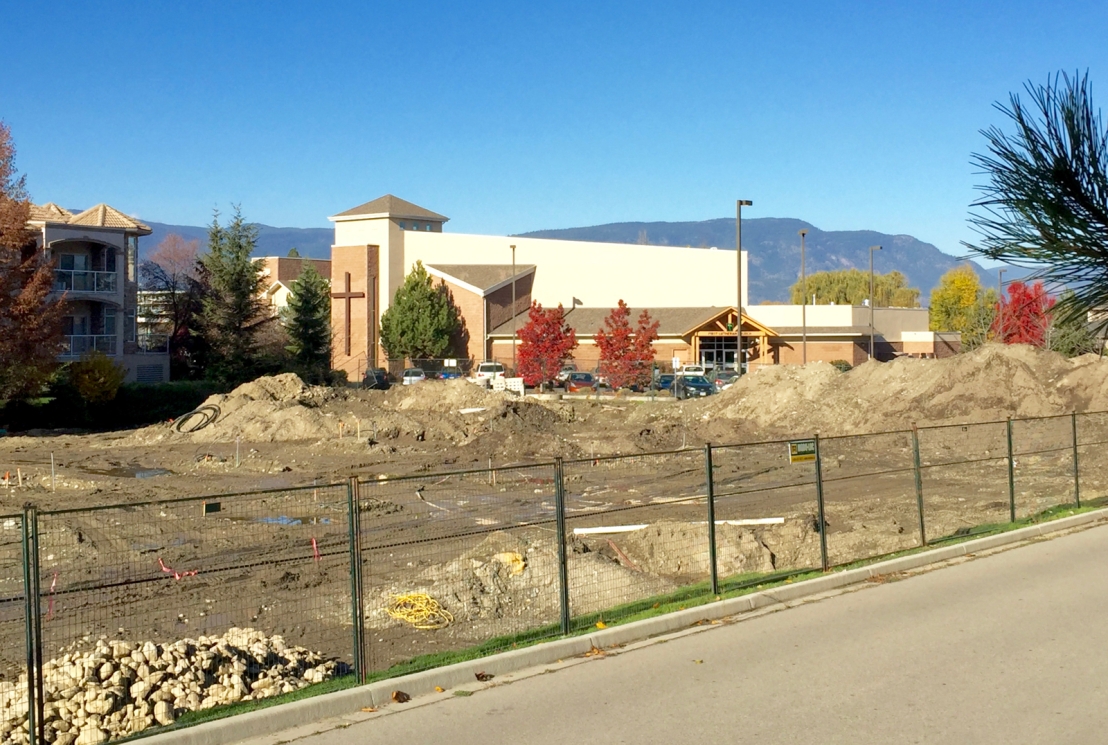
I’ll be brief and very local. The map below shows how two condo construction projects are now underway between our home and Lakeshore Drive, in the area close to Belmont Park and Ponds. The one in the northwest corner of the map is actually an improvement over a structure that was there before. The one south of the Lutheran Church parking lot, closest to our condo, however, for as many years as most people in the neighbourhood can remember, has been a vacant lot. Indeed, earlier proposals to develop the property were effectively opposed by local residents or failed for lack of funds or adverse economic conditions. This fall, however, construction of an 18-unit townhouse complex is underway.

In our two years, here, the vacant lot has been a breeding site for a family of Killdeers.


The stone foundation under our condo has been used by a colony of Violet-Green Swallows that pretty well kept the neighbourhood free of mosquitoes. They would sweep across Belmont Pond and over the vacant lot and enter the small spaces between the large cement foundation blocks to feed their young ones inside.


It will be very interesting to see what transpires over the next six months. The swallows will return in March, well before the completion of the townhouses I believe. Will they adapt to the changes? How will other birds and turtles escaping from the pond be affected by their loss of this land?
Don’t get me wrong! Our own condo development and many of our neighbours’ were constructed after 2001. There was a time, not long ago when there were no homes where Belmont Park is now, where caring families along the fences support the birds that visit their properties. Indeed, there was no park with its portion of the arboretum that the city put in place around the turn of the century (that’s only 16 years ago!). Belmont Pond, before the trees and cattails grew up around it was just a gravel pit. The fish that sustain Ralph the Great Blue Heron, the Mission Rec Field Ospreys, and the many other waterfowl that feed on them are mostly goldfish and koi that were (thoughtlessly?) discarded there years ago. The Western Painted Turtles likely found the ponds by themselves, migrating from other waterways nearby.


In the last two years, as I’ve watched the cattails get beaten down in fall by our limited snowfall, the Red Osier Dogwoods, Oregon Grape, Virginia Creeper, and various other hedge shrubs and grasses have grown a little taller and thicker. And then in spring, the cattails come roaring back to life even denser and taller and block the view of the pond on the south and west sides. I asked the arborist who trims back the Privet hedge marking the school boundary on the west side to cut some holes in the growing shroud along the pond; he said he’d think about it.
Photos coming
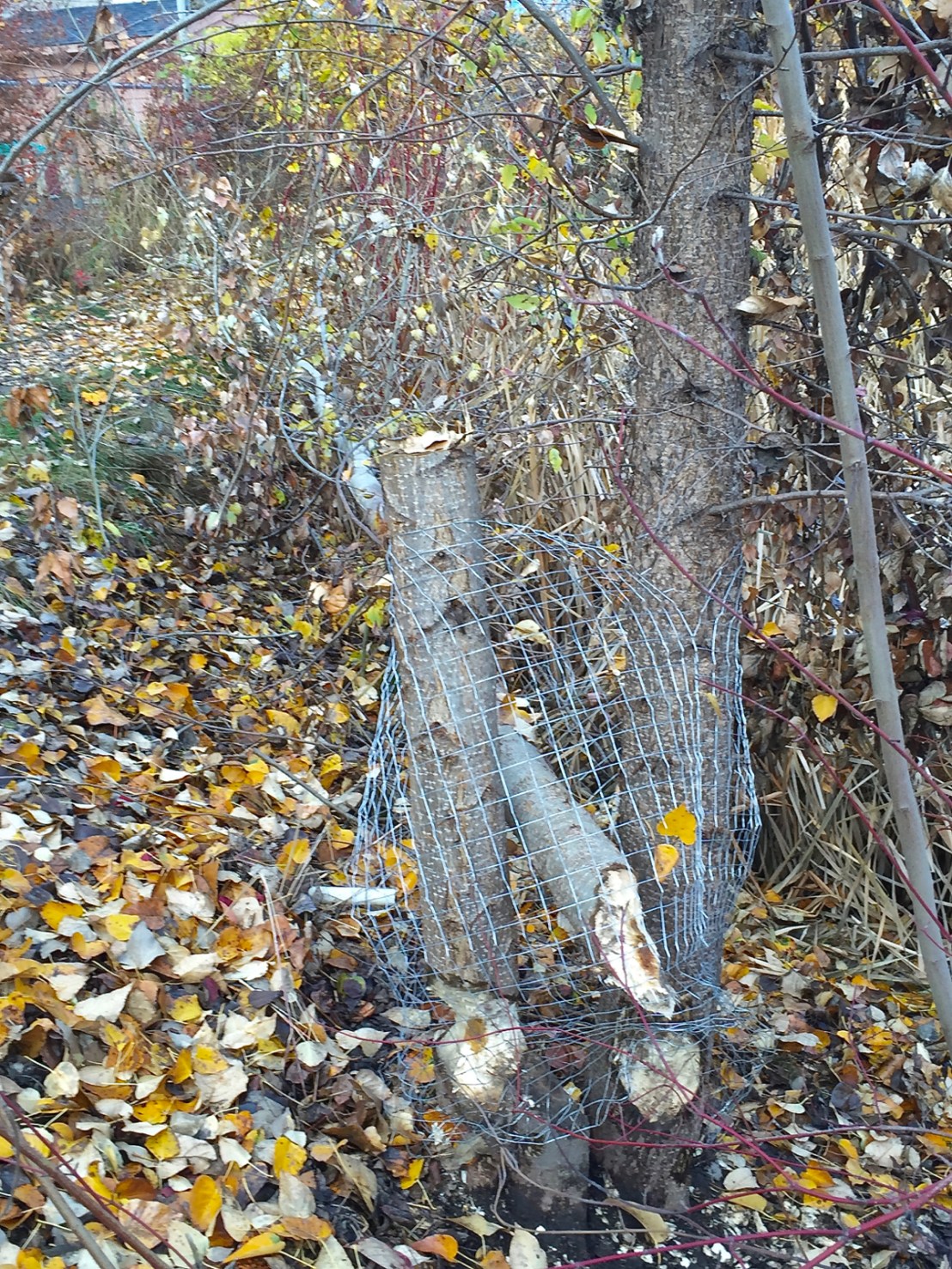
Meanwhile, a beaver has moved into the area and has been doing some clearing that most of us would rather he wouldn’t. Even the wire cages wrapped around the larger deciduous trees on the margin of the pond haven’t stopped him. He just pushes in and gnaws away. Several trees that were well used by warblers last spring are gone! On the other hand, the bushes that once hid the small pond now have a hole in them just like the one I’d asked the arborist to create. I’m thinking I want to train the beaver to be a little more discriminating on the big pond!
The blue holes of earlier in the morning have closed. Now I feel blue….
December 2, 2016: Late autumn in Kelowna: another grey sky. Beyond cloudy, actually. It has been snowing overnight—up the valley slopes—for the past several days, and this morning, the foggy line separating white heights from the brown/green bottom is only a couple of dozen meters up the valley from where I sit. A day to stay indoors and catch up on—well—whatever….
I’ve been meaning to write some reflections on how our life has changed in the two years since we moved “up here” from “The Coast.” So much I could cover: traffic oddities like the HOV lane being in the same place as the right turn lane, or how much faster it is to take side roads and avoid Highway 97,(aka Harvey, which coincidentally was my dad’s name)…. Or the inadequate medical care in a city with a first rate hospital and a chronic shortage of GPs. Or the wonderful joys of spring and autumn, and the odd discomfort of searing mid-summer and the tourist invasion, not to mention the occasional flood or wildfire, or the tedium of winter days where the sun is perpetually obscured by sullen clouds. Or the maxim we adopted shortly after we figured it out: stop complaining; you’re in Kelowna; you’ll get used to it—and you’ll love it!
And we do love this city, especially our corner of it so close the Lake and the city’s main recreational facilities. And, for us particularly, great places for birding, photography, or long walks that begin right outside the door.
I must not, obviously, write a post covering so many topics.
I will focus on local amenities, illustrated with some images made since we arrived in autumn 2014.
And how change fits into this picture….
Neighbourhood map:
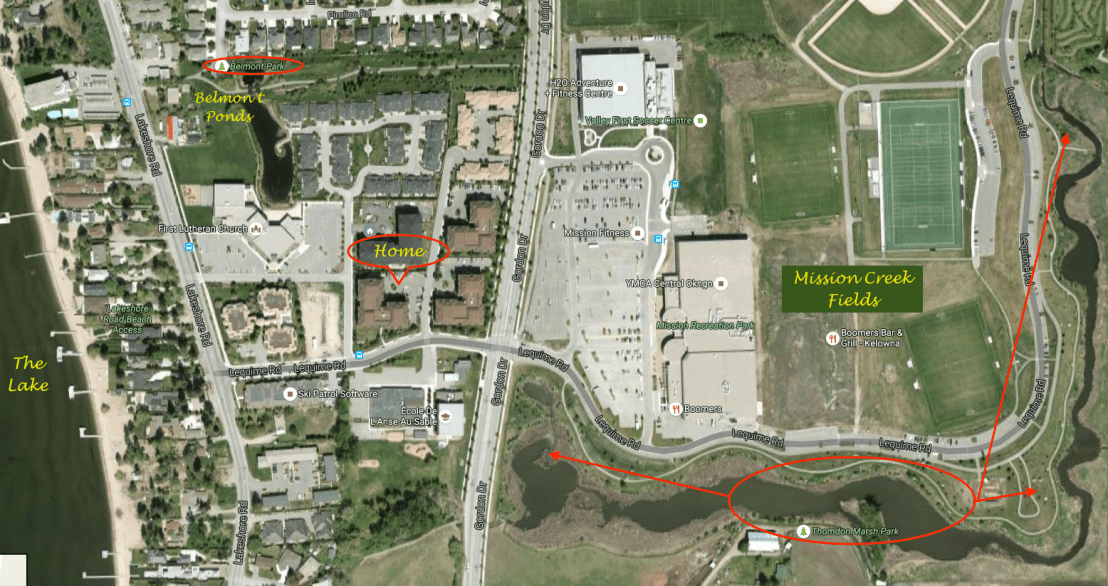
In the Okanagan Valley, Kelowna (including West Kelowna and West Bank on the other side of the lake) is growing faster than its nearest neighbour cities, each about 50 minutes away by car, Vernon to the north and Penticton to the south. While change is often synonymous with growth, “progress” may also threaten situations or phenomena we hold dear. In the case of the Okanagan Valley, I’d rather live where I do than in either of the other two cities aforementioned. Perhaps I’ll feel differently in five years. Or not, because who knows whether I’ll even be here in five years…. Suffice to say, I realize that we’re enjoying the benefits of growth in the recent past (which I’ll illustrate presently) and simultaneously growing mildly anxious about new developments around us (also to be identified in Part 2) that we may not like so much.
Both my wife and I love hiking along the Greenway that flanks Mission Creek (see map below), and Thomson and Michaelbrook Marshes, or, in the other direction, along Belmont Ponds and Park. Because their development predated our arrival, it feels as if they have always been here. Of course, that’s not true. The Greenway has been developing since 1996. It’s hard to imagine the area as it was back then.
“The Phase 1 Greenway project was announced in 1996 and was the most successful community funded project in Kelowna’s history. Landowners along the Greenway donated in excess of 16 acres of land valued at more than $300,000. Phase 1 project extends from Lakeshore Road to Ziprick Road, a distance of 7.3 kilometres, and was completed in 1998. It is a universal access trail that is well used all year by walkers, hikers, runners, bicyclists, wheelchair users, and equestrians. Usage is estimated at over 1,000 people a day.”
(http://www.missioncreekfriends.ca/about-us/friends-of-mission-creek-history)
Greenway Map: Click map below to view an enlarged image on the Trailmap website.

Phase 2, commenced in 2005 “after the loss of so many area trails as a result of the 2003 Okanagan Mountain Park fire” added another 9.2 kilometres of greenway to the mid section of the creek. Phase 3 began in 2015 and is ongoing.
In addition to the expansion of the Greenway as a whole, 2015 also marked the beginning of the Mission Creek Restoration Initiative, which aims in “[Phase] 1 [to] renaturalize floodplain function by realigning a 500-metre section of dike on the south side of the creek between Casorso Road and Gordon Drive. Fish and wildlife stocks will be increased by enhancing their habitats within the expanded floodplain. This includes increased gravel stability within a section of Mission Creek that provides the most valuable kokanee spawning habitat within the entire watershed, as well as improvements to riparian habitat for a wide range of wildlife species.

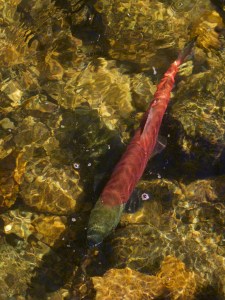 Stage 2 [not yet started, Dec. 2016] will restore important
fish habitat features within Mission Creek, including
meanders, pools, and overhead cover.
This will increase rearing areas for kokanee [image right]
and rainbow trout, and includes areas of refuge from
high temperatures during summer low-flow periods,
and from predators such as osprey, blue herons, ducks, and racoons.
To view enlarged images below, click on each one. To close, click the X at top right of enlarged photo.


As well as restoring fish habitat over time, the dike realignment and resulting floodplain expansion is expected to provide other benefits such as reduced erosion and flood risks, enhanced wildlife migration corridors,improved water quality, recharged groundwater supplies, expanded recreational opportunities, and increased economic impacts.”
The point is that we enjoy tremendously this ongoing development project and look forward to the promised benefits. Whether they materialize or not, of course, depends on time, money, and effective management. Lots of locals are betting on success.
The Greenway is only one of the recent projects that we have become so fond of. In researching for this post, I’ve learned that Kelowna has an even longer history of seeking to protect and enhance the larger community. The Central Okanagan Foundation, instituted in 1977, (Inspiring Others To Give | Central Okanagan Foundation) with city and other support, created in 1990, a land trust that by 2007 had evolved into the Central Okanagan Land Trust [COLT]. (History | Central Okanagan Land and Trust)
In the early 90s, “the Thomson families in the Mission area of Kelowna donated 4.5 acres to the City of Kelowna and requested COLT hold a covenant on the property. This transaction was finally completed in 2006.” COLT has done a great deal more as well, but I’ll focus on Thomson Marsh (see Neighbourhood Map above) as it’s most relevant to us.
“In 1990, Gifford and Brenda Thomson and Ken and Dorothy Thomson decided they wanted to preserve a sanctuary of land surrounding Thomson Brook where it flowed through a portion of their Gordon Road farm which they were selling to the City of Kelowna for a community recreation facility [now Mission Recreation Fields].
They wished to ensure that wetland habitat was preserved undisturbed, for birds and wildlife, in perpetuity. They had a long-time involvement in the Central Okanagan Naturalists’ Club and Brenda was the first President of the Friends of Mission Creek who initiated the Mission Creek Greenway project. She was also a COLT director for a short time.
In 1993, the family made a donation of 4.5 acres to the Trust when the land was sold to the city, but the specific site was not determined until work on the land was complete. In the interim, a receipt was issued by the City, with the idea that the sanctuary would be transferred to COLT when the boundaries were identified. In the end, in lieu of ownership, COLT holds a ‘no disturb’ preservation covenant on the property that was agreed on with the city in 2005.
Today, the watercourse through the property takes up more than the original acreage and the whole length of Thomson Brook is a sanctuary, in addition to the wetland. Adjacent to Thomson Marshes, the City has created an arboretum with a walkway between the access road for the Capital News Centre recreation complex and the waterway and wetland. COLT conducts annual inspections of the sanctuary to ensure the conditions from the original baseline inventory prepared by Biologist Nicole Thomas in September 2004 are maintained”
(History of Properties | Central Okanagan Land and Trust).
So, to come to the point, the environment we’ve been so lucky to plunk ourselves into has only come into its present form in the last 10 to 20 years. And it continues to evolve beneath our feet. It won’t be the same as it is now in another 10 to 20. Change waits for none of us.
As Spring, my favourite season here in the Okanagan (see my discussion of “favourites” in the previous post, ha-ha!), slowly eases Winter out of the way and ushers in the migration season, birders enter a special limited time frame for looking for the last of the Winter birds. A priority for me this year were Bohemian Waxwings, a species I had never seen before the winter of 2014-15, even though they are considered a circumpolar group. I knew before we moved here that BOWAs came down annually to our elevation near lake level, and that chances of seeing them in their large flocks was good but getting close to them was not so certain. There’s plenty of food here in the city for the entire winter, especially berries of Mountain Ash or Rowan trees that are very popular in our neighbourhood. As well, Mission Park’s Arboretum is well stocked with a diversity of trees that could attract BOWAs. Last year, the Park’s Russian Olives and Callery miniature pear fruit fed Robins well into February, and it was on the “pears” that I attained my first shots of these bright and busy gorgers.


This season, I couldn’t wait! I had done what research I could. In late November I chatted with Mike, a neighbour who told me that every February, the BOWAs came by to clear out the berries on his Virginia Creeper. On December 10, late in the afternoon, they swept down into the great Weeping Willows near his home at the west end of Belmont Park. I had parked nearby and, with such poor light, had left my camera in the car while I walked along the Pond’s path to Park where I hoped to do a spot check for activity. Suddenly the flock erupted from the Willows and attacked Mike’s Mountain Ash on the street corner 50 meters away. I hurried back for my camera, and returned to find the Rowan berries that had been abundant on that tree were gone—even the ones that had been knocked to the ground in the initial frenzy. When the birds retreated to the Willows, I was at least able to capture their numbers.


Over the next few days, I assumed that they would return for the Rowan berries in adjacent back yards, but November passed, then December and January, and while I occasionally saw the flock either flying or perching high above Mission Creek Greenway, completely out of camera range, I kept hoping that I would get lucky either in Belmont Park (BP) or Mission Rec Park (MRP). On the 26th of February, Mike and I crossed paths and spoke about the BOWAs’ absence this season. His VC fruit was gone, but the neighbours’ Rowans were still pretty much intact. The pear and olive trees in MRP had been picked clean early in the winter, whether by BOWAs or not, I’m not sure, but in February, there was very little left even for Robins. I began to fear that I’d missed my chance for this year. Bohemian numbers decline in March when their cousins, Cedar Waxwings, begin to reappear.
By a combination of the good luck of being out for a walk with my lucky charm, Nana, and of having had our plans disrupted several times that afternoon, we were returning home so late that I had packed up the camera, the light having fled behind clouds. When we reached Belmont Park, we had to choose whether to take a shortcut or to walk through the park and around the pond. It was a tossup, but the shortcut option was discarded, and we took the longer way round. Good choice, it turned out!
As we neared the west end of BP, we noticed a flurry of activity in the Sycamores but couldn’t be sure what we were seeing. Starlings, probably, we thought. The light was improving rapidly as the clouds gave way to the late sun when suddenly it became clear— the BOWAs were back for the Rowan berries, just as I’d hoped, though the beggars had left their visit to nearly the last minute! Nana was impressed with her first look at BOWAs. As we were going out for dinner that evening, she needed to hurry on home, but I remained to get what shots I could….


On March 3, I saw the BOWAs in a tree on the edge of our condo property, but couldn’t get shots, although, in my walk through BP earlier in the day I had seen a handful occupying a tree next to an even smaller flock of Cedar Waxwings. I wasn’t too concerned because I already had my BOWA images for 2016. The next morning, however, when the Bohemians showed up in the condo trees again, I suspended my exercise plans, and hustled out to see what I could get. This time, they were gorging themselves on Cotoneaster berries at ground level, and washing them down at the neighbouring condo’s fountain. I’ll let you judge how well the photos turned out….


Suffice to say, in my world, getting Bohemian Waxwing images is truly a matter of luck (with a certain degree of preparation and awareness), and this year, thank the BOWAs, the Force was with me. Sometimes, you can only watch and wait and hope for the best….
 People sometimes ask me, “What’s your favourite bird?” Sounds like a simple enough question. Makes me wonder, though, why we ask each other about favourites—birds, food, movie or musical genre, places, people, games, forms of exercise, you name it.
Maybe we’re hoping to learn something, perhaps about a category we don’t know all that well, or even about the person we’re asking. Anyway, we ask.
Like many of the folks I question, I usually require more clarification before answering. Do you mean “of all time,” “anywhere in the world, or locally,” including “those I may have seen or heard only once,” or are you asking about “ones that I encounter regularly,” those that I find most “colourful,” “curious,” “surprising,” or “powerful,” or some other endearing or otherwise outstanding quality?
“Look,” they reply. “What first comes to mind when you’re asked this question? Surely that’s your favourite!”
Truth be told (and it should almost always, should it not?), I don’t think I think that way most of the time, and even when, for a moment, I’m wildly enthusiastic about some particular “thing,” something else inevitably pops up to distract me. Of course, I do acknowledge favourites within categories, but my focus of categories is constantly shifting. Tomorrow’s choice could be different from today’s.
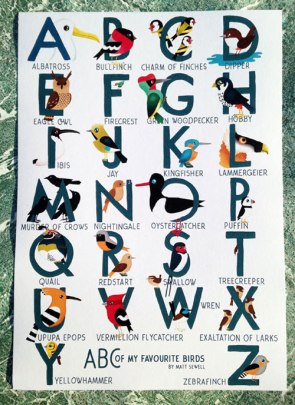 That said, with regard to birds, for me, “favourite” should apply to birds that I regularly, over the course of a season or a year, have a chance to encounter, am likely to feel excited about seeing and/or hearing, and, probably, have some kind of history with (“most impressive” might yield different results from “favourite”). Birds that have sat in my hand, voluntarily, or even permitted me to get very close, either out of some sense of trust or merely a lack of fear are likely to top my list. The more I’m out in nature, the more I have intimate encounters with its denizens. Now that photographing birds is such a big part of my life, interaction has become increasingly satisfying and an objective to pursue.
So, to get on with answering the question, I’m going to focus on birds in the past year with which I’ve had close encounters, and I’ll separate them into four groups: small songbirds, bossy birds, waterfowl and other birds that live off the water, and raptors. And to make it easier for myself, I’ll start with the last group.
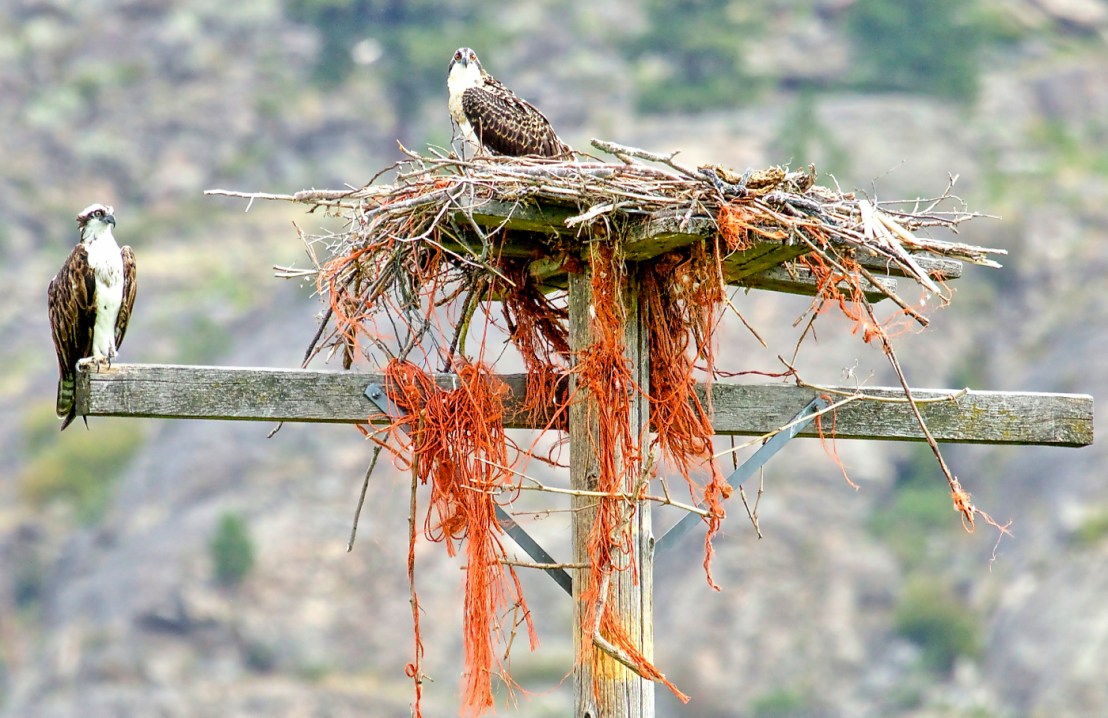
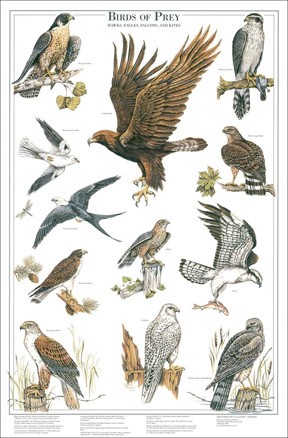 In Kelowna, the main raptors include two species of eagles, a couple of hawks, falcons, owls, and, finally, Ospreys (which, of course, are also included among birds that live off the water). Yes, an Osprey is a hawk, but it’s unique, yet distributed world wide (except in Antarctica); I have vivid memories of a pair hunting spectacularly, diving repeatedly, over the Teshio River in Northwestern Hokkaido, as well as many I’ve observed in various parts of western Canada. The Okanagan Valley offers wonderful access to these birds. A great spot where several Osprey nests can be found within sight of each other is the estuary of the Osoyoos River near the BC—US border, about an hour and a half south of our home. The image below shows a parent, likely the male on the left, and a juvenile still in the nest on a platform erected specifically for Ospreys. Apparently they love the bale twine from the nearby hayfields!
In the Kelowna area, we are also blessed with many Ospreys that have long staked out particular habitats for themselves and are well observed by people who may only know one particular location well. (I must add, that, unfortunately, in my experience, many people think they’re eagles, and others often mistake other hawks for Ospreys. I’m doing what I can to help those I encounter become better informed.)
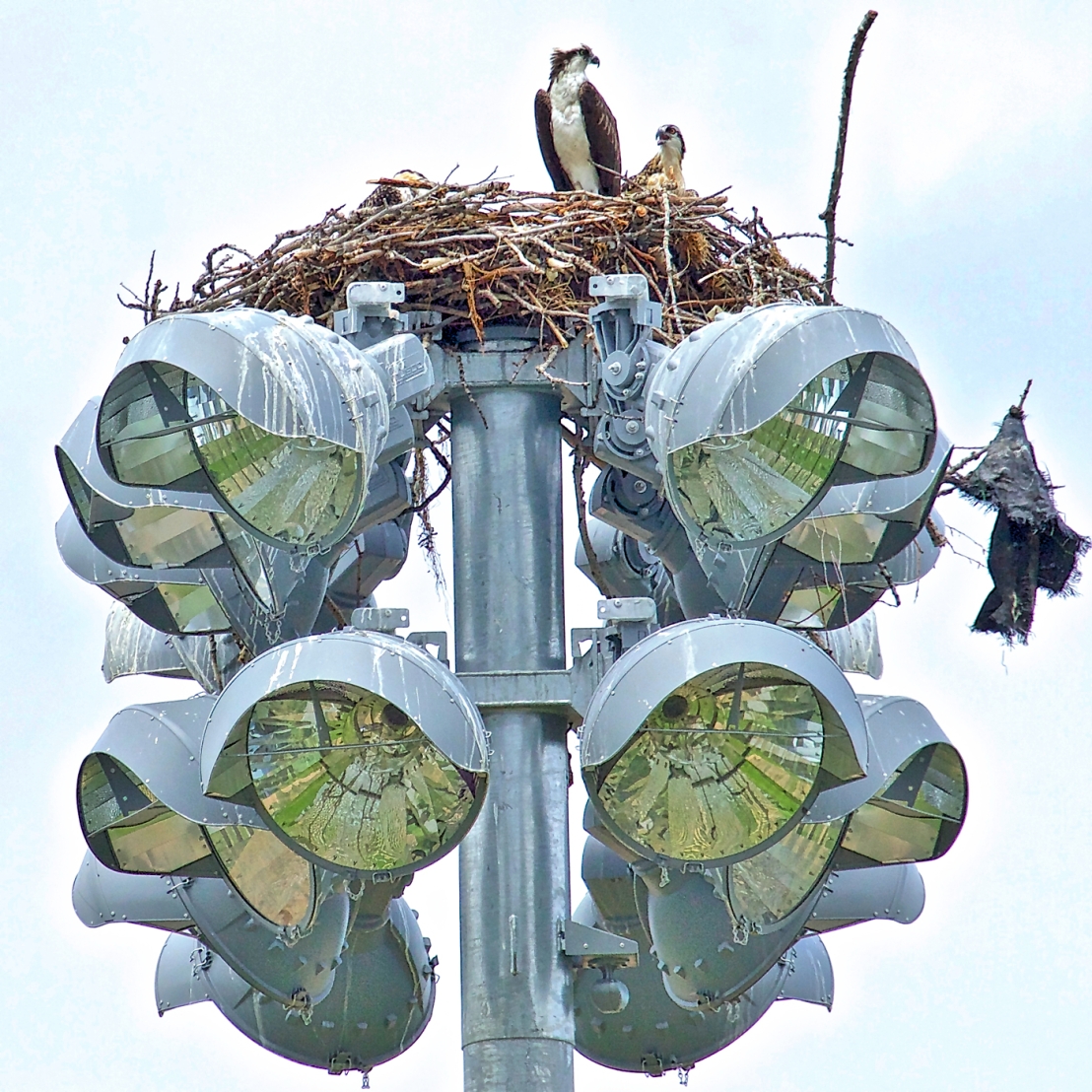
My favourite Osprey family annually nests at the top of one of the great lights above the Mission Recreation Field, which I can see from home and hike to in a very few minutes. In our first year here (just ending this month), I had the privilege to watch the parent birds successfully raise two offspring that I was able to study at fairly close range. While I’ve had many wonderful close encounters with several other birds from the categories listed in the previous paragraph, those I had in mid summer 2015 with the newly fledged Ospreys rank extremely high in my memory, and I will write about those encounters separately.
This post, then, is a celebration of the Osprey, aka the fishhawk, river hawk, fish eagle, and sea hawk. What follows are several photos taken in various places at various times over the past year and a half of this amazing predator.
In spring 2014, I got my first set of an Osprey diving, at Iona Beach, just north of Vancouver International Airport, in Richmond, BC. To enlarge them click on photos in groups.
To close the enlargements, click the small x in the top left corner of the image.


A well-known British website, listing “21 Facts about Ospreys” presents this as #1:
“…the osprey lives on fish that it catches by snatching them in a shallow dive from the surface of the water.” 21 Facts about Ospreys
In my experience, Ospreys, as eagles do, in some places, will strike from a low angle, but far more impressive are Osprey predations where, after hovering into the wind, the hunter drops almost straight down on top of its prey with a great splash, driving its talons into the fish and nearly submerging before lifting off, often with great difficulty, with a prize that seems too large to carry. It’s an amazing sight—guaranteed to take your mind off the game when you’re on a golf course beside a lake that affords you a ringside seat as I used to have years ago in the Cariboo….
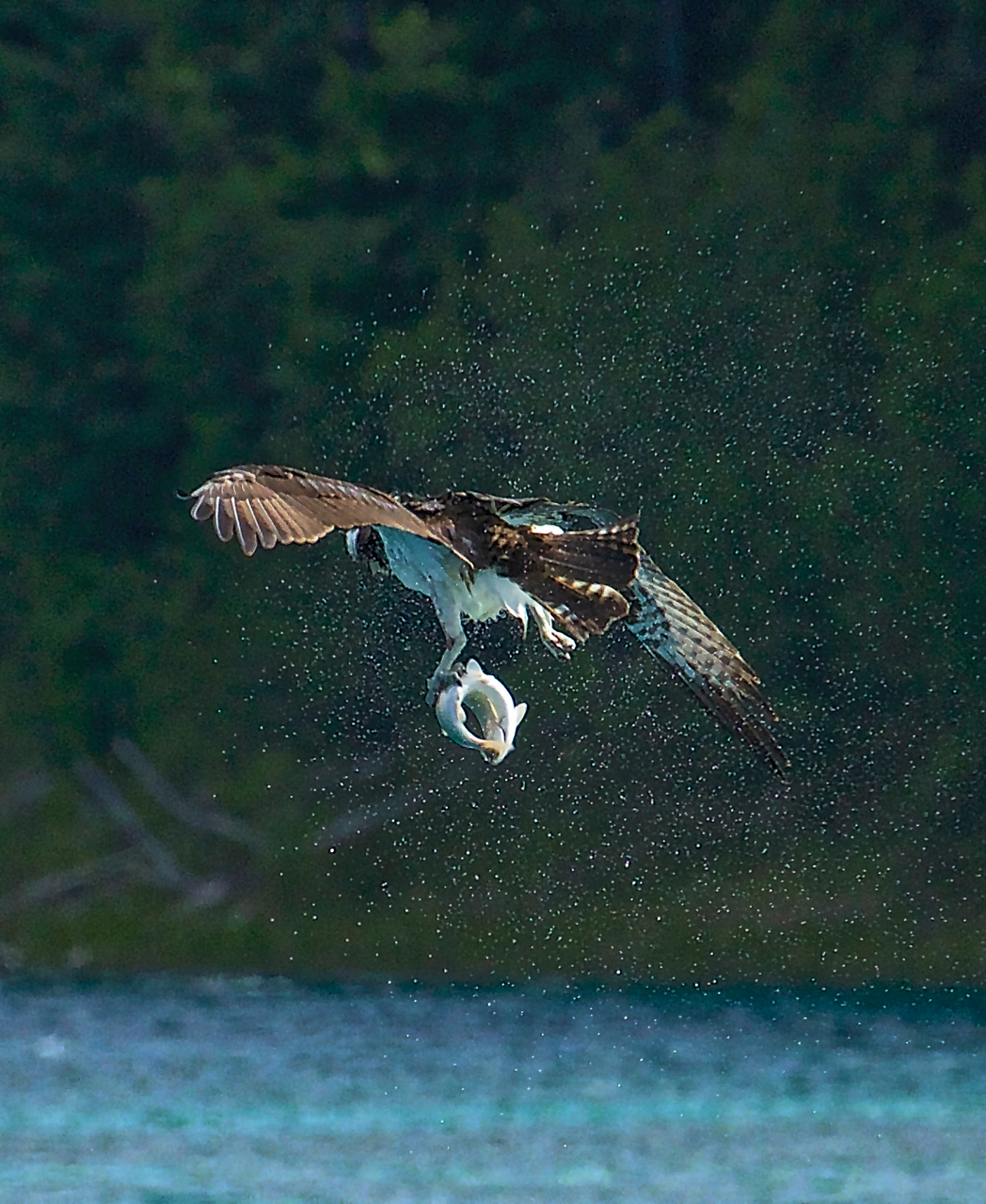
While I knew about Ospreys in the Okanagan long before we moved here, my most significant encounter with one up to that time happened in September 2014, early in the period when we were preparing to move here from The Coast. As my wife and I walked west along Mission Creek Greenway to where it intersects with Lakeshore Drive, we suddenly spotted, atop a hydro pole not far in front of us, a recently fledged juvenile preparing to dine on a Kokanee spawner it had just snagged from the creek. Within the year, I came to realize that this is a regular phenomenon to watch for in late summer/early autumn. I don’t think I’ll ever tire of watching these great fishers perform!


Seeing an Osprey soaring is especially moving as I hope the next three photos of different female birds indicate. According to the Cornell Lab of Ornithology, an adult female is characterized by a “distinctive facial pattern with bold black stripe through eye, sharply hooked black bill, glowing yellow eye, and [a] dark necklace across [her] white breast.”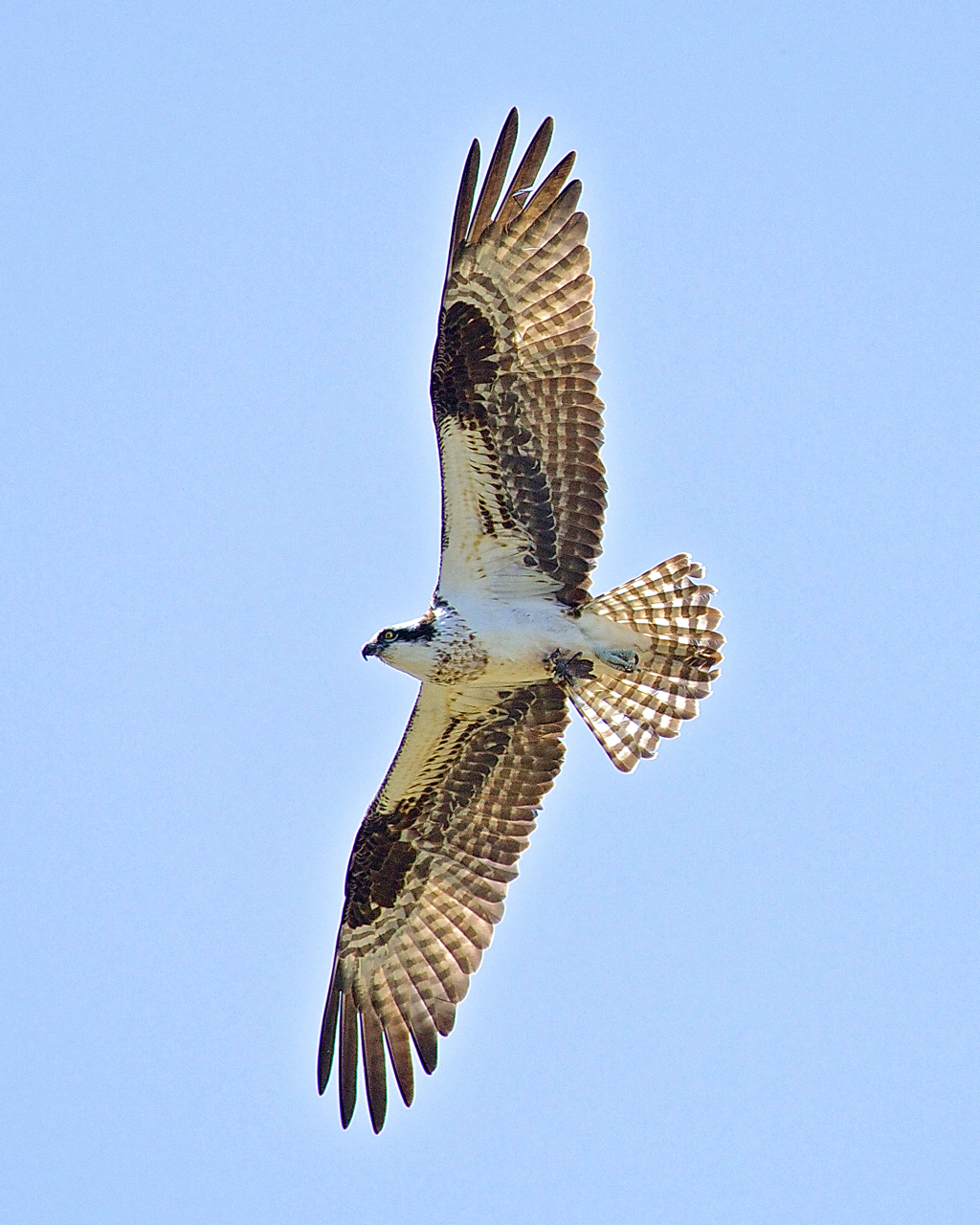
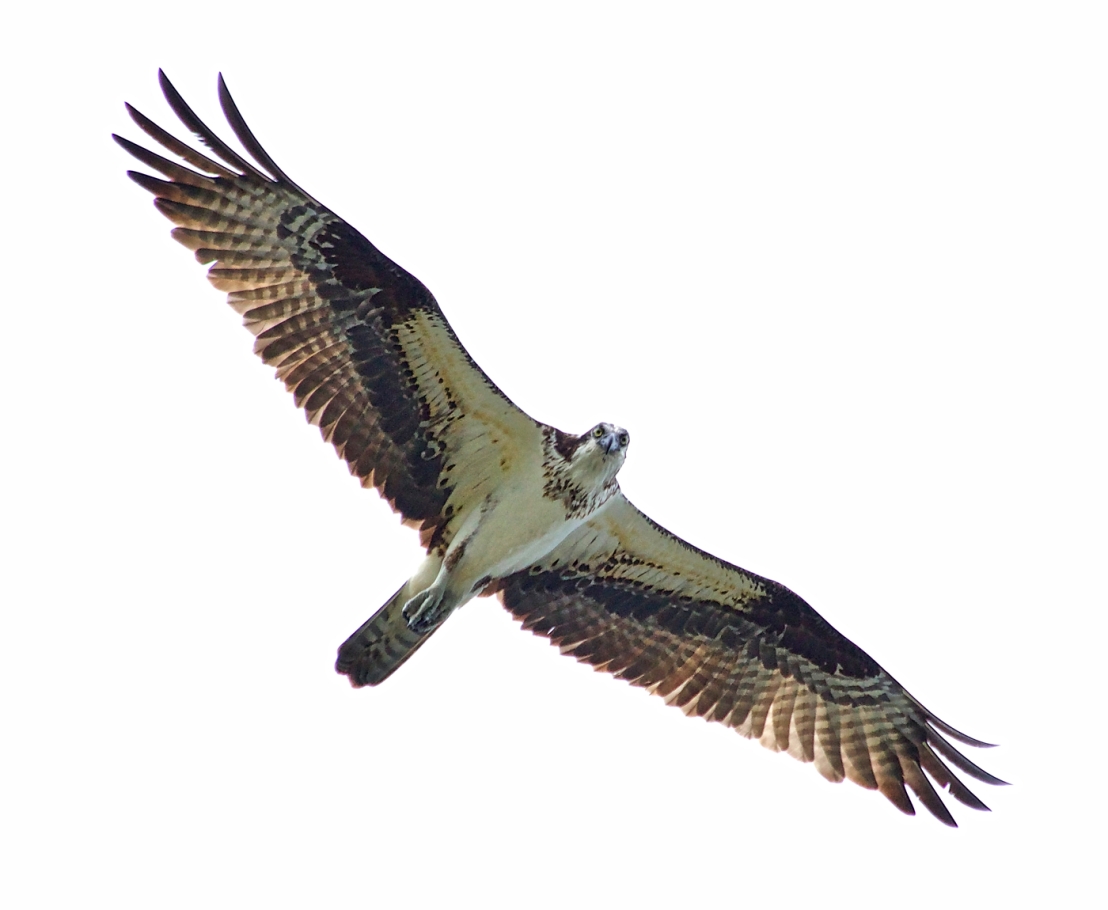
Juvenile birds like the one below have an orange eye, and pale scaling on the back and wings that fades to dark as they age. 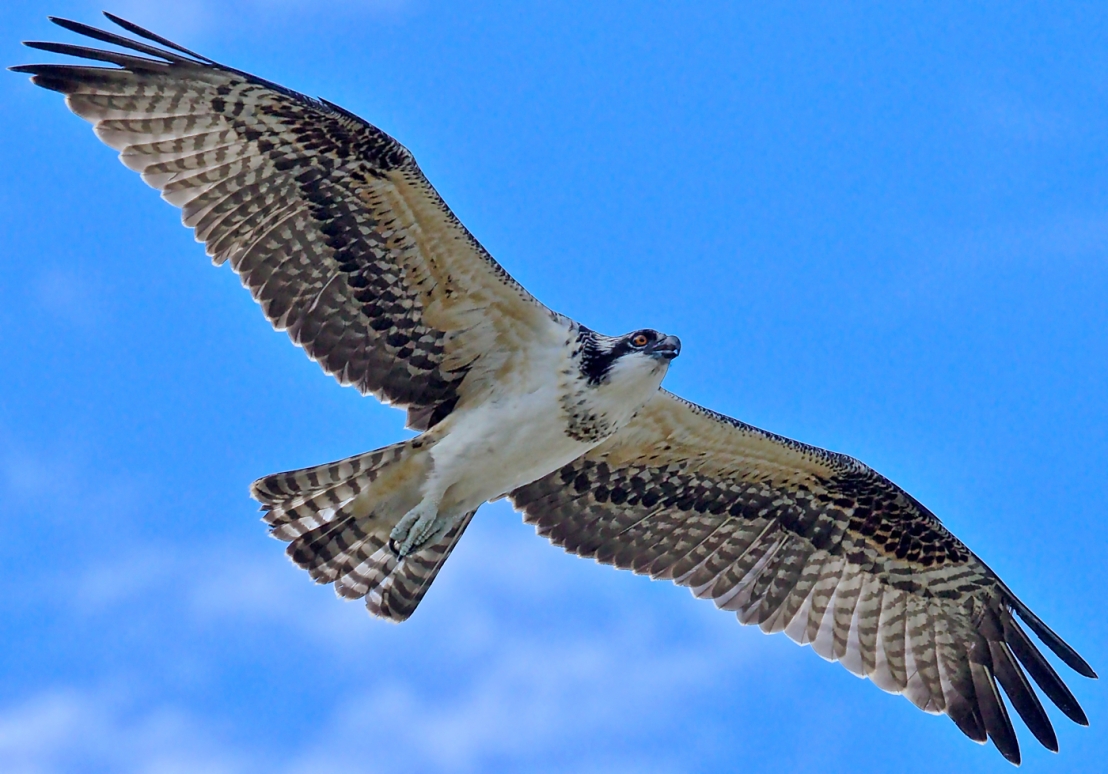
As mentioned earlier, I’ll prepare a special on the young Ospreys of the summer of 2015 that I enjoyed so much. Here’s a look at the one I dubbed Railbird; for more on this exciting experience, click this link….


For more on Ospreys, here’s a link to their Wikipedia entry: Osprey, Wikipedia
(Flight of Spring Ducks?)
Okay, it’s a bit much to mix the wonderful sonnet below, or at least part of it, with photographs of a Mallard drake taking flight, but has “a bit much” ever been much of a restraint for me?
From John G. Magee’s wonderful sonnet, High Flight, 1941….
“Oh! I have slipped the surly bonds of Earth
And danced the skies on laughter-silvered wings;
Sunward I’ve climbed, and joined the tumbling mirth
of sun-split clouds, — and done a hundred things
You have not dreamed of….
(For the rest of this inspiring piece, and more on the 19 year old RCAF pilot from the USA who wrote it not long before his death in combat, see this link:
Magee High Flight
And now for the “Mallard takes to the skies” images….
Click photos to enlarge them; click the x (top right of images) to close a set.
You can enlarge a single photo even more, and in a new tab, by
finding and clicking on the photo data box bottom left of each image.


These 11 images represent my first success in trying to capture this action. I was very fortunate with the light, and am surprised that the shutter speed was adequate to capture the action. What I’m happiest about, with this hand-held photography, is that I was able to keep the duck in the middle of each frame during the two seconds (according to my camera’s date/timer) that it took to shoot this content….
Here are all 11 photos in one tiled group:


 birds & musings