Category: Birds

Raptors on my Beat—Winter 2016-7

For Navigation Help, click here.

WARNING to all who venture here: this is a VERRRRY looong, very image heavy post…! 

rtha-in-flight-being-harrassed-by-a-gull-2015
RTHA harassed by gull, Oct. 2015 (Click to enlarge in new tab)

I am very grateful that our area is served by dozens of raptors, especially Red-Tailed Hawks. In what I call “my beat,” shown on the map below, each winter presents several different individuals. 2015-16 provided four RTHAs and one very friendly female American Kestrel. (UPDATE: she has found her mate and is frequently copulating.) I’m pretty sure I’d be UNable to differentiate so well at The Coast, given that I had to drive to find hawks and kestrels. Here, they’re only five minutes’ walk away, or, in many cases, a glance outside the window from my computer. We also see Bald Eagles frequently, and I’ll include them at the end….

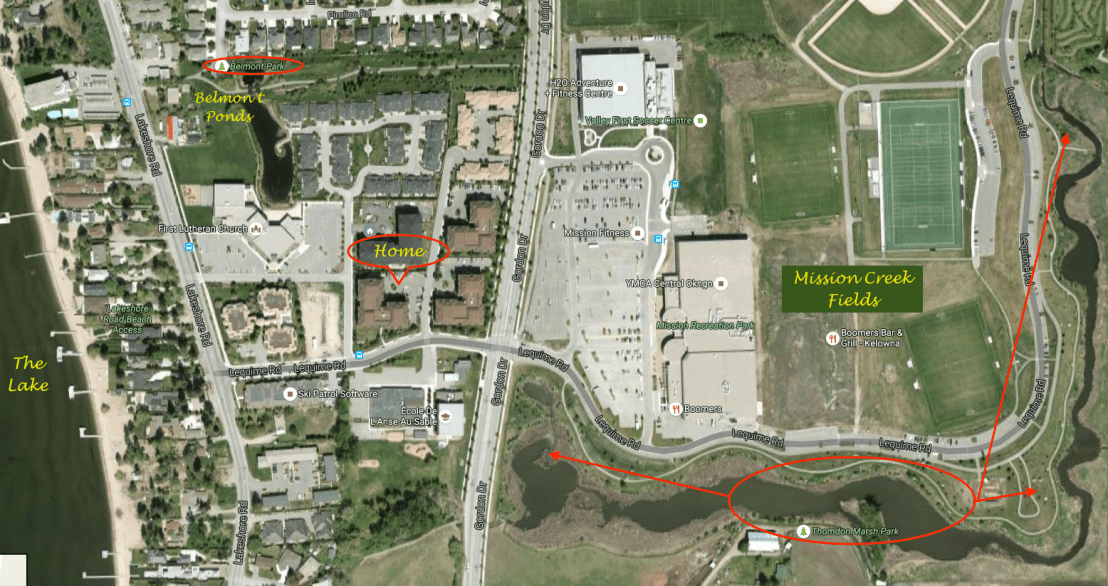
We’ll start with the maps: first, the area, then the birds’ territorial map:

area-of-my-beat

red-tailed-hawk-territories
Click image to enlarge in a new tab

And now for the raptors:

Kessie, the female AMKE covers the territory of all the hawks west of the creek that is the basis of Thomson Marsh (and east of Gordon Road, and south of Mission Creek). I’ve been interacting with her since January 2015; she’s very friendly, of her own accord (i.e. no one’s baiting her or doing anything to entice her). She’s simply comfortable around people and cameras, and will often fly with me and others on our walks. She’s quite willing to look right at me when I whistle, and on lots of occasions has flown from distant locations to much closer perches almost as if she wants to be photographed. I’ve featured her before on this blog; here are a couple of new photos from the late winter of 2017 that I’m very happy about:

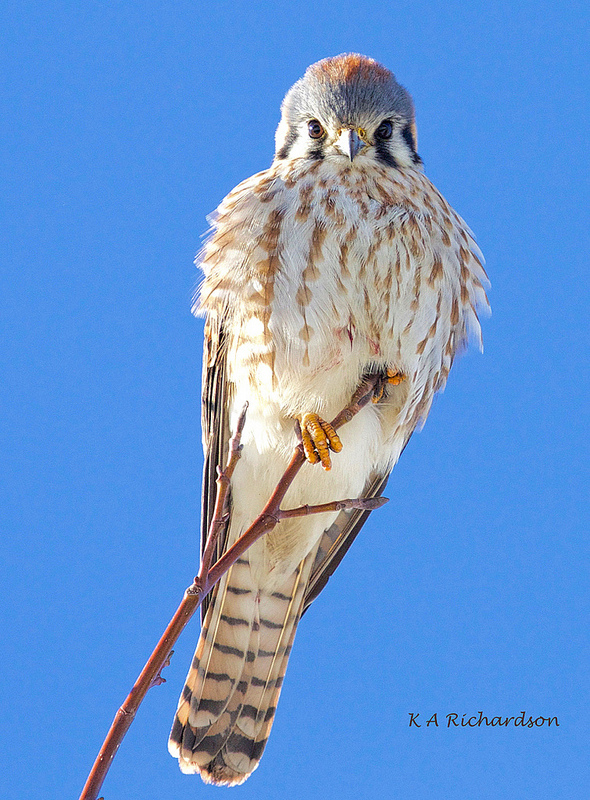
I thought the first one below was a pretty good look, but then I realized that I wasn’t pleased with the branches and told her so, telepathically. So she backed up to a better perch, gave me time to stagger up through the crusty snow and take more than 50 shots.

The first shot:

Kessie against a cerulean sky.jpg
Kessie against a cerulean sky….

and the improved perch on a different tree:
Kessie making my day!.jpg

Kessie makes my day….

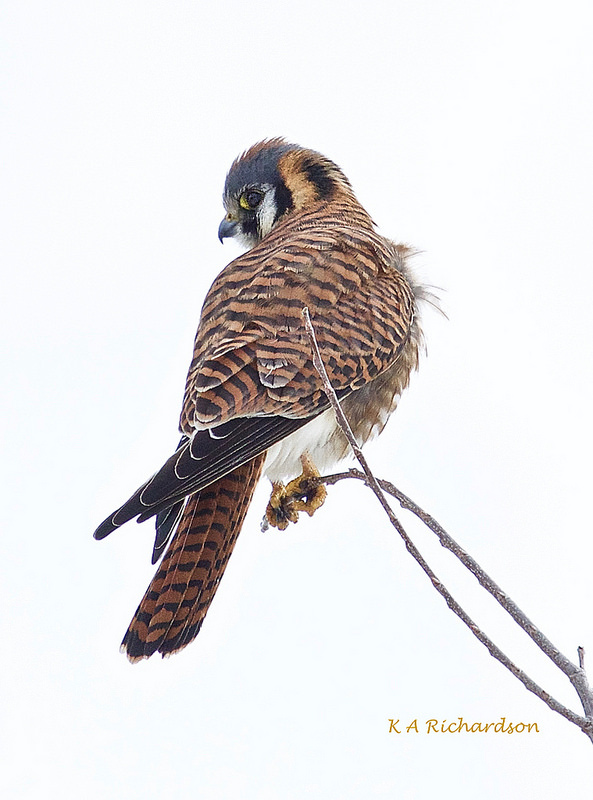
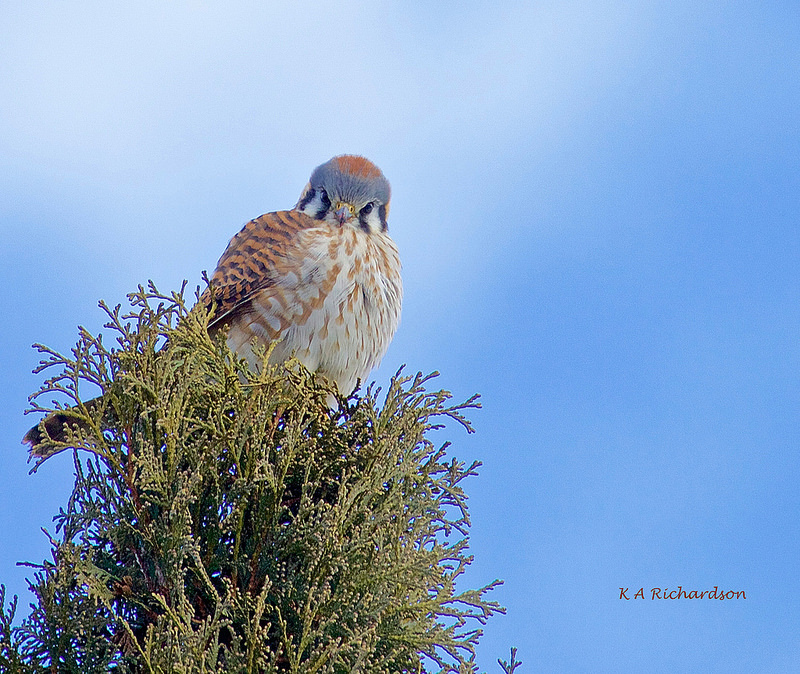
Several days later, I watched and worked with her for twenty minutes while she scanned the area searching for lunch. Eventually, she caught a vole, flew up to one of her lamp post perches, and took her time dining, before retiring to a Cedar shrub….
Kessie looking for lunch.jpg
Kessie looking for lunch….

Kessie enjoys a lite lunch.jpg

Kessie enjoys a lite lunch…. (Click image above to enlarge in new tab.)
Kessue resting after lunch.jpg

Resting after lunch…. (Click image above to enlarge in new tab.)
Interaction like this would be enough to make any day special!

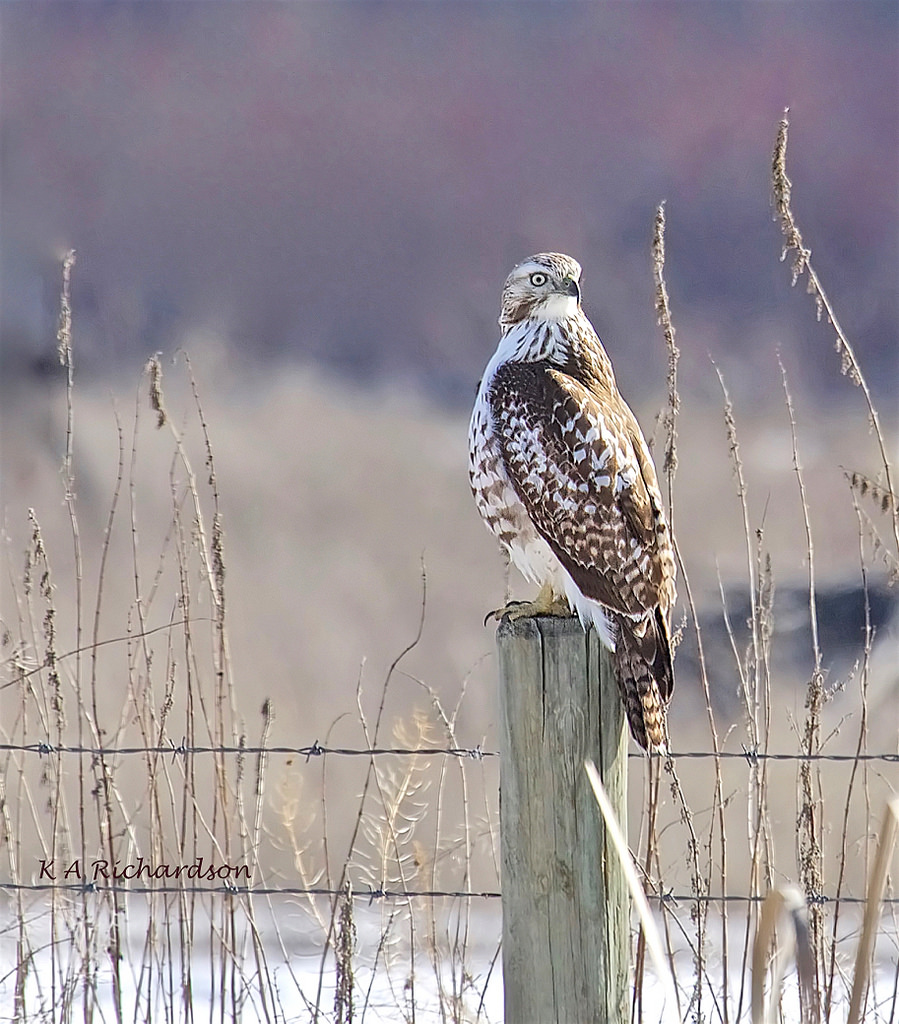
But I promised you RTHAs, so let’s begin with a newcomer and my favourite, and a familiar greeter of so many of the folks who walk their dogs and their kids and spouses ’round the perimeter of the Rec Fields. I credit Mel Hafting (aka Birdergirl) with identifying Whitey as a Buteo jamaicensis harlani—a Harlan’s subspecies or possibly separate species depending on whose authority you accept. Whitey arrived sometime in December. I didn’t realize that he was here for the winter until December 22, when I got a series of shots as he perched on a large dirt pile behind the Capital News Centre Rec Facility about 300 meters from home. He allowed me to walk up to within 30 meters, and we’ve been good friends ever since. (Note: I say he, but I have no way to know the gender!)

Whitey on the dirt bank.jpg
Whitey on the dirt bank behind the Capital News Centre (CNC)….

I have many precious images of him, whether at a distance in the Raptor Tree across the Marsh or in various parts of his southern and eastern range as shown on the map we started with. Here are some of my favourites:

Whitey grooming in the Thomson Marsh Raptor Tree.jpg
Whitey grooming in the Thomson Marsh Raptor Tree….
Whitey in the Raptor Tree on a different day.jpg
Whitey on the other side of the Thomson Marsh Raptor Tree on another day….

and some close ups near the entrance to Mission Rec Fields, just south of the CNC arena:
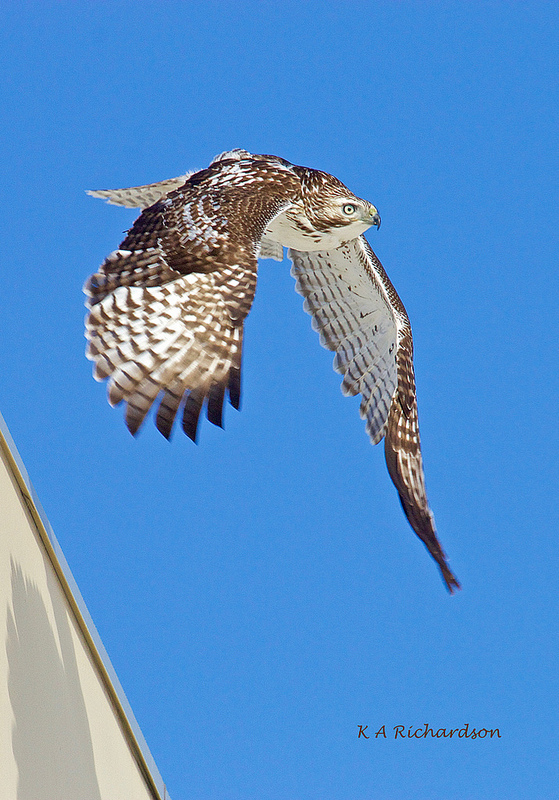
Whitey leaves the edge of the Capital News Centre Rec Facility to harvest a quail.jpg
Whitey leaves the edge of the CNC roof in an attempt to harvest a quail….

On this day, he hunted the same area from his lamppost:

Whitey on his lamppost.jpg
Whitey on his favourite lamppost. Oddly, he uses only the path lights, never the giant field lights favoured by Ready Eddy (Re’ddy)….

and was successful:

Whitey catches a vole - 1.jpg
Whitey catches a vole – 1
Whitey catches a vole - 2.jpg
Whitey catches a vole – 2. Can you see it?

Whitey can spot competition a couple of hundred meters away. It seems that the only threat he really cares about is at the eastern fringe of his territory. When Harri or Sunny dare to cross the invisible boundary, Whitey is likely to fly over and let them know who’s boss. I’ve not seen actual combat, but its always the other birds that retreat to their own territories. On the other hand, Re’ddy, who encroaches from the north, usually by roosting on one of the giant field lights that illuminate the Rec Fields, is never challenged by W, nor does R challenge W. (Actually, Re’ddy is a bit of a chicken hawk, it seems to me). R and W simply ignore each other.

Whitey on a lamppost watching Harri the invader.jpg
A long shot of Whitey on a lamppost watching his rival Harri who has crossed the line. Eventually, Harri retreated.

Recently, as it appears that Harri has left the area (more on him in a moment), I see Whitey exploring more of the the eastern side of the territory, even perching occasionally on the fence posts that Harri had called his own….

Whitey in a delicate perch at the east end of his territory.jpg
Whitey on a delicate perch at the eastern edge of his territory. I’ve seen none of the other hawks I study attempt this; Whitey often does….

Whitey in the Osier Dogwood (again)  -.jpg

A better indication of Whitey’s perching skills on his eastern perimeter….

Whitey in the Osier Dogwood (again) - (3).jpg
And one more  low branches closeup….
whitey-takes-control-of-the-marsh
Whitey takes control, now sitting where Harri used to reign….

Now, I expect most of you can see that Whitey’s colouration and territorial range make him easy to identify, and I suspect that many are wondering how I can be so sure about the other three…. Turns out there are both physical features and, more importantly, behavioural idiosyncrasies for each one that make the job fairly easy. Keep in mind, too, that I can often see all four hawks at the same time!

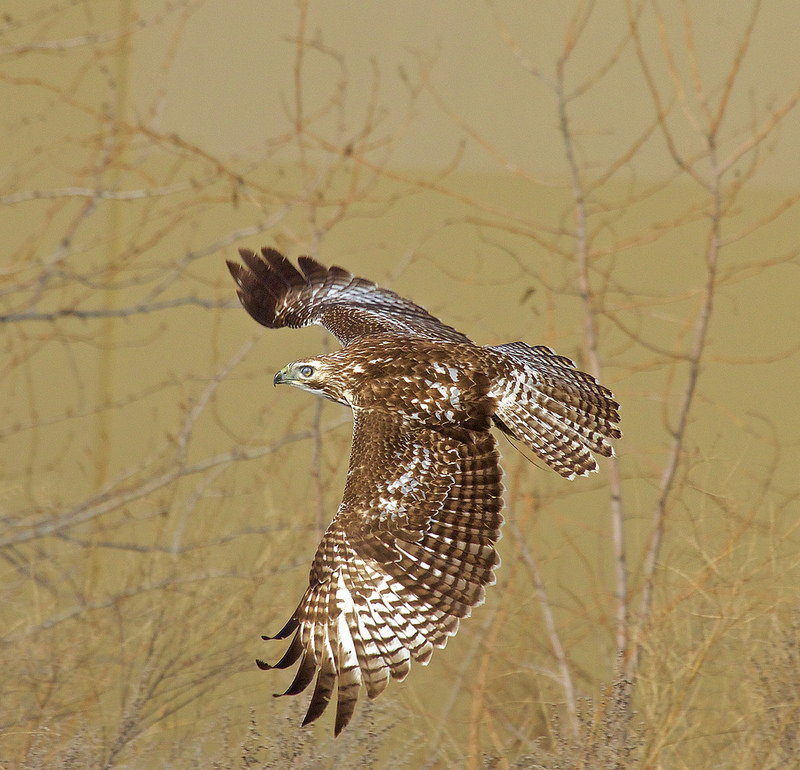
I’ll start with Harri, because I really don’t have decent photos of him. He rarely crosses the marsh into the Rec Fields. Instead, he cruises, Harrier-like (hence the nickname) along the fence line and through the great field on the east side of the Marsh, usually five to ten feet off the ground. When he does perch on a post, he takes flight as soon as he senses a camera being raised in his direction. He has a beautiful red tail (though it’s white underneath), and a light front that makes him a very desirable subject. On a scale of 1—10 for accessibility, where ‘1’ is “wrapped in the cloak of invisibility,” he’s a 3! Here’s the best I’ve been able to do with him so far:

Harri on a fence post of the east side of Thomson Brook.jpg
Harri on a fence post of the east side of Thomson Brook (Marsh). He may have already departed for his spring and summer hunting grounds…. Can you spot some obvious ways he differs from Whitey?

Reddy Eddy is a different character! He has been around for the past two winters. Like Harri, he hates to see a piece of glass, especially if it’s a camera lens; he’s even nervous about binoculars. He has three preferred roost locations, two in the Raptor Trees on opposite sides of Michaelbrook Marsh, and several of the giant field lights). I can see Re’ddy almost every day, but it’s usually a lot of work to chase him around and get a photo although he’s slowly adjusting to birder-paparazzi. He used to simply fly away; now, he’s more willing to fly up and find a thermal or even fly over me to a distant perch. Like Harri, and unlike Sunny, he has, besides a quite light breast, a white throat, and this spring, a red tail. These features, together with his intense need for privacy, makes him a character easy to ID.

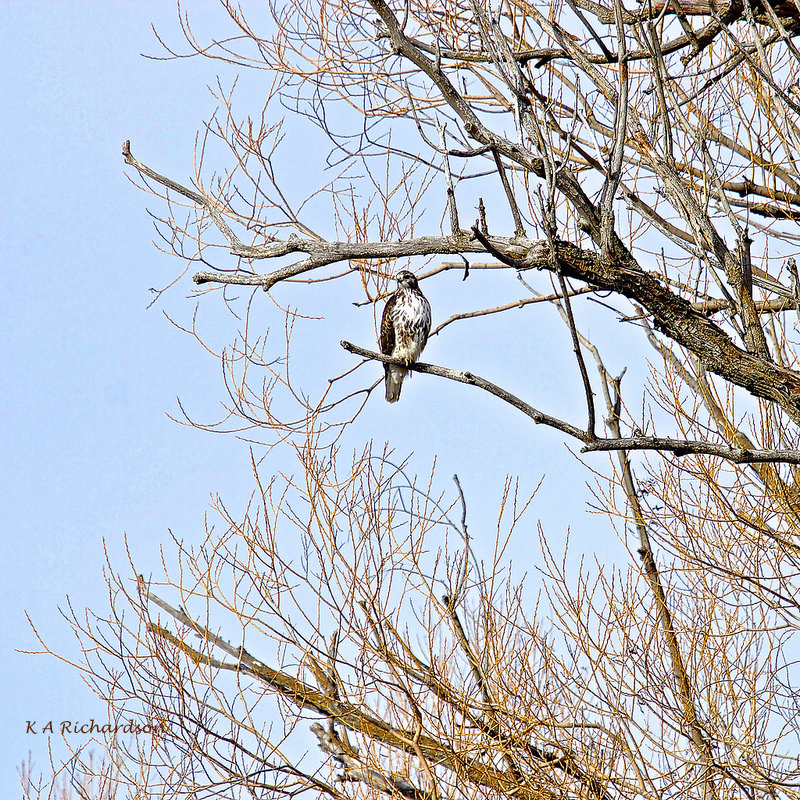
Re'ddy 2017.jpg
Re’ddy in the south Michaelbrook Raptor Tree.
Re'ddy 2016 —
Re’ddy in the Big Willow southeast of the Dog Park.
Re'ddy in Michaelbrook Raptor Tree.jpg
Re’ddy in the northwest Michaelbrook Raptor Tree.

This is Re’ddy being attacked by a Red-winged Blackbird on March 25, 2016 — before he acquired his red tail. Click on the photos for captions and to enlarge. To close the expanded window, click on the small x in the top right corner.

All I wanted was a shot of Re’ddy in flight (after he’d eluded me all winter), and what I got was so surprising and much better! You can’t wish for opportunities like this!

Finally, allow me to present Sunny, a newcomer last autumn who occupies the northeast quadrant of the map. On that 1-10 scale mentioned above, I rate him a 7.5. He’s camera tolerant but doesn’t really care to be stalked. When hunting, however, he maintains his focus pretty well and tolerates the yelps of dogs and people from the Dog Park while he hunts in the fields and mounds to the east. Recently, he seems to have expanded his territory, especially towards the Casorso Bridge and the Trapalanda Farm. Sunny has a darker head than Re’ddy, a dark throat, and dark eyes.

Why Sunny? Because my first photo of him was this one in early November 2016; click to enlarge these photos:

He’s handsome and he knows it; clap your hands!

And then we get the occasional interloper that just doesn’t quite fit. I used to think this was Sunny, but the flight photos clearly show a white throat and a dark tail just beginning to turn red.
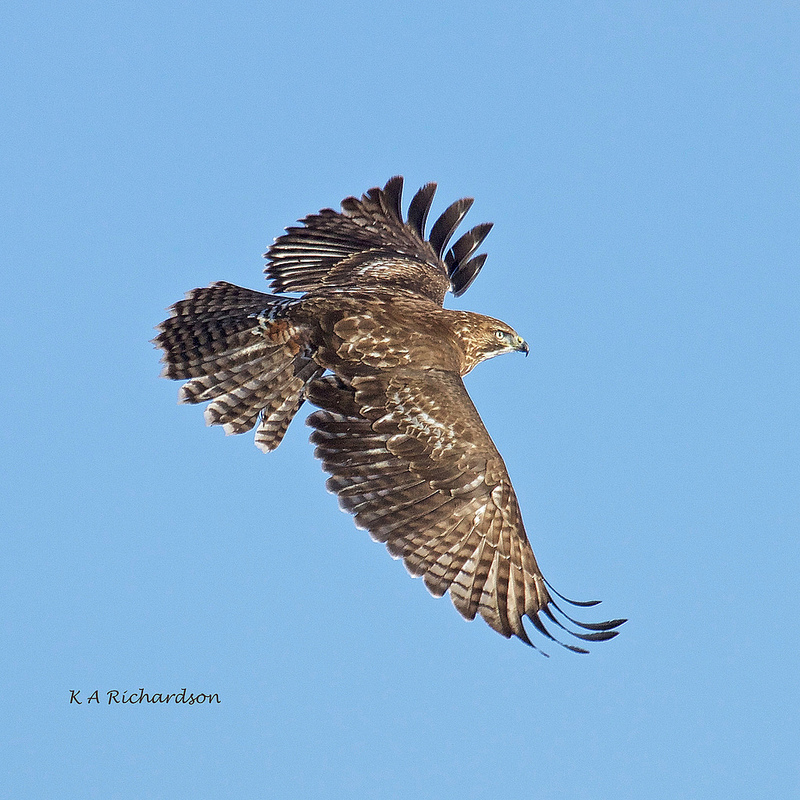
An interloper?.jpg
Who is this handsome dude? (January 4, 2017)

He can’t be Re’ddy (he didn’t behave like R. at all!) and the white throat doesn’t fit Sunny either (although I realize that there are plumage changes as juveniles age). As well, he’s way out of Harri’s range, and doesn’t fly like him. So, for all my certainty, there are still mysteries to be explored….

A lot of photos and explanation. For the few who took the time to read to the end, I hope you enjoyed the tour of my Red-tailed Beat….

Cheers!  😃

Oops! Almost forgot I’d promised eagles. Here’s a couple of shots I waited all winter to get:

Baldy - 1.jpg
Bald Eagle, likely male, on an exposed branch on the north side of Mission Creek.

This one and its mate were hanging out near the old nests just north of Mission Creek. Sadly, no sign that they’ll use them this spring.

Baldy - 2.jpg
I love every bird who takes the time to scope me back!

To all who stayed in for the whole show, thanks for your patience!

thumbs-up-happy
Well done!

Index of 2016 Water Bird highlights

For non water-birds of 2016, click here:

Water Bird Highlights of 2016 in photos and text:

Part 1: Waders and shorebirds: American Avocets, Black-necked Stilts, Killdeers, Sandpipers (Least, Solitary, Pectoral), Lesser Yellowlegs, Wilson’s Phalaropes.

For Spotted Sandpipers from 2015, click here.

Part 2: More waders and shorebirds: herons—Great Blue and Green

Part 3: Some ducks and coots : American Green-winged Teals, American Coots, American Wigeon, Buffleheads,  Goldeneyes: Barrow’s and Common

Part 4: More ducks: Gadwalls, Hooded Mergansers, Common Mergansers, Common Loon, Mallards

Part 5: More ducks: Northern Shovelers, Pied-billed Grebes, Horned and Red-necked Grebes (briefly), Redheads, Ruddy Ducks, Teals—Blue winged and Cinnamon, and finally, Wood Ducks.

Part 6: Geese and swans: Canada Geese, Snow Geese, White-fronted Geese, Tundra Swans.

Highlights of 2016, part 6–geese & swans

Canada Geese with Cackling Goose
The Cackling Goose is much smaller than its cousins. There are so many subspecies, even among Cacklers that I can’t tell apart. Click to enlarge in a new tab.

To begin with, let me say that “geese in the Okanagan Valley” is a very controversial subject, with opinions varying from “How nice to have so many of these great Canadian symbols in our back yard” to “Kill off all of these pests fouling [which is different from fowling] our beaches and playing fields!” For a pretty fair assessment of the issue and its debaters, have a look at this article , which explains that, in the first place, Canada Geese are not native to the Okanagan Valley. They were introduced by well-meaning folks in the 1960s and ’70s (according to the article) and have flourished [or dominated] here ever since. Goose management is now a major concern of almost everyone in the Valley.

That said, for birders, there are several varieties of geese, including several subspecies of Canadas, and accidental Snow Geese and Greater White-fronted Geese noted here every year. A few photos will suffice to illustrate what we see….

Last spring (2016), I was privileged, I felt, to find a Canada Goose nesting just across the brook in Thomson Marsh. Although I kept checking on her, I missed the hatching, and the parents and their offspring either moved to a safer location or suffered predation. One never knows. It was interesting to see the gander a few meters away seemingly keeping watch. He wasn’t there all the time, however, unlike goose pairs I’ve observed in other places. And oddly, one day, there was a Mallard drake stationed only a few meters away from the goose on her nest. Not quite sure what he was looking for…. Click images to enlarge.

Swans visit the valley in winter, a mix of Trumpeters and Tundras. I didn’t photograph any of the former last year (and not for political reason, I must add, though that might have been a subconscious factor), but got some pleasing images of a young Tundra family in Okanagan Lake near Maude Roxby Sanctuary.  Click images to enlarge.

In the spring, the Snow Goose that stayed for several weeks at the Thomson Farm (just south of the Marsh named for this farm family that donated the land that made the marsh sustainable) was accompanied by this lonely Tundra Swan. It was quite independent yet capable of getting along with the small flock of geese and its white cousin. It will be interesting to see if we have a similar situation this spring….  Click images to enlarge.

Highlights of 2016, part 5–more ducks– N to end

Almost done with ducks and their cousins, but this is a very long post!

You may have noticed that I’ve skipped over geese and swans, which I’ll cover separately….

n-shoveler-range-cornell

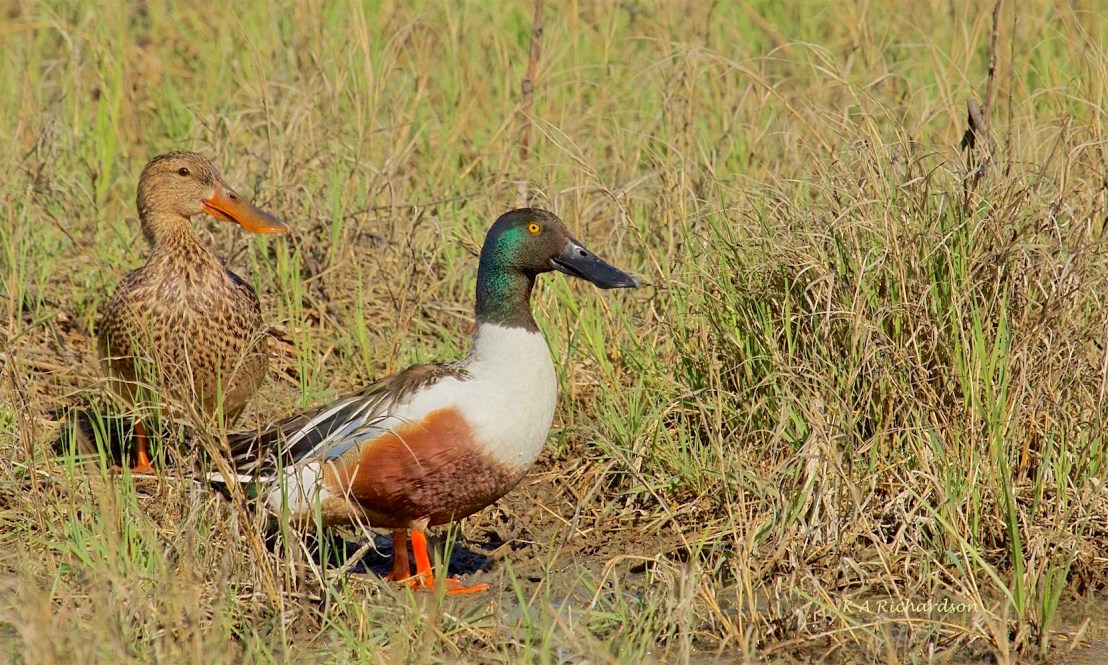
First up is a duck that I had enormous difficulty getting close to at The Coast, with one notable exception at Piper Spit, Burnaby. Up here, however, especially at Robert Lake, despite its tiny viewing area, I’ve been able to do much better with Northern Shovelers. I was also able to observe them in a more natural setting in Michaelbrook Marsh.

While predominantly a western duck during breeding season, the NSHO can be seen in other parts of Canada and North America in other seasons.

“Perhaps the most outwardly distinctive of the dabbling ducks, the Northern Shoveler inhabits wetlands across much of North America. Its elongated, spoon-shaped bill has comblike projections along its edges, which filter out food from the water.” Cornell Lab of Ornithology

northern-shovelers-2
Northern Shoveler pair at Robert Lake, May 2016. Click to enlarge.


Northern Shoveller
Magnificent in spring! Click to enlarge.

The bill of the Northern Shoveler is about 6.5 cm (2.5 inches) long. The bill has has about 110 fine projections (called lamellae) along the edges, for straining food from water.

Northern Shoveler pairs are monogamous, and remain together longer than pairs of other dabbling duck species.

When flushed off the nest, a female Northern Shoveler often defecates on her eggs, apparently to deter predators.

The oldest recorded Northern Shoveler was a male, and at least 16 years, 7 months old when he was found in Nevada. He had been banded in California.” (Cornell)

NSHOs in mid May. To enlarge the images above, just click on them….

A month after the photos posted above were taken, the NSHO has evolved into this guy below:

Northern Shoveler – mid June
Our drake in mid June. Click to enlarge in a new tab.

Turning away from ducks for a moment, I must give some space to one of the smaller members of our local menagerie, the Pied-billed Grebe.

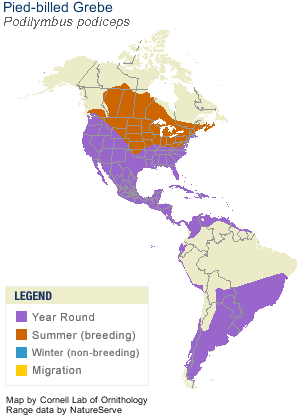
pied-billed-grebe-range-cornellPart bird, part submarine, the Pied-billed Grebe is common across much of North America. These small brown birds have unusually thick bills that turn silver and black in summer. These expert divers inhabit sluggish rivers, freshwater marshes, lakes, and estuaries. They use their chunky bills to kill and eat large crustaceans along with a great variety of fish, amphibians, insects, and other invertebrates. Rarely seen in flight and often hidden amid vegetation, Pied-billed Grebes announce their presence with loud, far-reaching calls.

In our neighbourhood, as with so many of the water birds, we see PBGRs in Belmont Pond and Thomson Marsh  just before breeding becomes intense. I wish they’d nest where we can observe the chicks, but they don’t. Part of the fun of this avocation, however, is the ongoing effort to learn more about the birds when the heat is turned up….

Pied-billed Grebe
(Podilymbus podiceps) large Belmont Pond, Kelowna, BC. Curiously, this one, an autumn juvenile, does not have the usual “pied” stripe on the bill….
Pied-billed Grebe
(Podilymbus podiceps) small Belmont Pond, Kelowna, BC. Smaller space, different light!

Part bird, part submarine, the Pied-billed Grebe is common across much of North America. These small brown birds have unusually thick bills that turn silver and black in summer. These expert divers inhabit sluggish rivers, freshwater marshes, lakes, and estuaries. They use their chunky bills to kill and eat large crustaceans along with a great variety of fish, amphibians, insects, and other invertebrates. Rarely seen in flight and often hidden amid vegetation, Pied-billed Grebes announce their presence with loud, far-reaching calls.” (Cornell)
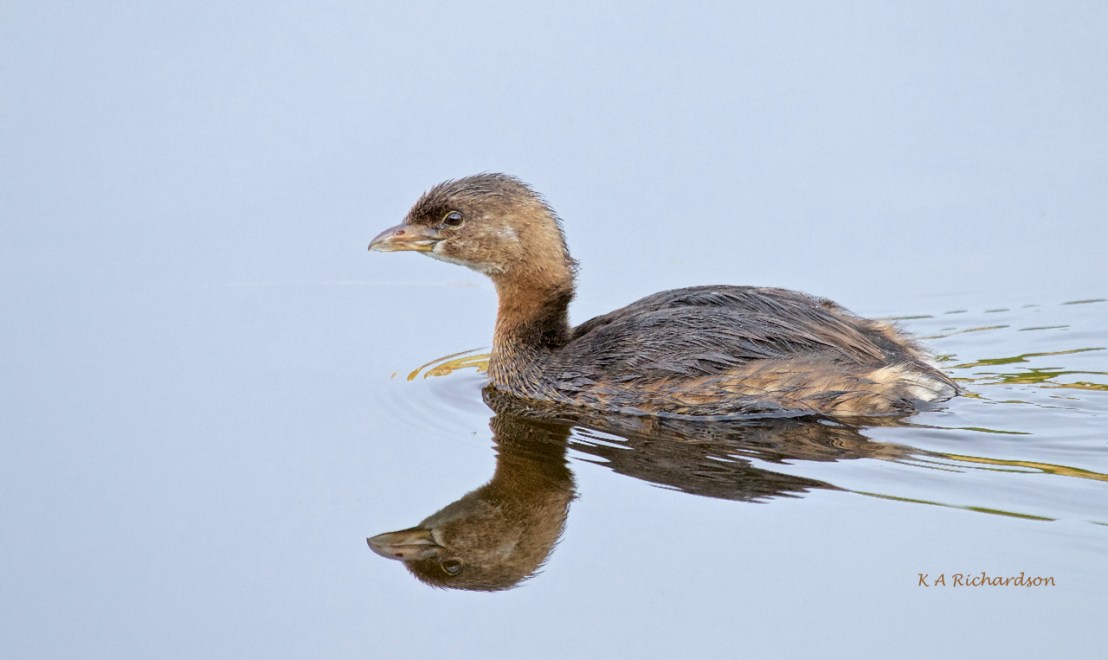
Pied-billed Grebe under duress - 2

We see other grebes as well, but so far I haven’t built up a very strong library of the Eared, Horned, Red-necked, and Western varieties. Another project for 2017!

Click to enlarge these record shot images:

And one shot of a Horned Grebe in winter plumage:

Where lake meets sky....
Horned Grebe, (Podiceps auritus) Okanagan Lake near Rotary Marshes, Kellowna. BC.

Two of my favourite spring ducks fall into the “R” category: Redheads and Ruddies.

Ruddy Ducks have a much greater presence in the West; Redheads are seen in more areas of North America. Each is a striking addition to any spring pond!

While 2016 did not provide opportunities as great as the previous two springs, it did not totally disappoint. We travel to Birdie Lake at Predator Ridge Resort south of Vernon each spring where we have been quite lucky with these species. No Ruddy in Belmont Pond this year, but we’re keeping our fingers crossed for a drop-in  this year. Surprise us, 2017, just as 2016 did when, for one day, we had Redheads in Thomson Marsh!

The image below was taken through some tall cattails on a cloudy afternoon. While it does not rank as a great image, it marks a noteworthy moment with its diversity of pond mates all crowded onto one heavy log! A most unusual find, unlikely to be replicated….

Redheads —special appearance
In Canada, we love diversity!

Click to enlarge images.

Ruddy Ducks, at least the drakes in breeding season are also known as Bluebills:

Another project to work on this spring!

From Cornell’s Lab of Ornithology come these two tidbits:

The bright colors and odd behavior of male Ruddy Ducks drew attention from early naturalists, though they didn’t pull any punches. One 1926 account states, “Its intimate habits, its stupidity, its curious nesting customs and ludicrous courtship performance place it in a niche by itself…. Everything about this bird is interesting to the naturalist, but almost nothing about it is interesting to the sportsman.” That’s an account from a different era, and one that I would question today. One can only imagine how the writer might describe human behaviour ninety years after he wrote that piece!

Ruddy Ducks are very aggressive toward each other and toward other species, especially during the breeding season. They are even known to chase rabbits feeding on the shore.”

Skipping Snow Geese and Swans, we move to another genus of ducks, Anas —teals comprising three species commonly found in BC. In Part 1 of this series, we met the American Green-winged Teal (and its Eurasian cousin the Green-winged or Common) Teal. In this concluding Part, we’ll look at two of the relatives: the Blue-winged and the Cinnamon. The latter is truly a western waterfowl with an amazing north-south range; the Blue-winged, however, is common across Canada. Here in the Okanagan Valley, I see more CITEs than BWTEs, at least in our two and a half years.

Teal males of all three species are striking. For me, the Cinnamon is most arresting,

teal-cinnamon
Solo Cinnamon drake….

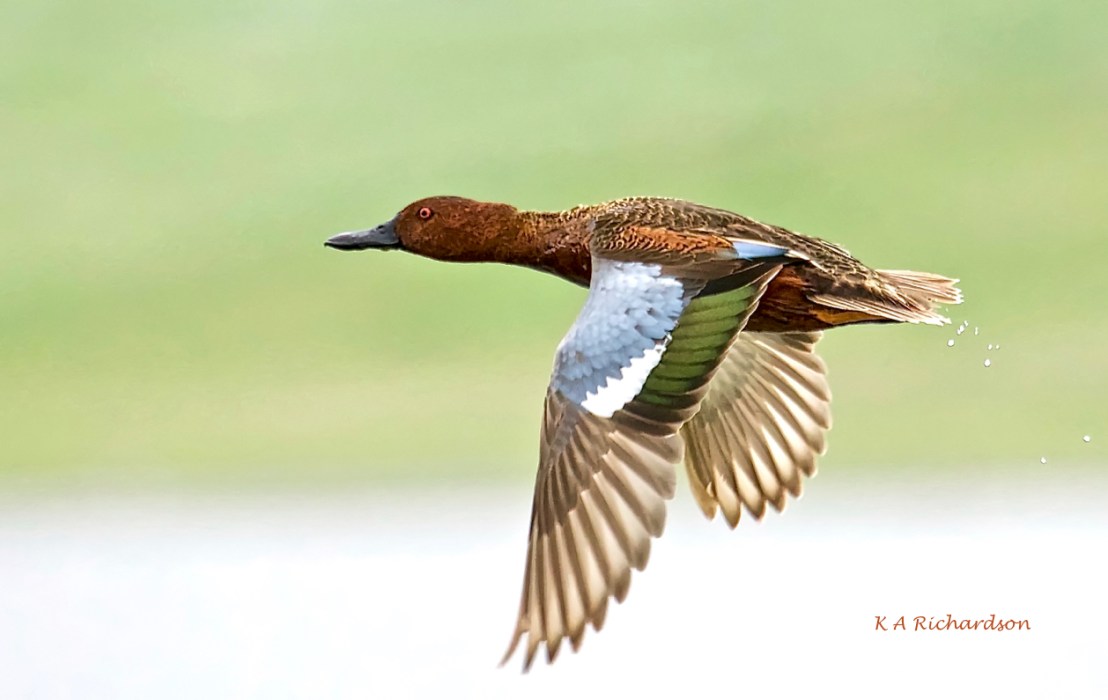
and especially beautiful to capture in flight with its combination of reddish brown, teal blue, and green. Not the best flight shot you’ll see, but my best so far. Another one to work on in 2017.

Cinnamon Teal in flight
Cinnamon Teal moving to a preferred spot at Robert Lake near Kelowna. Click to enlarge.

In 2015, I got my best CITE shots close to home. Last year, however, these ducks presented very well near the tiny viewing area at Robert Lake. This is my favourite shot by far.

Click to enlarge in a new tab.

teals-youre-so-vain-probly-think-this-photos-about-ya
“You’re so vain; you prob’ly think this shot is about you….”

I was very pleased the day that I found CITEs and a BWTE together in Teal Corner in Thomson Marsh. I had never seen a BWTE in this marsh before, and to have the two species together for comparison was a great bonus.

Teals - Cinnamon, Blue-winged
Cinnamon Teal pair in the background; Blue-Winged in front. Click to enlarge.
Blue-winged Teal
Blue-winged Teal surprise! Photographed through the cattails….

Wondering how I know which drake above the female on the right is mated to?

Good question. For starters, I watched the CITEs work together; the BWTE was clearly the visitor, and I’d seen him alone in the location before (left). Click to enlarge.

Cornell’s Lab of Ornithology online also provides this guideline: “Female and immature Cinnamon Teal are notoriously difficult to distinguish from Blue-winged Teal. Cinnamon Teal are always larger-billed than Blue-winged. They also have a warmer-toned face, whereas Blue-winged Teal has colder, gray tones and a bolder facial pattern. Green-winged Teal has a slimmer bill and more boxy head. Their overall body color on females is darker brown, with a darker stripe through the eye and darker cap. Green-winged Teal in any plumage lack the pale blue upperwing coverts of Blue-winged Teal, Cinnamon Teal and Northern Shoveler.” (Cornell)

Here’s a shot of a BWTE and a NSHO sharing space at Robert Lake (Click to enlarge in new tab):

Blue-winged Teal and Northern Shoveller
Blue-winged Teal and Northern Shoveler in a “twofer shot.”

And finally, we reach the end of our ducks for 2016 with my all-time favourite, one we are blessed to enjoy both at The Coast and here in Okanagan Valley, the duck whose photo graced the beginning of this five-part series (hey, these guys deserve a fanfare, too!)~

The Wood Duck!

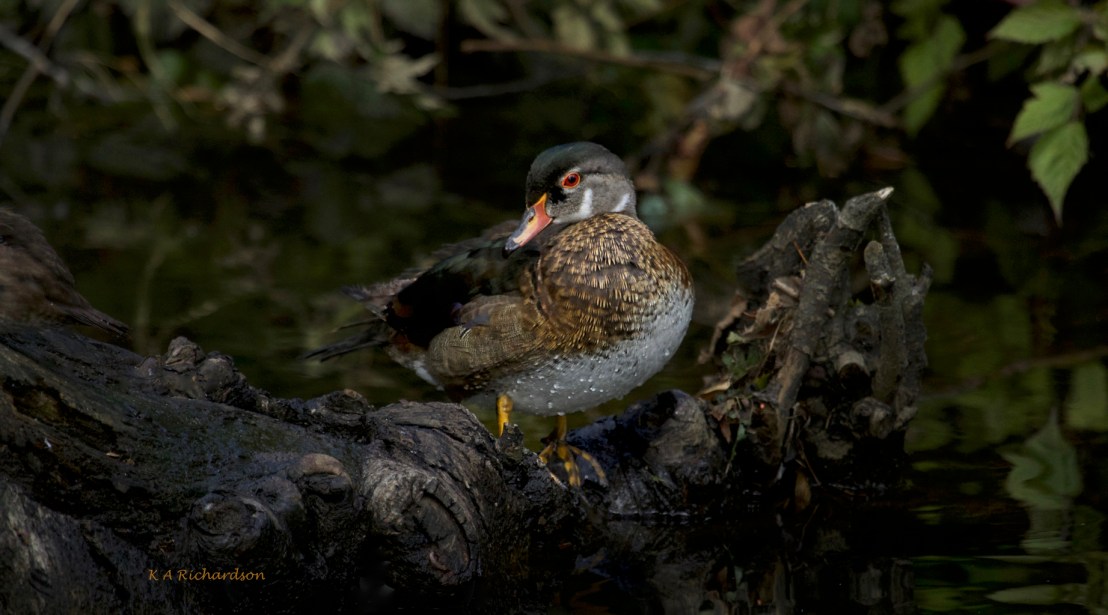
Wood Ducks Belmont small - 1
Wood Duck pair in Belmont Pond where we enjoyed their presence for several weeks in the Spring of 2016. Sadly, they didn’t breed here, but that may change in 2017 if the newly installed WODU nest boxes impress them sufficiently….

Click to enlarge images.

Wood Duck drake on grass - 2.jpg
Wood Duck drake high in grass. (I said ‘in’, not ‘on’….)

And we’ll say goodbye for this post with this triptych from Piper Spit in Burnaby, BC.

For geese and swans, see Part 6.

Highlights of 2016, part 4– more ducks— G to M

If you were looking in Part 3 for ducks or water fowl with “C” in their first names, perhaps Cinnamon Teal or Common Mergansers, you didn’t find them except as a note. You’ll find the latter in this part, along with Gadwalls, Hooded Mergansers, the Common Loon, and, of course, Mallards (on which I did a piece earlier). For  Horned (and other) Grebes, check part 5.

Gadwall male - 09a
Gadwall drake, Thomson Marsh, early spring. Click to enlarge in a new tab.

Gadwall. Unusual name. Just like the word ‘unusual with its three ‘u’s. I’ve heard them called Gladwells, Gadwells, Godwills, and plain ducks. But to me, they’re a treat, and we have lots of ’em, although I always wonder how that happens. Really. I find Gadwalls are among the most devoted of mates and yet I’ve never seen, to my knowledge, a hatch of Gadwall ducklings! I’ve watched them copulate, so that can’t be the problem. But where do those wee ones go?

gadwall-range-map-du
Click to enlarge in new tab.

According to Ducks Unlimited ,” Gadwall[s] breed near seasonal and semi-permanent wetlands, mainly in the grasslands and mixed Prairie regions of the United States and Canada. Substantial numbers also breed in wetland habitats of the Great Basin. Gadwall tend to begin breeding later than most ducks. Female gadwalls nest in fields and meadows, and on islands and dikes in wetlands, and lay an average of 7-12 eggs.”

In addition, “The North American gadwall population remained stable through the 1970s and early 1980s, while populations of other waterfowl species generally declined. Since the late 1980s, the gadwall population has increased to record levels, with the most recent estimates nearing 3 million, due to improved wetland habitat conditions.

Gadwalls - 3
“Okay, maybe this is the angle he’s lookin’ for. Smile, dammit!”….. “I’m smilin’; I’m smilin’!”

Many of you in the northeastern US and Atlantic Canada, western Ontario and the high Arctic, and most parts of BC may be unfamiliar with this subtly plumaged (until you really look closely) and almost silent species. We used to have a single pair in our urban pond in New Westminster that I admired for their devotion. But it wasn’t until we moved to the Interior that I really came to appreciate them, especially in early spring and late autumn, when light angles illuminate them best. And, now that I think about it, I don’t see them much in summer, likely because that’s when they’re rearing their young in more remote locations…. Live and learn (OK, and speculate!).

Click on any of the photos in the set below to enlarge them.
To return to this screen, click the small x in the top right corner of the enlarged window.

gadwall-breeding-pop-du
From Ducks Unlimited: http://www.ducks.org/hunting/waterfowl-id/gadwall

The North American gadwall population remained stable through the 1970s and early 1980s, while populations of other waterfowl species generally declined. Since the late 1980s, the gadwall population has increased to record levels, with the most recent estimates nearing 3 million, due to improved wetland habitat conditions.

In spring and autumn, we occasionally see drakes displaying their hidden colours, above left, when they stretch. In Thomson Marsh, in spring, pairs can be rather shy. In the shot above, top right, the drake and his mate had been swimming north along the brook, keeping an eye out for any snooping paparazzi who might be tracking their whereabouts. The drake, in the lead, decided to move ahead as quickly as possible, but the duck held back, unbeknownst to him. When he finally realized that he and she were now on opposite sides of me, he showed a little consternation as he tried to decide if it was safe to swim back to her. (He could have flown, but chose not to.) Slowly, deliberately, he swam back in her direction, giving me a number of great looks, including the one at the beginning of this  Gadwall section….

A much more colourful bird that I’m very pleased makes itself widely available in Okanagan Valley ponds and streams is the Hooded Merganser. Like its Common Merganser cousin, it shows up in Belmont Pond, only steps from home, and in Mission Creek in spring and autumn. Several breed in the area like the family that gave me some of my best images in 2015 at Michaelbrook Marsh.

All of the photos of HOME drakes were taken in Belmont Pond, very close, appropriately, to home. They can be found in many other locations in the Valley, however.

Click on any of the photos in the set below to enlarge them. 
To return to this screen, click the small x in the top right corner of the enlarged window.

Mergansers of all species can be problematic to photograph. Some of my Flickr friends envy how approachable Hoodies and COMEs are here. I appreciate their cooperation but still find capturing them to my satisfaction an ongoing challenge. But that’s the fun of it all, isn’t it— the ongoing drive for improvement.

These are two of my favourite Hoodie shots of 2016, both of drakes, but with different lighting….

Hooded Merganser (Belmont) - 12a
Hoodie drake in special light, Belmont Pond. Click to enlarge in new tab.
Hooded Merganser (Belmont) - 09a
Less dramatic, perhaps, but special in its own way…. Click to enlarge in new tab.

Click on any of the photos in the set below to enlarge them. To return to this screen, click the small x in the top right corner of the enlarged window. Before you do that, however, what do you mean you already did? I wanted you to note that three of these photos show a female Hooded Merganser, and one does not. It shows a juvenile male. Now which one is the juvie? And I don’t mean all those little ones, especially the one who’s mounting his guard, the Western Painted Turtle because he thinks it’s a pony….

If she has an all black bill, she’s not a she, he’s a he….

The Common Merganser is a much larger bird. While there are some similarities among the female cousins, we’d never mistake a COME for a HOME. That’s even more true for males. I had few chances to observe COME drakes at the Coast, but only because I didn’t like driving to look for them. Here, they show up in the spring as a pair—in Thomson Marsh or Mission Creek. At this stage, the drake looks a responsible mate. But after breeding, and even more, after the eggs hatch, he abandons his mate and his family.

And, in our neighbourhood, at least ini 2016, he became a regular visitor who spent his summer vacation in Belmont Pond, visiting with other ducks and mergansers, and providing wonderful photo opps for local photogs:

common-merganser-belmont-pond
I love the colour and finery of these magnificent males, even if they are lousy dads! Click to enlarge.
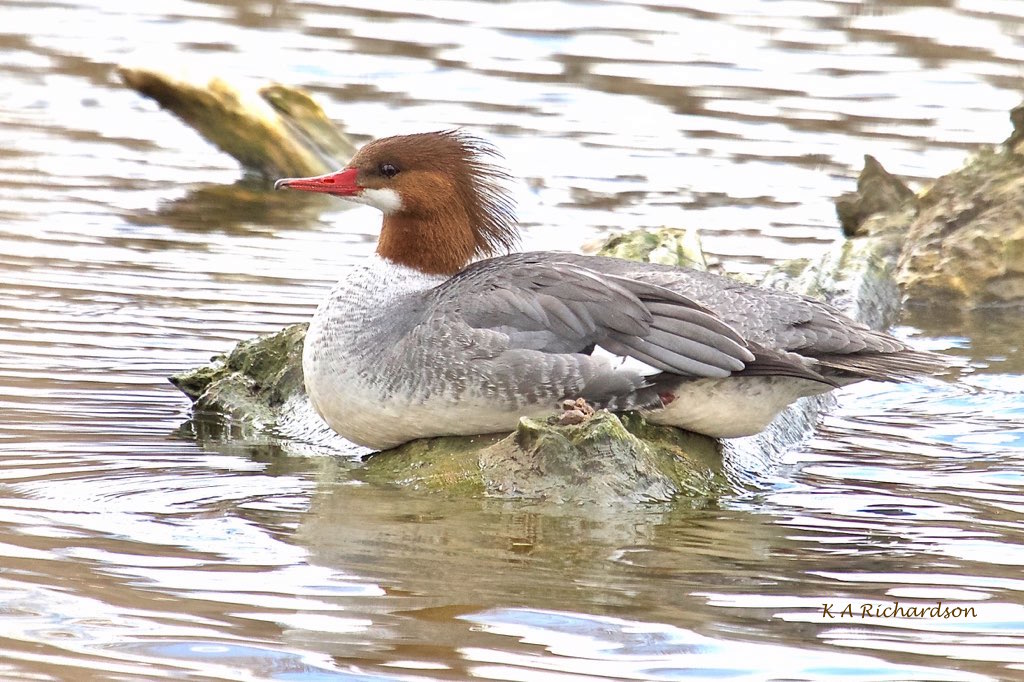
Common Merganser female
Female Common Merganser in Thomson Marsh in Spring, waiting for her mate to arrive.

Some interactions were hilarious, at least to me…. Click photos to enlarge.

Poor guy! He’s gets it from everybody who thinks they’re the boss!

BC, including the Okanagan, is also home to the much rarer Red-breasted Merganser. Sadly, I didn’t see any this past year. One was reported on Okanagan Lake, but I couldn’t verify the find. Maybe this year….

Got so carried away with Mergansers that I nearly forgot the Common Loon, which I decided to put into this category. 2016 did not provide me with opportunities like those at 108 Resort in 2014 and 2015, and we did not get back up there this year. Of course we have Loons in the Okanagan-Southern Interior Plateau region, but I didn’t make them a target in 2016. Another species to pay more attention to in 2017. I’ve got some ideas; we’ll see if they materialize.

Click images to enlarge.

Besides its dazzling appearance, the COLO is renowned for its vocalizations. On a big lake like Okanagan L., we don’t get to enjoy that as much as we do in smaller Cariboo Lakes or those in the Kane Valley. I took their calls and chatter too much for granted in the 15 years when I heard them calling in the evenings and sometimes in the dark when it was time for humans to sleep. Now I long for those sounds again….

Well, the “M category” would not be complete without a mention of the Mallard, on which I’ve already posted a set of flight shots. I’m hoping to do a special feature on this species later in the spring. For this post, besides the Mallard above, here’s a couple of shots without comment: click on the photos to enlarge them.

For all the remaining ducks, see Part 5….

Highlights of 2016, part 3—ducks, coots, and goldeneyes: A to C*

Juvenile Wood Duck ed outside Photos
“The Darkling Wood Duck” (juvenile drake), Piper Spit, Burnaby Lake, BC. Click to enlarge in a new tab.

*For teals other than American Green-winged, look under “T.” Similarly, Common Mergansers are found with their Hooded cousins under “M.”

Part 3 looks at some of my favourite water birds shots from 2016 that are not covered in part 2.

We are especially fortunate to have a great selection of species, ducks: both dabbler and diving , as well as two (and on rare occasions three) species of mergansers, and an assortment of others mentioned in the heading….

Late winter, spring and autumn are the prime seasons for ducks here. While there are plenty around in summer, that’s when we  focus more on songbirds and Ospreys.

Most of the photos are taken in the Kelowna area, many close to home. Some, however, like the juvie Wood Duck above, were taken in the summer at Piper Spit on Burnaby Lake in the Vancouver area on our trips to pick up and deliver grandkids….

Teal - American Green-winged drake
(Anas crecca carolinensis) Thomson Marsh, Kelowna, BC. Folks at The Coast shooting at places like Piper Spit in Burnaby may have no idea what a challenge it is up here to get this close. This fella had attached himself to a small flock of Mallards slightly less fearful of people than he…. ………Click photo for enlarged view in new tab.

As with other parts of this review of 2016, the presentation will be roughly in alphabetical order. And that means starting with the American Green-winged Teal (Anas crecca carolinensis) . Few of us bother with the “American” designation, but as we occasionally see the Green-winged Teal (aka Common Teal, Anas crecca) more commonly found in Europe and Asia, I’m using the AGTE designation here. At Burnaby Spit, in fall, winter, and spring, AGTEs forage very close to the boardwalk are easily photographed up close. Up here, however, these tiny ducks have to fight for their place in the ecosystem and are generally very difficult to get close to—at least in the places where I see them. During our colder, snowier than usual winter 2016-17, I was able to find them in Thomson Brook and with great stealth to get a few shots, but not unobstructed. Getting shots at a distance is not so difficult, but I’m not able or interested in spending thousands of dollars on high powered lenses to overcome this issue…. More teals near the end of Part 3….

“The waterborne American Coot is one good reminder that not everything that floats is a duck. A close look at a coot—that small head, those scrawny legs—reveals a different kind of bird entirely. Their dark bodies and white faces are common sights in nearly any open water across the continent, and they often mix with ducks. But they’re closer relatives of the gangly Sandhill Crane and the nearly invisible rails than of Mallards or teal….

American Coot Rotary - 3
American Coot in Belmont Pond, Kelowna, BC. Always difficult to balance tones! Click to enlarge.

You’ll find coots eating aquatic plants on almost any body of water. When swimming they look like small ducks (and often dive), but on land they look more chickenlike, walking rather than waddling. An awkward and often clumsy flier, the American Coot requires long running takeoffs to get airborne.” (Cornell Lab of Ornithology)

We see rafts of coots in the winter in Okanagan Lake. In spring, however, they move into the brooks and ponds where they raise their young. I have seen them breeding in Belmont Pond, so close to our home, but sadly, the birds moved to a different location to hatch and rear the “cootlings.” (Incidentally there doesn’t seem to be an approved designation for coot chicks; one suggestion  I saw—’cootie‘ just isn’t acceptable!! In England, related birds are sometimes called “moorchicks.”) I have photos of the chicks at such a distance they’re not good enough to post. Definitely a challenge for 2017!

Another fascinating “American bird” for me is the American Wigeon. (I used to see their Eurasian cousins in Japan, and EUWI are showing up in increasing numbers in BC these days. Have yet to capture one in the Interior, so will look hard this year.) AMWIs, up here, I thought at first, were very difficult to approach. 2016, however, changed that opinion. Spring in Thomson Marsh seems to be the best time to observe and shoot them (with a camera, of course!) They do stop over in the fall and a few stick around near Okanagan Lake through the winter. In spring, however, they return to marshes and are great fun to watch…. Only the male sports the bald pate and green racing stripe through the eye.

A duck that stands out despite its size is the very active and, in the right light, colourful Bufflehead. I didn’t get a lot of shots of this species in 2016. (Check more recent posts for evidence of my good fortune in 2017.) In the set below, click any photo to enlarge ’em all.

“We may be small, but we’re show stoppers!!”

There are two species of goldeneyes to watch for: the Common Goldeneye and the one below, Barrow’s Goldeneye. While the females of both species are quite similar though fairly easily distinguished if one can get a clear image of their bills, the males are striking different. Of the two, the Barrow’s, a northwestern-corner-of-the-continent duck to begin with, is rarer even out here, and, in my humble opinion, the more attractive duck with his splatter of white stripes and his purplish head with his quarter moon or teardrop white crescent stripe, take your pick.

Incidentally, the Barrow’s in the name honours Sir John Barrow (1764–1848) who, according to Wikipedia was a long time secretary in the British Admiralty, where he”… was a great promoter of Arctic voyages of discovery, including those of John Ross, William Edward Parry, James Clark Ross and John Franklin. The Barrow Strait in the Canadian Arctic as well as Point Barrow and the city of Barrow in Alaska are named after him.” I used to think the duck was named for one of these far north locations, but apparently, we can reach such a conclusion only indirectly (written my best civilservantese).

barrows-goldeneye-pair
I spotted this pair at Robert Lake quite far away, but was able to sneak up and get this medium range image using the technique described below. Click to enlarge.

In my experience, BAGOs prefer wider stretches of water—ponds and lakes—that enable them to stay farther from my camera. Being divers, however, they need to come into the shallows to forage, so they can be stalked sometimes. Take your time, move when they’re really hungry and submerged, but know that once they spot you, there’s a good chance they’ll give up food for privacy. A fellow photographer in Penticton, however, has managed some wonderful closeups of Barrow’s in that town’s wonderful canal. Find the right pond, I guess! I think a Barrow’s side trip (to Penticton, not Barrow’s Strait!) is in the works when I start my south Okanagan region spring birding….

Common Goldeneyes by comparison are truly common. Still, they’re a pretty duck in winter when they visit Mission Creek to forage on the bottom of the stream.

Cornell agrees: “The male Common Goldeneye adds a bright note to winter days with its radiant amber eye, glistening green-black head, and crisp black-and-white body and wings. The female has a chocolate brown head with the same bright eye that gives this species its name. These distinctively shaped, large-headed ducks dive for their food, eating mostly aquatic invertebrates and fish. They nest in tree cavities in the boreal forest of Canada and Alaska; look for them on large rivers, lakes, and Atlantic, Pacific, and Gulf coasts in winter…. 

Females are best distinguished by head and bill shape (above); also, female Barrow’s usually have more yellow on the bill than female Common.

female-cogo-and-bago
Comparison of female bills of Common Goldeneye and Barrow’s Goldeneye.

In our very cold December 2016, Mission Creek froze over in the lower reaches, but fortunately some stretches of mid-stream, ironically, stayed open.COGOs were able to forage, but their numbers were much reduced from the past two winters.

Common Goldeneye drake
COGO in the very cold Mission Creek, December 2016. Click to enlarge.

in the very mild 2015-16 winter, I was very much surprised  to discover a solitary female COGO in the mix of ducks that wintered in Thomson Marsh sometime in mid February. Later that month, this same duck, I believe, moved over to Belmont Pond where she waited patiently, it seemed, for two weeks. Because she was a bit of an explorer, an individualist, I named her Dora. Eventually, she was joined by a single COGO drake that I christened Melvin. They stayed in Belmont Pond for about three days with an assortment of other species I had not seen here the year before, then by mid-March, they were gone, and I never saw them again.

Dora and Melvin
Melvin and Dora in Belmont Pond
common-goldeneye-drake-melvin
Melvin, Dora’s prince whom she waited for for weeks! You can tell he’s royalty by that purplish tinge added to the green in his crown….

For Gadwalls, Hooded and Common Merganser, Common Loons, and Mallards, check Part 4….

Waders & waterfowl highlights of 2016, part 2: herons

In Part 1, we looked at waders (some of whom, like avocets and phalaropes, float) and shorebirds. In Part 2, we turn to a favourite of mine and many folks (though not my wife’s for some unfathomable reason), the Great Blue Heron.

great-blue-heron-range-cornell

GBHEs are found across Canada, the USA, and Mexico, Central America and the Caribbean and parts of northern South America. But in Canada, they are normally found year round only in BC and along the Great Lakes and St. Lawrence River. Whether their distribution will change as climates warm remains to be seen. The Okanagan Valley is one of the few non-coastal parts of Canada where we can observe GBHEs even in winter. Since coming here, I’ve gained even more respect for these large, almost prehistoric looking birds and their ability to adapt to varied environments. We have quite an assortment; I’m able to identify a few individuals by their favourite hangouts and differences in behaviour….

the-neighbourhood

Where I see GBHEs mostly—Belmont Ponds and Thomson Marsh. Michaelbrook Marsh, located off the top right quadrant of the map is frequented by herons from these areas, too. Munson Pond, about a kilometre away, as the heron flies, is home to several individuals who seem to spend most of their time watching the lake from perches high above. Click to enlarge.

Great Blue Heron
Sir Ralph of Belmont Ponde on his logge, facing the sunne in the west….


Let me show you a few shots of these guys/gals (I can’t tell the difference) who never fail to grab my attention whenever I come across one. Let’s begin with Sir Ralph of Belmont Pond. People either praise or vilify my inclination to “name” the character birds I encounter, but in this case, I’m blameless, or almost so, for the name ‘Ralph” had been given by the residents on the Pond to this wonderful specimen before I arrived. But the name feels right, and, in my infinite wisdom, I’ve added the knighthood—I think he’s earned it and  hope you agree.

Click image to enlarge in new tab.

Featured fotos of Sir Ralph:

Other GBHEs I’ve photographed this year: Click images to enlarge them.

hider-the-buzz-bomb-3
Hider the GBHE of Thomson Marsh West. Very different behaviour from Sir Ralph’s stoicism.

“How do I know one GBHE from another?” is a legitimate question. I do see herons flying from one location to another, certainly, and  I understand the issue. Based on their behaviour,  however, I suspect some who act similarly within relatively close proximity to be the same bird, but I can’t be sure.

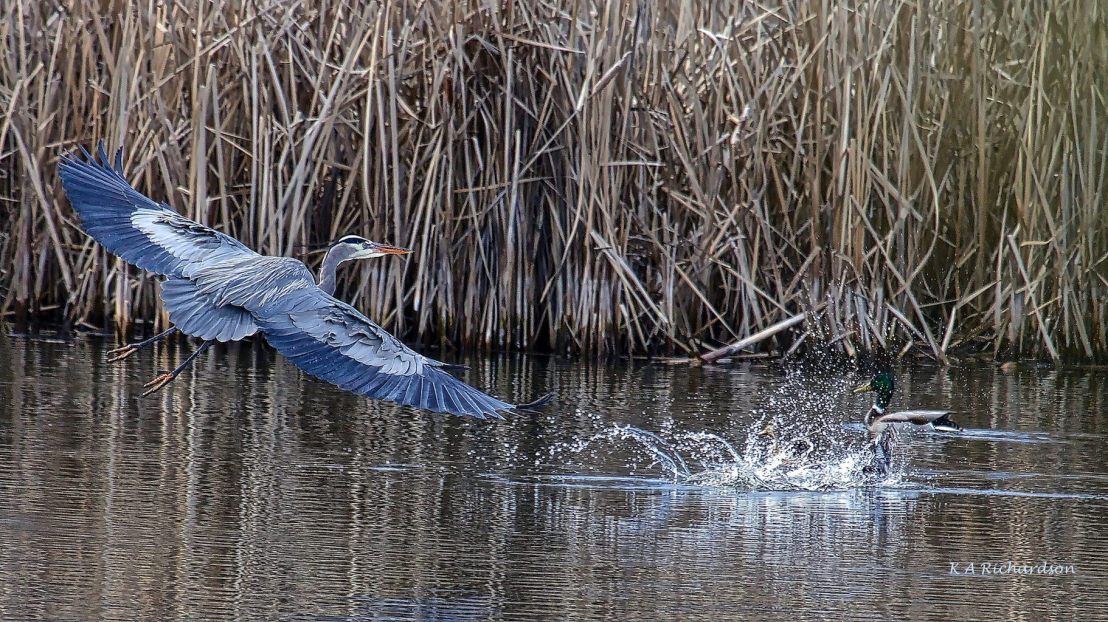
Hider is so named because, unlike Sir Ralph who has no problem with public performances, Hider likes to snuggle in among the reeds and cattails so that he’s just barely visible, a difficult trick because he’s a large one. In the flight shot above, he’s asserting his right to dominate the far west corner of Thomson Marsh, and a wee Hooded Merganser is fleeing without squawking any protest!

Great Blue Heron
This fellow is a frequent visitor to Michaelbrook Marsh, not far from Belmont Ponds. Could he be Sir Ralph on vacation? Behaviourally, he’s very similar!
Great Blue Heron, Ottawa River
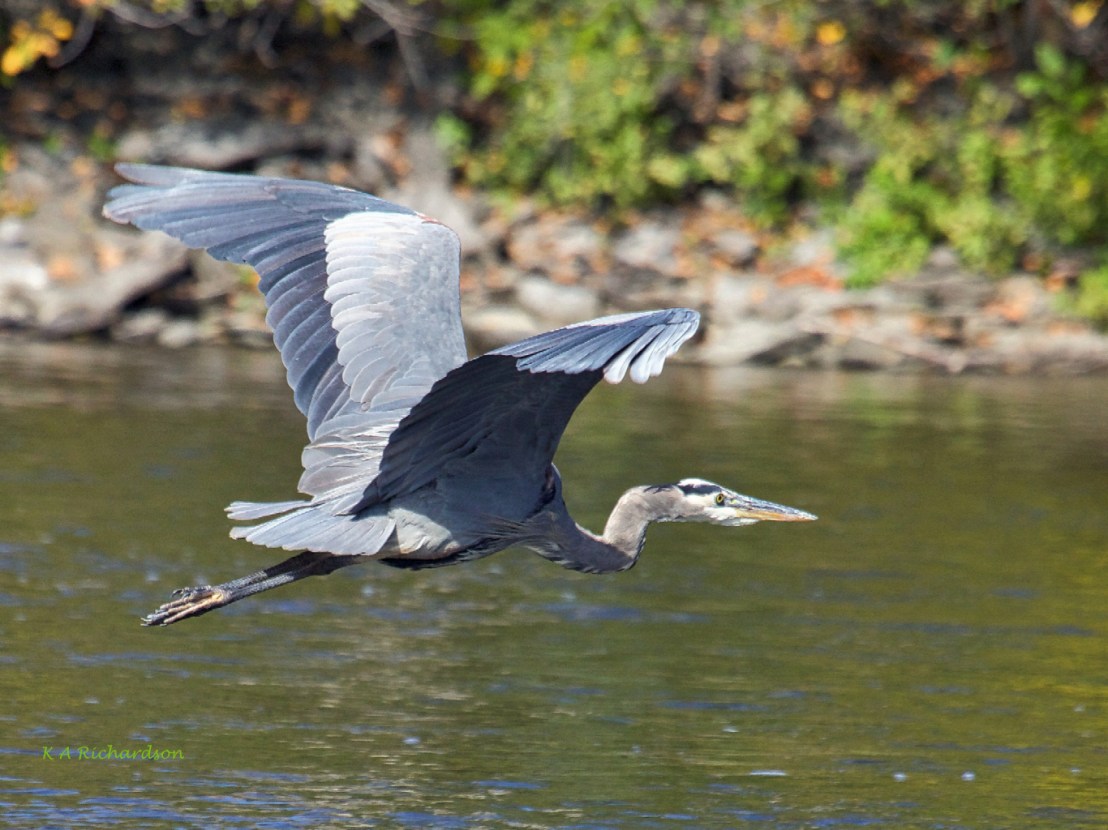
GBHE heading for Parliament from Mud Lake, Ottawa, ON, taken on our autumn trip there.

In December, at -5ºC,  a somewhat small Great Blue I hadn’t (to my knowledge) seen before showed up one afternoon in Thomson Brook on the northeast side of Thomson Marsh where there was still some flowing water. I’d already been alerted to his/her presence by another photographer who’d marvelled at how close he’d been able to approach. I arrived at the spot probably 20 minutes later and (s)he was still hunting and willing to be observed. I was able to get several shots including savouring his/her sushi appetizer….

One regret I have from late 2016 is that I was unable to observe the Green Heron that unexpectedly visited Rotary Marsh along with a couple of out of season/out of place passerines, a Lucy’s Warbler and a Least Flycatcher. I found and photographed the Lucy’s but couldn’t locate the other two. Still, my visit to the “far end of town where the trickle-grass grows” was not in vain, as I got excellent looks at some ducks that appear in Part 3 of this series, and this lovely Great Blue, too!

Great Blue Heron - Rotary Marsh


Below: a Green Heron from another time and another place, just because it’s fun to recall…. A note to those who’ve never seen one, Greenies are much smaller than GBHEs, and much more colourful! Click image to enlarge in a new tab.

green-heron-at-langley-bc
Green Heron at Brydon Lagoon, Langley, BC, 2014, helping rid the marsh of invasive bullfrogs….

Part 3 introduces some ducks, and coots ….

Waders & waterfowl highlights of 2016, part 1—waders and shorebirds

Last week, I completed my favourite/best photos collection of perching birds (and a few that roost or climb) from 2016.

IMG_9055
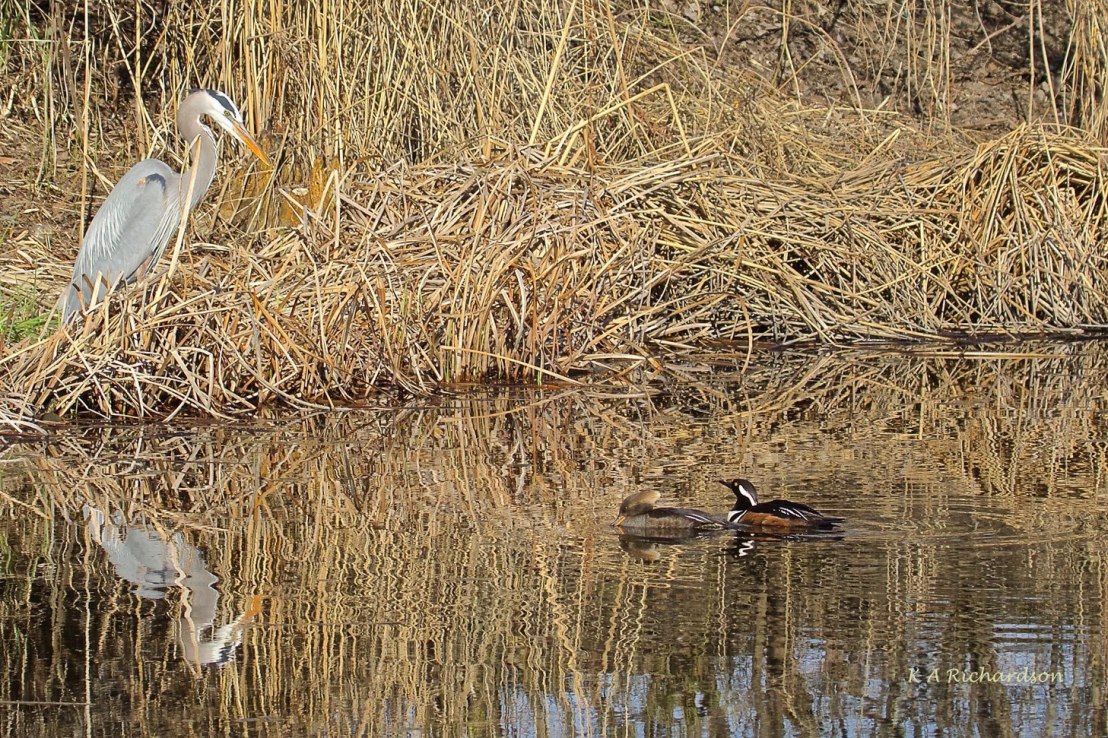
“Greetings, Sir Ralph. It is we, your humble servants, Henry and Hermione Hoodie of the Merganser genus…”

am-avocet-range-cornell

As promised, I’m going to provide separate posts for raptors and water birds, as well as the few mammals that caught the attention of my eye and camera last year. So let’s begin with the waders, which for me means “birds that commonly occur in [and around] reedy areas, shallow waters, ponds and such” (Wikipedia) and, up here in the Interior, this includes mainly two subcategories, herons and shorebirds. Compared to the waders’ catalogues of our most avid birders, mine is considerably smaller. At The Coast, there’s a much greater diversity, especially of shorebirds, and a community that’s deeply committed to it. On the other hand, up here, while  there are fewer species (though more than I’ve searched out), some of them are indigenous to our ecosystems and unlikely to appear in coastal conditions; I’m very pleased to be located right where we are. No doubt, I’ll add to my list in years to come….

Among the wader/floaters unique to the Interior, the American Avocet particularly stands out! In fact, the map above shows that while this mostly western species breeds in states that touch the 49th parallel, none breed in BC at all. My photos show the contrary. Click photos to enlarge….

Some interesting facts about American Avocets from Cornell’s Lab of Ornithology:

  • american-avocet
    American Avocet wading at Robert Lake….

    With its elegant profile and striking coloration, the American Avocet is unique among North American birds. In summer it can be found in temporary and unpredictable wetlands across western North America where it swings its long upturned bill through the shallow water to catch small invertebrates.

  • In response to predators, the American Avocet sometimes issues a series of call notes that gradually changes pitch, simulating the Doppler effect and thus making its approach seem faster than it actually is.
  • Nesting American Avocets aggressively attack predators, sometimes physically striking Northern Harriers or Common Ravens. 
  • A female American Avocet may lay one to four eggs in the nest of another female, who then incubates the eggs. American Avocets may parasitize other species’ nests too; single American Avocet eggs have been found in the nests of Mew Gulls. Other species may also parasitize avocet nests. Avocets have incubated mixed clutches of their own eggs and those of Common Terns or Black-necked Stilts. The avocets reared the stilt hatchlings as if they were their own
  • American Avocet chicks leave the nest within 24 hours after hatching. Day-old avocets can walk, swim, and even dive to escape predators. 
  • The oldest recorded American Avocet was over 15 years old, when it was found in California, where it had been banded a decade and a half earlier.”
american-avocet-female
Avocets love the salty environment of Robert Lake near Kelowna.

In our community, Avocets are found at Robert Lake, a saltwater marsh with very limited access for birders (a looooonnnngggg story that I won’t be going into here!) and, oddly, just to the north, in ponds now incorporated into the Kelowna Landfill, including one still referred to locally as Alki Lake — “Alki” because its so alkaline, and “lake” because that may have been true in the past. Although the landfill is a state-of-the-art operation, any landfill is, after all, a complex built with garbage and not a great place to spend the day no matter how many eagles and ravens and hawks and ducks and even avocets and stilts it supports….

Efforts to encourage AMAVs & Black-necked Stilts to relocate have been largely unsuccessful….

Speaking of BNSTs, here’s the best proof that this species is doing well here, too, in the same environment as the Avocets (click to open enlarged image in a new tab):

black-necked-stilt
Juvenile and adult Black-necked Stilts in salty Robert Lake.

The stilts and avocets occupy quite different territories most of the year as the comparison of their ranges (below) shows. We’re very fortunate in Kelowna to be able to enjoy both species in the same locale!

Other shorebirds (that I have photos of) that grace our Okanagan community:

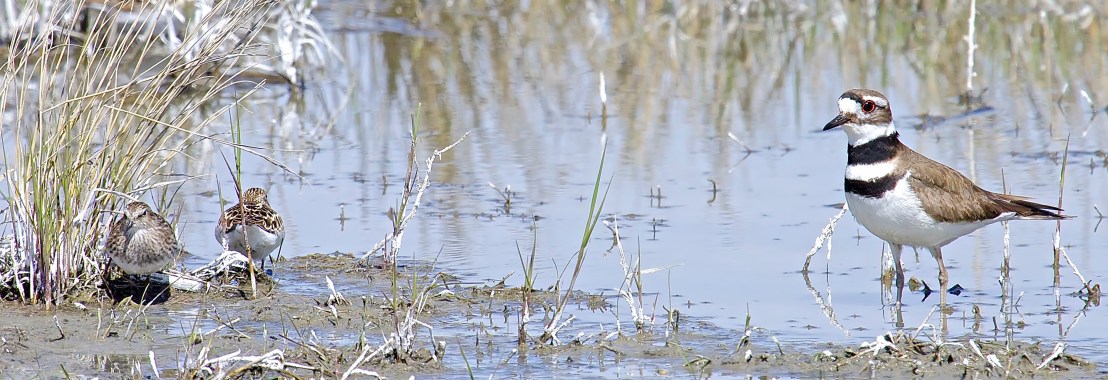
I’m inclined to believe that the Killdeer above, from Thomson Marsh, is a male. On my walks in spring, while his mate was sitting on eggs, he would pop out of the brush between the path and Thomson Brook and lead me along, regardless of which  way I was travelling, away from her. Of course, to me, it felt like I was walking with a Killdeer; his perspective was likely a little different, but as I’m not fluent in Killdeer, I couldn’t always grasp what he was trying to tell me…. To enlarge graphic and photos, just click them!

Robert Lake is a great place to see a wide variety of shorebirds, including Killdeers, but it’s especially great for sandpipers that really prefer salt marshes, such as the Least, Solitary, and occasionally, outside its usual range, Pectoral Sandpiper.

least-sandpipers-with-killdeer
At Robert Lake, in 2015, Least Sandpipers in the company of a Killdeer….

I found Solitary Sandpipers in several locations in 2016, including this one in a pond near Upper Mission Creek where it was foraging on a carpet of algae. It took a little work to get a suitable vantage point for the shot, but I think it was worth it….

From Cornell: “The Solitary Sandpiper is commonly seen in migration along the banks of ponds and creeks. While not truly solitary, it does not migrate in large flocks the way other shorebirds do…. The Solitary Sandpiper lays its eggs in [abandoned] tree nests of several different song birds, particularly those of the American Robin, Rusty Blackbird, Eastern Kingbird, Gray Jay, and Cedar Waxwing….Of the world’s 85 sandpiper species, only the Solitary Sandpiper and the Green Sandpiper of Eurasia routinely lay eggs in tree nests instead of on the ground. ….In migration and winter [SOSAs are] found along freshwater ponds, stream edges, temporary pools, flooded ditches and fields, more commonly in wooded regions, less frequently on mudflats and open marshes.”

Pectoral Sandpipers are being found in BC more often these days although Cornell’s range map for them indicates otherwise. We’re likely to see them, if at all, only during migration. I was lucky to be alerted to this one’s presence and to get this lifetime shot!

As rare as Pectorals are, the Lesser Yellowlegs below (and its close relative the Greater Yellowlegs) are regular visitors to Robert Lake and other Okanagan wetlands.

Most fascinating bird in the marsh

The final entry in this part on waders/shorebirds is actually, like the AMAVs we began with, a floater/swimmer as well as a wader. The Wilson’s Phalarope is one of the most fascinating birds we see in the salt marsh. Unlike most birds we see in Canada, the females are not only more colourful than males; females “court and defend male mates—several per season—while males do most of the work of raising the young.”  Imagine that, all you MCP- couch potatoes! Nature does work in mysterious ways…. Besides the unusual gender appearances and roles, WIPHs also utter peculiar sounds—like dogs barking in the distance. Moreover, “Phalaropes are the only shorebirds that regularly swim in deep water. They bob on the surface, often spinning in circles to bring small food items within reach of their slender bills.” (Cornell)

Part 2 of this series will focus on Great Blue Herons and a few gulls….
Part 3 will cover ducks, grebes, and coots….

Songbirds and perching birds (passerines) of 2016 in photos and text: 

For Navigation Help, click here.

lewiss-woodpecker-on-the-long-branch
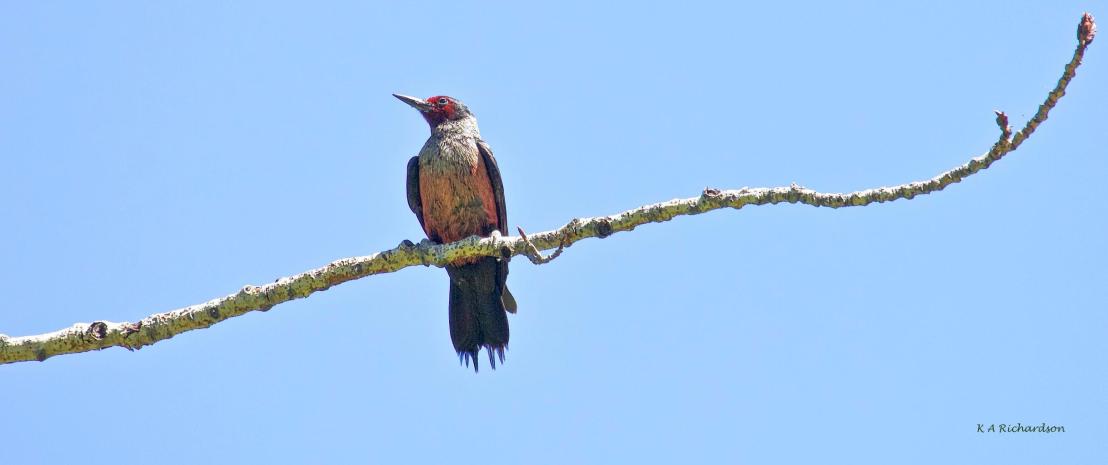
Lewis’s Woodpecker on the Long Branch. (Technically, NOT a passerine, but read on…).

For Water Bird Highlights of 2016 in photos and text, click here.

Click on any part below to open it in a new tab.

part 1: American Goldfinch, American Redstart, American Robin, Black-billed Magpie, Black-capped Chickadee, Black-headed Grosbeak, Brown-headed Cowbird, Brewer’s Blackbird, Bullock’s Oriole

part 2: California Quail, Cassin’s Finch, Cedar Waxwing, Clark’s Nutcracker, Downy Woodpecker

part 3: Eastern Kingbird, Eurasian Collared Dove, European Starling

part 4: Hairy Woodpecker, House Finch, House Wren

part 5: Lazuli Bunting, Lewis’s Woodpecker

part 6: Mountain Bluebird, Mourning Dove, Northern Cardinal, Northern Flicker

part 7: Orange-crowned Warbler, Pileated Woodpecker, Pine Siskin, Pygmy Nuthatch

part 8: Red Crossbill, Red-winged Blackbird, Rufous Hummingbird

part 9: Savannah Sparrow, Say’s Phoebe, Song Sparrow, Steller’s Jay, Townsend’s Solitaire, Tree Swallow

part 10: Violet Green Swallow, Warbling Vireo, Western Bluebird, Western Kingbird, Western Meadowlark, Western Tanager, White-breasted Nuthatch, White-crowned Sparrow, Willow Flycatcher

part 11: Yellow-headed Blackbirds, Yellow-rumped Warblers, Yellow Warblers

2016 Faves—Passerines, part 11: Y

End with a flourish,” I’ve read. So here goes.

The “Y” birds (Y not, you may ask) include three birds whose names begin with Yellow. One, the Yellow-headed Blackbird is a western bird.The other two, warblers, are found across the North American continent and coast to coast to coast in Canada.

Yellow-headed Blackbird – Version 2
Yellow-headed Blackbird puts his foot down!

Yellow-headed Blackbirds return to us from the southwestern US and Mexico in early April. Occasionally, they’ll land on a rooftop on their way further north, but their season starts for us when we see the first males in Thomson Marsh where the Red-winged Blackbirds by this time are already well established. The first few males are very quiet; we’re likely to see them before we hear them. Within a couple of weeks, the situation reverses, and we enjoy the cacophony of the clash of vocalizing RWBLs and YHBLs. As with RWBLs, YHBL females show up a couple of weeks after the males have established their territories.

I confessed in part 3 of this series that my favourite species in the summer marsh is the Eastern  Kingbird. The Yellow-headed Blackbird is a close second. The chief difference and factor that makes me lean to the EAKIs is that individual families are much easier to identify among the EAKIs. The pairs are devoted to each other in ways that the YHBLs are not. The YHBLs arrive earlier than the EAKIs and depart earlier, as well, at least the males. By late summer, the marsh is ruled by the RWBLs and the growing EAKI families. But last year, at least, I was able to identify a couple of females that continued hang around. Their offspring seem to become independent fairly quickly. It was surprising to find a couple of female YHBLs still being chased by a fledgling Brown-headed Cowbird that had “conned” one of them into raising. Although they’re not very attractive/photogenic at this time of year, I find “Yellow-heads” an interesting group to study….

From Yellow-headed Blackbird, Identification, All About Birds – Cornell Lab of Ornithology [with some editing by KAR]:

With a golden head, a white patch on black wings, and a call that sounds like a rusty farm gate opening, [male] Yellow-headed Blackbirds demand our attention. Look for them in western and prairie wetlands, where they nest in reeds [or cattails] directly over the water. 

[We don’t get to see them winter in Kelowna, but we do run into migrating flocks in Kane Valley early in the spring.] They’re just as impressive in winter, when huge flocks seem to roll across farm fields. Each bird gleans seeds from the ground, then leapfrogs over its flock mates to the front edge of the ever-advancing troupe.

Yellow-headed Blackbirds breed in loose colonies, and males mate with several females. During the breeding season, they eat insects and aquatic invertebrates. [See map for wintering grounds.] They form huge flocks in winter, often mixing with other species of blackbirds, and feed on seeds and grains in cultivated fields. 


yellow-rumped-warbler-in-spring
Springtime Butterbutt, Belmont Pond


Well, we’re quickly nearing the end of this final chapter of Favourite Passerine Fotos of 2017. Let’s talk about two of the warblers that we look forward to every year in Belmont Park and ponds and Thomson Marsh: I’ll take them in the order in which they appear, which means we look first at Yellow-rumped Warblers, another bird that’s distributed across the NA continent and coast to coast to coast in Canada.

Yellow-rumped Warblers are impressive in the sheer numbers with which they flood the continent each fall. Shrubs and trees fill with the streaky brown-and-yellow birds and their distinctive, sharp chips. Though the color palette is subdued all winter, you owe it to yourself to seek these birds out on their spring migration or on their breeding grounds. Spring molt brings a transformation, leaving them a dazzling mix of bright yellow, charcoal gray and black, and bold white.” (Cornell)

The first year here, I waited expectantly and failed to find many close enough to photograph well. In 2016, however, I learned where to locate them—closer to home, ironically, and am looking forward to similar opportunities this spring. In summer, the Butter Butts pretty much leave town and the heat of the valley bottom for the cooler hillsides. In autumn, in their new camouflage, they reappear along with Warbling Vireos and juvenile Waxwings in various locations, along the Creek, but also among the many weeds now offering their seeds and harbouring insects….

These photos are not outstanding, but may indicate the kinds of interesting challenges that Yellow-rumps offer in the waning months of the year. By late October, they’re gone.

The final bird of this long series is the Yellow Warbler. I’ve learned to be patient with this  species. It appears in different locations at different times from  spring through early autumn. Early and late summer into autumn afford the best photo opps in the Okanagan. YEWAs can be very difficult to capture due their rapid movement and propensity for cover, but I can usually count on excellent chances late in the season….

Two of the shots below are of males. I’ll leave it to you to figure out which is which.

Click the photos to see them enlarged.

Yellow Warblers forage along slender branches of shrubs and small trees, picking off insect prey as they go or briefly hovering to get at prey on leaves. Singing males perch near the tops of the bushes or trees in their territory.

As male Yellow Warblers are setting up territories they may perform a “circle flight” in which they fly toward a neighboring male or female in a horizontal, semicircular path. A male may also fly slowly with fast, exaggerated wingbeats away from a female he is courting or a male he is competing with. As these territorial encounters proceed, males start by singing at each other; as the dispute goes on, the songs get quieter or switch to chip notes as the males begin to chase each other.

Yellow Warblers typically form monogamous pairs that sometimes last more than one breeding season and reform the next. Yellow Warblers defend their nesting territories from many species, including other warbler species, chickadees, House Wrens, blackbirds, and Eastern Kingbirds. They may even chase off other warbler species while on their wintering grounds. Common predators of Yellow Warbler nests include garter snakes, red squirrels, jays, crows, raccoons, weasels, skunks, and domestic or feral cats.” (Cornell)

And finally, a note on conservation with regards to YEWAs, again from Cornell:

Yellow Warblers are one of the most numerous warblers in North America but their populations have been slowly declining, and have decreased by 25% between 1966 and 2014, according to the North American Breeding Bird Survey. Partners in Flight estimates a global breeding population of 90 million with 37% spending some part of the year in the U.S., 15% in Mexico, and 57% breeding in Canada. They rate a 6 out of 20 on the Continental Concern Score and are not on the 2014 State of the Birds Watch List. In the western U.S. the grazing of rangelands can degrade Yellow Warbler nesting habitat, particularly stands of willow trees along creeks. The Brown-headed Cowbird lays its eggs in the nests of many species including Yellow Warblers, and this can reduce their breeding success. Like many migratory songbirds that move at night, Yellow Warblers are at risk of collisions with buildings; they can be attracted to and killed at tall, lighted structures such as TV towers and tall buildings.” We all hope this delightful, beautiful, interactive songster is able to survive in its Okanagan breeding grounds for years to come!