For my favourite presentation of the young Ospreys of Kelowna Rec Field in August 2015, click this link: it will open in a new tab….
April 12, 2017: Although one of the Ospreys of Mission Rec Field returned last Saturday, with a softball game going on right below, it took off and headed towards the mouth of Mission Creek. Haven’t seen it since despite checking the Field regularly. Something similar happened last Spring, so haven’t given up hope just yet. Still, if they have abandoned this site, where MayB refused to stay last Autumn, and which Red-tails and Bald Eagles have defiled this winter, I will be left with a big hole in my heart! Prey for us!
Sooo, in lieu of photos of “our” Ospreys, here are some shots from our trip to Osoyoos River’s floodplain yesterday. To read about the trip, click this link. On this post, all you can do is see photos: click any photo to enlarge ’em all….
We have the best nest!!
Another background…
…and still another
Warning: some of the shots here are not worthy of posting to Flickr or other photo websites, but I’ve posted them herefor illustrative purposes. Sometimes, all they illustrate is that they deserved trashing in the first place, heh-heh-heh!
Poppa Osprey is not quite all there!
To enlarge photos in a cluster and see captions, click on any one….
Momma O gets some exercise.
These shots show…
…bent wings.
Momma – 1
Momma – 2
Momma – 3
Momma – 4
Momma – 5
Momma – 6
There are a few things I hoped you noticed. For starters, the sky colour is inconsistent — for a couple of reasons. First, processing for light and colour can create differences. Second, as the series was taken, the sky itself changed as clouds came and went. Third, the bird was in different parts of her orbit at different times….
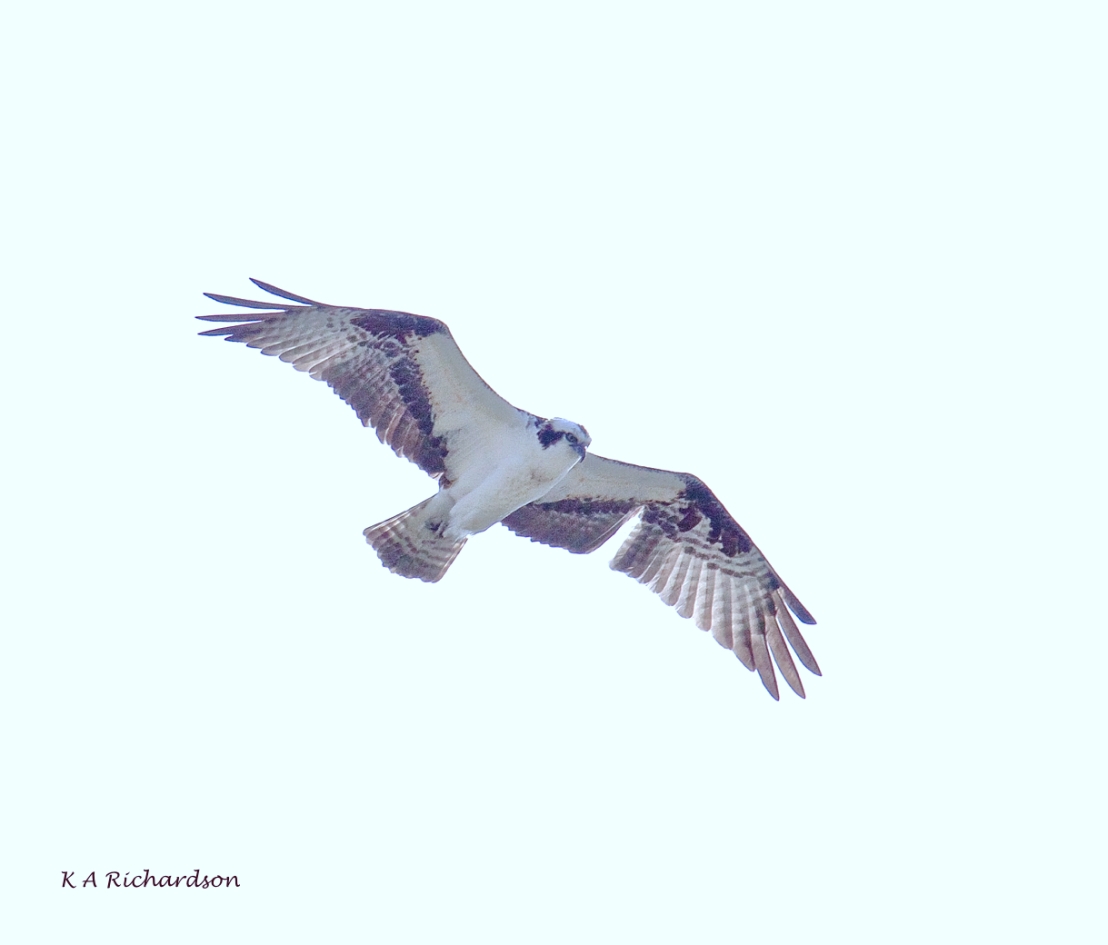
Momma put on a great aerial show! One thing I hope you picked up on is her necklace — pretty much absent in the male. Also, she has one dark, central tail feather that’s quite obvious in these shots. I’d never noticed this in other birds; it’s not obvious in Poppa’s flight shot. After going back through photos of other Osprey, it appears that this feature may be present to some degree in both genders. Now, it’s something I’ll be looking for….
Finally, it would be hard to justify so many photos in one Flickr series. Here, however, I’m able to post shots that seem quite similar, but which, upon more careful observation, reveal some of the fine adjustments an Osprey makes in flight….
Yes, you are meant to sing this posts’s title’s last five words — à la Johnny Horton!
April 11, 2017: With strong assurance that we had a sunny day at last, Nana and I set out for White Lake and Osoyoos hoping to discover whatever we could. There’s less disappointment with such vague objectives, you know….
Truth be told (and shouldn’t it always?), we were looking for Mountain Bluebirds (Sialia curricoides), Western Meadowlarks (Sturnella neglecta), and Nature-willing, Yellow-rumped Warblers (Setophaga coronata). Won’t keep you in suspense — we found ’em all right, yet came home with not one decent photo of any of ’em. Not the right day. Nice to see, but far too far off to fotograph!
Click the map at left (or any graphic where the cursor turns to a pointing hand) to enlarge it….
Before you start commiserating, however, let me finish. We did not return empty-memory-carded! At White Lake, right off the bat, I got some decent shots of a Western Bluebird (Sialia mexicana). Actually wished later that I’d spent a little more time there, right across from the parking lot, but we had our targets and figured they were down the trail. We had some fun with meadowlarks, but they were smarter than we. As for the warblers, found that we could do better at home….
Click on any photo in the cluster to enlarge them all….
Western Bluebird (Sialia mexicana) at White Lake – 1
Western Meadowlark at White Lake. Damn that unseen piece of grass!
Western Bluebird (Sialia mexicana) at White Lake – 2
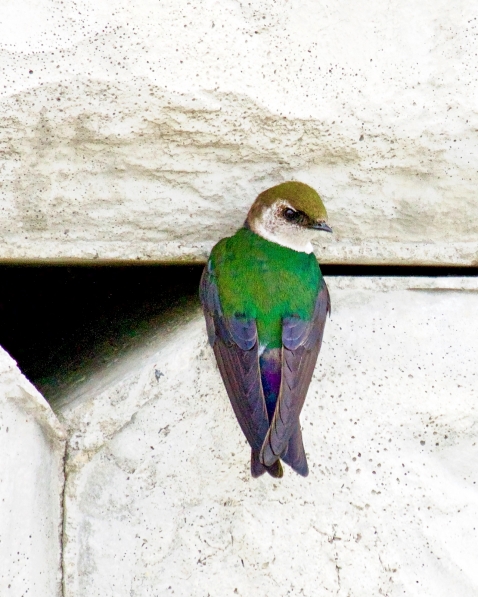
(Tachychineta thalassina) female in the stone foundation of our condo, Kelowna.
We didn’t linger long at the lake. Instead we headed south to Osoyoos and famous Road 22 which crosses the Osoyoos River floodplain just north of Osoyoos Lake. At this time of year we can expect to see Ospreys freshly returned from their winter homes in the States, as well as a few other migrants navigating northwards. As we crossed the river and turned south onto the dike road, we saw a flight of Violet-green Swallows (Tachychineta thalassina), a couple of hundred I’d guess, swarming around the bridge area. As we have these at home, we didn’t take time to shoot any….
We did enjoy some success with the Ospreys, however. There are three nests in the floodplain that I’m aware of, and pairs occupied each one . We focused on the largest and most colourful nest, perhaps in the whole Okanagan Valley, maybe in BC, maybe even the world, (!) not that it matters. I’ve provided just three Osprey shots here but if you want more, click this link…. To enlarge the photos, below, click on the —oh, you know…!
We have the best nest!!
Poppa Osprey is not quite all there!
Momma Osprey on wing and the lookout!
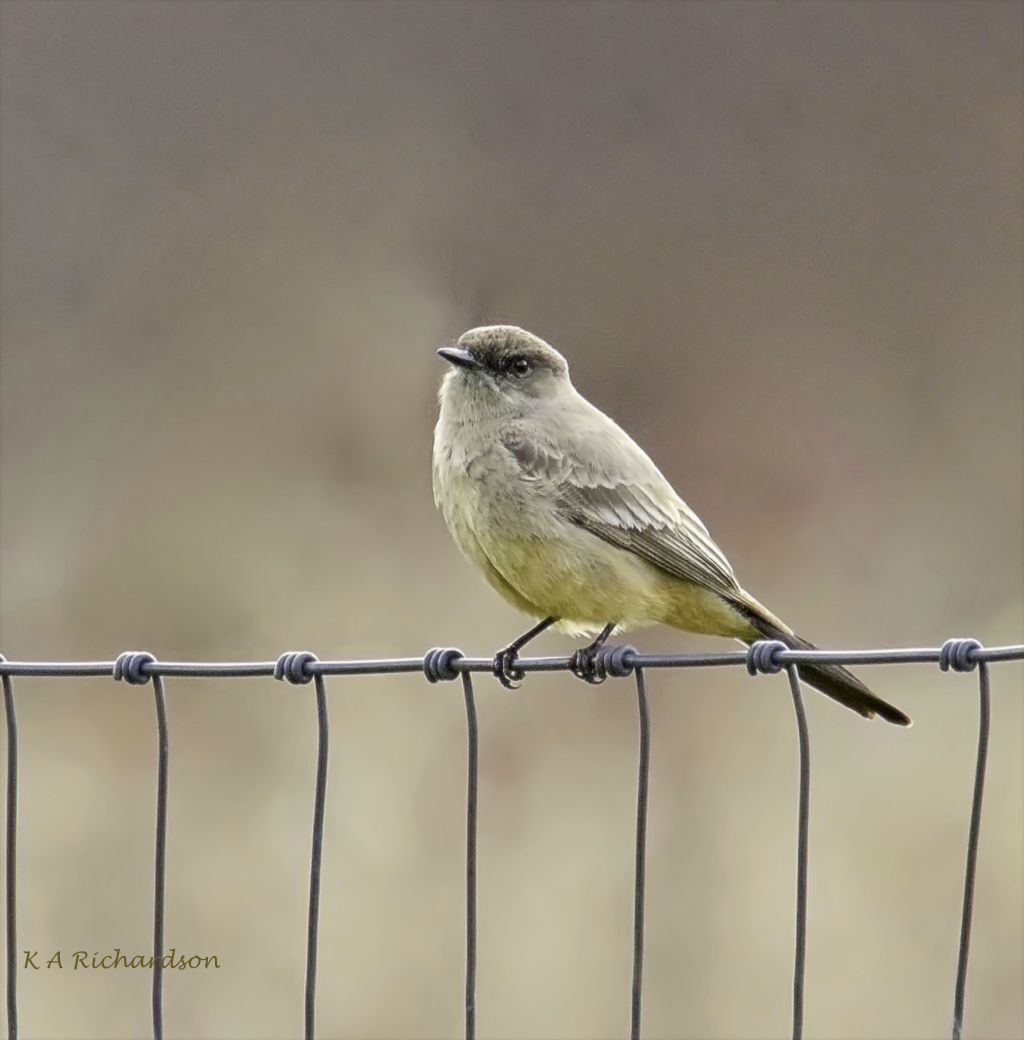
On our way back to Oliver, we chose to take the Nimkip Road through Osoyoos Indian Band lands (the road is provincial). Near the junction of Rd. 22 and Sage Rd. sits an old barn and, across the road, some other sadly deteriorated ranch buildings. There we enjoyed great looks at some Say’s Phoebes (Sayornis saya), which seem to be in abundance through their BC range this year. Came away with one acceptable photo.
From Oliver, we drove to Vaseux Lake and up McIntyre Rd. (which Google insists on calling Dulton Creek Rd. Apple Maps, for once, gets it right!) This area is collectively referred to as McIntyre Bluffs (or sometimes Vaseux Bluffs). See map above.
It’s home to a variety of wildlife, both avian and four-legged. We saw (and interacted again) with meadowlarks (still denied the quality shots we got last year). We saw four mule deer, which, after spotting us, turned their attention to a predator they could see, but we couldn’t. Although they stayed put, the here was giving it undivided attention. As the Mulies were too far away to photograph, we didn’t.
Ewe is here!
Wait, this is U2! One down, one up!
On the way up to the ranch on McIntyre Bluff, we stopped to appreciate a rather thin and tired looking California Bighorn ewe. Nana wanted to go look for the rest of the herd, but that came later on our way home….
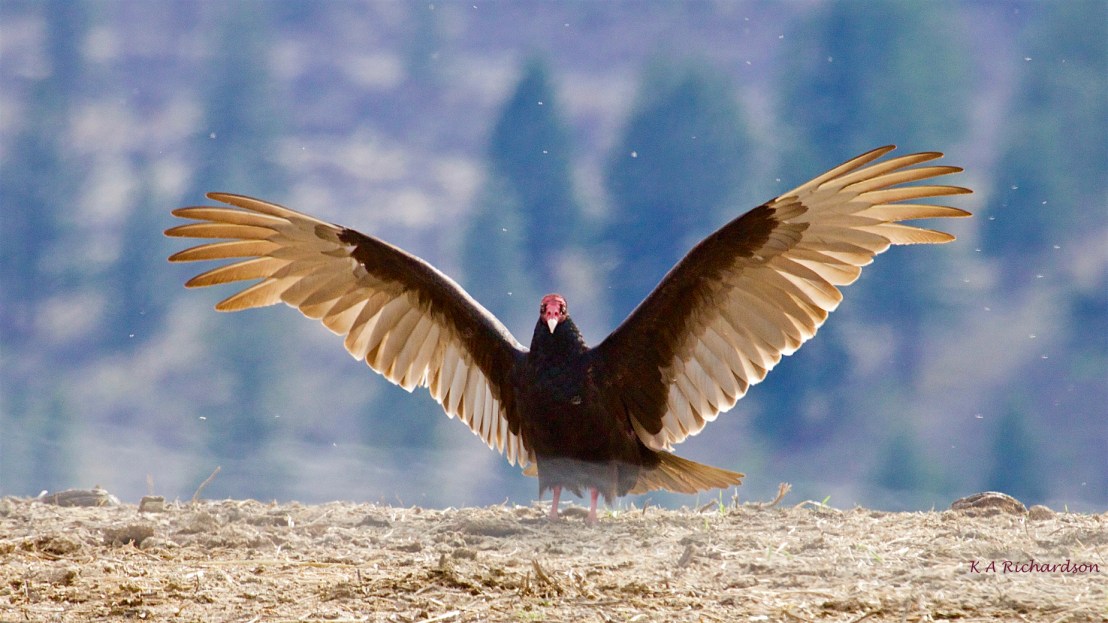
Turkey Vulture at the ranch above Vaseux Lake near Oliver, BC.
After turning around, a km or so past the ranch, we were startled on our way back down, just as we approached the feedlot, to find a wake of Turkey Vultures (nine altogether) mostly on the ground but also flying in and out. Must admit that I was struck with vulture fever! Stopping the car as close as I could on the opposite side of the road (with no traffic, that was a mistake!), I rolled down the window and attempted to shoot between strands of the barbed wire fence. While the opportunity was fabulous, the fence was a foil. To get the results I wanted, I had to get out and hope that in their frenzy, the ol’ buzzards would stay put and let me shoot. Alas, not happening on this day! While I got the closest ever to TUVUs, the images produced are not nearly as good as they should be. Were I doing it again, I’d drive to the wrong side of the road close to the fence; I think the TUVUs were oblivious to the machine but not to the man…. One of those situations where one is seen exulting and beard-muttering at the same time!
Sort of what I felt like doing when I got such a feeble result!
On the way down the highway, located “our Ewe” again, and observed her and 21 others in the herd, by Nana’s count. There may have been more. No rams, however…. To enlarge any photo below, click on it!
The view of Vaseux Bluff from McIntyre Bluff. Can you spot “Ewe”?Ewe is a sweetheart!One dozen of the herd. Nana counted 22 in all….
Finally, from the new tower-blind at the Vaseux Lake “Important Birding Area” (a lot more on this fraud some other day!), one last look at Vaseux Lake and Bluff.
Vaseux Lake from the beautiful new tower-blind. Sadly, the same old lousy birding spot!
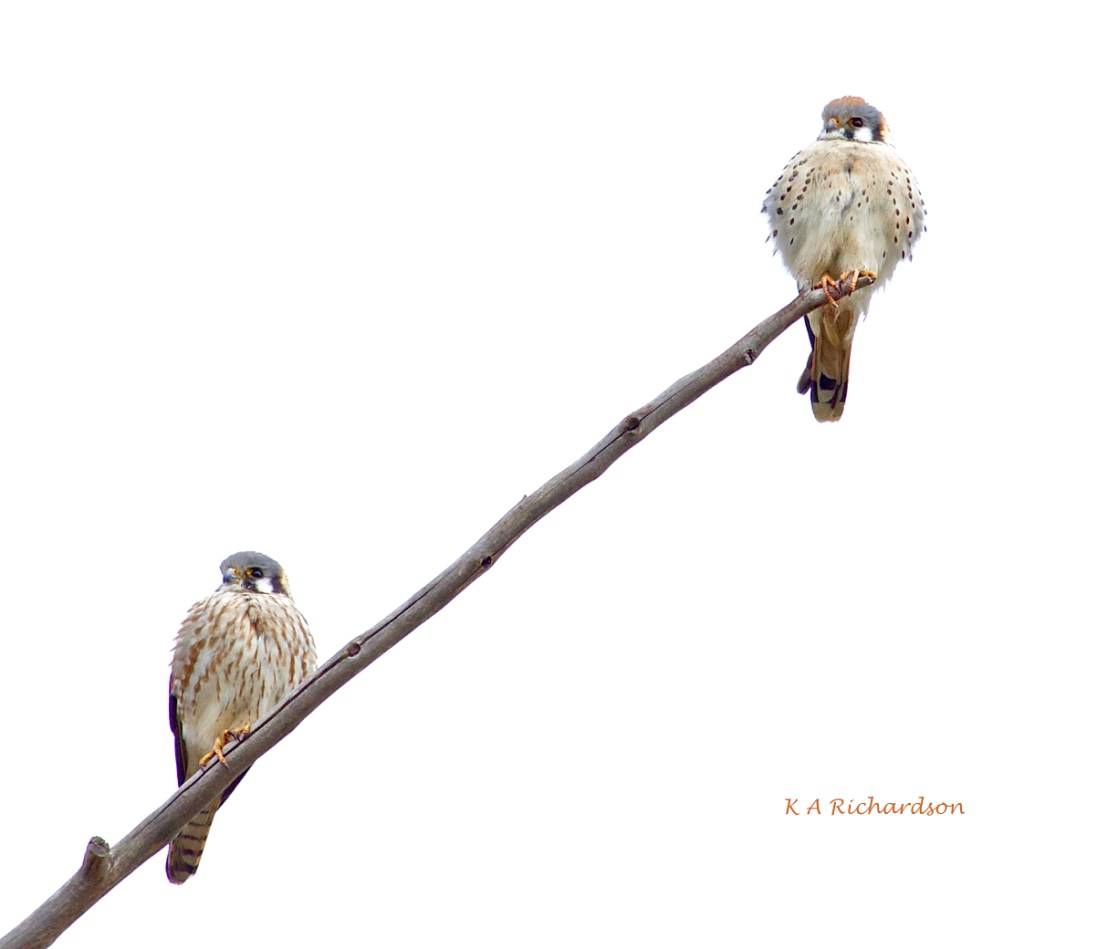
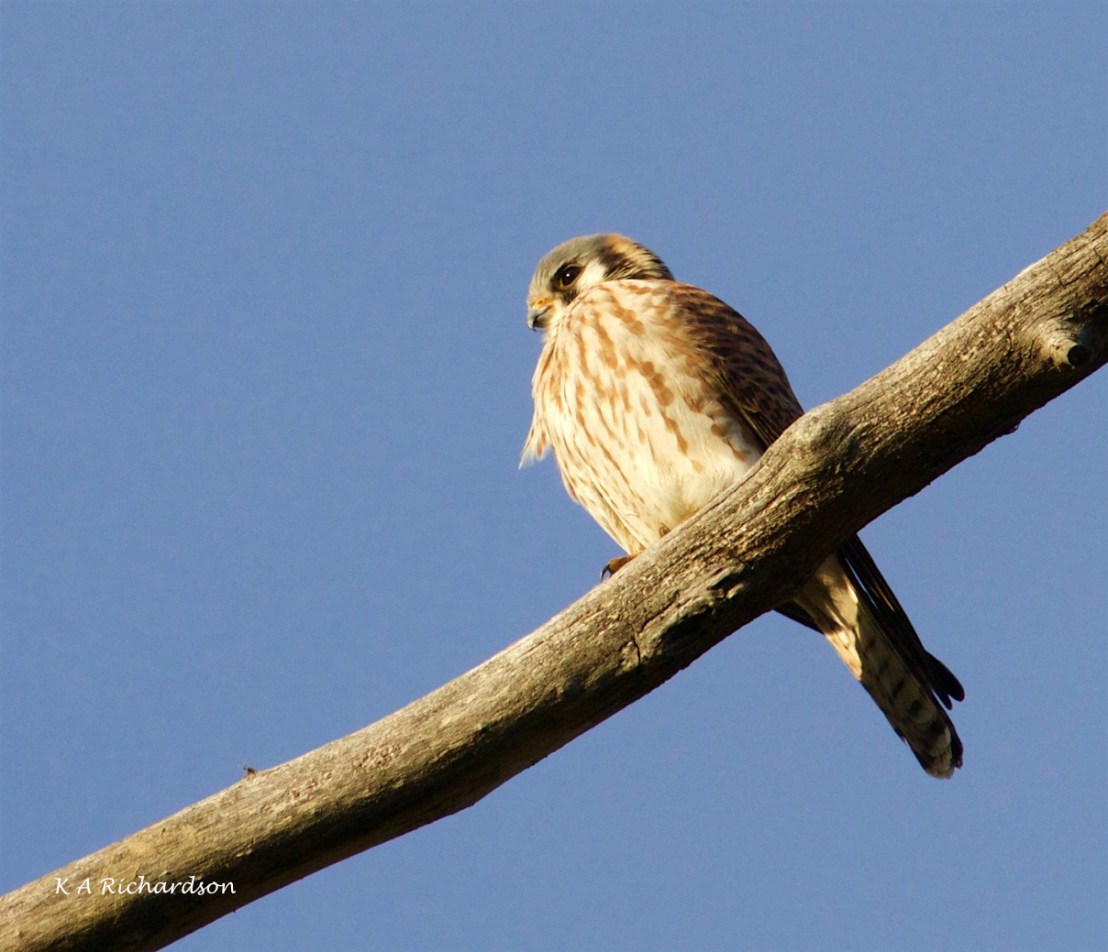
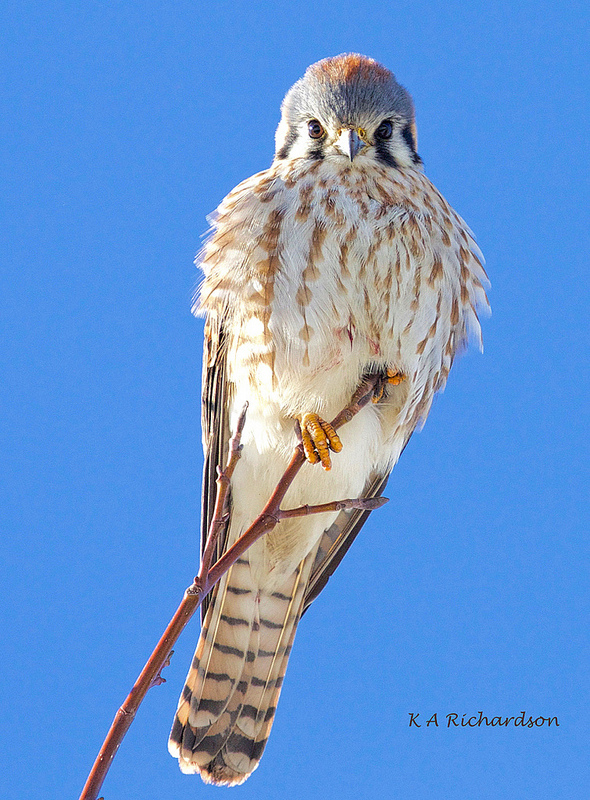
April 2017: Recently, I discussed the winter raptors of “my beat” in the Thomson and Michaelbrook Marshes that mark the boundaries of Kelowna’s Recreational Fields in Lower Mission. I beganthat postby featuring a female American Kestrel that I have been flirting with (actually, I have to give her most of the credit, here) since Spring 2015.
I named her “Kessie.” Seemed reasonable, I thought. Last year, I had the privilege of watching her mate with “Amke“, a handsome but less interactive bird not far from their nesting tree on the southwest edge of Michaelbrook Marsh. This Spring, sometime in late February and through March, she began spending more time in that part of my beat. In the first week of April I have twice watched them copulate on different days. Most of the photos in this post are not spectacular, but I’d like to share them with Kestrel lovers everywhere:
Kessie on the left and Amke, her mate, on the right above Michaelbrook Marsh.
Click on clusters of photos like the ones below to open them in a new tab….
The parents to be….
Kessie on the nesting tree…
…with Amke on a nearby branch.
Getting together looked pleasant enough:
Not the most glamorous place for a romantic occasion. Two days later I watched them re-couple on a branch near the nesting tree.
Preparing for the trials of parenthood starts with nutrition….
Kessie dining on a vole…
Some must die that others may live….
Kessie after lunch….
Kessie greets us on an evening visit.
I whistle and she gives me her attention; this has been going on for four months….Basking in some evening sunshine, April 9, 2017.
(Above) Kessie looks more serious, somehow, than she did two months ago (below)….
Kessie, January 31, 2017.
We’ll keep an eye on this pair and hope to see offspring in due course.…
Thanks for visiting this blog, a work in progress since 2015, especially if you’ve come here from my keithricflickFlickr site. Hope you find something interesting. I want your experience to be as user friendly as possible! For the most recent posts, choose from the list on the right
or scroll down below this sticky post that always appears at the top of the blog.
My purpose is to share photos and stories of wildlife, particularly birds, in the Okanagan Region. You’ll also find “bonus information” from other places I’ve travelled to. Secondly, when the muses dictate, I’ll offer some rambling about politics and other topics of general interest. Look under Politics~
Recommended posts: (changes occasionally). Click a blue or boldfaced underlined link.
Belmont Pond in late November 2015 with a light veneer of ice….
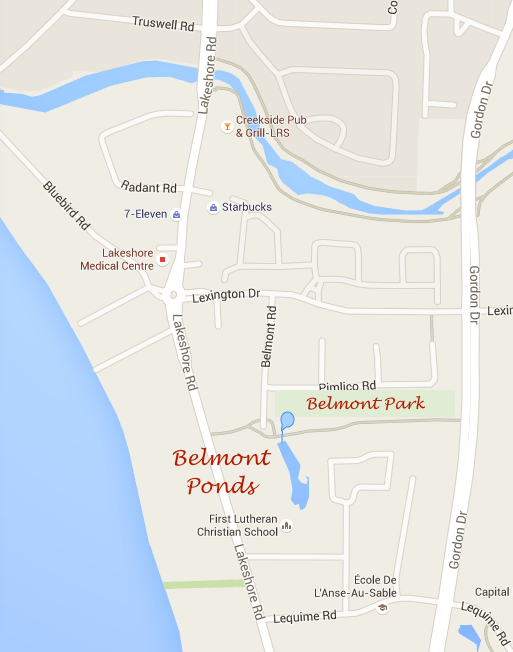
Sometime in March, little Belmont Pond — surrounded by homes, a park with the same moniker, a church and private school and its fenced off playground — melts back to life. In winter it may be — or not — frozen for weeks at a time depending upon the severity of that season. In 2015, it froze long enough for a skating area to be cleared, while in 2016, an El Niño year, it was open except for brief spell when it wore a thin veneer of ice.……………………
Through January, February, and much of March 2017, thick ice sealed the pond. Kids hauled hockey nets onto it; residents took to watering the surface from time to time so the folks would have smooth skating.
Belmont Pond, February 2017Hider Heron checks out one of Belmont Pond’s new nesting boxes.
And a group of neighbours got together to make and install three Wood Duck nesting boxes in hopes that in Spring we’d be able to enjoy the thrill of watching Woodies, and possibly Hooded Mergansers, Common Goldeneyes, or Buffleheads use them to raise young. It’s too soon to say, of course, but we remain hopeful. The ducks have returned to the pond. How long they’ll stay is still a guess.
…………………………………
……
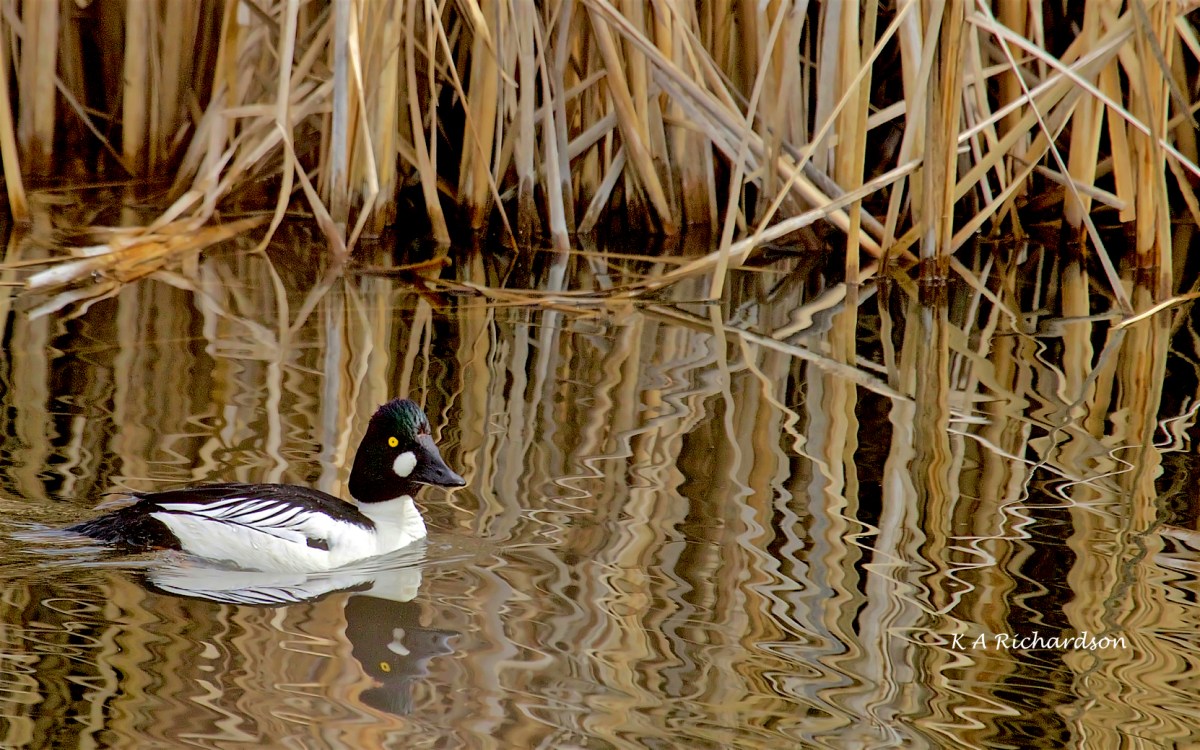
By mid-March, the ice had thawed enough to allow some ducks to return, like this Common Goldeneye (Bucephala clangula) who was obviously pleased to be here!
Clarence is one happy COGO!
He grew even happier as the water opened up…. Note: click on any image in a group to enlarge it!
“Oh, what a feelin’!”
“Oh yeah!”
“I’m feelin’ somethin’ comin’ over me…..”
And soon he had company!
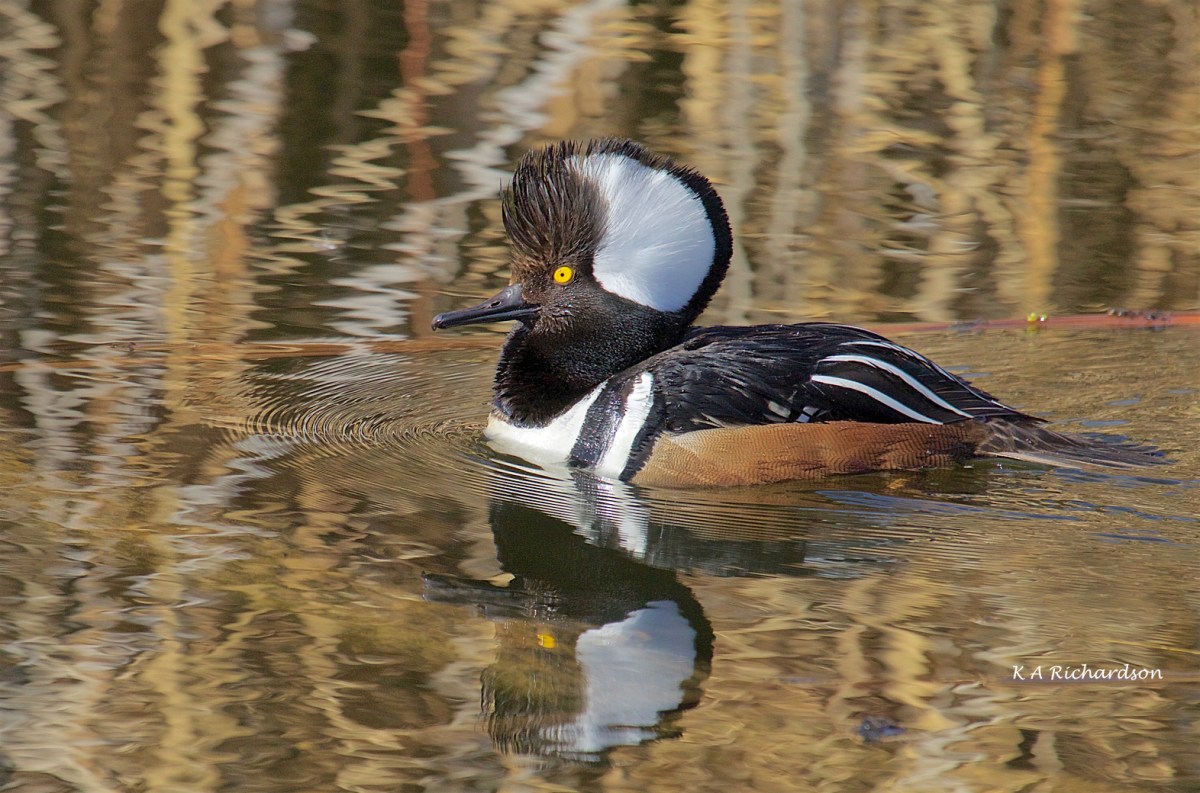
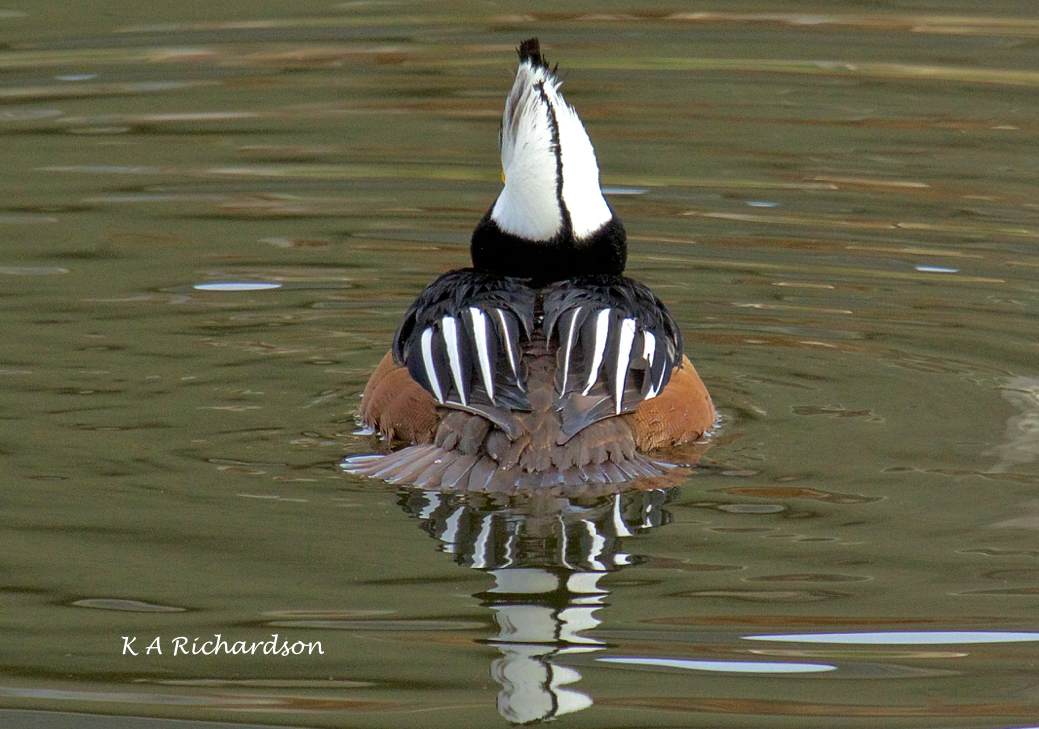
Howard the Hooded Merganser (Lophodytes cucullatus) applauded the change of seasons….
By late March the Wood Ducks (Aix sponsa) were back. Whether they noticed the new nesting boxes is not known by anyone not fluent in Woodduckese…. We have to wait and see.
Wilbur Woodie in all his glory, April 1, 2017….And wife, er, partner, Wilma, who was about to greet one of our Western Painted Turtles, obscured for this photo by a cattail blocking the way….
The WPTs appeared at the end of March as well: click on any image in a group to enlarge it!
Stick together fellas!
“This pond is our pond…”
The bravest, closet to shore.
The smartest, closest to escape routes!
Soon, the entire pond was clear, and the Hoodies were asserting themselves, especially Howard who likes to think he’s the boss, but whom no one else takes as seriously as he takes himself….
I’m a happy dude, clap your wings! I’m a …..
Click on any image in the group to enlarge it!
I love this place…
and you know what else I love?
Yep! ME!!
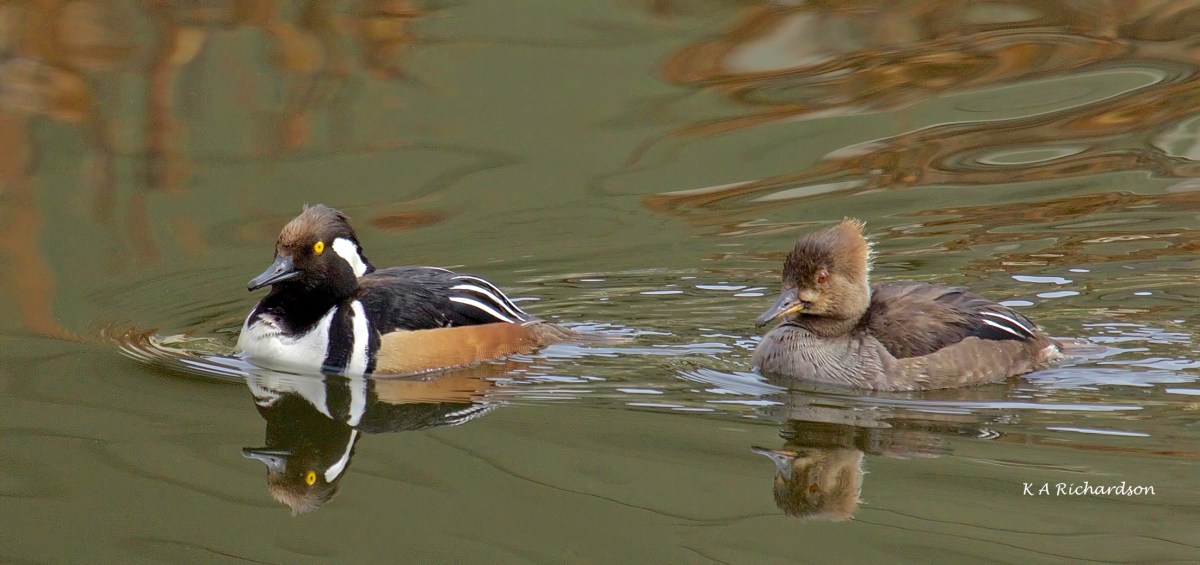
If he becomes too full of himself, however, one way to Howard Hoodie can be back to earth, er, water, is by his partner, Hester, who has her feathers full!
Hester pins his Howard’s hood back from time to time….and appreciates it when he does his job when interlopers start getting too cute….
Howard did ask that I include the photo below with his question in the caption:
Do you think this ‘do makes by butt look big?
It’s been a bit much for Clarence Cogo, all this Hoodie kerfuffle. His partner apparently isn’t keen on Belmont and it appears they have bade us farewell….
Clarence, it was nice to have you with us for your staycation. Be happy!
With no intent to downplay the supporting cast, the real stars of Belmont every Spring are the glorious Wood Ducks, Wilbur and Wilma. So here’s a closing look at them. Click on any image in a group to enlarge it!
I don’t want to belabour the point that Spring’s arrival is more eagerly anticipated than any other season’s, yet it’s not only a fact, but a particularly poignant one in 2017 when its is taking so long to extract Winter’s talons from the back of the land….
So I thought I should share this poem I started writing many years ago and have updated many times as my insights have evolved. I think it’s especially relevant now:
Spring Birdswhat first excitesabout the return of Springis the birds....as southern Sun duels
tired North Windfor Soil's allegiancewe search,each day,heavenwardhopefullyimpatiently...
more suddenly than bursting buds,new green,or arctic blooms,our winged friends reappear
almost as ifthey’d never left...
First, the geesein majestic undulating wedgespointing the way —their unmelodic greetings still
music tostarved ears...then one.....by one......and more..........and more
...........they find us —
mergansers and mallards dartingin and out of marshes and shoressquabbling for space.
Click images below to enlarge….
House Finch, Belmont.
Crested Song Sparrow of Belmont photographed on April 1….
sparrows and finches trilling in hedges,....bluebirds riding fence rails,.......robins and flickers pulling treasure from lawns,blackbirds, red-flashed and furious, grating like rusting barbed wire stretching on fences crossed,..........staking their claims and pleading for mates,.................killdeers kri-kri-ing in charade,..........and, here and there,
.......juncoesinvestigating everything.
they jog our memory —are these the fledglingslast seen camoufrockedin battle fatigues?bright plumage nowrestored by tropic sunshinecostumed to suit the operettasrehearsed for eternitynow broadcast on sunbeamsto our winter-weary souls....
As promised in the previous post on late winter ducks, here’s a look at some ducks that usually arrive a little further into spring: mergansers (Common and Hooded) and Wood Ducks.
To enlarge single photos after the one below, just click the photo.
Heron checks out Belmont Ponds and signals an alternative use for the new nest boxes….
But first, a look at some encouraging signs that we may have some of the COGOs with us a bit longer than usual this year. Over the winter, some of the lads who live along the east side of Belmont Pond got together and built three Wood Duck nesting boxes, or at least that was their intent. Such boxes, however, are also used occasionally by cavity nesters such as Buffleheads, Hooded Mergansers and COGOs. Now that the ice is finally off the pond, all of us duck watchers in the neighbourhood are curious to see which species, if any, make use of the new nesting facilities!
Some birds will use them for their own purposes, do doubt….
Among the first to show up in Belmont Pond Main, now that it’s is no longer a ‘hard water reservoir,’ were a pair of COGOs. The young drake below seemed eager to practise his moves before his lady came by:
(NOTE: IN MULTI-PANE ILLUSTRATIONS, JUST CLICK TO ENLARGE!)
“I’m feelin’ somethin’ comin’ over me…..”
“Oh, what a feelin’!”
“Oh yeah!”
“Hoo—whee!”
“Makes my nictitating membrane just twitch!” (170318)
Keeping Loverboy company was a pair of Hooded Mergansers.
(Lophodytes cucullatus) Belmont Pond, Kelowna, BC. First of the year, still lots of ice on our little pond….
The object of his affection….
And this lad was also showing signs of spryness appropriate for springtime shenanigans!
Yoga workout…:
The Bowling Pin…
The Flippy Flap…
The SlowMo…
and Breathe….
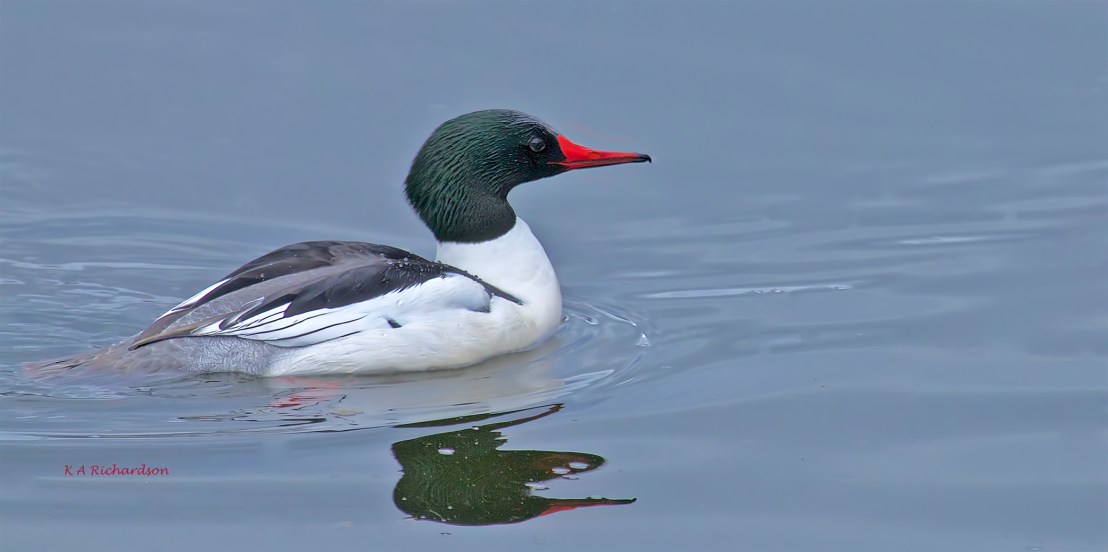
Meanwhile, back at the Fish Pond on the other side of town, where we last watched the Canvasbacks beginning to sense their own need to start preparing for the season, another kind of merganser had found the pond en route to its own rendezvous.
In the Fish Pond….
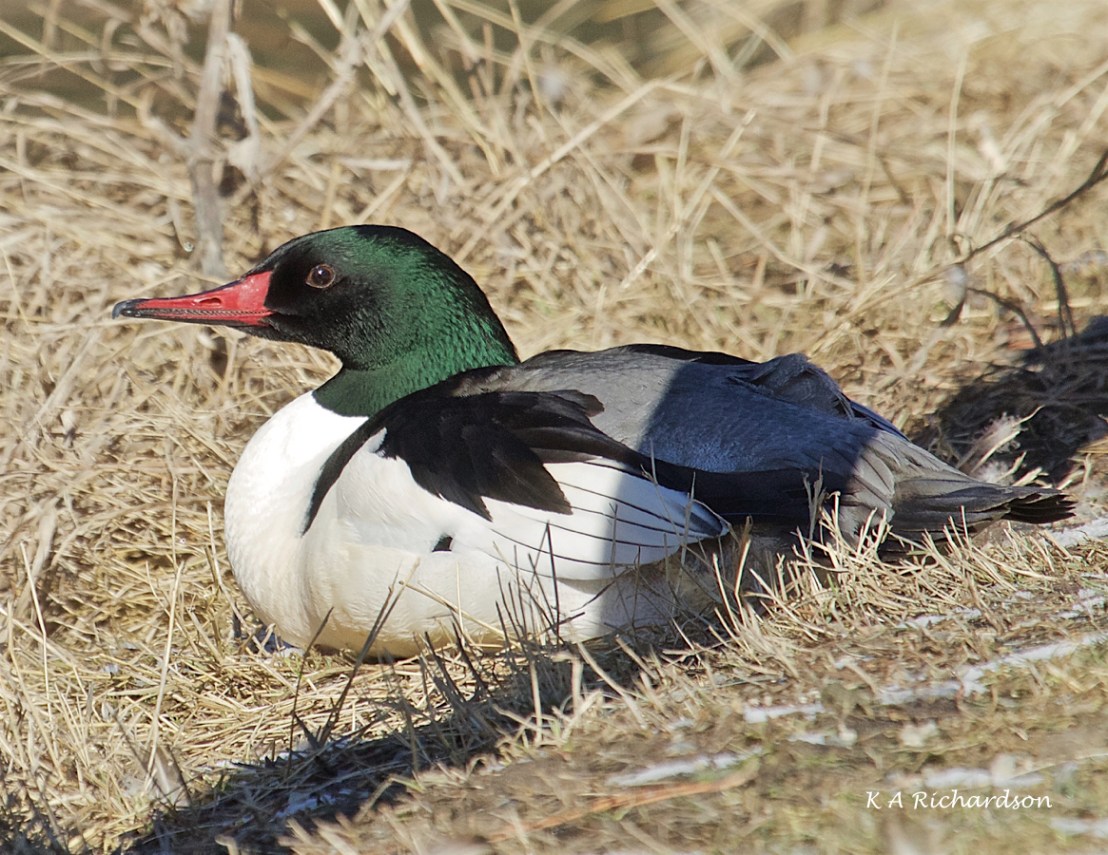
Green, black, white, and, oh yeah, ORANGE!
In this light, black and white…not really….
Not one for mixing with the other ducks on the pond, and at this point, the only COME to be seen, he later swam to the south end and pulled up onto the bank for a little sunshine:
Enjoying the sun on the last day of February 2017.
He stayed around for several more days and was eventually joined by another of his kind:
Common Merganser drake buddies, 170328
On March 23, I found yet another COME, this time in Munson Pond where it’s usually impossible to get a closeup shot. However, because that pond was still frozen except for a narrow channel around the shore, I was able to snag a shot of this guy working along the shoreline from 250 meters away towards me. He didn’t see me until after I had captured his soul. Here he has turned around and retreated from my intrusion….
On his way back to less interaction with Homo sapiens….
Mergansers do nest in the area, and I will cover them again, I’m sure! I can hear some folks asking, “But where are the females?” Well that’s covered in a different post, to some extent, but I will offer this group of shots of a female COME taken in February while there was still a considerable amount of ice on lower Mission Creek. The two genders are getting together as I write this and will stay together until the merganserlings hatch….
Kelowna is a wonderful location for people who love waterfowl, especially ducks. You can read all about ’em in Parts 3, 4, and 5 of my 2016 highlights —just click the Ducks tab in the menu to the right (and down a bit) of this post…. Most of the quackers (actually, most of them don’tquack, but that’s too fine a point right now!) in those posts are spring and summer residents. A few stay all year ’round, or most of it anyway. This post is dedicated to the ones who are most prominent in late winter / early spring, including a species that seems to be popping up in many new spots around BC in 2017, the Canvasback. Until this year, I’d seen them only at a distance. It was a great joy to find them close to home in a pond where photographing them is reasonably easy.
Canvasback pair, Hall Road Fish Pond.
Cornell’s Lab of Ornithology describes the species: “A large diving duck, the Canvasback breeds in prairie potholes and winters on ocean bays. Its sloping profile distinguishes it from other ducks.” In coloration, it’s similar to the Redhead (a close cousin of the Eurasian Pochard), which has a round head. Both species, especially in winter, can be found in sizeable flocks or rafts on fairly large bodies of water.
While Canvasbacks are found in all regions west of Atlantic Canada, they can be a challenge to find and get close to.
Cornell offers a couple of interesting facts about CANVs. The second one I find really amazing!
The species name of the Canvasback, Aythya valisineria, comes from Vallisneria americana, or wild celery, whose winter buds and rhizomes are its preferred food during the nonbreeding period.
The oldest recorded Canvasback was a male and at least 22 years, 7 months old when he was shot in California in 1991. He had been banded in the same state in 1969.
Good buddies….
Displaying….
Intelligent, prudent, and confident….
So glad to have these guys around for more than three weeks 2017.
For comparison purposes, here’s some images of Redheads from 2015 and 2016. You can see that the similarities and differences are about equally balanced. Click images to enlarge.
We’ll see this species in a month or so at a ‘secret location’ north of Kelowna.
Redheads’ range is similar to Canvasbacks’ but not identical.
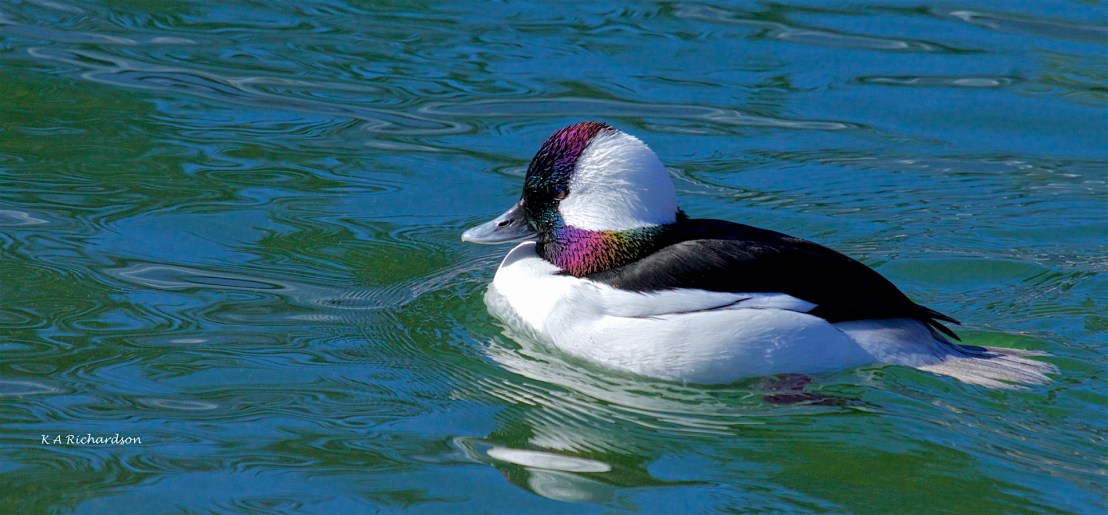
I discovered the Canvasbacks at a kids’ fishing pond beside Hall Road when I went there to observe Buffleheads. I’d seen BUFFs there the previous two late winters where they are confined sufficiently to let a photographer get close…. While the CANVs were a great bonus, I wasn’t disappointed by the wee ones, either.
On a cloudy day, he looks black and white with a hint of colour…. Hall Rd. Fish Pond.On a brighter day, we get a very different impression!
Click on any of the images below to enlarge it.
Bufflehead range is widespread — well done, little ones!
The Bufflehead nests almost exclusively in holes excavated by Northern Flickers and, on occasion, by Pileated Woodpeckers.
Unlike most ducks, the Bufflehead is mostly monogamous, often remaining with the same mate for several years.
Bufflehead fossils from the late Pleistocene (about 500,000 years ago) have been found in Alaska, California, Florida, Illinois, Kansas, Texas, and Washington. One California fossil that resembles a modern Bufflehead dates to the late Pliocene, two million years ago.
Bufflehead normally live only in North America, but in winter they occasionally show up elsewhere, including Kamchatka, Japan, Greenland, Iceland, the British Isles, Belgium, France, Finland, and Czechoslovakia. In some of these cases, the birds may have escaped from captivity.
The oldest Bufflehead on record was at least 18 years and 8 months old. It was caught and re-released by a bird bander in New York in 1975.
One more group that we see mainly in the winter and that leaves us around the same time the Canvasbacks return are the Goldeneyes, both Common and Barrows. You’ll find images and further information on Common Goldeneys, near the bottom of this post: Waterfowl Part 3. Here are some photos from 2017: Click on any photo to enlarge them all.
The COGO raft in Mission Creek, February
Handsome is as…
handsome does… (whatever that means!).
COGOs make underwater art!
Thanks to Cornell, again, for these fascinating facts about COGOs….
Hunters dubbed the Common Goldeneye the “whistler” for the distinctive whistling sound of its wings in flight. Cold weather accentuates the sound.
A female Common Goldeneye often lays eggs in the nest of another female, especially in nest boxes. She may lay in the nests of other species of ducks as well. Common and Barrow’s Goldeneyes lay in each other’s nests, and Wood Ducks and Hooded Mergansers often lay in the goldeneye’s nest too.
Like Wood Ducks, Common Goldeneyes readily use nest boxes as a stand-in for naturally occurring tree cavities. Some return to the same box year after year.
Goldeneye chicks leave the nest just one day after they hatch. The first step can be a doozy, with nests placed in tree cavities up to 40 feet high. As the female stands at the base of the tree and calls, the downy chicks jump from the nest hole one after the other and tumble to the ground.
After the ducklings leave the nest they can feed themselves and require only protection. Some females abandon their broods soon after hatching, and the young will join another female’s brood. Such mixed broods, known as “creches,” may also occur when a female loses some ducklings after a territorial fight with another female. Young scatter and mix when females fight, and not all of them get back to their mother when the fight ends. Some or all of the ducklings may be transferred to one brood, usually that of the territory owner.
The eyes of a Common Goldeneye are gray-brown at hatching. They turn purple-blue, then blue, then green-blue as they age. By five months of age they have become clear pale green-yellow. The eyes will be bright yellow in adult males and pale yellow to white in females.
In winter and early spring, male Common Goldeneyes perform a complex series of courtship displays* that includes up to 14 moves with names like “masthead,” “bowsprit,” and “head throw kick,” in which the male bends his head back to touch his rump, then thrusts forward and kicks up water with his feet. *I hope to cover this in future posts….
The oldest known Common Goldeneye was a male, and at least 20 years, 5 months based. He was banded and found in Minnesota.
Look for Spring mergansers and Barrows Goldeneyes in a post coming soon….
Published first in March 2017
and updated several times up to April 2024.
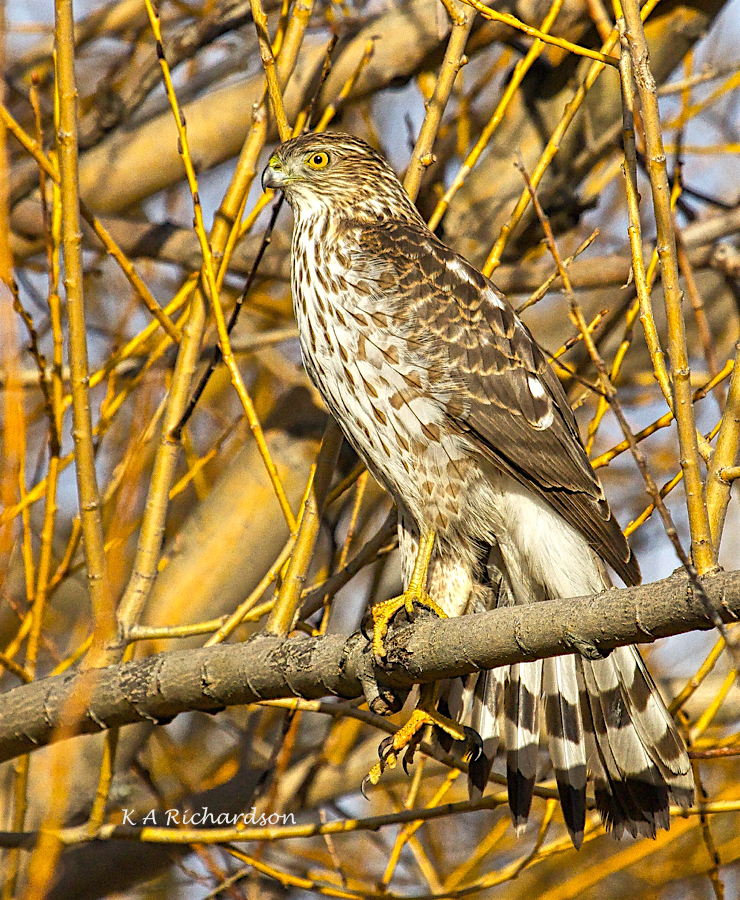
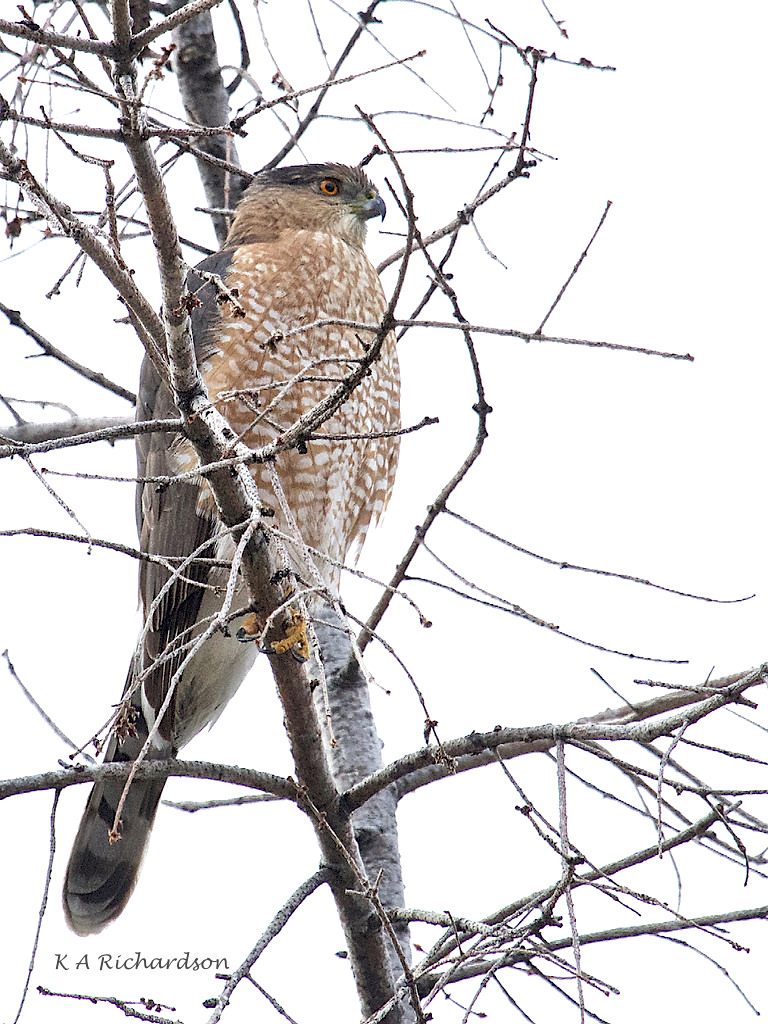
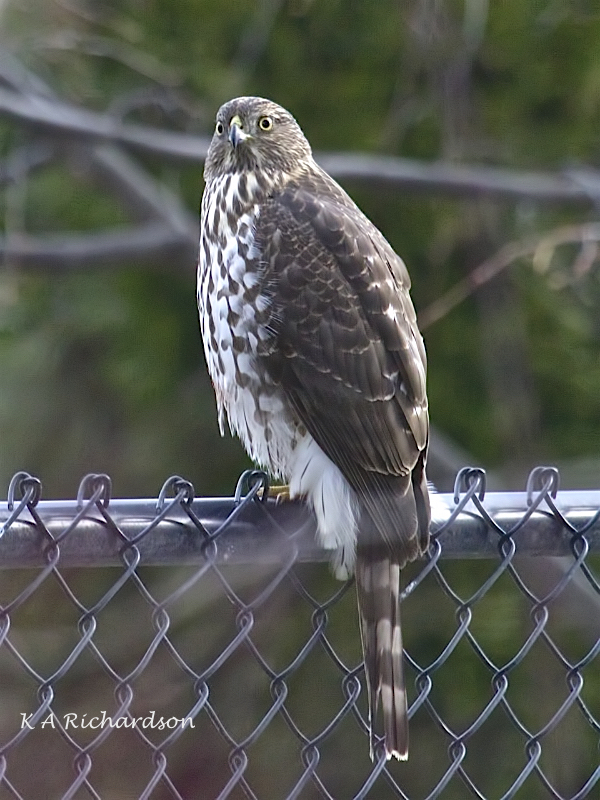
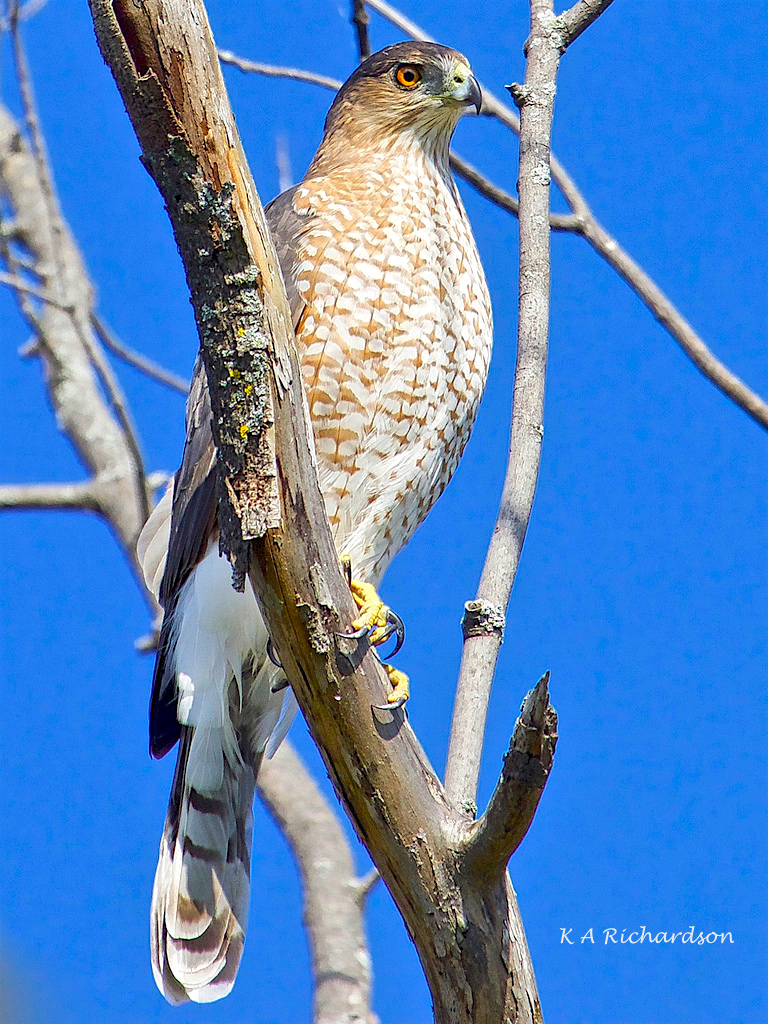
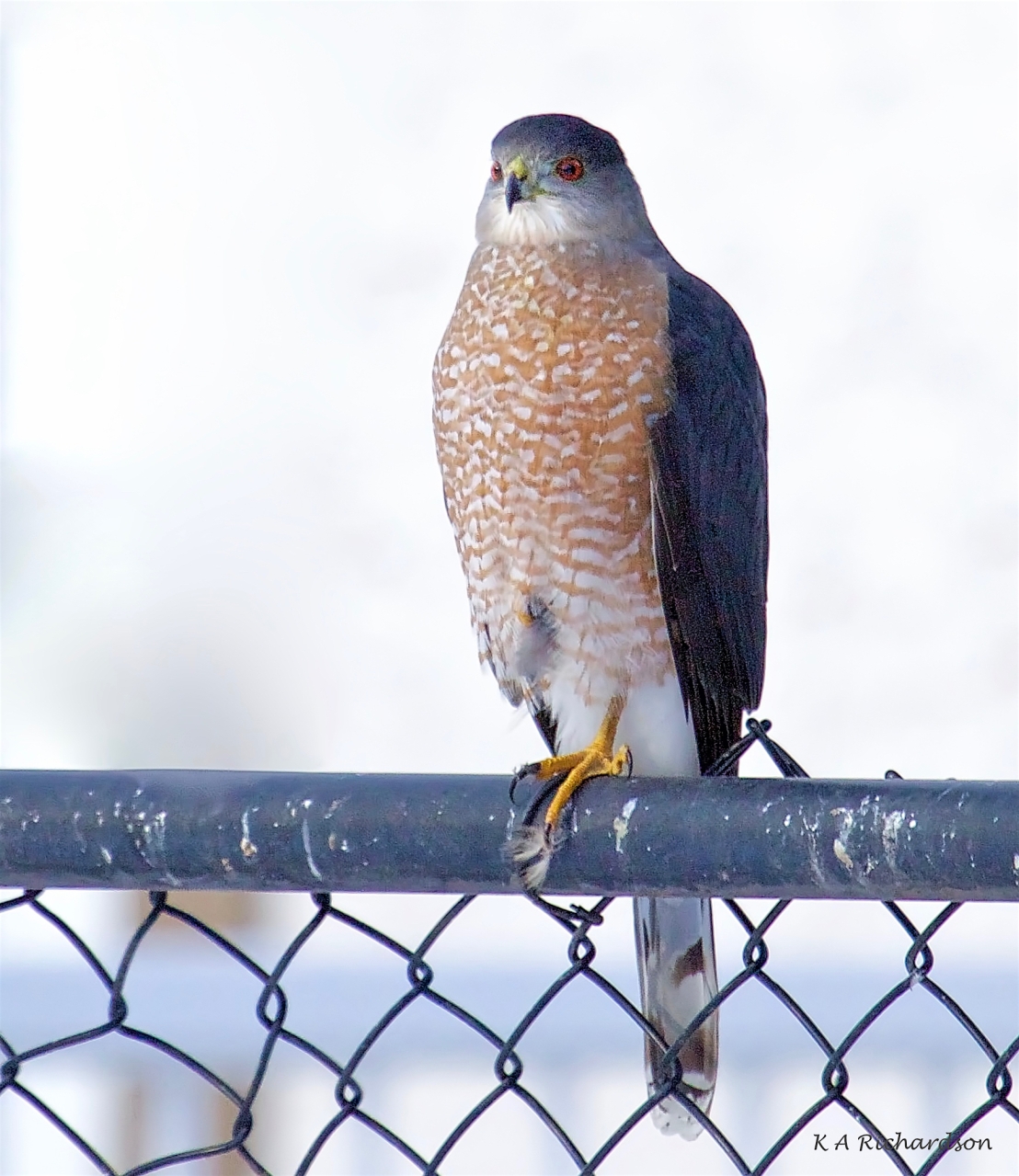
One of the great natural mysteries for me is how two species (sometimes more) can evolve to look so similar and yet not be an offshoot of the other. Take Cooper’s and Sharp-shinned Hawks, for example. If I see one or the other in the wild,
I really can’t be sure which it is, even though I’m familiar with many of the indicators that pros use to differentiate them.
I’m not alone!
For what the Cornell Lab of Ornithology tells us look for,
go to their website. The images are NOT very good,
but the table summarizing the differences is helpful. Click on items in their list for extra illustrations / details:Cooper’s vs Sharpies – Cornell
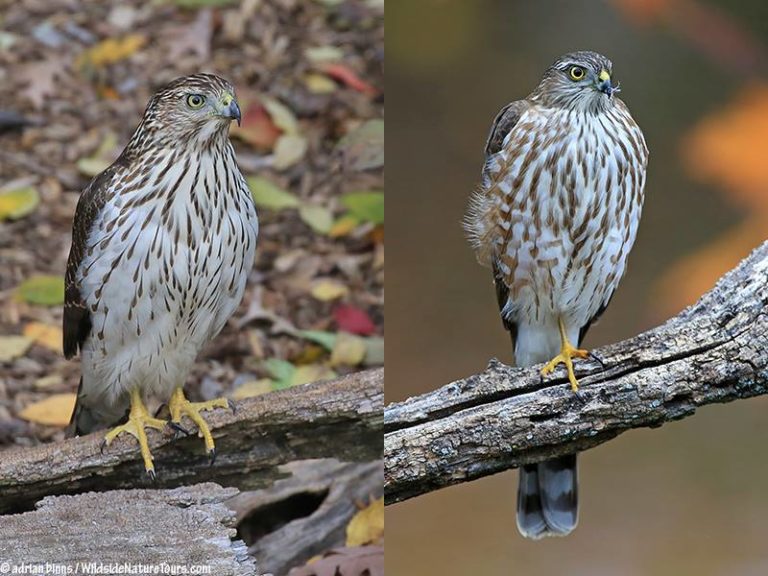
And from another site (info seems no longer visible unfortunately, comparative images copied below):
Cooper’s juvenile (left) and Sharp-shinned juvenile (right) from Notes from the Wildside.
I’ve edited, for improved clarity, the description from Notes from the Wildside below:
“In the above composite image we can compare a juvenile Cooper’s Hawk ( left) with a juvenile Sharp-shinned Hawk (right). When they are shown side by side, it easier to work out which is which, even though they are in slightly different postures.
The eye looks larger and more foreward in the head on the smaller headed Sharpie. NOTE: CORNELL’S SITE SAYS THE OPPOSITE! “Eyes appear to be close to half way between front and back of head [of the Sharpie].” Just keeping life interesting…. [To this, I’d add, from the Cornell site, that a Cooper’s head seems larger and less rounded than a Sharpie’s, and that the Cooper’s head appears ‘capped’ while the Sharpie’s appears ‘hooded’ with a shadowy patch down the nape. This may not be obvious with juvies, however….]
The Cooper’s head is typically less ‘tucked in’ than a Sharpie’s. There is a noticeable dark stripe on the throat of the Cooper’s.
The breast pattern is ‘ dark brown’ on the Cooper’s, and, ‘warm brown’ on the Sharpie.
Cooper’s display narrower and cleaner tear drop markings, thinning out on the belly,
whereas the Sharpie has heavier, or coarser, ‘blurrier’ markings.
On the Sharpie Broad note the broad barring on the flanks.
Cooper’s have thick sturdy legs (tarsi), while Sharpies’ are delicate and pencil-thin.
Though we can’t see the tail on the Cooper’s in this image, it is usually rounded compared to the Sharpies’ squared-off tail. While tail shape can be easier seen in flight, when posing upright with the tail fanned, a Cooper’s tail feathers get shorter towards the outer feather” giving it a rounded look when spread in flight.” (edited by KAR from the Wildside)
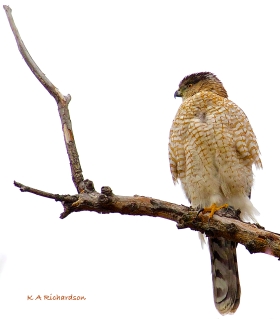
So what’s the one below, then?
I’m going to go with Cooper’s juvenile emerging into adulthood….
This one has my Flickr friends giving me opposing labels. I think it’s an adult Cooper’s, but I’m still not sure….
Not a great perch, but with enough details to offer ammo to both Sharpie & Coops fans….
From these lists, items that are easiest to examine are tail feathers, eye position, and head shape and cap, and in juveniles, breast markings. Size, it turns out, isn’t very reliable, as male Cooper’s are relatively small and female Sharpies are relatively large, so even though we know that Sharpies are generally noticeably smaller than Coops when comparing the same gender, it’s a problem when we can’t be sure which gender we’re looking at, and there’s no reliable way in the field to differentiate the males from their mates.
So, even knowing a few identifiers, I often have to wait until I get home and look at the images to make my guess — and then wait until after I’ve posted and real experts weigh in….
Sharpies range through more of Canada than Cooper’s do. Despite their larger range, it seems that there are more Cooper’s in total for the continent than their smaller lookalikes. Click either image below to enlarge it.
Cooper’s range – CLoO
Sharp-shinned range – CLoO
It’s always exciting for most of us to come across either species. While not rare, they’re not a bird that I can expect to see on a regular basis, or at least, they weren’t until I moved to Kelowna. Here, their territories are a little easier for me to pin down than they were at The Coast. This winter, J L Cummins, a birder-photog colleague in Washington State, has enjoyed having a Sharpie in his backyard, and it has become as familiar to him as Kessie, the female American Kestrel has become for me. Perhaps the Cooper’s / Sharp-shinned that I observed several times each winter and spring in our neighbourhood will become as identifiable as Jim’s…. (Update 2024: I haven’t seen either species in the neighbourhood for the past two years!)
So, I’ll wrap up this discussion of uncertainty with some photos taken in the neighbourhood:
I now think it’s a Sharp-shinned juvenile, after first calling it a Cooper’s, based mainly on plumage details, but I’m still 100% not sure….While I think this is the same bird as the one above, I’m less than certain. The breast marks seem to suggest a Sharp-shinned…. …..It’s entirely possible that both species visit this park! Click photo above to enlarge in new tab.
The photo, below, of an adult bird has been identified by expert friends as a Cooper’s. To me it seemed large enough, and the tail is rounded, but I see a hood, not a cap on its rounded head and nape, which are more indicative of a Sharpie!
This one, taken on our trip to Ottawa in October 2016 is, I’m told, is certainly an adult Cooper’s…. To me the tail definitely says Coop, but the rounded head and grey-black down the nape make me wonder….
In January 2017 I had a great but unexpected opportunity to photograph the hawk below. Sadly, my camera settings were right for a previous photo I’d taken of a distant Red-Tail, and woefully wrong for this guy/gal. Surprisingly, when I posted it on Flickr anyway, it got far more hits and positive comments than it deserves. It’s here simply because, at the time, I promised myself that if I got another chance, I’d do much better…. See the next one….
Cooper’s or Sharpie? Belmont Park, Kelowna, BC. I’m betting on the former!
So finally, on March 8, 2017, I did get my “another chance.” Guided by instinct, at about 10 AM I entered Belmont Park from the east so I’d have the light behind me. The Park was extremely quiet, as it often is when there’s a hawk about. Just after I passed a small fir on my left, I heard a flapping of wings and figured I’d flushed one of the Mourning Doves that frequents the area. Then I saw the hawk as it veered to perch on a pine about 20 meters ahead of me. I got the shot, and, right or not, am calling it a Sharp-shinned, based largely on the one shot of the tail and the two shots of the head and nape. Click on any of the photos to enlarge it.
Sharp-shinned with Quail breakfast – 1
Sharp-shinned with Quail breakfast – 2
Sharp-shinned with Quail breakfast – 3
Hope you got this far and that you enjoyed looking at these powerful and handsome hawks!
I have seen more owls since we moved up here in 2014 than I had seen in my lifetime before that. On the other hand, I have yet to see several species that I’m told are not unusual to come across — in other words, I have lots to look forward to. In this section, I’m including some photos from my days at The Coast, where it’s much easier, I think to find the diversity of this special, highly sought after genus.
The two species I have had a chance to observe in Kelowna are the Great Horned and the Long-eared. Let’s start with the latter, which I saw only recently and briefly.
While on my beat around Thomson Marsh, I was alerted by a young gentleman walker that there was an easy-to-see owl only 100 yards away. Here’s what (s)he showed me: my first ever Long-eared Owl. Usually, this species is found in thick cover; I was exceptionally lucky. Gone next day, (s)he left no forwarding address!
Click on any photo to enlarge it….
LEOW Thomson Marsh 170212
As I saw it first….
One profile…
… and the other.
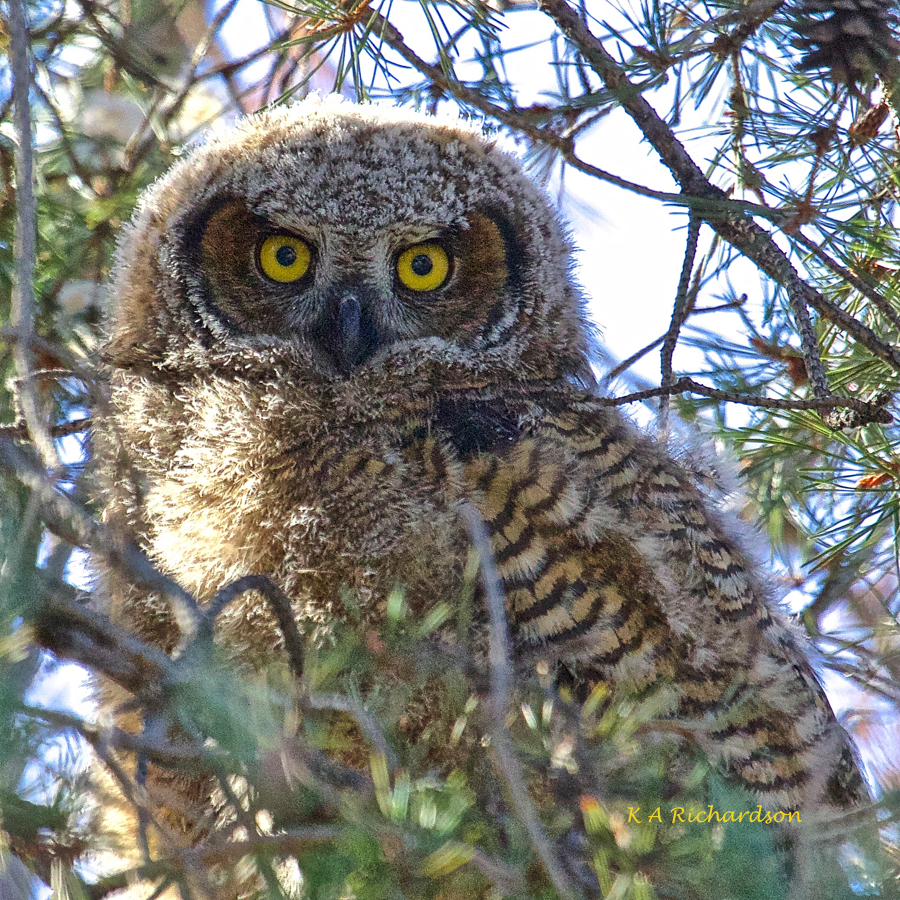
Great Horned Owls, on the contrary, are frequently found in the Okanagan, and close to where we live. This winter, we had the pleasure of listening to them hoot from an unseen perch very close by at 12:30 AM! Here are a few shots I’ve managed so far. I’ve learned a lot about capturing them in the process — looking forward to better capitalizing on future opportunities.
The first group of photos are the best to date, and the earliest! These owls were easy to find in the woods near Munson Pond (once I was shown their location!). They are no longer resident there; some homeless people set up a camp that summer in the very spot I took these shots.
November 15, 2014 – 1
November 19, 2014: the mate
November 19, 2014: the boss!
Folks frequently report owls much closer to home both near the Lower Mission Greenway where we have observed them for the past three winters, and even in various parts of Thomson Marsh. Unfortunately, the perches these closer GHOWs choose are not ideal for photography!
GHOW just below the Greenway, 151004
160108 in a perch (s)he has favoured for many years apparently.
Same perch above the Greenway, 170129
(S)he wanted to sleep, but let me know (s)he knew I knew….
In March of 2016, birders, photographers, and the general public were treated to watching a family of three owlets fledge in uptown Kelowna — in a tall, old pine tree on the grounds of the Courthouse. Here’s my best shot of one of the wee ones (or not so wee by this time!). They all fledged successfully, but we’re not sure what happened to them later on:
It may appear that we were on the same level; we were not! Cropped photos can lie!!
As for the owls we have yet to see such as the Northern Pygmy, Northern Saw-whet, Western Screech, Barred, Barn, and Snowy, Short-eared, and if we’re really lucky, a Northern Hawk-owl, we keep our fingers crossed. Of these I’ve seen all but the first three elsewhere…. The owls below were all found in different location in BC’s Lower Mainland.






















 as southern Sun duels
tired North Wind
for Soil's allegiance
we search,
each day,
heavenward
hopefully
impatiently...
as southern Sun duels
tired North Wind
for Soil's allegiance
we search,
each day,
heavenward
hopefully
impatiently...
 more suddenly than bursting buds,
new green,
or arctic blooms,
our winged friends reappear
almost as if
they’d never left...
more suddenly than bursting buds,
new green,
or arctic blooms,
our winged friends reappear
almost as if
they’d never left...
 First, the geese
in majestic undulating wedges
pointing the way —
their unmelodic greetings still
music to
starved ears...
then one
First, the geese
in majestic undulating wedges
pointing the way —
their unmelodic greetings still
music to
starved ears...
then one
 mergansers and mallards darting
in and out of marshes and shores
squabbling for space.
mergansers and mallards darting
in and out of marshes and shores
squabbling for space.


 they jog our memory —
are these the fledglings
last seen camoufrocked
in battle fatigues?
bright plumage now
restored by tropic sunshine
costumed to suit the operettas
rehearsed for eternity
now broadcast on sunbeams
to our winter-weary souls....
they jog our memory —
are these the fledglings
last seen camoufrocked
in battle fatigues?
bright plumage now
restored by tropic sunshine
costumed to suit the operettas
rehearsed for eternity
now broadcast on sunbeams
to our winter-weary souls....














 birds & musings