Category: Birds

Not a hybrid after all!

An old dog learns something new…. Does the term “intersex duck” intrigue?

Please note: some of the photos are high resolution and take extra time to load on a slow computer.
ALSO: IF YOU’RE VIEWING THIS ON AN iPad,I recommend that you turn it sideways to landscape view then tap the AA at the top of the toolbar and choose Show Reader: I think you’ll enjoy the enhanced reading experience!
If you’re using a Mac from 2020 or newer, I also recommend that you click on the reader view icon on the left side of Safari’s address bar. I have no idea whether you can get enhanced reading from other systems on non-Apple devices….

Large Belmont Pond, March 23, 2020.
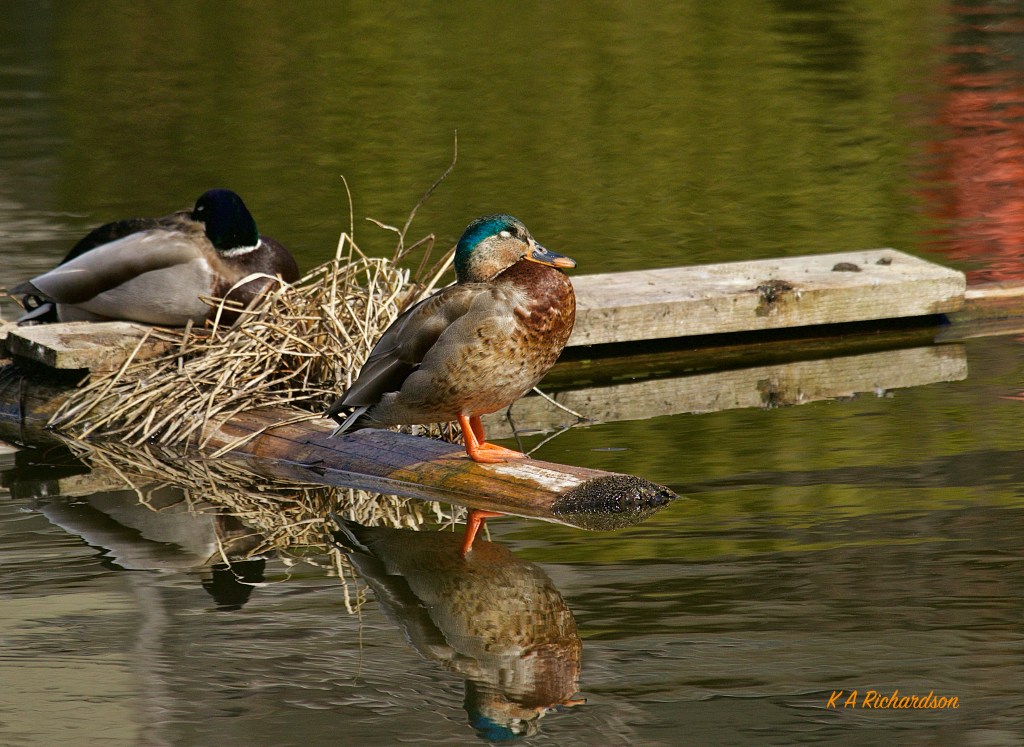
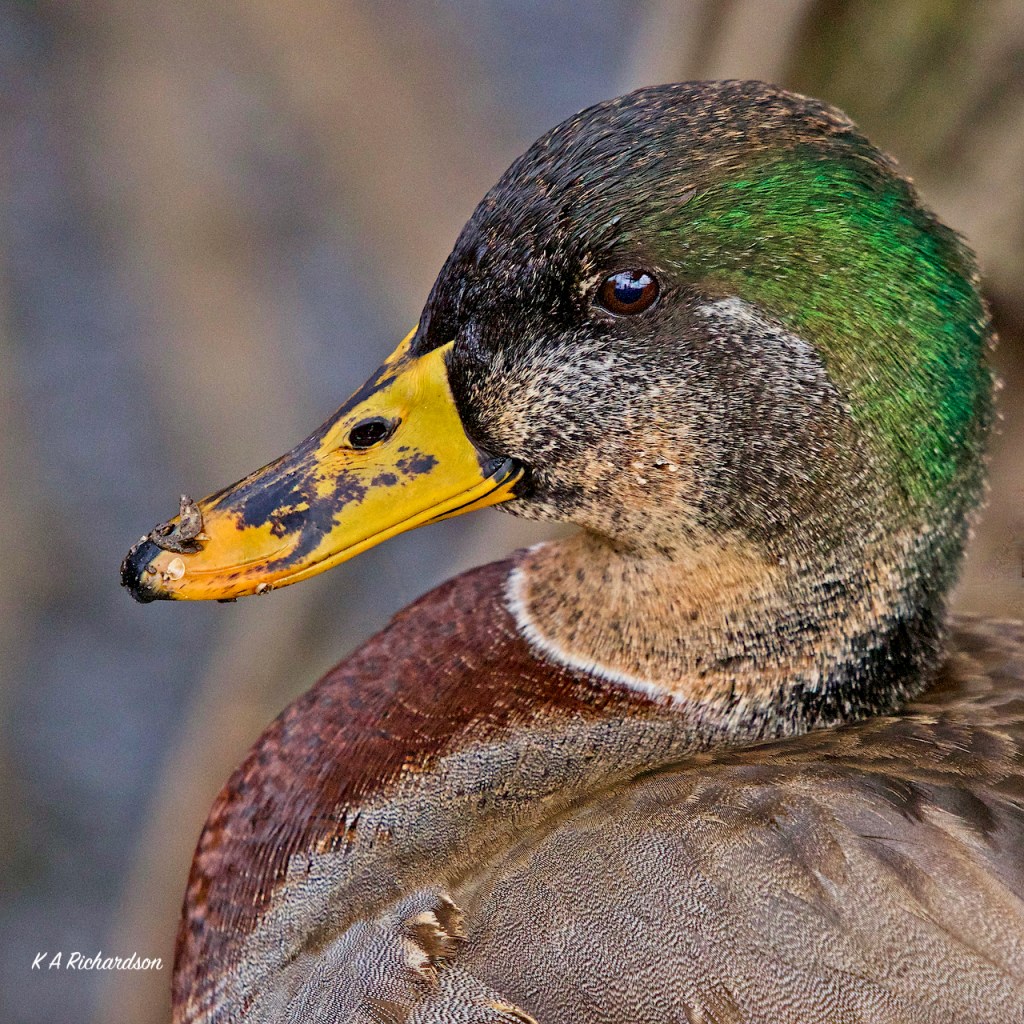
Unusual Mallard, Large Belmont Pond, Kelowna, BC. Check the female bill on this otherwise male-looking duck….

I noticed a strange looking duck, resembling a Mallard drake, sitting calmly on the south-end raft where various species, but mostly Mallards, preen and sun themselves from Spring through Autumn. As there were other Mallards in the pond, it was easy to compare/contrast. What I noticed first was this one’s “white eye,” or more accurately, its closed white lower eyelid. 

The plumage wasn’t quite right, either, but that’s not unusual as we move from Spring through Summer. Of course, on this day, we were just at the official beginning of Spring! Remember, too, that this was the first Covid year…. 
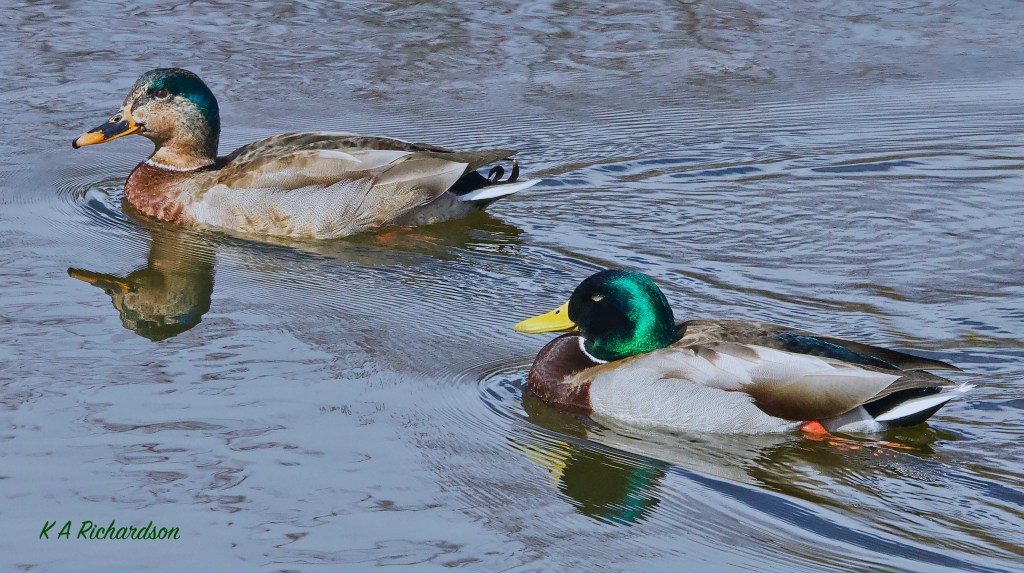
Above is what I thought was (foreground right) a Mallard (Anas platyrhynchos) and (upper left) a hybrid Mallard-Gadwall (aka Brewer’s Duck so named by Audubon in 1822) in the Large Belmont Pond, Kelowna, BC. Umm, I got the ‘Mallard’ part right….

Then I noticed the newcomer’s bill: orange with black streaks or spots, like a Mallard hen’s. The head was streaked only on the top side with the green that completely covers other Mallard drakes’ noggins. And the new duck’s sides resembled both a female’s and a male’s. 

At the time, I was very puzzled by the combination of male and female physical characteristics. I had nothing in my lexicon to describe it. On my way home, I recalled having seen a reference somewhere to a “Brewer’s Duck” that Audubon had named sometime back in the 1800s that had eventually been shown to be a hybrid of a Mallard and a Gadwall. At home, I looked up BD on the Internet, and found this:

Audubon’s Brewer’s Duck, which he first identified in 1822 as a “Bemaculated Duck,” a misspelling of ‘bimaculated’ and named in honour of the same ornithologist for which the Brewer’s Blackbird and Brewer’s Sparrow are named, Thomas Mayo Brewer.

Then I did what no effective birder, student of Nature, or anybody, really, should do: I jumped to a conclusion without asking enough questions / doing sufficient research. The bird with the fake blind eye (I had already named it Homer, in honour of the blind Greek poet/historian) was, I surmised far too easily, a Brewer’s Duck — a Mallard-Gadwall hybrid! After all, I had seen Mallard hybrids before, particularly a Mallard-Northern Pintail cross that I’d observed in 2013 in White Rock (South Surrey), BC. And I’d learned at that time that Mallard hybrids are not rare, in fact not all that remarkable, really, except for their “enhanced appearance.”
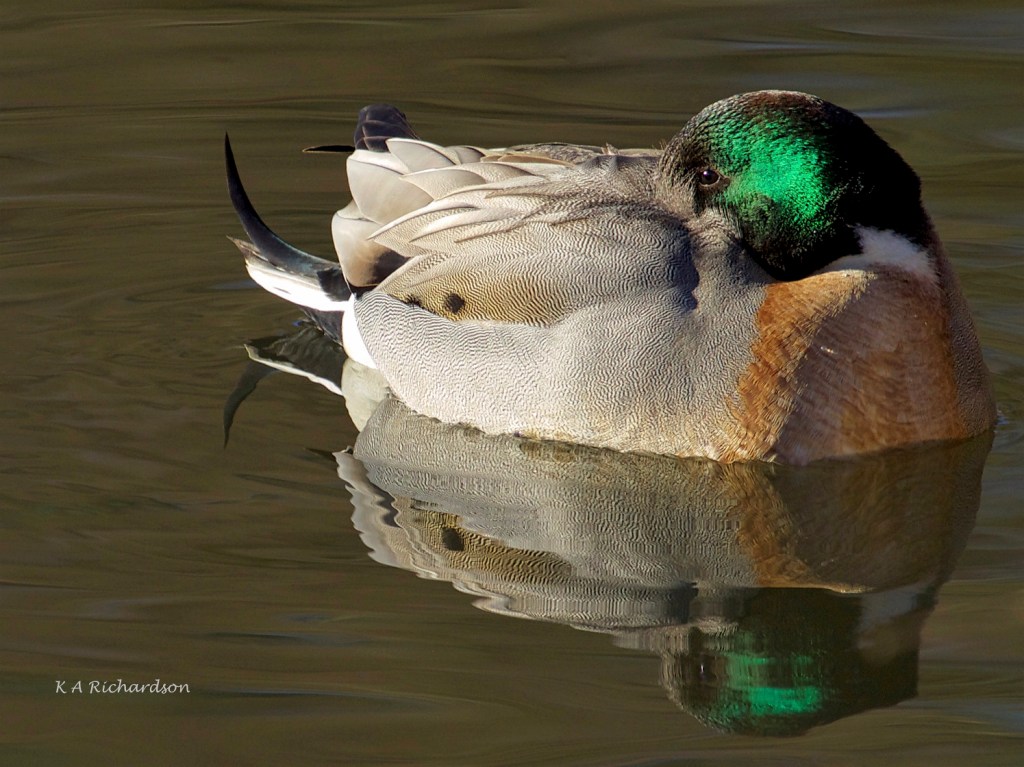
Mallard-Northern Pintail hybrid, January 31, 2014, South Surrey, BC.

Still, Brewer’s Ducks, my research showed, were certainly uncommon. I noticed that Homer didn’t fit perfectly the description of BD’s I was reading, but blithely chalked that up to the idiosyncrasies of hybridism. And then, as I am wont to do (!), I began “sharing the news” of my discovery — on Flickr, and with friends and acquaintances who live in the area and likely to see Homer themselves.

For that impulsive transgression, months later, I humbly apologize. In a moment, you’ll be picking up on the fact that from here on pretty much every use of the male pronoun appears in quotation marks. If you haven’t guessed already, soon you’ll understand why….

‘Homer’ hung around Belmont Pond for a week or so and, even with the sudden onset of Covid-19, friendly neighbours on the east side of the pond allowed me access to their back yard on the pond’s east side to photograph ‘him’ at closer range than in my first encounter.

The original comment, below, turned out be NOT TRUE!!
“Mallard-Gadwall hybrid, aka Brewer’s Duck, named by Audubon in 1822.
A rare find and a welcome addition to the large Belmont Pond, Kelowna, BC. “
(‘Homer’ was the original spelling; the name has since been adjusted to reflect more recent ‘information.’ Read on!)

Then suddenly, as April arrived, ‘he’ was gone from Belmont Pond. Forever, I suspected; off with the other Mallards to Northern destinations for the breeding season. 

I was very pleasantly surprised, therefore, when I “rediscovered Homer” in a channel of Thomson Marsh on April 4 and again on the grass near Teal Pond during the week of April 13. 

The main core of my daily beat….

The April photos included extreme closeups that have become very important parts of an historical record. By mid-April, “Homer” had “disappeared” once more. Forever, I thought, again(!).

‘Homer’ in the Channel just north of Teal Pond, Thomson Marsh, April 9, 2020.

Naturally, I celebrated the find, anyway, and persisted in trumpeting the re-arrival of the “Brewer’s Duck.”
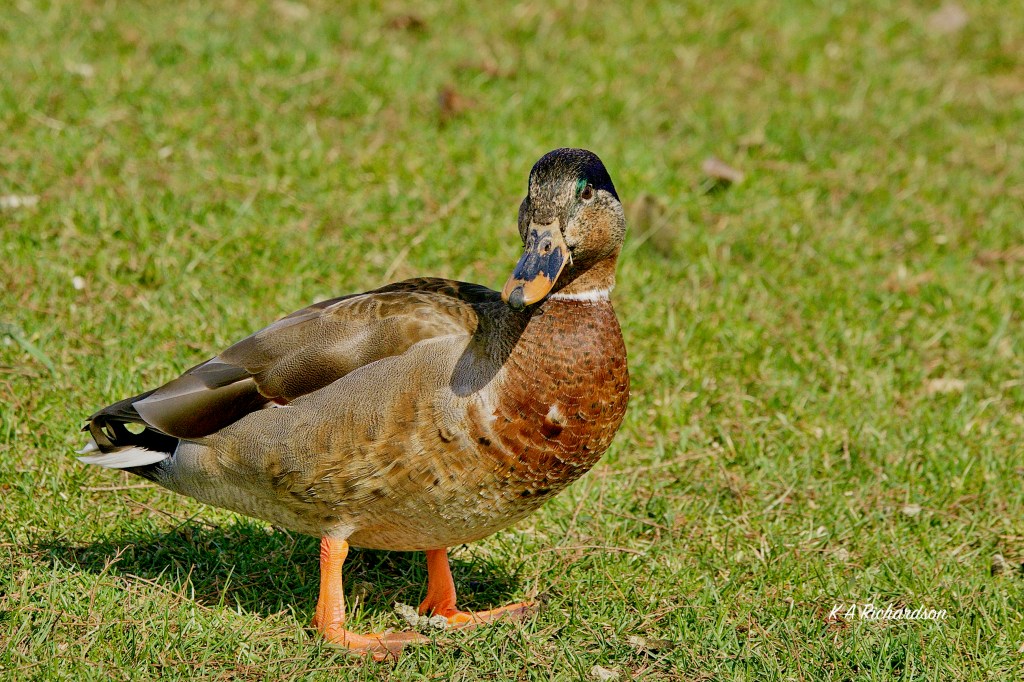
Not who I thought ‘he’ was…. But certainly very friendly in this ‘new’ location….

By May, however, Homer was no longer to be seen, at least by me. Not until Autumn, October 29, 2020, when ‘he’ magically reappeared in Belmont Pond, then, as in the spring, in the Southeast Sector of Thomson Marsh, between Teal and Raptor Ponds.. Imagine my surprise!

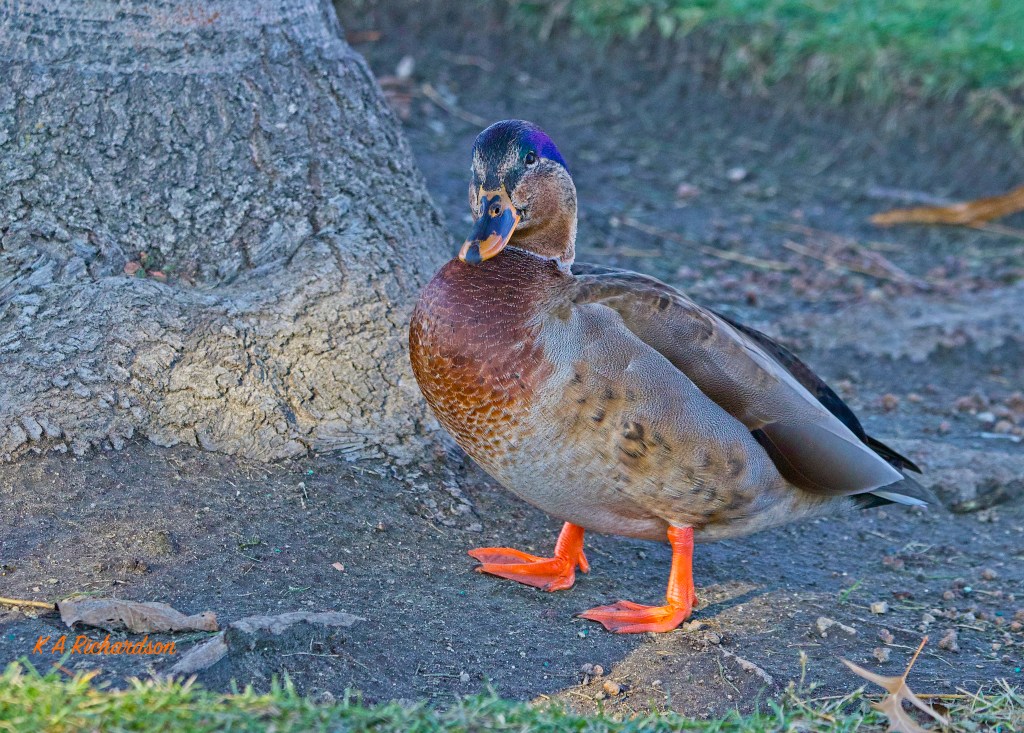
” ‘Homer’ returns. I had observed this duck in the Spring of 2020 and was surprised and delighted to see ‘him’ again in Belmont Pond in late October 2020. No doubt about ‘his’ being the same bird!”
“Gettin’ back to my roots….”

Soon, others were noticing and photographing ‘him’, too. Still, no one I knew ever had a “better” identification of ‘him’ than mine. Then one day, on an umpteenth Flickr post, the late Paul Anthony Baker, a colleague from The West Coast, wonderful photographer and birder who went by the handle “ebirdman,” whom I’d known since 2013* , wrote a simple question/comment in a response:
“Lovely shot, Keith! Have you ever done any reading on intersex birds? This bird looks very much like an intersex Mallard. Take a look (at this link) and see what you think. https://www.inaturalist.org/projects/intersex-ducks
And that kind prodding, as we say, changed everything! 
*(Very sadly, Paul passed away in January 2021: https://www.flickr.com/photos/ebirdman/51842381242/in/dateposted/
For much of a year, we did not know what had happened,
until his son chose to update his blog. Paul is deeply missed!)

Here’s what turned up, in part, on the site Paul referenced:
Note on iNaturalist website by Reuven Martin (project createdon January 26, 2018):
“Intersex” birds are those that show plumage and bare-parts colour seemingly intermediate between male and female. This is commonly seen in Mallards and is also known to occur in other ducks and perhaps other birds. Such birds are often confused with hybrids. As far as I know, the phenomenon is not well-understood or studied.
I use “intersex” in quotes because the term has quite a different meaning to how it’s used in humans.

Click this link to view an excellent collection of images of what I now call ‘iDucks:
 https://birdhybrids.blogspot.com/2015/01/intersex-birds-and-their-confusion-with-hybrids.html

Reuven continued: This project is for any ducks thought to be or to possibly be “intersex”. I’d like to get a better handle on how their plumage can vary. Other interesting questions:
* Can these birds reproduce, and if so which sex are they?
(Generally thought to be female, but I’m not sure how well-supported that is).
* Is behaviour and voice typically more male-like or female-like?
* Does the plumage remain consistent over the birds life?
(The answer is at least sometimes yes.) 

The screen shot below shows some of the locations of interest to Reuven on the iNaturalist blog….

I had written “Homer, the Brewer’s Duck (Audubon, 1822), a Mallard-Gadwall hybrid near Teal Pond, Thomson Marsh, Kelowna, BC, shows how to clip the grass with precision…. “Not so fast,” my friend Paul replied. “Have you ever done any reading on intersex birds?”

As I probed for information on the Internet, I was overwhelmed by what I found. The earliest data I encountered came from a cooperative website, Bird Hybrids http://birdhybrids.blogspot.com (apparently coordinated by Dave Appleton from North Elmham, Norfolk, United Kingdom). It enabled me to find the site of another Flickr member in Sweden, Carl Gunnar Gustavsson, that is also devoted to hybrids and birds that might be mistaken for hybrids, such as the duck below that so resembles “Homer.” Mr. Gustavsson’s post is dated December 27, 2008! And these are his images:

Under his photos, he had written: _63I8334 Mallard Intersex 1
Malmoe, Sweden 27 December 2008. This is the most masculine out of 2 or possibly 3 individuals at the same pond today. At two other ponds there were only normal birds. I saw this one also about 2 weeks ago when it was accompanied by a normal male and a normal female. Today it seemed to be accompanied by a female only when it at times separated from the flock. I presume that this is a pure mallard with poor sex definition alternatively a masculinised [sic] female. Arguments in favour of other origin?? I uploaded this picture because I think it might add something to the discussion if a bird is a hybrid or an abnormal individual of a pure species.

While clearly NOT “Homer,” Carl Gunnar’s duck in Sweden 12 years ago certainly represented the same natural phenomenon I’ had’ been viewing in Kelowna, BC, Canada!

Besides his own photos I found a useful opinion Mr. Gustavsson had offered on on someone else’s work, as well, that sets out his criteria of judgment in the hybrid vs intersex argument (quote copied and edited to remove Internet links that no longer work):
“I [d]on’t think it is a hybrid at all but what we call an intersex, i.e. a pure Mallard with both male and female features. Odd but not too uncommon. This one is the most extreme that I have heard of [dead link removed]. It was ringed [banded?] as a typical female but 10 years later looked like a rather typical male except for the bill which is still of a female type (it is the bird in the front I am talking about!!!!!!!!!!!). Some other examples, mainly my own [dead links removed]…. As you can see there are different degrees of masculinity and I think yours is rather typical. Black on the bill like in a female, green on the head green from the eye and backwards/downwards reminding on an american wigeon [sic], a mixture of male and female feathers along the side of the body and more or less obvious male type “hooks” on the tail. Moulting [eclipse] male birds is the big pitfall but should not be a problem at this time of the year, [as they] do usually not have black on the bill or only a black mid rib on the culmen [upper ridge of a bird’s bill] and usually have a more mixed pattern of colour on the head not the typical limited one that your bird has.” [bold face and square brackets – [ ] – are mine – KAR]

As I delved deeper into Dave Appleton’s Internet page on hybrids vs intersex ducks, I came across other opinions. One of the most interesting is authored by Laura Erickson, a birding expert and writer from Duluth, Minnesota. One of her first references to “intersex ducks” appeared on her Flickr site on February 3, 2009. [https://www.flickr.com/photos/lauraerickson/3251558114] where it attracted a comment from Joern Lehmhus. (He is still actively chasing this issue as shown by his comment on one of my Flickr posts in December 2020 pointing out that I had found an intersex duck, not a Mallard-Gadwall hybrid!)
In 2009, Mr. Lehmhus was questioning whether the duck Laura had labelled “intersex” was perhaps a Mallard-Black Duck hybrid. It was not as we learned from yet another post by Cathy Sheeter, another Flickr member who discussed the Mallard-Mexican Duck hybrid vs iDuck issue on Appleton’s Bird Hybrid’s site on April 1, 2013 (and no, I don’t think there’s an April Fools prank involved here!). https://birdhybrids.blogspot.com/2014/04/mallard-x-mexican-duck.html

Cathy’s duck, she concludes, is a hybrid, not an intersex. This discussion continues below the sidebar in red below.

SIDEBAR! This “hybrid/intersex/eclipse drake distinction” became important to me when I came across a second duck at Thomson Marsh on December 1, 2020, that was also difficult to identify, one I eventually named Socratease.

More on her (shown just above) later..

In her piece, Cathy Sheeter emphasizes the importance of the appearance of the bill. When I suggested that Socratease (above) is an intersex Mallard, my Flickr friend Jody Wells, on Vancouver Island, challenged me, claiming that it was just an eclipse drake, using the bill and other features to explain why he thought so. At first, I was inclined to agree. Over time, and having managed a couple of times to find Socratease again, I became more sure of my judgment. Jody was apparently unfamiliar with intersex ducks at that time, and is learning about this phenomenon along with me…. Eventually, I concluded that Socratease is also an iDuck!

Now back to C Sheeter’s case for why the duck in the photos below is NOT an intersex Mallard:
(Note: as I cannot copy the individual photos, I’ve had to use a screen shot from her site.) 
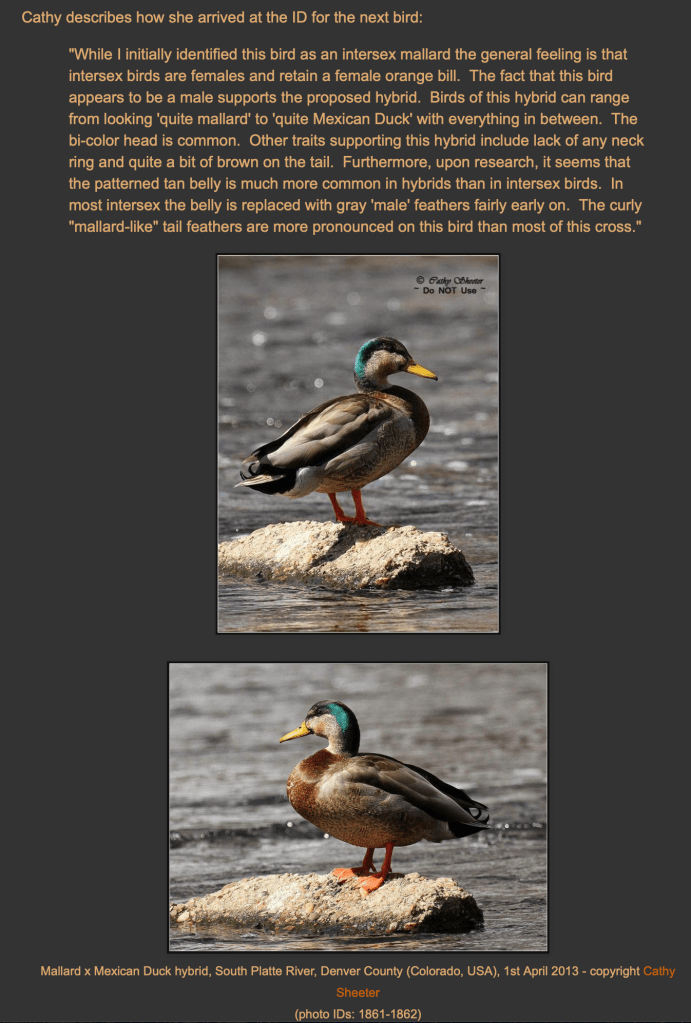
This discussion shows how easy it is for some of us to mix up hybrids and intersex ducks….

I also want to return to Laura Erickson’s blog from Minnesota for a moment. Although she first discussed intersex Mallards on her February 2009 podcast, she returned to that story in her blog post of February 13, 2016 where the audio has been transcribed. I encourage anyone interested in this story to read it here: https://blog.lauraerickson.com/2016/02/intersex-mallard.html.
Part of what makes it interesting to me is her attempt to link aging to sexual characteristics, not just in Mallards, but in other birds, and even people

To hear the original 2009 podcast click the link below then follow my instructions.
Her audio podcast is a bit hard to get to, but worth the effort:
https://www.lauraerickson.com/radio/?year=2009
Scroll down and click 2009 (on the list on the left), AND THEN in the next window, scroll down again to the February 4th entry – “Intersex Mallard” and click the audio link THERE to hear her short and fascinating podcast

 PLEASE NOTE: as time/opportunity permit and more information and thoughts develop,
I am continuing to update this post and add others related to it!

These are the main areas I go to; there are many others as well.
This map is included to show the distance between Belmont Ponds / Thomson Marsh and Munson Pond and Park.
UPDATE: In January 2021, at Munson Park, as the ducks fly, about 3.6 km north of where Homher resides, I found a third iDuck. To keep things simple, I named her Muncie. She was hanging out with a pair of mooching Mallards near a well-known bird feeding station catering to passerines. The ducks help clean up the spillage. The drake of the pair was somewhat mean towards Muncie, but she handled his harassment cleverly and found efficient, somewhat sneaky routes back to the treats. I  observed her several times through the remaining winter of 2021. At one point, she had met a single Mallard drake whom she was dominating! 
Here is a little gallery tribute (Click on a photo to enlarge it and enter the gallery; to close it, click the x in its top right corner.)
In the fall of 2021 she appeared again and is still to be found in the same location in February 2022 and in Spring 2023:

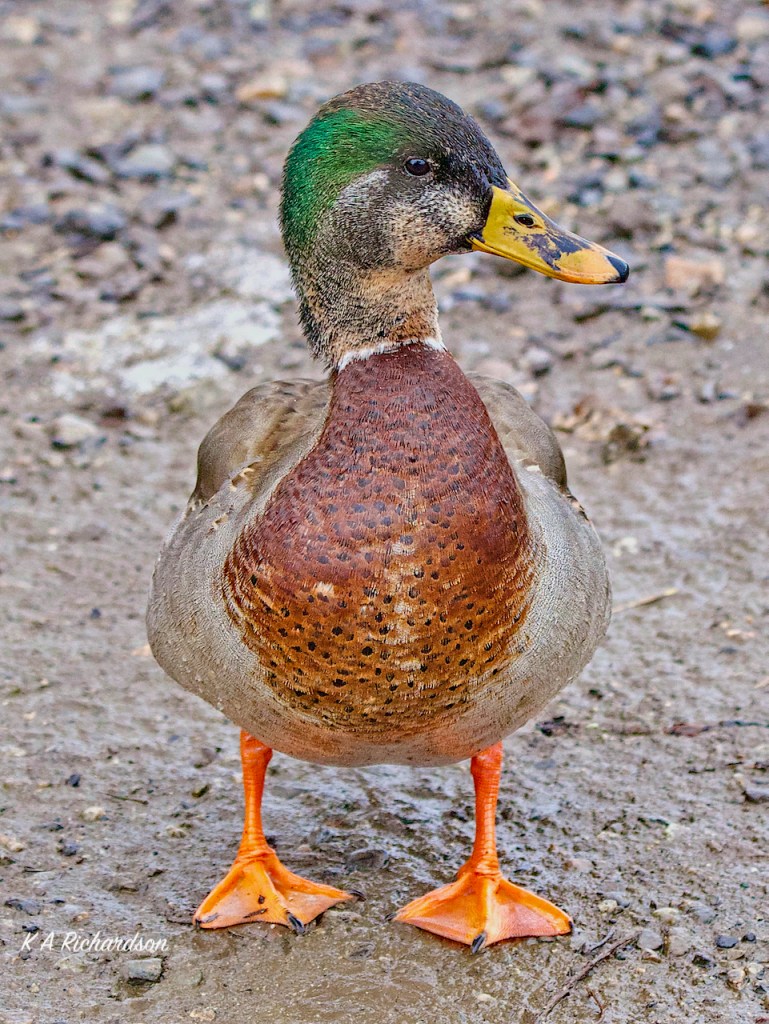
Muncie the Intersex Mallard (Anas platyrhynchos) of Munson Park, March 1, 2021

For the full record of Homher, the gorgeous iDuck star of Thomson Marsh (below), take a quack at my growing Flickr album of Homher here:
www.flickr.com/photos/8666250@N02/albums/72157713743926477
Here’s one of our “venerable lady” in February 3, 2021, and below that three and a half months later, and below that a link to a new post following her through to a full year after that — February 2022.

Intersex Mallard, Homher, SE sector, Thomson Marsh, Kelowa, BC, February 2, 2021.

Update November 4, 2021
Homher disappeared again in April but reappeared on May 18, 2021 at Belmont Pond (where I had first seen her over a year earlier and where she had been seen by another Kelowna photographer, Roberta Snow, as far back as June 2019).

Intersex Mallard (Anas platyrhynchos) Large Belmont Pond, Kelowna, BC, taken May 18, 2021. It appeared that our venerable lady had decided to hang out here for the summer. Latest spring sighting was June 1. After this she went AWOL again — until she reappeared near Teal Pond in Thomson Marsh, over a kilometre to the east on October 27! She continues to hang out there into 2022!

For more on Homher, starting with her reappearance at Teal Pond, Thomson Marsh, see this update post: https://birdsandmusings.wordpress.com/2021/11/05/homher-the-iduck-reappears/

Additional links:

British writer Charlie Moores visiting Vancouver, BC in 2009:
https://www.siung.net/bird/tmp2/bird/intersex-mallard-vancouver.htm

Dallas-Fort Worth, Texas link from 2014:
https://dfwurbanwildlife.com/2014/04/11/chris-jacksons-dfw-urban-wildlife/mallard-intersex/

Reflecting on an Unusual Winter — 2018-19

IMPORTANT NOTE: ALL PHOTOS IN THIS POST CAN BE OPENED, ENLARGED, IN A NEW TAB.
JUST CLICK THE IMAGE!

Sparrow Haven, in The Brush Pile behind CNC, adjacent to Kelowna Rec Field, Kelowna, BC.

After five full years here in Kelowna, I’ve come to realize that every year is different from a birding/photography standpoint. Just when I think I’ve figured out a pattern, something happens to disrupt my generalization. This past winter was a doozy.

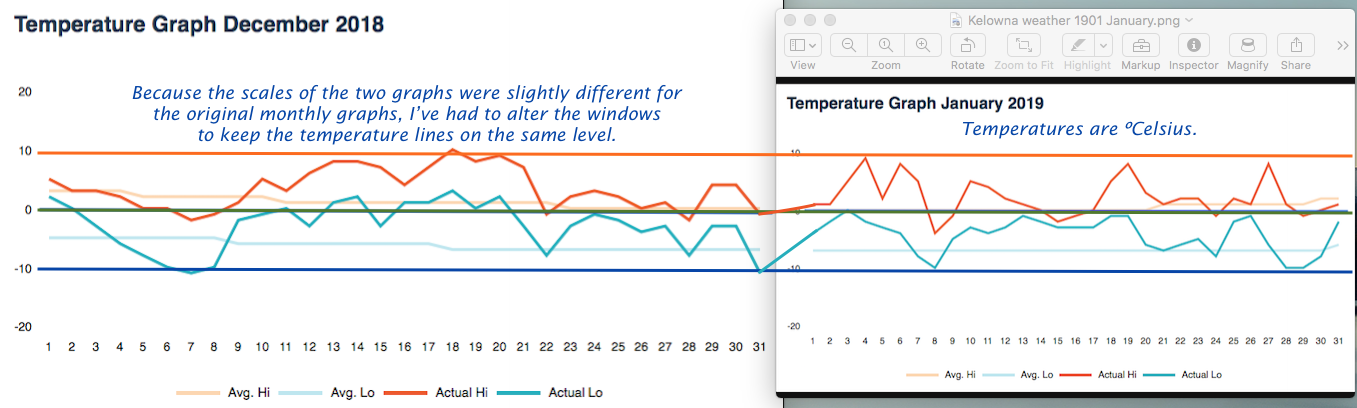
Start with the weather: December and January were wonderful, above average temperatures, no snow to speak of, the Marsh unfrozen: who didn’t appreciate climate warming?!
Click on the graphs below to open them, enlarged, in new tabs.

Then February arrived: this graph shows how our Feb. temperatures have changed over the last three years. We had only a little snow in 2019-, but, as you can imagine, it did not melt until mid-March. Click to enlarge.

February has gotten much colder!

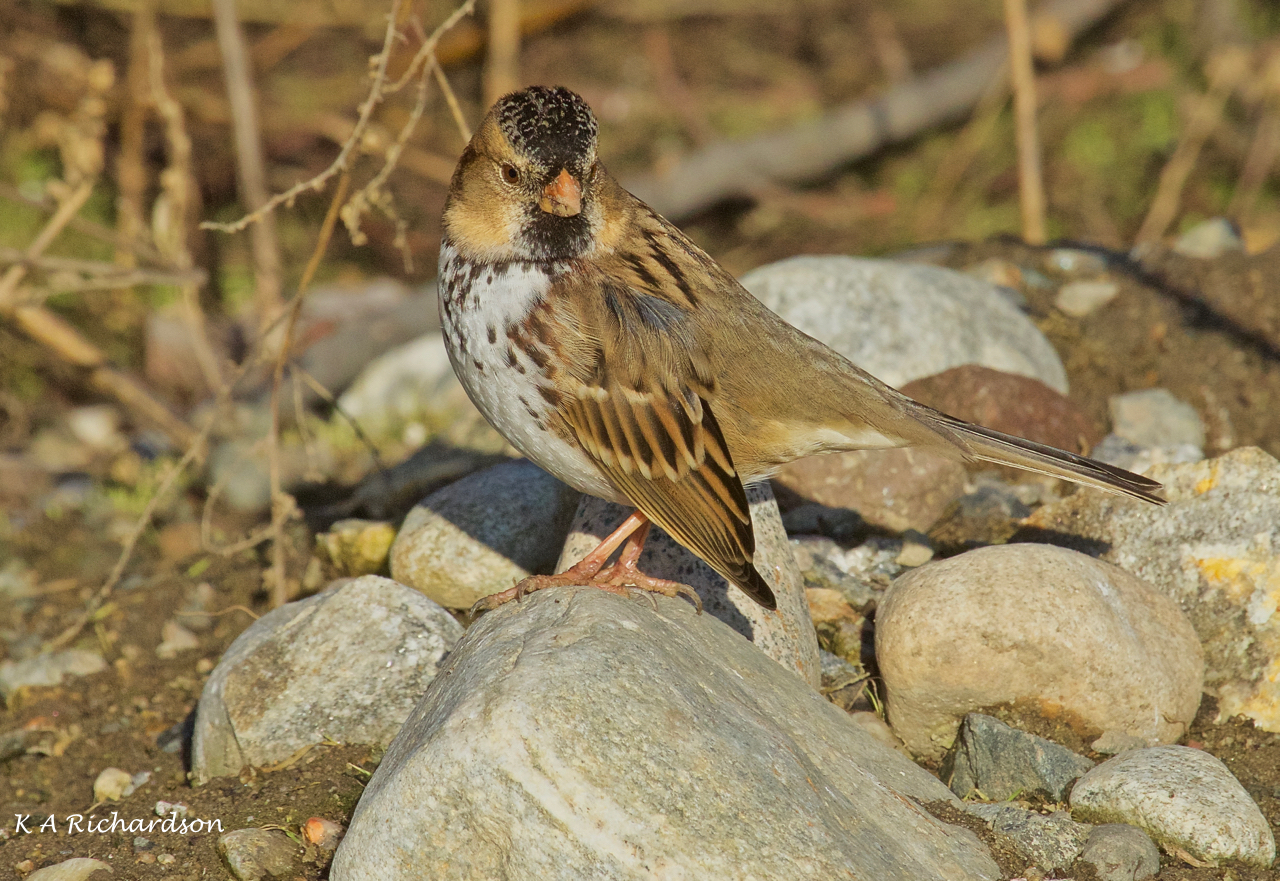
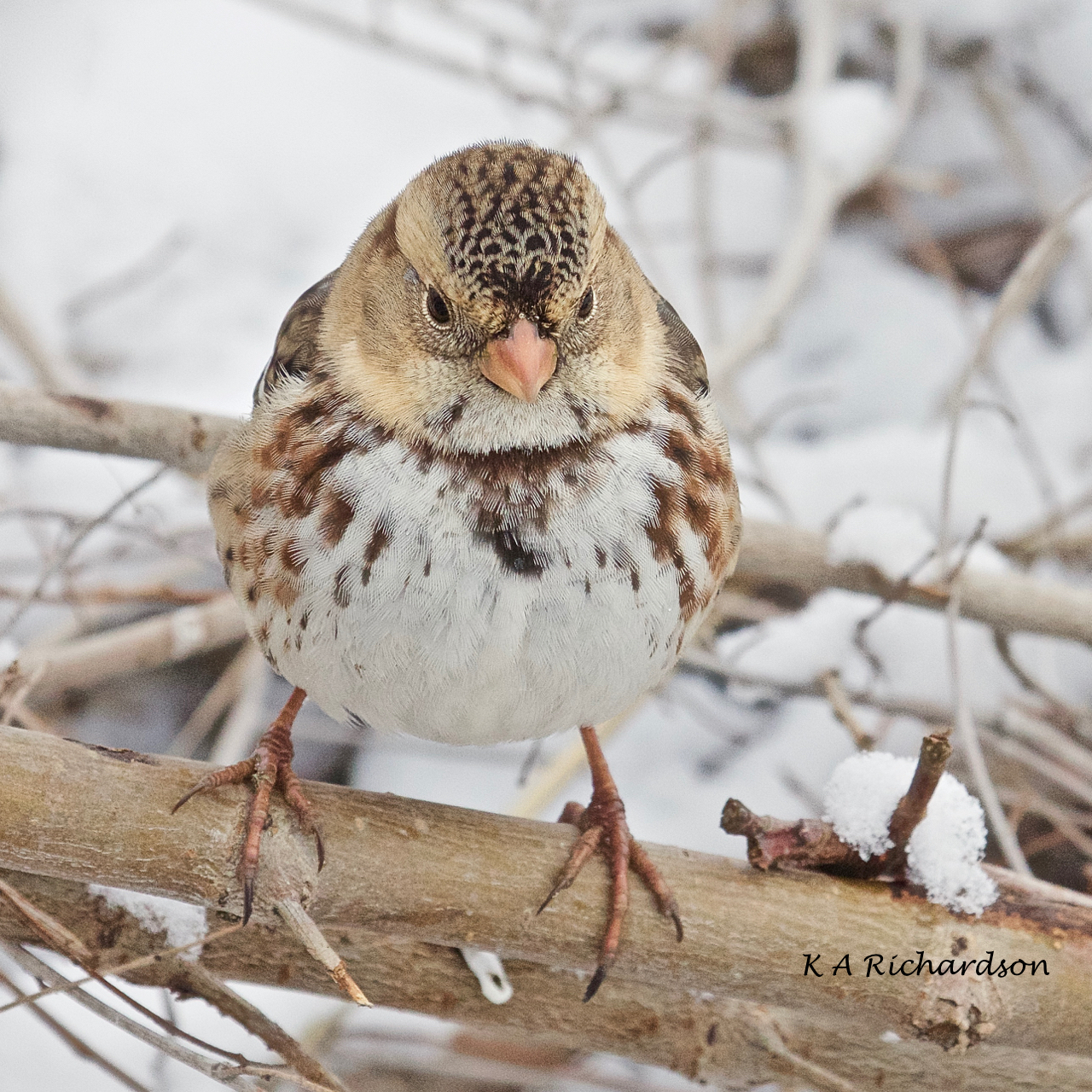
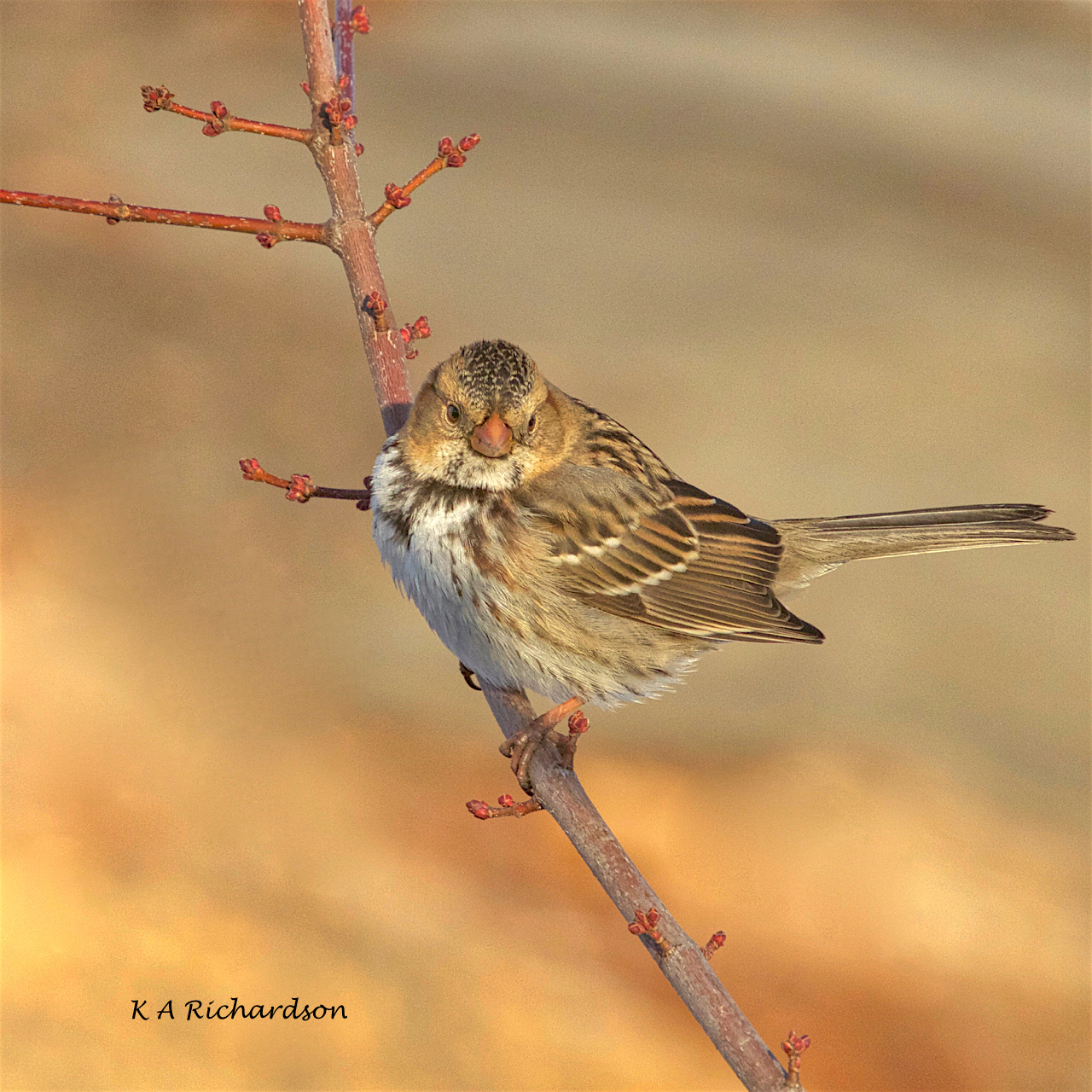
More important, from a birding/photography standpoint, was the accidental creation of an environment that was very much appreciated by our local Song Sparrows and White-crowned Sparrows, and four (some claim five) accidental tourists who normally spend their winters east of the Rockies — Harris’s Sparrows:

Blackbeard, the adult in his/her winter plumage.
White Bib, the second most easily identified.
Whiskers, more difficult to ID until you know what to look for….

Tawny, perhaps the most difficult to spot and identify because she is similar to White Bib and Whiskers — again, until you know what to look for….

So how do we tell them apart? Well, as I indicated, Blackbeard and White Bib are pretty easy to differentiate. I came to know them first:

Blackbeard looks just as you’d expect!
White Bib has a a lovely white bib with a well defined Fu Manchu moustache. The black slash on his upper breast runs down and right from our perspective.

Whiskers was so named because in the bib area s/he from the beginning he had some darker streaks unlike White Bib who had none. In time, however, I also noticed two more distinguishing features: a small black dot below each eye and near the back of the bill, and a faint black spot on the breast just below the dark slash, which on Whiskers runs from right to left as we are facing him.

Also note that Whiskers’ black slash on the upper breast runs down and to our left.

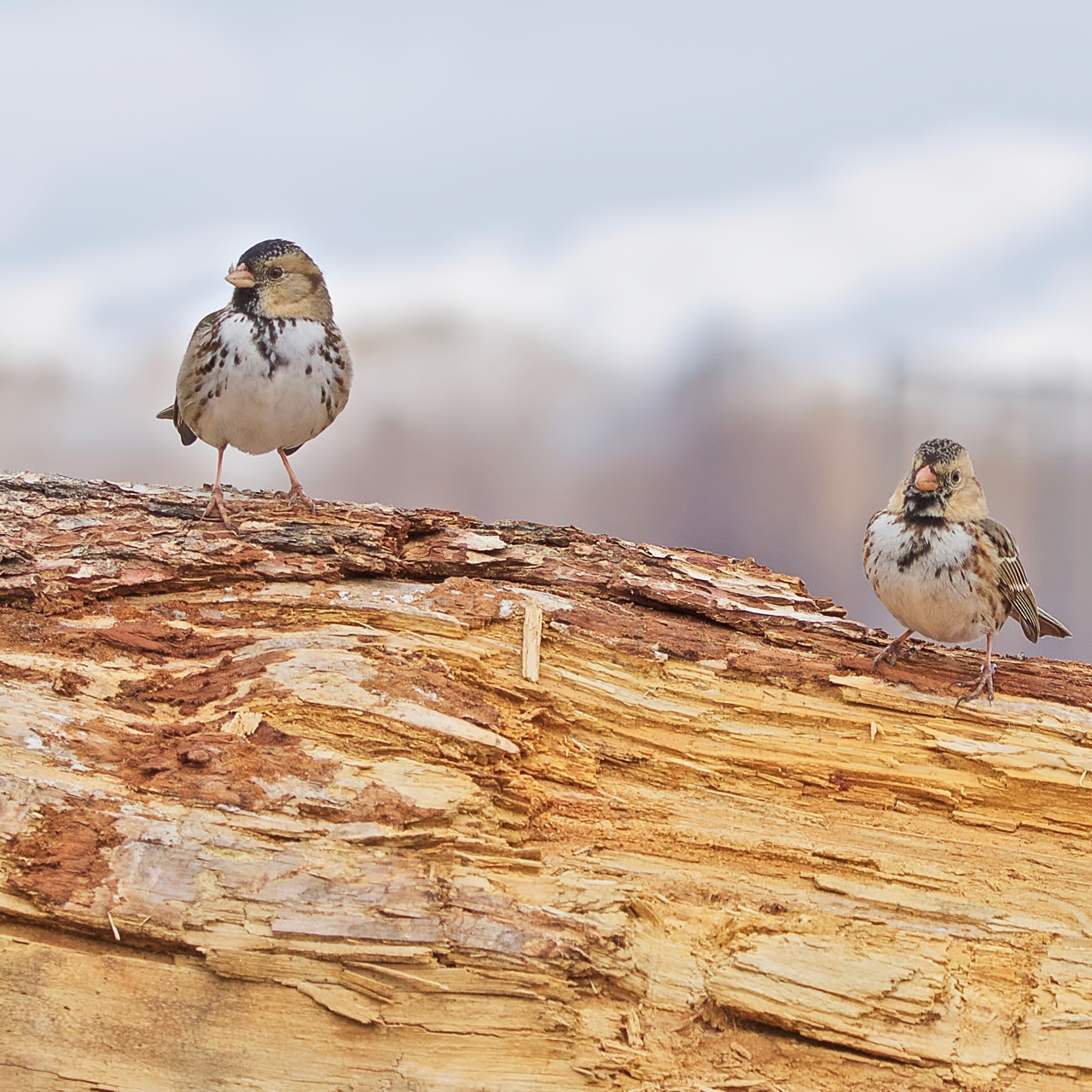
Here we can see Blackbeard and Whiskers together:

Blackbeard on the left, Whiskers on the right.
The faint spot on Whiskers’ breast (under the dark streak) has become darker as have his/her whiskers!

And finally, Tawny, the most difficult to distinguish from White Bib but easily distinguished from Blackbeard and Whiskers:

Tawny has a bib that’s less white than White Bib’s, but is not nearly as dark as Whiskers’. The crown is not as black as the other Harris’s either….

Reflections on Quality

Several years ago, I used to frequent a popular birding forum in BC. I was new to wildlife photography and at first had less than ideal equipment. I needed all the help I could get! The forum was valuable for a great variety of information, not least of which was access to some excellent images of BC birds. I learned a lot about birds and even more about quality photography — just by observation. No one was anything but supportive of those who posted (a fact that seems to apply to most photographic sites I visit). Sometimes, however, it was pretty obvious that some posts were of substantially higher quality / value than others.

The basics came quickly — the rule of thirds, issues of exposure and colour balance, clarity, capturing motion in a still, and of course, processing (both over and under)…. Besides these considerations, it was obvious that different folks have different tastes and different tolerances for defects. While I’m inclined to be a perfectionist, I’m a failed one who is often far too tolerant of my own “near misses”….

Why I seldom visit Rotary Marsh

This piece is a reflection on shots taken recently at Kelowna’s Waterfront Park, a place I visit only a few times each year. Also know as Rotary Marsh, this spot is a 15-minute-drive from home, all of 6–8 km away, depending upon one’s route choice. Sure, I’ll go in early Spring just to see what’s there, or on Canada Day just to be patriotic. But in late October / early November, on a sunny Second Summer late morning, it’s for the light, and the Gadwalls….

Probably one or two photos would have sufficed to show why I like the place. I’ve chosen, however, to post the near misses as well as the ones that come closest to the quality I had in mind when I pressed the shutter button.

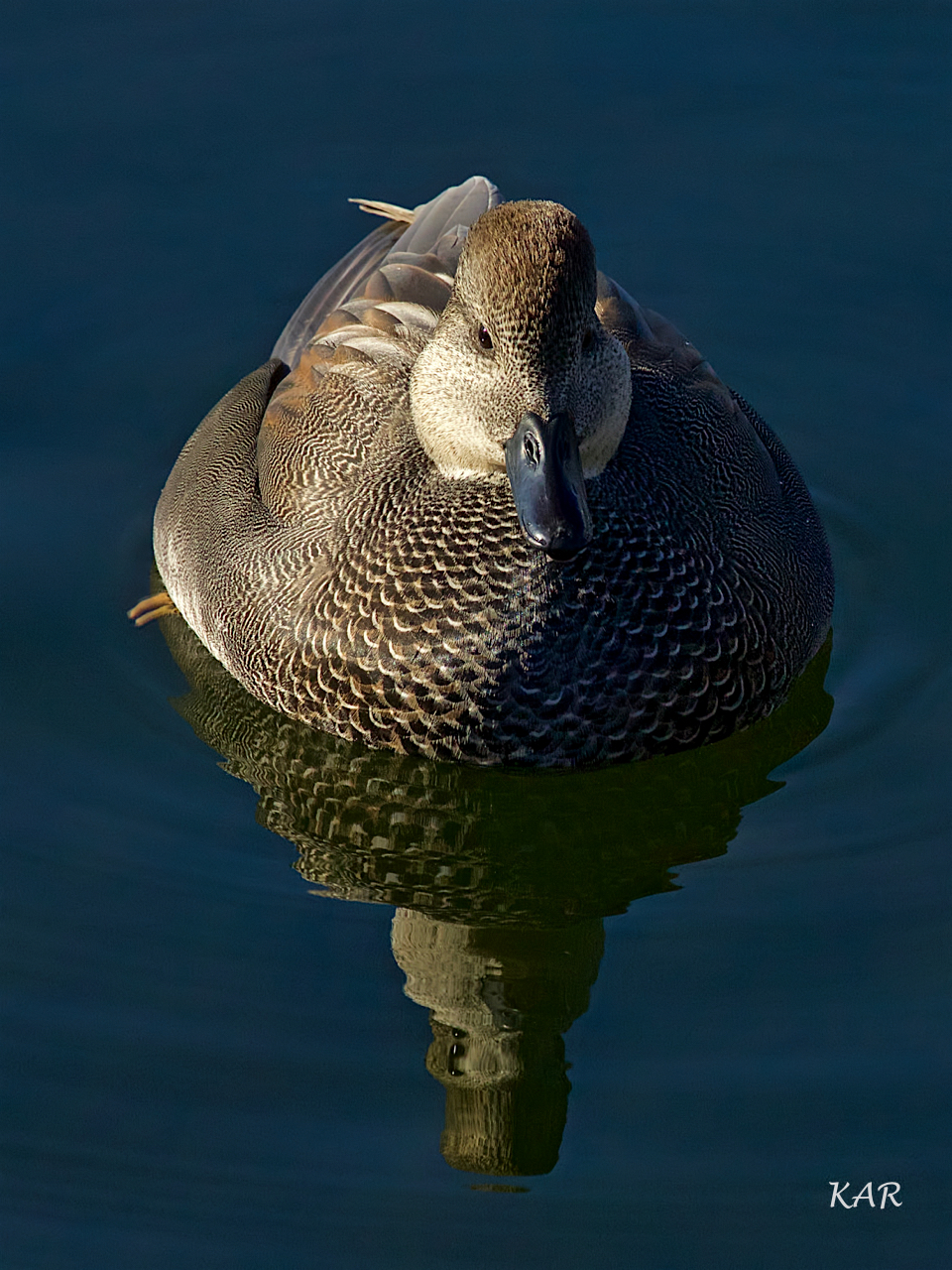
Let’s begin with the best of the bunch, then take a look at others and examine why they don’t work as well:

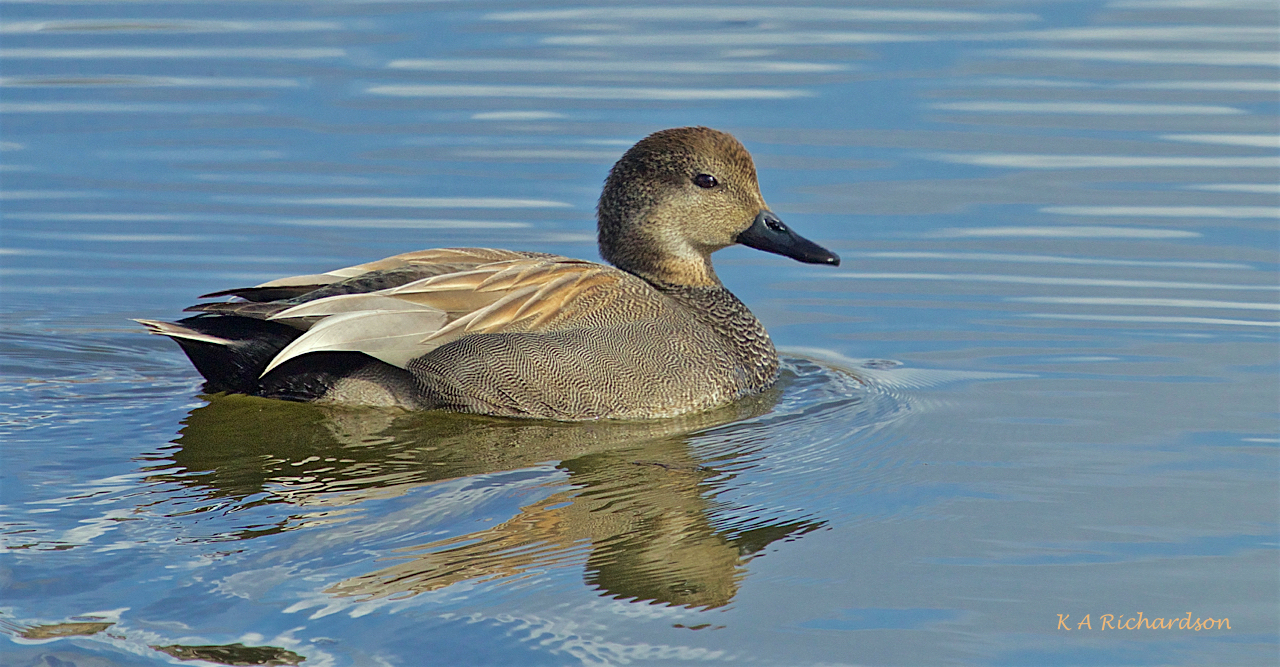
Gadwall drake (Anas strepera) -01.jpeg

I like the way the bird is centred so that it’s half in light and half in shadow.  Even the shaded side, however, offers some detail and trace of light. The reflection on the left tip of the bill is a nice touch. With its saturated tones, we realize that the photographer is aiming for art not merely a record or snapshot. There is effective clarity throughout. The water bokeh is informative but not distracting. Although the duck is not looking directly at the camera, we get a sense that he’s aware of what’s going on.

Contrast the shot above with the next two near (or, perhaps, not so near) misses:

Gadwall drake (Anas strepera) -02.jpeg
Can you see the missing quality?

Gadwall drake (Anas strepera) -03.jpeg
If you’re going to show the reflection, make sure you show it!

In the shot just above, the distribution of light and shadow, compared with the image we like, is off target, not 50-50. The plumage detail on the sunlit side is beautiful, but, sadly, we’ve got only halfaduck here!

In the set below, viewer preferences will determine” the better shot.” I’ve been quite surprised, sometimes when my peers’ selection of the “quality one” differ from mine.

Gadwall drake (Anas strepera) -04Gadwall drake (Anas strepera) -05

In this set, while both are near misses, in my opinion, each still has some appeal. I like the greater simplicity in the photo on the bottom. I wish the drake didn’t look so sleepy, but that’s a minor consideration for me. The upper photo has an orange tint, the lower one more blue. The water is less distracting in the lower shot. Finally I prefer to see the whole foot rather than its fragmented image.

Yet I have friends who see what I consider defects as positive attributes. Sometimes, it’s simply a case of my being more sensitive to some flaws than others rather than finding certain attributes more resonating than others. Critical vs affirming mental approaches….

One more point about quality and perceptions of it. Since we’re viewing our photographs on monitors, it behooves us to make sure the latter are set for optimal viewing. Back in my consulting days, I saw way too many monitors that needed to be recalibrated — corrected for brightness and colour…. I’m sure that some over-saturated photos I see online were produced on monitors that were too bright, and some diluted-toned images developed on monitors that were too dark….

Finally, two shots below remind us that the photographer is to some degree as much responsible for the way a pond looks as nature is. Change your angle and you’ll change the photo. We all know this, I think, and sometimes, there’s no opportunity to find the optimal shot location — we have to shoot what we’re served. But when we have a choice, make it!

The shots below were taken in the same pond only minutes and metres apart. The outcomes, however, are remarkably different….

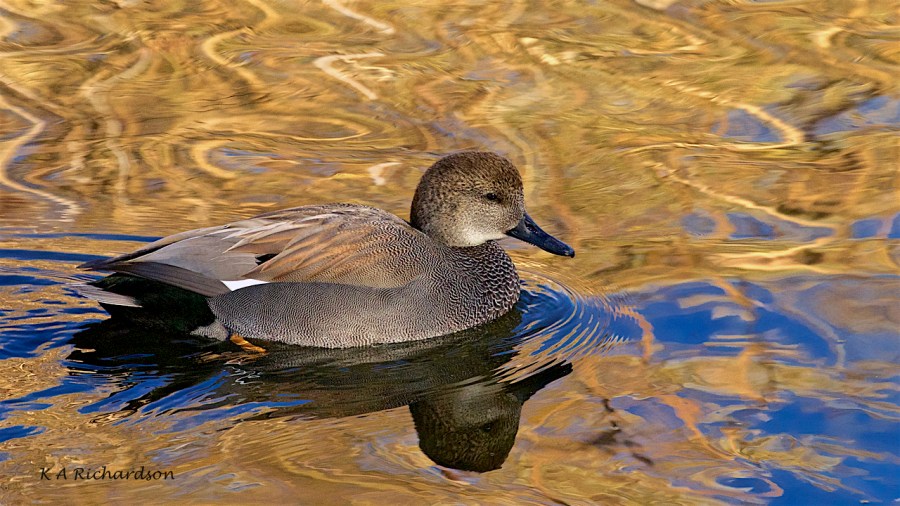
Gadwall drake (Anas strepera) -06.jpg
On golden pond? Click photo to enlarge in a new tab.

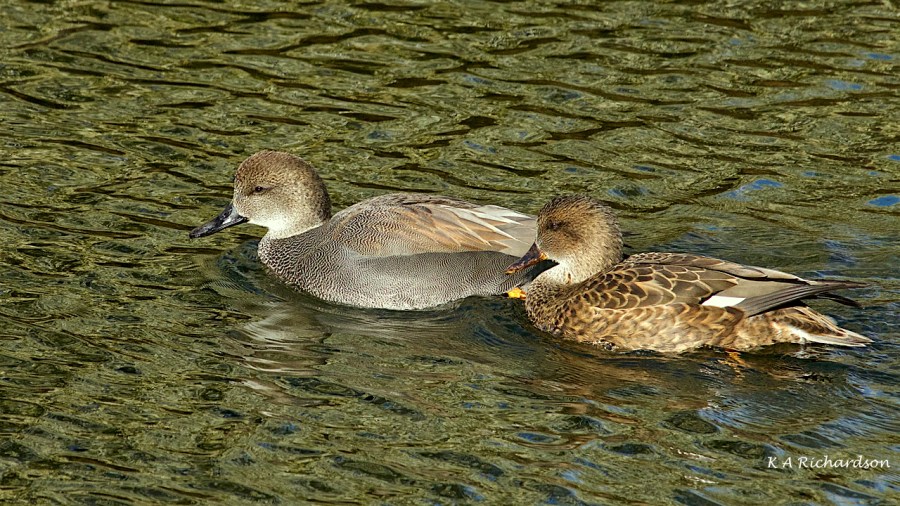
Gadwall pair (Anas strepera).jpg
Or in another dimension? Click photo to enlarge in a new tab.

So that’s it for the moment. If you’re a young photographer or a neophyte to this genre, I hope you’ve found something worth thinking about. I wish you well.  I hope that you will continue to study, explore, and pursue the best results you can come up with!

Mall-ice aforefoot!

Redheads —special appearance.jpg
Diversity rules! Thomson Marsh, April 28, 2016

I’ve often remarked on the wonderful cooperation among diverse waterfowl species on a pond. I’ve also noted moments of remarkable conflict, frequently involving Mallard ducks. Usually, we see this in breeding season, often between male and females. Sometimes there are horrible conflicts between hens over whose brood is going to be raised on a particular pond. And, certainly, there plenty of anecdotes about rivalries among drakes.

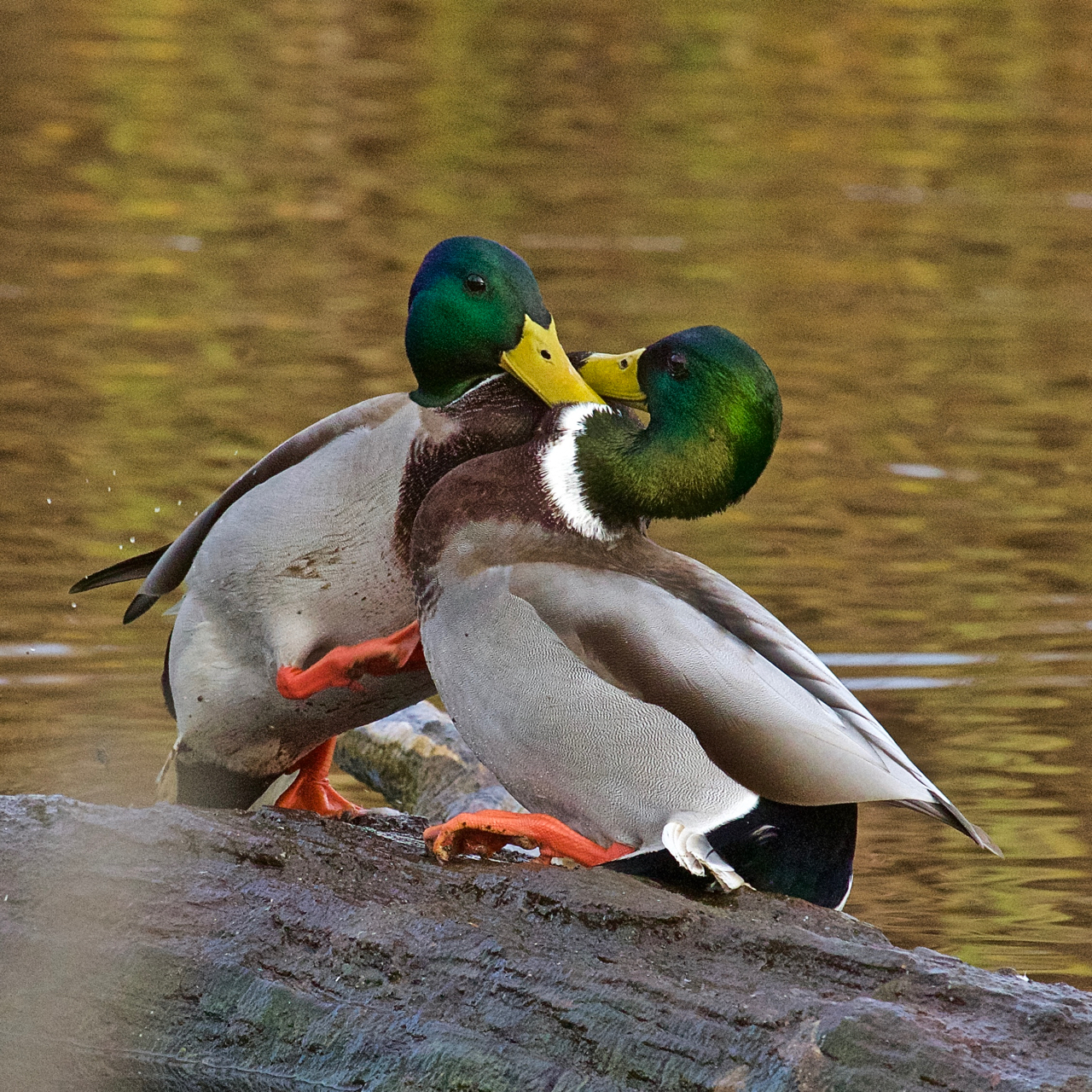
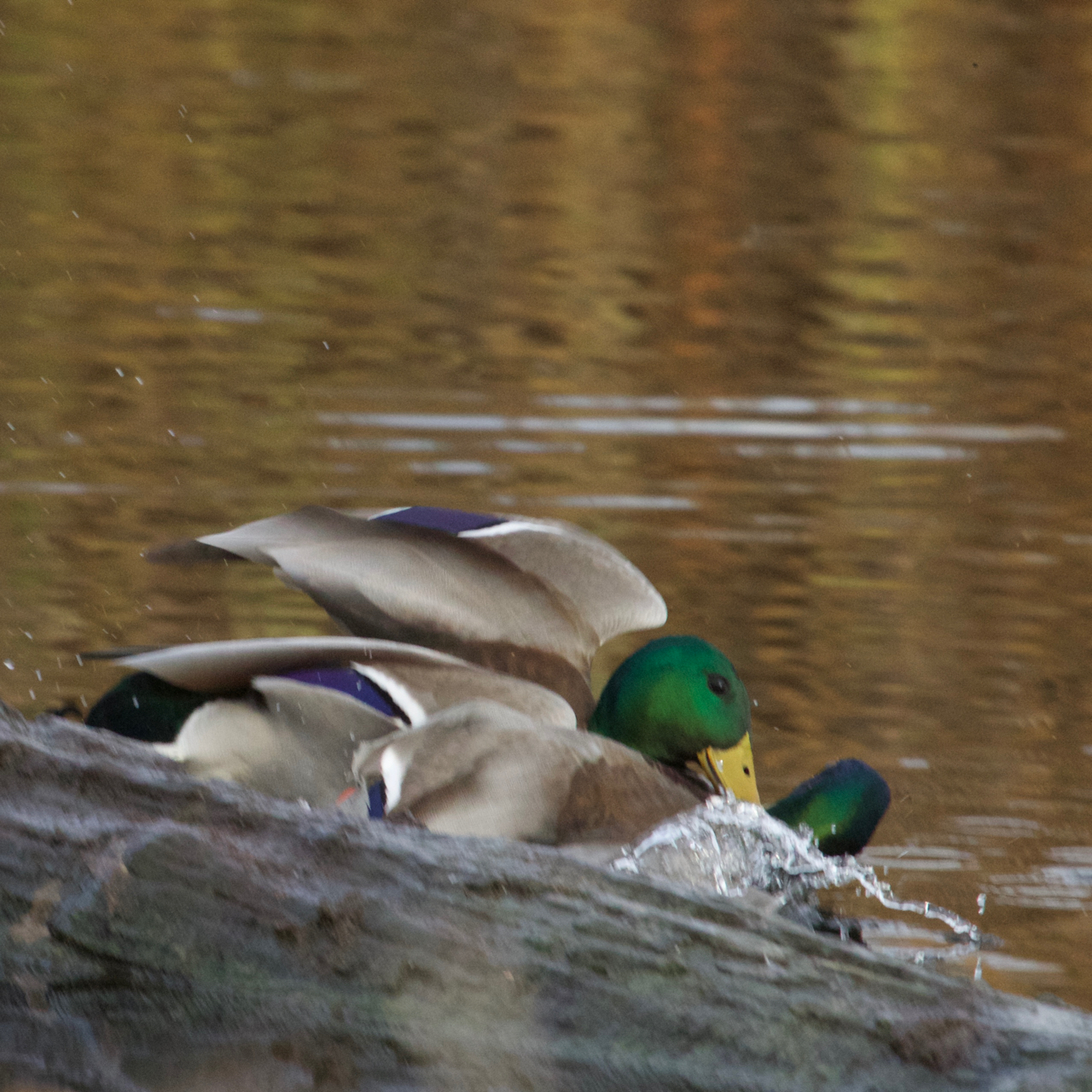
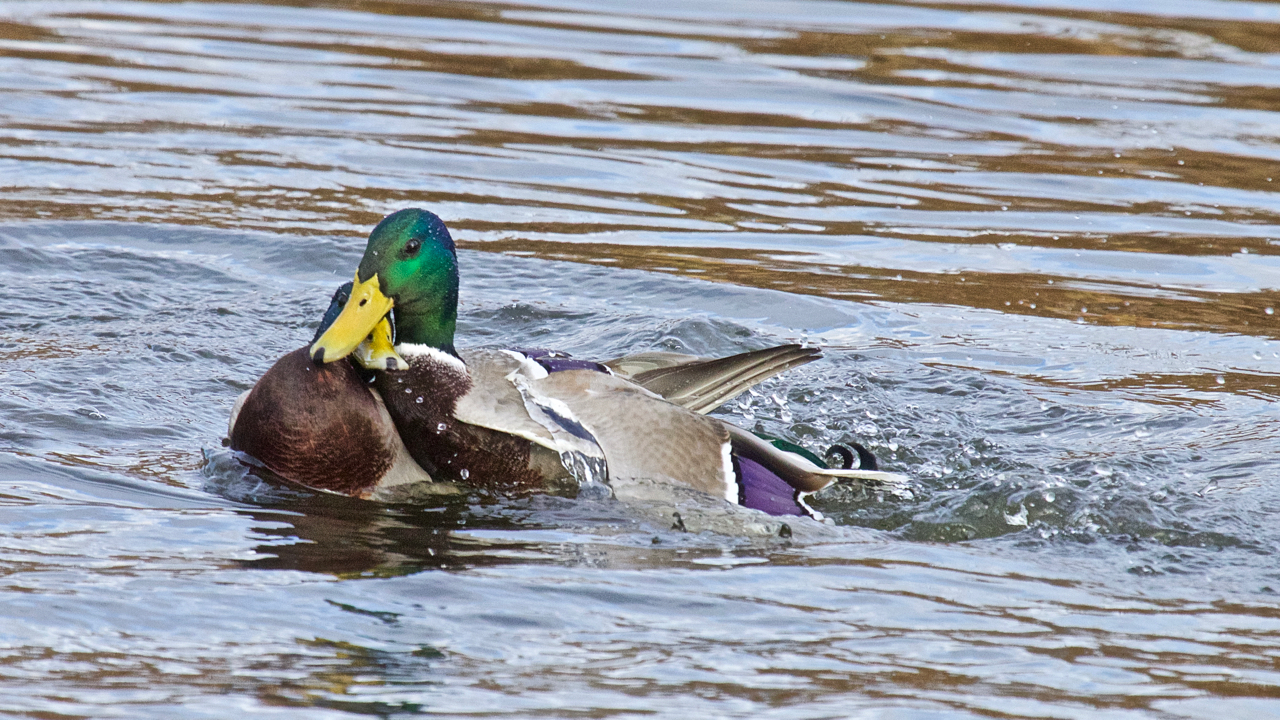
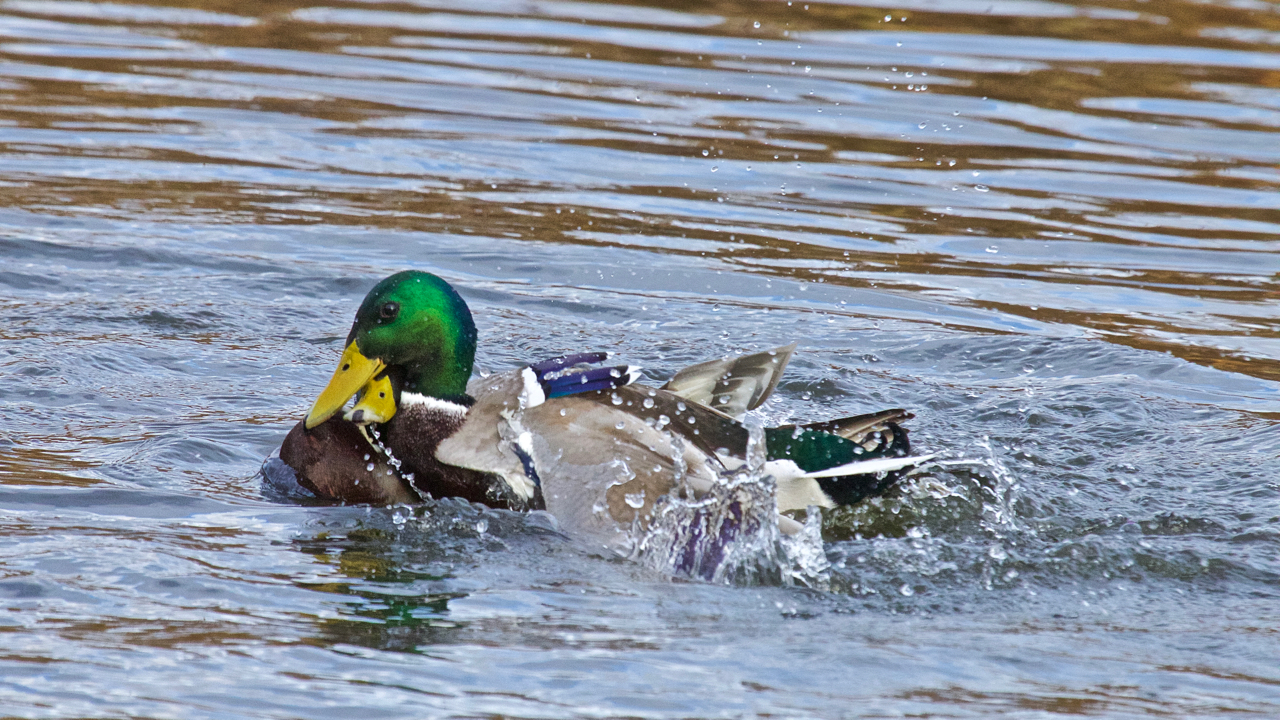
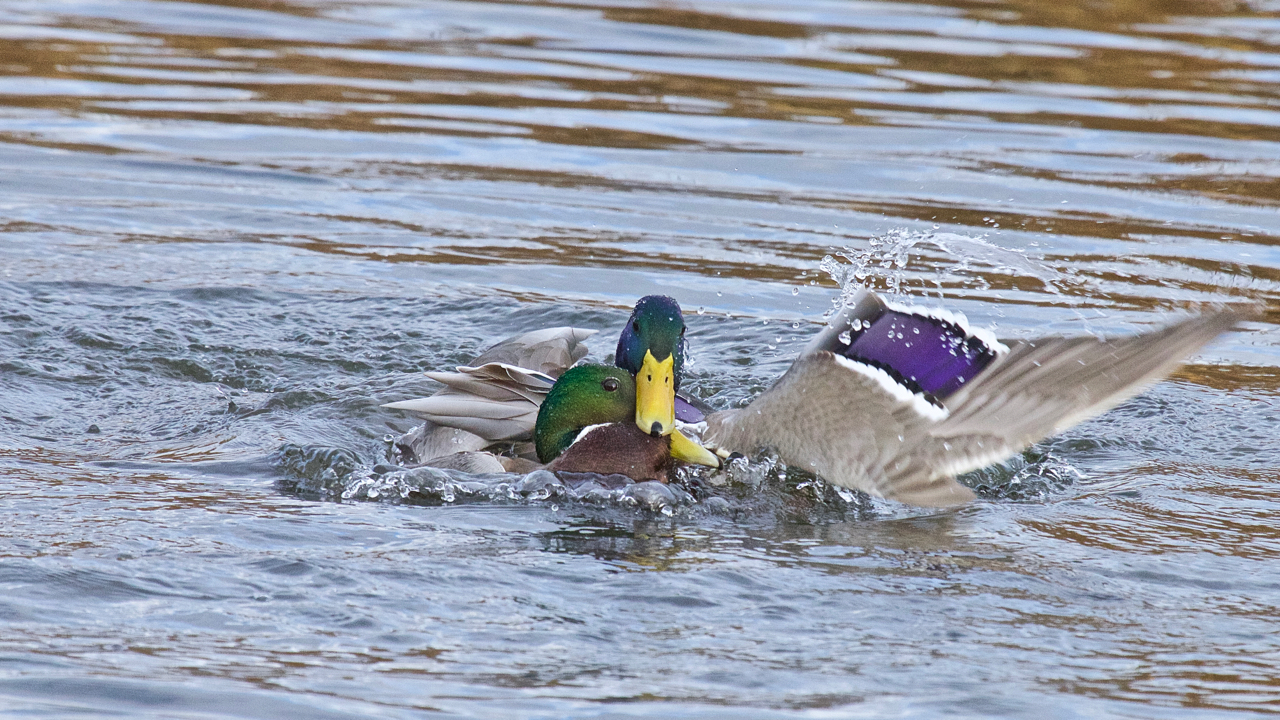
But it’s nearly the end of October, 2018, for goodness sake! What I witnessed the other day at Teal Pond, TMarsh, took me by surprise. A little quarrel rapidly escalated into a probable duckicide. To be sure, in the end, one drake was driven away and a Victor declared, but I have to admit I was holding my breath as I pressed the shutter….

As I hadn’t wanted to disturb the ducks on the log, I wasn’t as close as I could have been. That ghost of a cattail in the lower left of the frame is annoying and should have been avoided. But being too close might have kept the conflict from erupting. I’ll leave it to viewers to decide whether or not I did the best thing….

Duck fight!-03
The aggressor is the drake on the left…. We’ll name him at the end of the series….

Duck fight!-08
Notice the leverage with both bill and foot…

Duck fight!-11
Over they go….

Duck fight!-12
It’s all a blur! Who’s got the upper bill, so to speak?

Duck fight!-13
The bill-neck clamp hold!

Duck fight!-14
It’s becoming very serious!

Duck fight!-15
Is a drowning about to happen?

Duck fight!-16
No question who’s in control!

Duck fight!-17
The victim makes a break….

Duck fight!-18
The Victor regains control and submerges the victim….

Duck fight!-20
Wild thrashing!

Victor -01
Only a few moments later, Victor poses — revealing no signs of the near carnage just attempted!

Solomon Song Sparrow

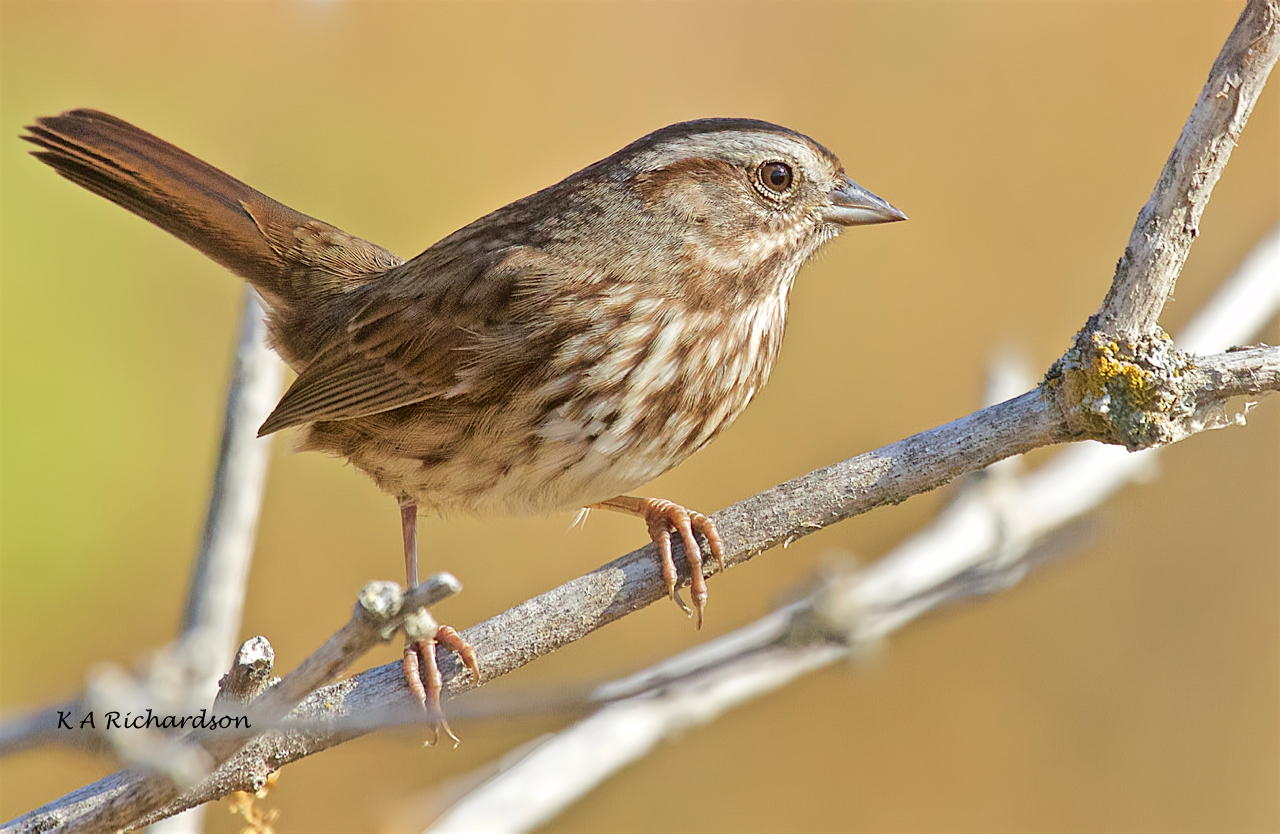
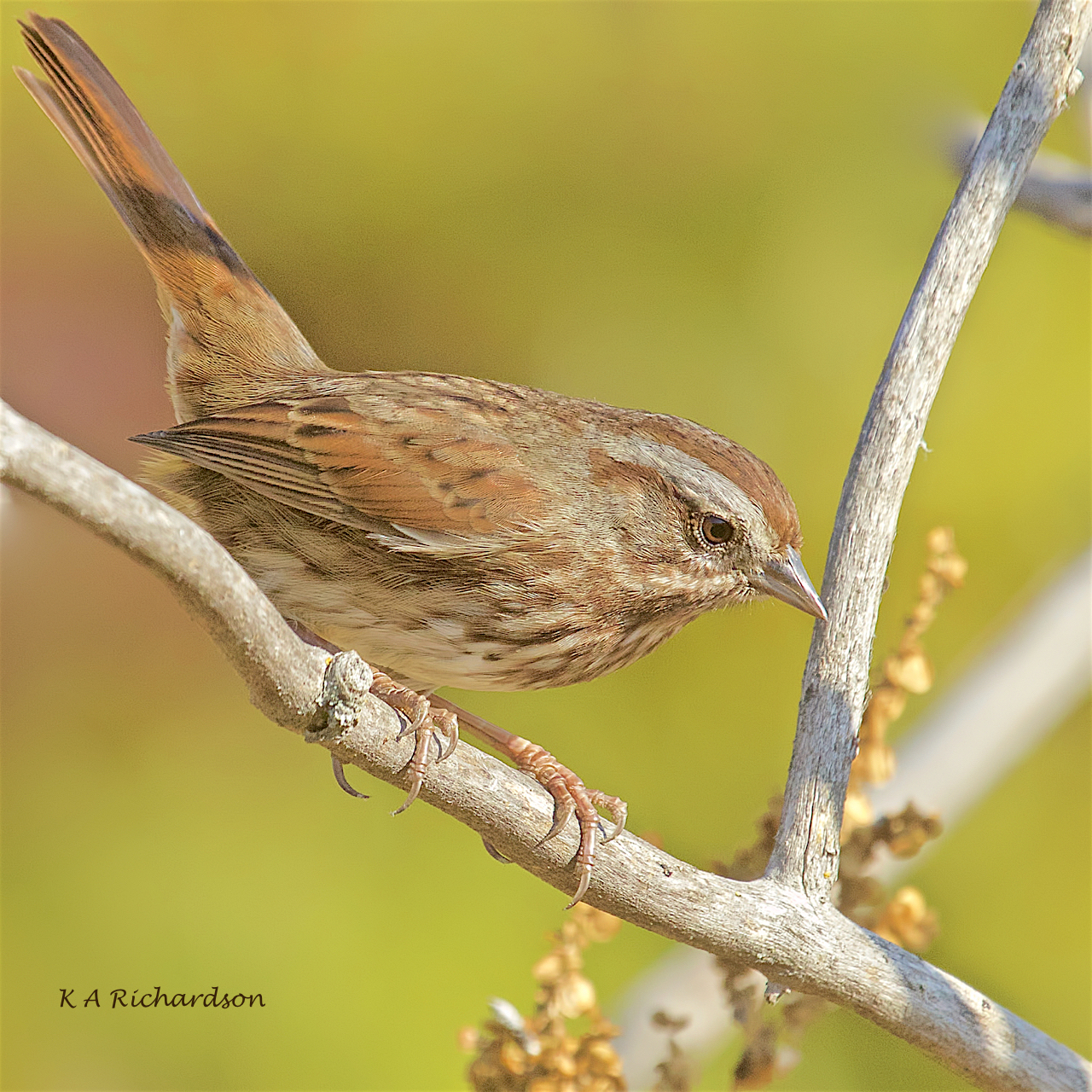
I’m often quite dissatisfied with the photos I take. This set, however, turned out quite well, in my opinion. I’ll add more about the species and this particular bird as I have time:

Song Sparrow (Melospiza melodia) -04.jpeg
Solomon searching….

Song Sparrow (Melospiza melodia) -02.jpeg
Solomon thinking….

Song Sparrow (Melospiza melodia) -03.jpeg
Solomon listening….

Song Sparrow (Melospiza melodia) -05.jpeg
Solomon profile….

Song Sparrow (Melospiza melodia) -07.jpeg
Solomon wondering….

This little guy and most of the SOSPs I know tend to inhabit relatively small territories throughout the year, often in small groups that may or may not be family-based. Solomon is often accompanied by a less bold “mate” (take this in whatever way you like), but he is the one who comes out looking for action….

Here’s a note on Song Sparrow subspecies (and coloration) from Cornell’s All About Birds site:

Scientists recognize 24 subspecies of Song Sparrows and have described some 52 forms: they are one of the most regionally variable birds in North America. In general, coastal and northern birds are darker and streakier, with southern and desert birds wearing paler plumages.

Patience update #1

As promised, as long as Patience is in the neighbourhood, I plan to keep updating B&M with recent shots. Probably, most will be quite similar; still, I’m interested in compiling a record of her over time…. The group of shots below were taken on October 24, 2018.

Click on any photo to enlarge it. To enlarge it further in a new tab, scroll down to the bottom of the enlargement and click “View full size.”

Patience, please! (or Patience pleases….)

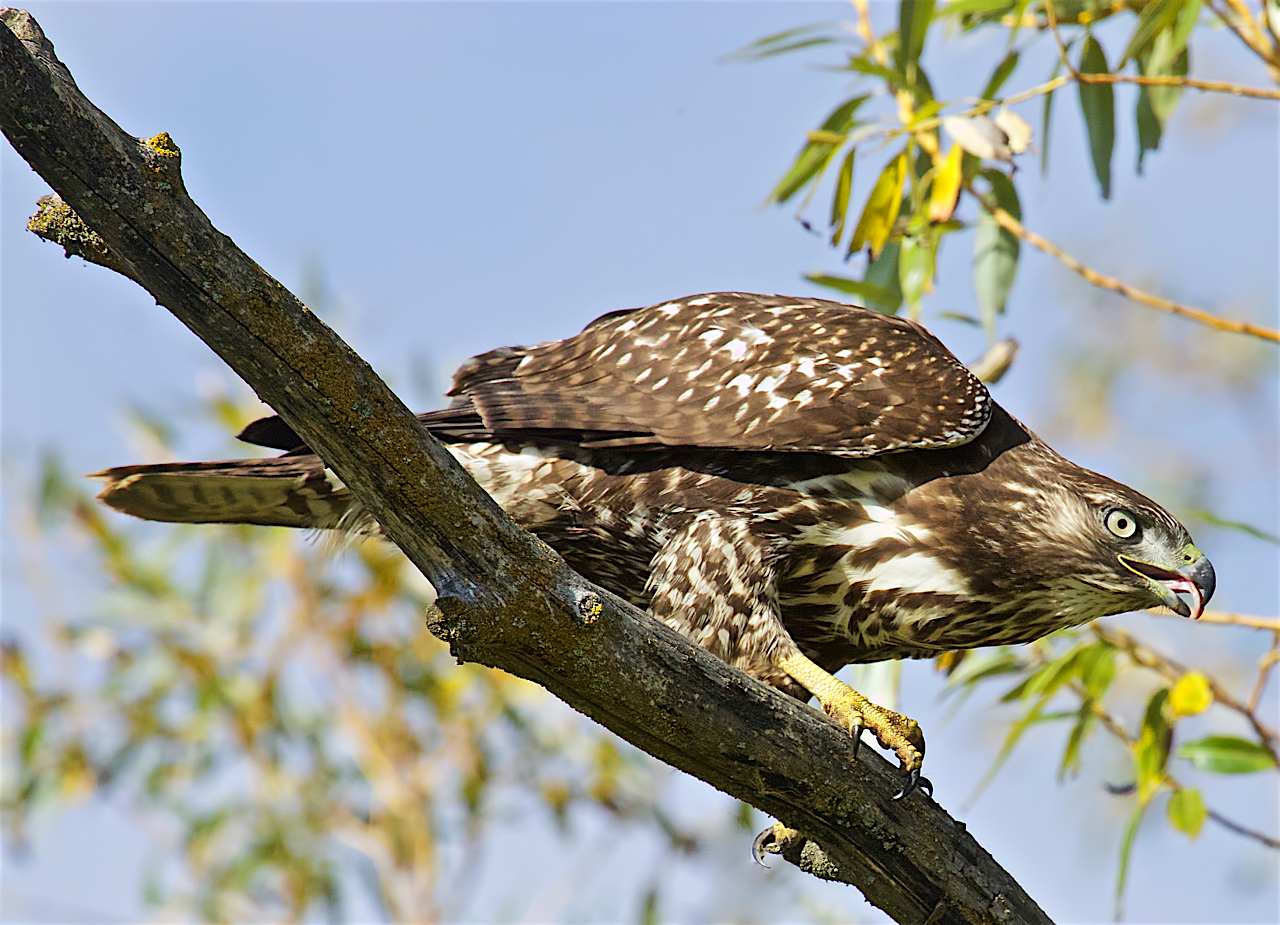
I’ve long been fascinated by hawks, especially Red-tails. Since coming to Kelowna in 2014, this species has been high on my list of great birding moments in our neighbourhood — Thomson Marsh. I’ve written about these experiences many times, especially here.

Spike, Red-tailed Hawk (Buteo jamaicensis) -05.jpg
Spike, adult Red-tail who visited for a couple of days.

In the past four autumns, the hawks arrived back from their summer breeding locations earlier, it seems to me. I’ve noticed a few around Kelowna, and we did have one adult drop in for a visit back in August. Another, likely a returnee from last winter, turned up near Michaelbrook marsh in September (more on him later, probably), and I got some good shots of a juvenile at Munson Pond on September 25 as well. In October, we began seeing the familiar kettles of migrants drifting by, had quick glimpses of unfamiliar kestrels, a Merlin, and Cooper’s hawks. Kessie, the resident American Kestrel, is “around,” but not as prominent as she will likely become in a month or two.

Patience RTHA tree (Buteo jamaicensis) -03.jpg
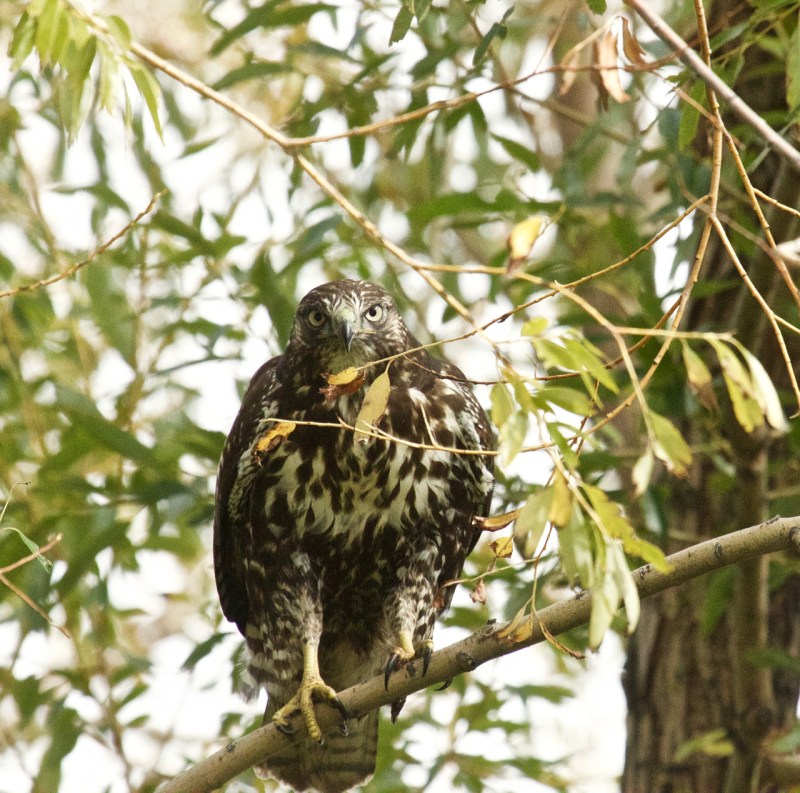
Patience, juvenile Red-tailed Hawk

But the real star of October, and, I hope, of this hawk season, is a beautiful juvenile that is affording all of us who walk the Thomson Marsh beat unparalleled views of her beauty and grace. She loves to pose, especially on lampposts, but occasionally on trees. She’s foraging successfully and appears to like it here. I have been guardedly optimistic that she’ll stay the winter, giving us the opportunity to watch her develop. I’ve named her, for her proclivity to tolerate people, Patience. I met her for the first time at our Community Garden plot on October 3. She flew in along the north edge of the gardens, across the road, and into the willows that line the north end of Thomson Brook. There she gave me the once-over you can see above.

When I took my eyes off her to check my camera, she left the tree and lit on a nearby lamppost, one frequently used by Kessie over the past four winters. I was surprised by her tolerance of the camera, and indeed, her willingness to pose.

Patience (Red-tailed Hawk [Buteo jamaicensis]) -05.jpg
A thinking hawk? October 3, 2018
October 11: eight days since Patience first appeared, and I’ve been able to locate her every day I’ve gone looking, though not always on the first try.

Here are a few of my favourite images of her:

Patience in pine -06.jpg
Patience in pine, October 6, 2018.

That tiny bit of red on her forehead needed some explanation, and that came about 30 minutes later, after she moved to a lamppost nearby and then disappeared for a few minutes.

Patience on Saturday... -04.jpg
October 6: Patience on a lamppost at the opposite end of the marsh walk from where I first encountered her.

Having lost her to her hunting, I continued my walk counterclockwise around the marsh. When I entered the far southeast sector of the marsh, I spotted her again, and quickly ascertained the reason for the red spot mentioned above:

Patience on Saturday... -13.jpg
Patience at the kill site. How long since it happened is anyone’s guess, but by the time I got there, she had returned and was just finishing her last morsel, leaving nothing but feathers….

She showed no fear of me, indeed no concern for my presence or the camera. In fact, after finishing her last bite, she hopped up onto a nearby stump and posed for posterity:

Patience on Saturday... -16.jpg
One of many cool poses she struck while on her pedestal.

It was a great day! Clearly, she’d found a winter home. Or has she? I’ve seen hawks show up for a couple of weeks, only to decide that they could do better in another location. She won’t stay forever, I know, but I’m crossing my fingers that she’ll stick around until next spring and give the folks who frequent the marsh a chance to watch her grow.

I haven’t photographed her every day that I’ve seen her. Sometimes the light was poor, or the lamppost poses were pretty much the same as before. A couple of times when I checked in the morning, I didn’t see her, but there hasn’t been a day where I didn’t encounter her at some point.

On October 10, I missed her in the morning. After our anniversary lunch, Nana and I decided to stop by the garden, the marsh, and check again. And sure enough, she showed up, this time in the big Weeping Willows that line Lexington Road and Michaelbrook Creek — the same area where I had first seen her. Nana figures that this is where she roosts at night, which seems very plausible to me, too.

It was great to get shots of her in a natural perch, especially on a sunny day. She had just caught some lunch and allowed me to photograph her devouring it:

Patience, Red-tailed Hawk (Buteo jamaicensis) -13.jpeg
Yum!

Patience, Red-tailed Hawk (Buteo jamaicensis) -26.jpeg

My favourite portrait of Patience so far. Is she posing or just surveying?
Of course, it’s likely the latter, but I can’t be quite sure.
Take a look at the next shot, in a different perch, where clearly
she’s had enough of this playing for the paparazzo.

Patience, Red-tailed Hawk (Buteo jamaicensis) -36.jpg
“Look, enough’s enough, don’t you think?!”

Patience, Red-tailed Hawk (Buteo jamaicensis) -18.jpeg
Wednesday, October 10, 2018. Near the Community Garden, Kelowna Rec Field, Kelowna, BC.

Continued good hunting, Patience; I’m looking forward to keeping this connection going!

I will post, in separate entries, more photos of Patience as I acquire them.

Thanks for visiting!

Spring Wood Ducks of Belmont Ponds, 2018

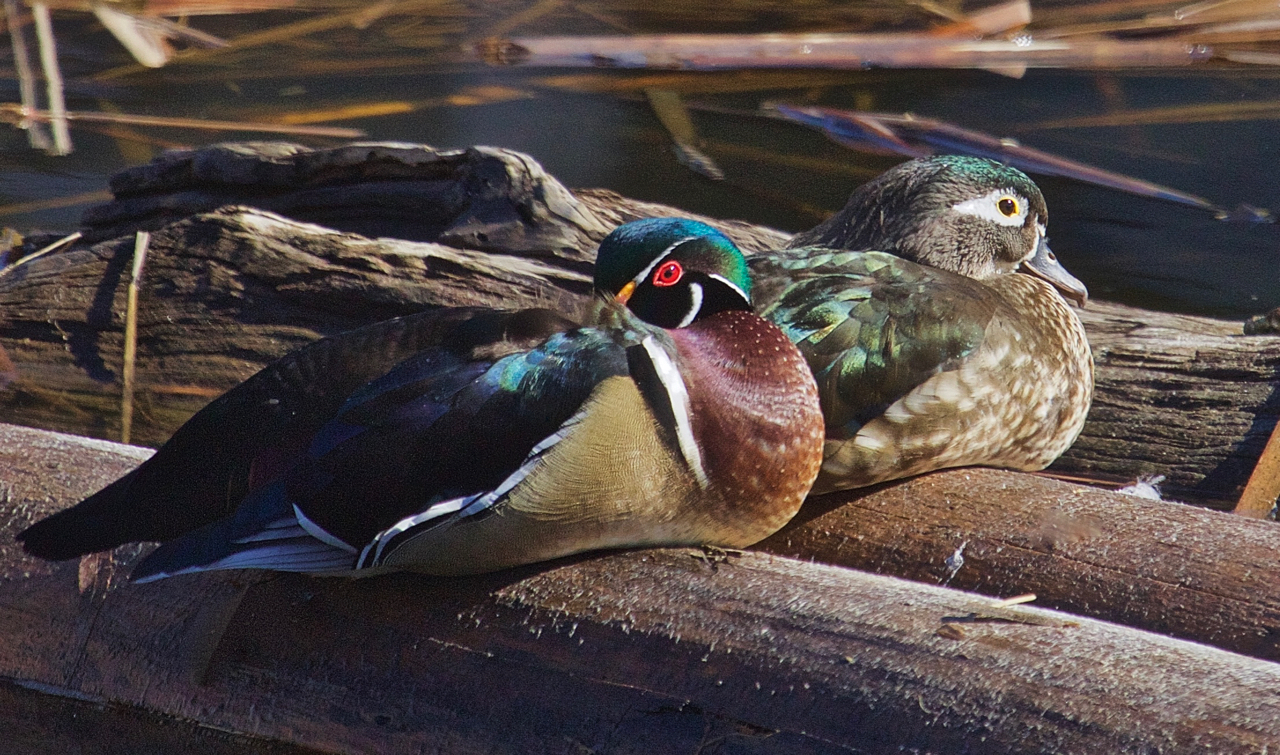
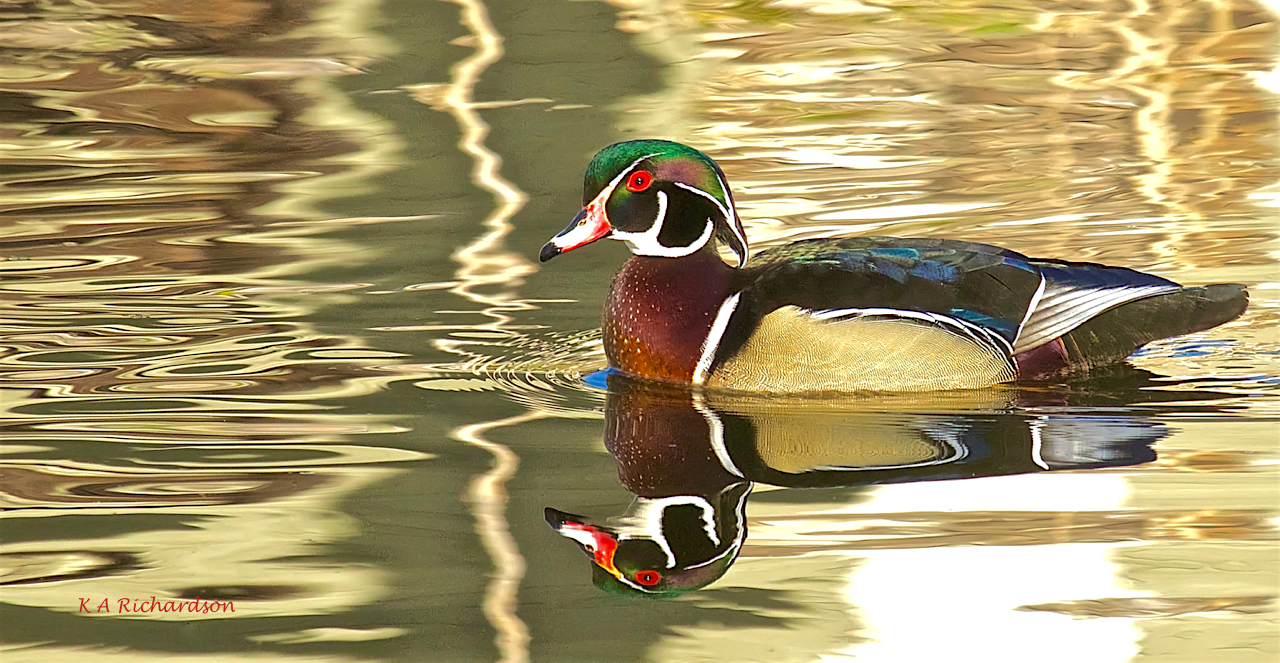
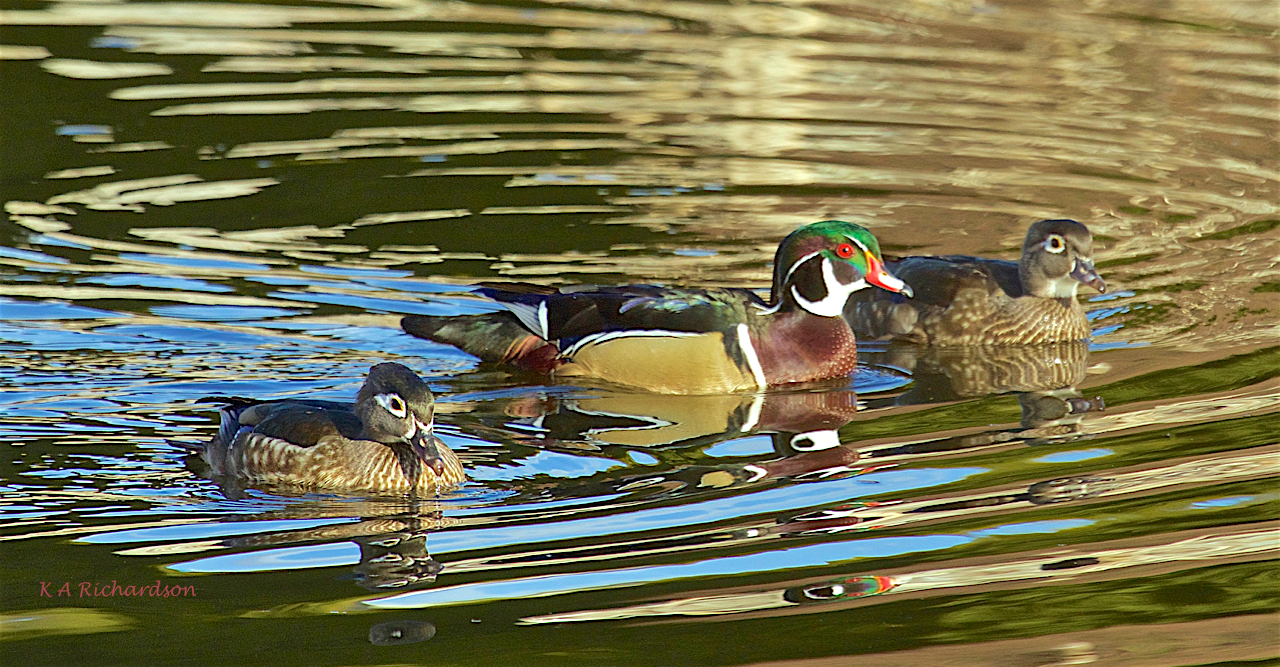
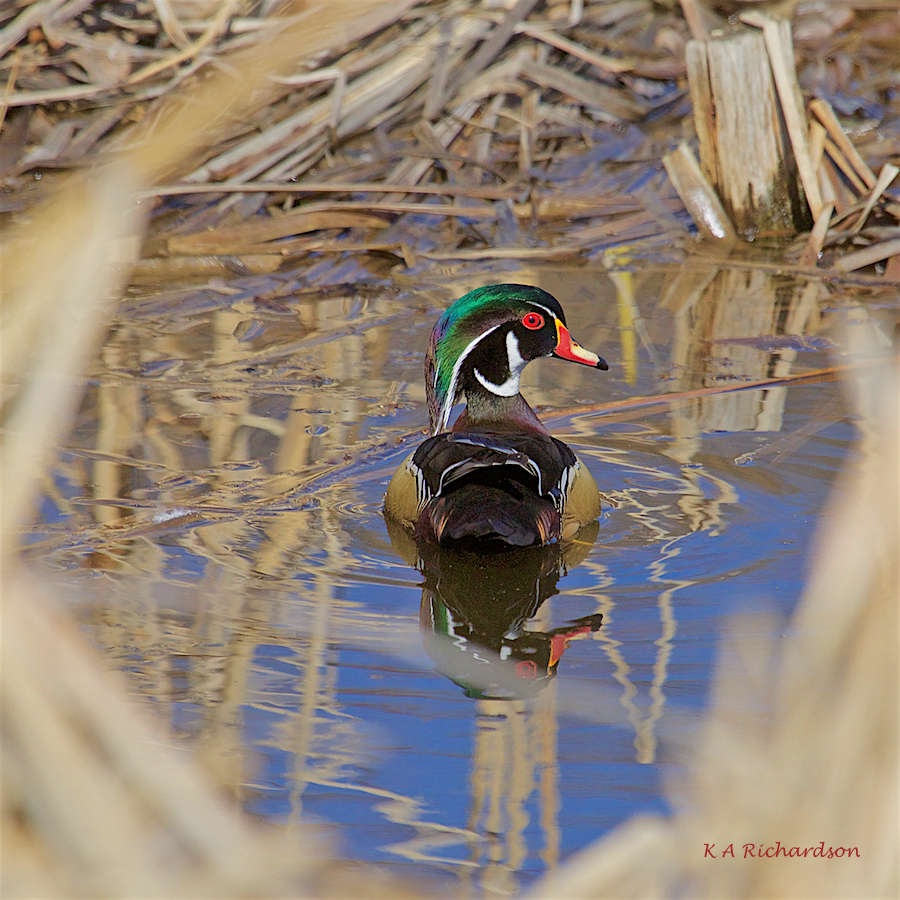
If you’ve visited this blog before, you probably know I’m a huge fan of Wood Ducks,  by far the most colourful waterfowl we see here. As this shot from last fall shows, each adult in a pair has quite distinctive and different colouring as shown below
(Click any image to enlarge it in a new tab):

Wood Duck pair (Aix sponsa) -07.jpeg
This pair, surprisingly, were photographed on November 26 in Teal Pond, Thomson Marsh, Kelowna, BC.

Relatively rarely, however, have I seen or photographed them in the Marsh. More often I see them in one or both of the Belmont Ponds that are only a couple of hundred metres from home. And every Spring and Fall they are a highlight of the season for me and many others who may not really be “birders” in the usual sense.

Here are some highlights of the small band that visited us from March into May 2018. Most of the shots that follow are from the end of March and early April. At the end of this post, however, there’s something special — a first for my observations in this location….

My first glimpse of the WODUs’ return happened in Thomson Marsh, on the Ides of March, before all the ice was gone there or on Belmont Ponds: unexpected — and exciting:

Wood Duck pair (Aix sponsa) -03.jpg
So great to see them here again at the beginning of Spring. They would stick around long enough (at least she would) to raise a brood into the summer of 2018.

Wood Duck drake (Aix sponsa)  FOY Belmont Pond.jpg
On March 15, I photographed this fella and wrote on my Flickr page, “Large Belmont Pond, Kelowna, BC. Record shot only.  
This fella was following his mate, more hunched up than usual for a drake…. Looks a little dazed, or is that dazzled…?
Here we are in mid-March. The snow is 85% gone, and Thomson Marsh again is ice free. Michaelbrook is only 50% thawed, but will come along quickly now.
The larger Belmont Pond is 80% ice free (it thawed suddenly over two days, and will be all gone the day after tomorrow). Today, we had two pairs of WODUs, one pair of COGOs, a couple of pairs of Mallards, and, of course, Ralph, the GBHE….
It really feels as if Spring has arrived at last — the first Violet Green Swallows over the marshes, and even a couple checking out the foundation wall of our condo despite the new townhouses crowded onto the old vacant lot over which they used to cruise after filling up on insects over Belmont Ponds. Should know in a few days if they’re prepared to adapt to the changed environment or not.
Also saw a flock of waxwings, possibly CEWAs flying in and around the TM Raptor tree. The BOWAs are still hanging around Mission Creek, and should be checking out soon….

Better images followed:

Wood Duck pair (Aix sponsa)  -0.jpg
For several days, this pair seemed content to spend an inordinate amount of time doing just this!

The lady of this species is often overshadowed by her more colourful mate.
Here’s a set from March 20 to address that oversight…
Click any of the images below to view it fully & enlarged in a separate window….

Wood Duck drake (Aix sponsa) -01.jpg
March 25: Of course, the drake also demands his due….

Wood Duck drake (Aix sponsa) -06.jpg
There were a couple of pairs around, but only one stayed. The drakes’ duck-tail ‘dos were slightly different…. Not sure that’s an important detail, however….

Wood Duck drake (Aix sponsa) -04.jpg
March 28: “Cross this line & enter a whole new dimension of time and space!”

Click either image below to view it fully & enlarged in a separate window….
(from March 28 also)


But there was a little trouble brewing in Pond City. A single female was attempting to turn one pair into a threesome. Ironically(?), it was the drake that put an end to it. In the process, our “unloved duck” lost a few head feathers….

Wood Duck pair (Aix sponsa) -03.jpg
The duck on the left in the photo attempted to ingratiate herself into the family…

Wood Duck pair (Aix sponsa) -04.jpg
But the drake was having none of it….

Unloved Wood Duck hen (Aix sponsa) -02.jpg
Hester has a haircut….

Wood Duck drake (Aix sponsa) - special.jpg
While I probably don’t need any more Wood Duck shots, couldn’t resist trying to create something more artistic. 
Will leave viewers to decide if I succeeded….

Wood Duck drake (Aix sponsa) -08.jpg
I was still trying as with this natural vignetted shot through the Cattails on the south end of the larger Belmont pond….

And, now we’ll end this saga from Spring 2018 with this set all from April 20 dealing with a recurring theme in my Belmont photos — Wood Ducks minding turtles — starring William Wodu and a trio of Western Painted turtles,
Melbert on the left end, Malcomb in the middle and Mini-Mickey…..
Click images to enlarge in a new tab.


Wood Duck drake (Aix sponsa) -03.jpg
“Well, thank goodness that’s over! Now for a nice sitz bath.
You might say this is like having your lake and logging in, too!”

Early Spring Highlites, 2018

A few images taken around home and in the Okanagan region in April prior to our departure for Texas on the 24th. Click any image to open it, enlarged, in a new tab.

Killdeer (Charadrius vociferus) -02a.jpg
Killdeer returning to Thomson Marsh marks the official beginning of Spring….

American Wigeon drake (Anas americana)-04.jpg
American Wigeons show up in Spring and add some new colours and patterns to the Marsh.

American Wigeon drake (Anas americana)-01.jpg
Every so often they move out of the Marsh and into the Rec Fields where they strut around like royalty….

American Wigeon (Anas americana) takes off!.jpg
Here for a couple of weeks, it seems, and then they’re off to breed elsewhere….

Northern Pintail drake (Anas acuta) -08.jpg
Northern Pintails rarely come close enough to the Marsh to be photographed. In 2018, I learned that I could get shots in fields north of Munson Lake….

Ring-necked Duck pair (Aythya collaris)  with Bufflehead hen (Bucephala albeola).jpg
Sexually dimorphic Ring-necked Ducks and a female Bufflehead spent a couple of days in Thomson Marsh in mid March, giving me this closeup opportunity….

Gadwall drake (Anas strepera) -01.jpg
Gadwall Drake on Golden Pond, Thomson Marsh, Kelowna, BC. Year-round residents, really, we see them in breeding plumage this time of year and they feel like visitors.

American Coot (Fulica americana) -06.jpg
American Coots are seen on my beat frequently in Spring, less commonly in other seasons….

Mooch, the Gadwall drake (Anas strepera), & Meek, the Coot -04.jpg
A behaviour I noticed for the first time this Spring involves an odd relationship between Coots and Gadwalls where the latter waits for the Coot to dive down and retrieve succulents that the Gadwall craves. Because the Coot usually brings up more than it can devour, the Gadwall moves in and appropriates a share. I watched a pair of GADWs do this for several days with a pair of Coots, with no serious complaints from the AMCOs….

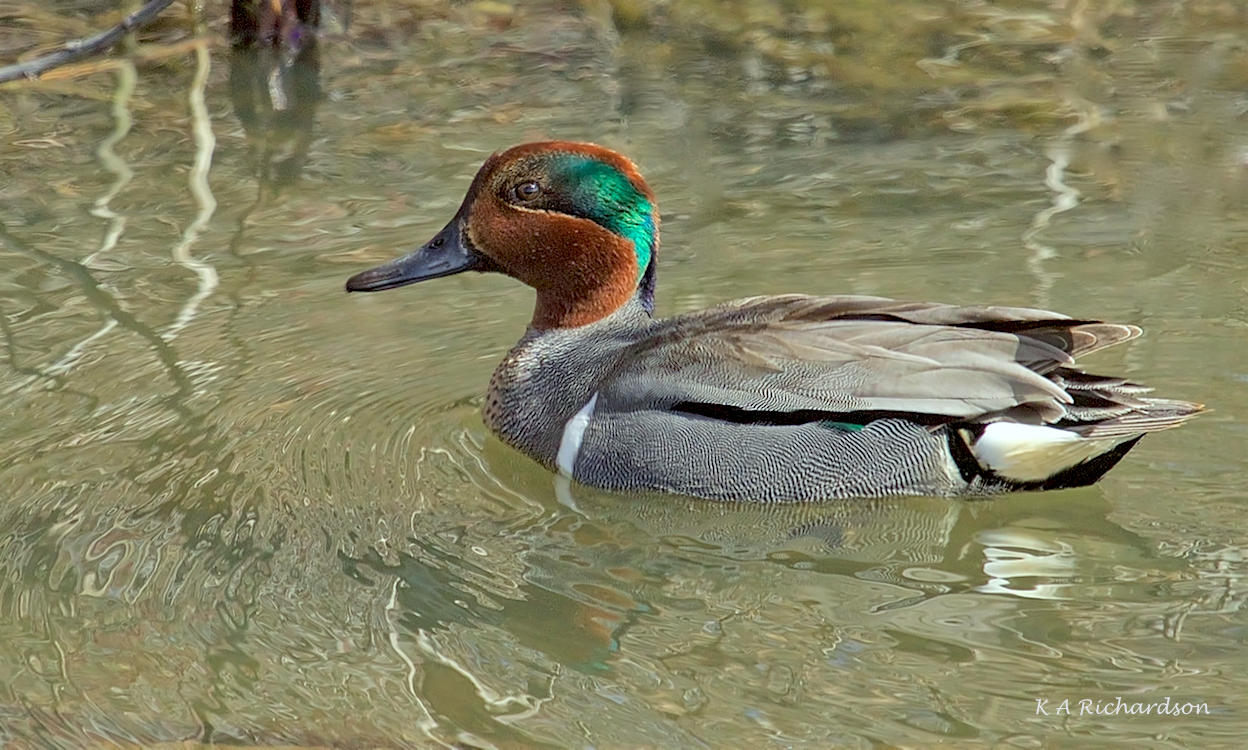
American Green-winged Teal drake (Anas crecca carolinensis).jpg
Thomson Marsh, Kelowna, BC.
For all my Coastal friends who can walk right up to these gorgeous little ducks at, say, Piper Spit in Burnaby, let me tell you that getting this shot required 20 minutes of hard work! 
The brook here is very narrow, so the teals, especially, cling to the shadowed side with its tangle of underbrush. Occasionally, if they flush, they’ll land in a slightly more accessible part like this. 
On my camera tolerance scale where 1 is “here this second; gone the next,” and 10 is “I’ve got all day; knock yourself out!” they’re a 3…. 
Getting the shot, in the end, is very satisfying….

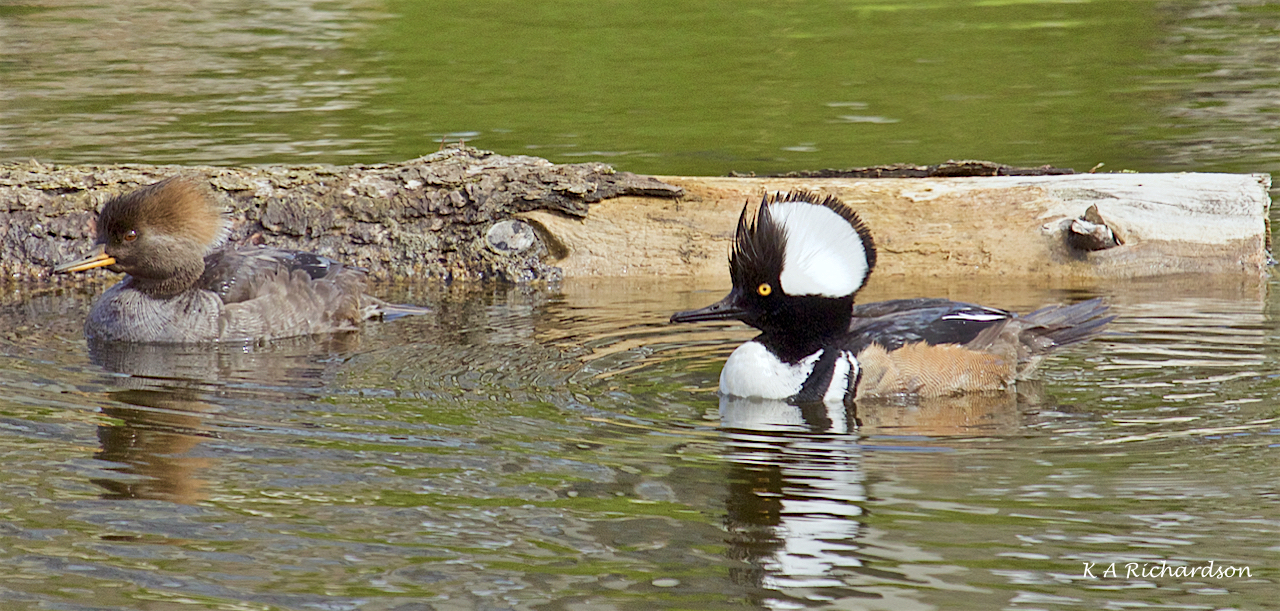
Hooded Merganser hen bathing (Lophodytes cucullatus) -01.jpg
Hooded Merganser female who showed up alone in Belmont Pond, just behind our condo, and spent several days grooming herself as if waiting for a mate to join her. The same situation occurred last year.

Click any image in the group below to enlarge the whole group and view one by one.

Hooded Merganser hen logged on (Lophodytes cucullatus).jpg
Now it’s time for Hilda to sit back and wait for His Nibs to show up….

Hooded Merganser (Lophodytes cucullatus) -02.jpg
Belmont Pond, Kelowna, BC.
Well, Hilda clearly knew he was coming, and now that’s he’s logged on, she’s really trying to impress!

Hooded Merganser (Lophodytes cucullatus) -01.jpg
Belmont Pond, Kelowna, BC.
“Okay! I’m here! What now?”
They stayed for a few days and then they were gone,
not to be seen again until Autumn….

Common Merganser drake (Mergus merganser).jpg
While 2017 was a better year for Common Mergansers here and in several other ponds I monitor,  we were graced in early April by this fella’s a visit. Unfortunately, this year he didn’t bring a mate…. Did see a pair and a singleton in Thomson Marsh, but here in Belmont Pond, we have a much better chance to get close enough for a good look….


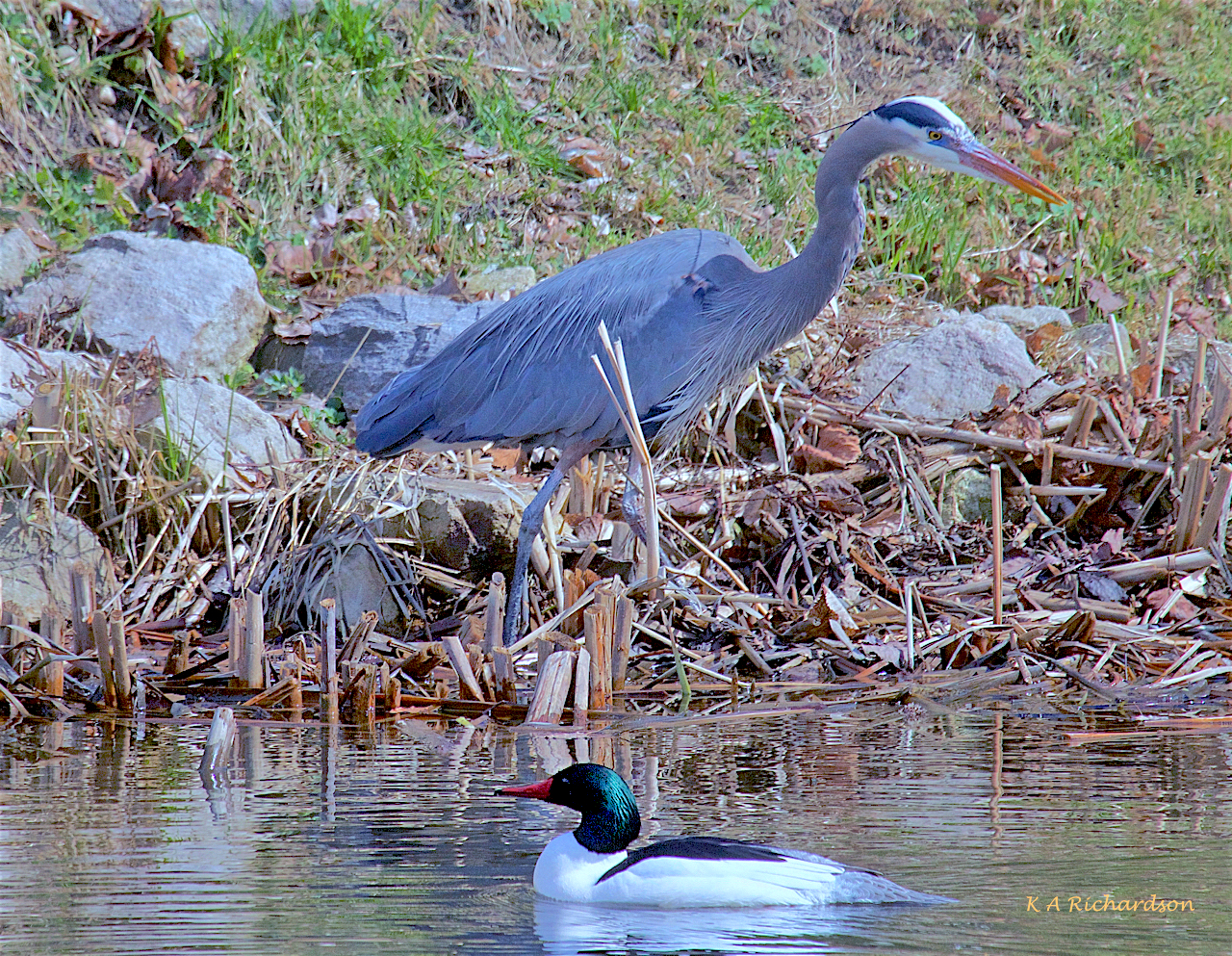
Noogye -05b.jpeg
Belmont Pond, where Noogye, a young Great Blue Heron 
now fully promoted to adulthood, exchanged pleasantries with 
Como the Common Merganser:
Como: “You fish your way…”
Noogye: “…and I’ll fish mine!”
Como: “Er, that’s just what I said…. (Sheesh! Herons!)”

In the next post, I’ll take a look at Spring Wood Ducks of Belmont Ponds…..

Breeding Season and the Challenges of Understanding Nature….

In the last year or so, I’ve been working at becoming a naturalist — one who studies and attempts to learn from the world of “nature,” which I’ll define as “the phenomena of the physical world collectively, including plants, animals, the landscape, and other features and products of the earth, as opposed to humans or human creations.” (Macintosh Dictionary app).

Like most of you who visit this site, I’m deeply interested in wildlife, especially birds. I enjoy what I perceive as their beauty, and am fascinated with their behaviours, especially interactions with each other, ranging from competitive, even predatory, to cooperative, even symbiotic.

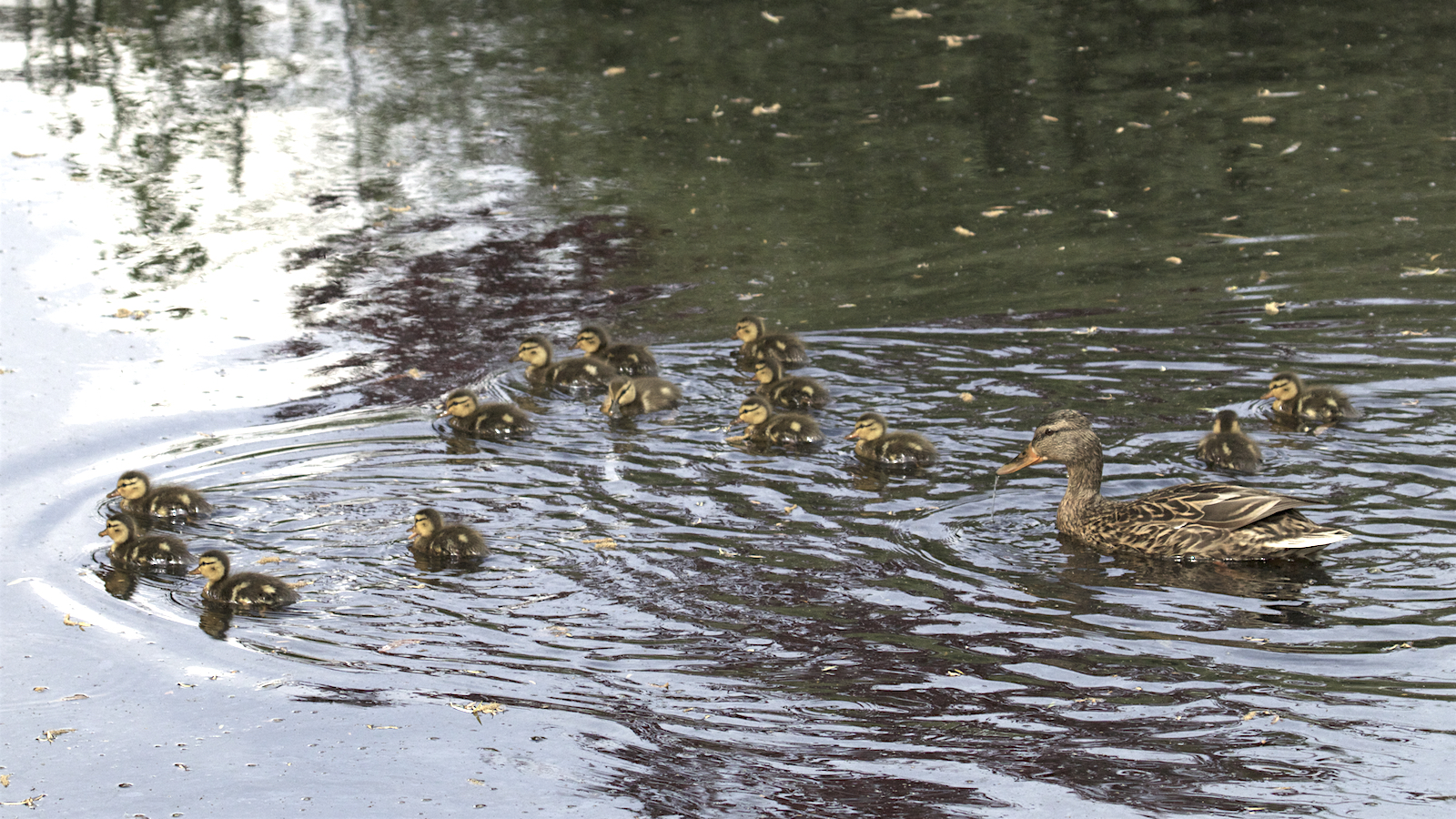
Here we have the first family of Mallard ducklings on Belmont Pond for 2016….

But, like you, I also recognize that not everything in “nature” is pretty or inspiring or even easy to witness, let alone study. In fact, that’s the focus of this post….

It’s impossible not to be tempted to dwell upon wholly “unnatural” interaction between wildlife and civilized humans, which often gives rise to anthropomorphism (“the attribution of human characteristics or behaviour to a god, animal, or object), and which, while it may make for entertaining fantasy, needs to be controlled or even avoided if understanding nature is really the goal….

So, the appearance of new life in Belmont Pond annually raises some interesting internal conflicts in my aging mind. No matter how hard I try to see the sudden appearance of ducklings as a mere “natural phenomenon,” I find myself attaching human attributes to natural creatures and processes that I have no right doing. As a naturalist, I need to strive for an “objective understanding” of the forces at work without being judgmental (definitely not something I’ll ever succeed at—because I don’t believe full objectivity is ever possible! Subjectivity trumps! But that dilemma is for another day…).

This comment from Emily Nagoski, (quoted online at http://www.washingtoncitypaper.com/blogs/sexist/2010/04/22/is-duck-rape-rape-rape/) is one that I’d like readers/viewers to keep in mind as they look at the photos that follow:

“It’s not so easy to avoid imposing human moral standards on [primates like] orangutans (sic) and chimps; they’re so like us, they’re so close to human. But we must avoid it. It’s not appropriate to overlay moral meaning on animal behaviour; chimps commit infanticide, but that’s just part of being a chimp. It’s not immoral or wrong, it’s just…chimpanzeedom.

There’s something in us, some apparently innate tendency, to find lessons and moral standards in nature. This is, in part, the naturalistic fallacy—the conclusion that if something is nature it must be right or good. Just as mistaken is the conclusion that something in nature is bad or wrong because it violates a human moral standard.”

All of which brings me to the issue at hand—the activities on the pond, particularly the breeding behaviours of Mallard ducks….

Mallard family
This image is rare for a couple of reasons: first, the enormity of the brood (14!) and second, the fact that the drake appears to playing an active role in rearing the ducklings. While I have seen this before, as the Wikipedia article below explains, that’s not usually the rule….

From Wikipedia:
“Mallards usually form pairs (in October and November in the Northern hemisphere) only until the female lays eggs at the start of nesting season which is around the beginning of spring, at which time she is left by the male who joins up with other males to await the moulting period which begins in June (in the Northern hemisphere). During the brief time before this, however, the males are still sexually potent and some of them either remain on standby to sire replacement clutches (for female Mallards that have lost or abandoned their previous clutch) or forcibly mate with females that appear to be isolated or unattached regardless of their species and whether or not they have a brood of ducklings….

Mallard family

The drake is nowhere to be seen as the mother duck does her best with the 14 after moving them from the larger pond into this smaller one. To be fair, he did fly in shortly after I took the shot….

“The nesting period can be very stressful for the female since she lays more than half her body weight in eggs. She requires a lot of rest and a feeding/loafing area that is safe from predators. When seeking out a suitable nesting site, the female’s preferences are areas that are well concealed, inaccessible to ground predators, or have few predators nearby. This can include nesting sites in urban areas such as roof gardens, enclosed courtyards, and flower boxes on window ledges and balconies more than one story up, which the ducklings cannot leave safely without human intervention. The clutch is 8–13 eggs [apparently someone forgot to inform the duck in my study—KAR], which are incubated for 27–28 days to hatching with 50–60 days to fledgling. The ducklings are…fully capable of swimming as soon as they hatch. However, filial imprinting compels them to instinctively stay near the mother not only for warmth and protection but also to learn about and remember their habitat as well as how and where to forage for food. When ducklings mature into flight-capable juveniles, they learn about and remember their traditional migratory routes (unless they are born and raised in captivity). After this, the juveniles and the mother may either part or remain together until the breeding season arrives (citation needed).

“During the breeding season, both male and female mallards can become aggressive, driving off competitors to themselves or their mate by charging at them. Males tend to fight more than females, and attack each other by repeatedly pecking at their rival’s chest, ripping out feathers and even skin on rare occasions.” There was one occasion on a pond in New Westminster where human observers witnessed the mother of the first of three broods systematically drown all nine of the second family within the first day of their lives….

“When they pair off with mating partners, often one or several drakes end up left out. This group sometimes targets an isolated female duck, even one of a different species, and proceeds to chase and peck at her until she weakens, at which point the males take turns copulating with the female. Lebret (1961) calls this behaviour ‘Attempted Rape Flight’ and Cramp & Simmons (1977) speak of ‘rape-intent flights’.”

What happened in Belmont Pond….

“Male mallards also occasionally chase other male ducks of a different species, and even each other, in the same way. In one documented case of “homosexual necrophilia”, a male mallard copulated with another male he was chasing after the chased male died upon flying into a glass window. This paper was awarded with an Ig Nobel Prize* in 2003.”

stinker-250.gif
“The Stinker,” the official mascot of the Ig Nobel Prizes.

* The Ig Nobel Prizes honor achievements that make people LAUGH, and then THINK. The prizes are intended to celebrate the unusual, honor the imaginative — and spur people’s interest in science, medicine, and technology. 

Every September, in a gala ceremony in Harvard’s Sanders Theatre, 1100 splendidly eccentric spectators watch the new winners step forward to accept their Prizes.  These are physically handed out by genuinely bemused genuine Nobel Laureates. Thousands more, around the world, watch our live online broadcast. “(https://www.improbable.com/ig/ )

But the question that needs to be asked is whether or not the behaviour I’ve documented is something about which we, as “naturalists,” not simply caring humans, should become emotionally responsive. It’s so hard not to feel that nature is “wrong” when we see animals acting “cruelly” towards one another, but, and you may not like my saying so, I think we have to restrain such sensibilities….

From the previously cited website, again:

“Forced copulation is a regular feature of sexual activity among ducks [especially Mallards]. In the phenomenon known as “rape flight,” several Mallards will aggressively peck at a female duck until she submits to sex (or dies). There’s reason to believe that female ducks very much do NOT enjoy this; the duck vagina has developed in a “rape-specific way” which allows female ducks to prevent pregnancy from this forced sexual contact*. But can we compare this animal behavior to the human conception of rape? Nagoski argues that there’s no such thing as “duck rape” for the same reason that meat isn’t murder—animals are incapable of consenting (or not consenting) to sex….”

Now the site cited below and several others that I looked at go much deeper into this issue than most of us would like to, and I don’t want to upset anyone, let alone ruin their day. Still, as an observer, I want to share with you what so many of us witness around breeding seasons, and if the content only makes you take a moment to think or reflect on a deeper level about “nature” and “human nature,” I’ll be satisfied….

*See this 2007 article from the website New Scientist: https://www.newscientist.com/article/dn11764-female-ducks-fight-back-against-raping-males/