Category: Meadowlarks

2021 April ~ Part 2

Before the 18th: first week of April…

While my son soldiered on in early spring, we all knew he couldn’t hold out long, as his breathing became more laboured, and he lost the use of his right arm. And yet, we all tried to support him by respecting his courage. I wish I’d said, however, “To Hell with Covid!” and spent some time with him. We spoke frequently by phone, and while he went to work for one-on-one sessions with his golf clients, he didn’t want those of us still circulating among the general public to visit him at home. I should have gone anyway; I’ll regret that choice for the rest of my life.

For the first part of April, life continued fairly normally, Covid restrictions notwithstanding. I could still hike my beloved Thomson Marsh and environs, drive to Munson Pond and Park, or one of the other birding locales like Robert Lake or Beaver Lake Road where I was unlikely to run into many people. I got a lot of satisfying images, including some almost ‘nemesis birds’. I’m trying to focus on diversity here….

In the shot below, the little nuthatch has pulled something out of the bark and
is tossing it around before swallowing it.

I have photographed Red-breasted Nuthatches for many years, but much less frequently than I’d have liked.

This spring was a
spectacular exception.
If RBNUs were found here in springs past, I wasn’t aware of it. But I didn’t know what to listen for. This year I quickly discovered that they make a sound like a tiny tractor backing up — a nasal one- pitch ‘beep-beep-beep’. And once I’d discovered ’em, they became a joy to work with!

More RBNUs below….
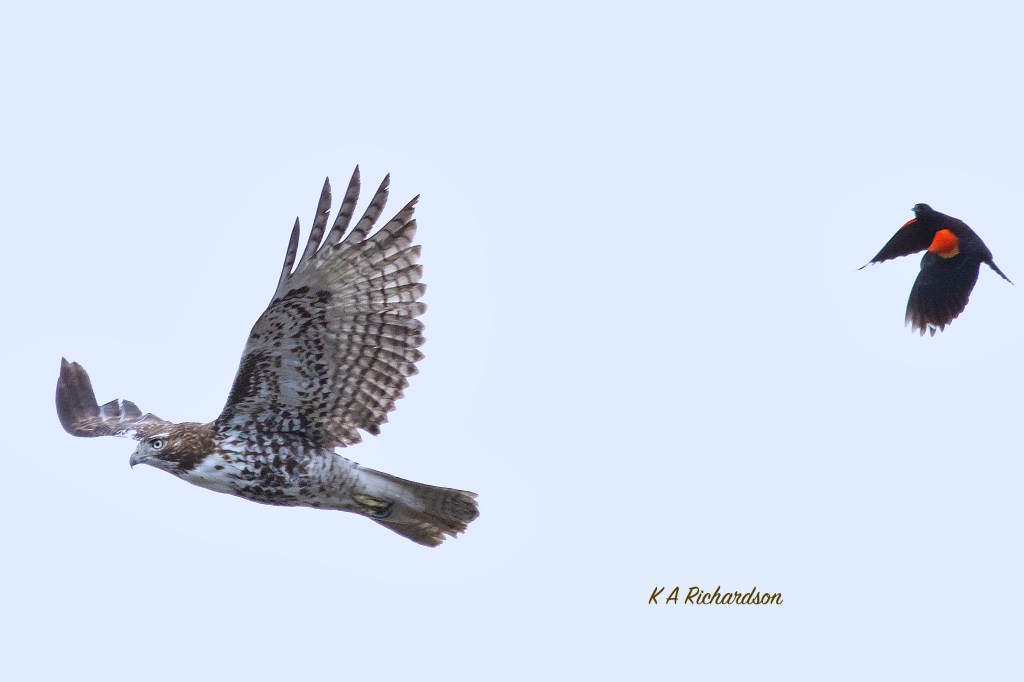
While pursuing a Cinnamon Teal, out of the corner of my eye I caught a Red-tailed Hawk over Michaelbrook Marsh being chased by a RW Blackbird. With no time to adjust my manual set up, I swung the camera up and hoped for the best. Only when I got home did I discover that it was our old friend Ready Eddie (Re’ddy with his white eyebrow and throat, a hawk I’ve been tracking for over 6 years) being harassed as he has been so many times over the years by Red-winged Blackbirds.
I first photographed this phenomenon in this area back in March 2016! (Scroll down the post.)
In the shot above the RWBL has backed off after successfully sending Re’ddy packing….
American Kestrels Kessie (right) and Amke (Falco sparverius) near their nesting site on the north side of Michaelbrook Marsh, Kelowna, BC. In the seven springs I’ve lived in Kelowna, Kessie has mated in this northwest sector of her territory every year. Whether her mate is the same one I’m not sure. This has become a rite of spring for me as much as for them.

I love Mountain Bluebirds! They are found in many parts of the Okanagan from White Lake Grasslands Park, north-west of Oliver to Beaver Lake Road in Lake Country. In 2020, I discovered them even closer to Kelowna in an area only 15 minutes from home.

While Western Bluebirds also nest in these areas, I find them less photogenic than the MOBLs. Every year there’s a continuing challenge to discover where they will nest and to get the quality of images this species deserves!

In most seasons, I’m most dedicated to the males . In 2021, however, I found a female to give them a run for their — er — feathers.
You’ll see later on….

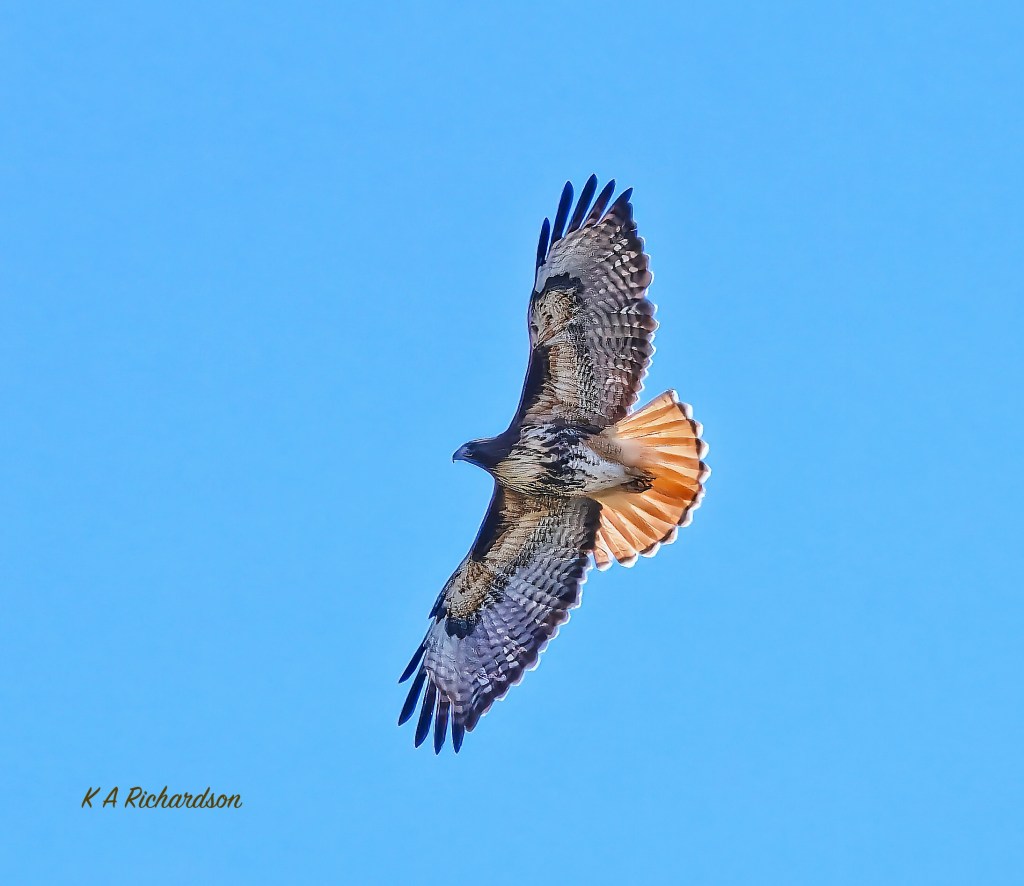
The Okanagan is blessed with an abundance of Red-tailed Hawks. Click here for my 2016 study of them.

An intriguing feature of this species is the great colour variability among its indvIduals. The harassed fella (posted above the kestrels above the bluebird), as you can see, has a white throat and overall lighter tones including a tail that’s not very ‘red’ compared to the one to the right here, soaring above Beaver Lake Road in Lake Country. This one has classic hues!
Some birds are more difficult to capture than others, of course.
Western Meadowlarks are often found in the same areas as our two bluebird species, but I find them much more flighty. Early spring, however, often brings opportunities as it did this April day. Of course, I’d prefer this bird to face me. S/he didn’t, but I would catch up with one more co-operative later in the month.

The Black-billed Magpie is another species I find challenging to photograph despite their relative abundance here. Finding them in the open in just the right light is certainly possible, yet I struggle to get my settings ‘just right’.

While this setting is far from pretty, it’s typical of where this youngster and his relatives hang out. He looks a little guilty about giving me as good an opportunity as even this!

One of our most colourful and controversial species, BBMAs never fail to get a reaction from onlookers. Personally, I like ’em and defend them against their detractors, which doesn’t make me very popular!

American Robins are one of the most familiar birds in North America. For many folks, the ‘first robin’ of a new year marks the beginning of spring.

Many bird photo-graphers I know don’t like to post images of commonplace birds.
I, contrarian, love the common birds with which, perhaps, I identify. And, as I’ve learned through travel to and living in ‘foreign lands’, what’s ‘common’ in one place is ‘exotic’ in another!

Pine Siskin (Spinus pinus) Belmont Park, Kelowna.
The Siskins in our area seldom pose for closeups.
This ‘keyhole shot’ has been edited to remove obstructions.

I must add, too, that, this bird was much lighter in colour than most Siskins.

The images below, while of low quality, were taken in low light as the bird was foraging in a shallow ditch.

On another day, I found a Pine Siskin sipping water from the ditch that runs through this part of Belmont Park. Very different ‘look’ in this spot, I think you’ll agree!

Red-breasted Nuthatches inhabit the same general area of Belmont Park. So, as promised above, here are three more images of them. They were sooo cooperative this year!

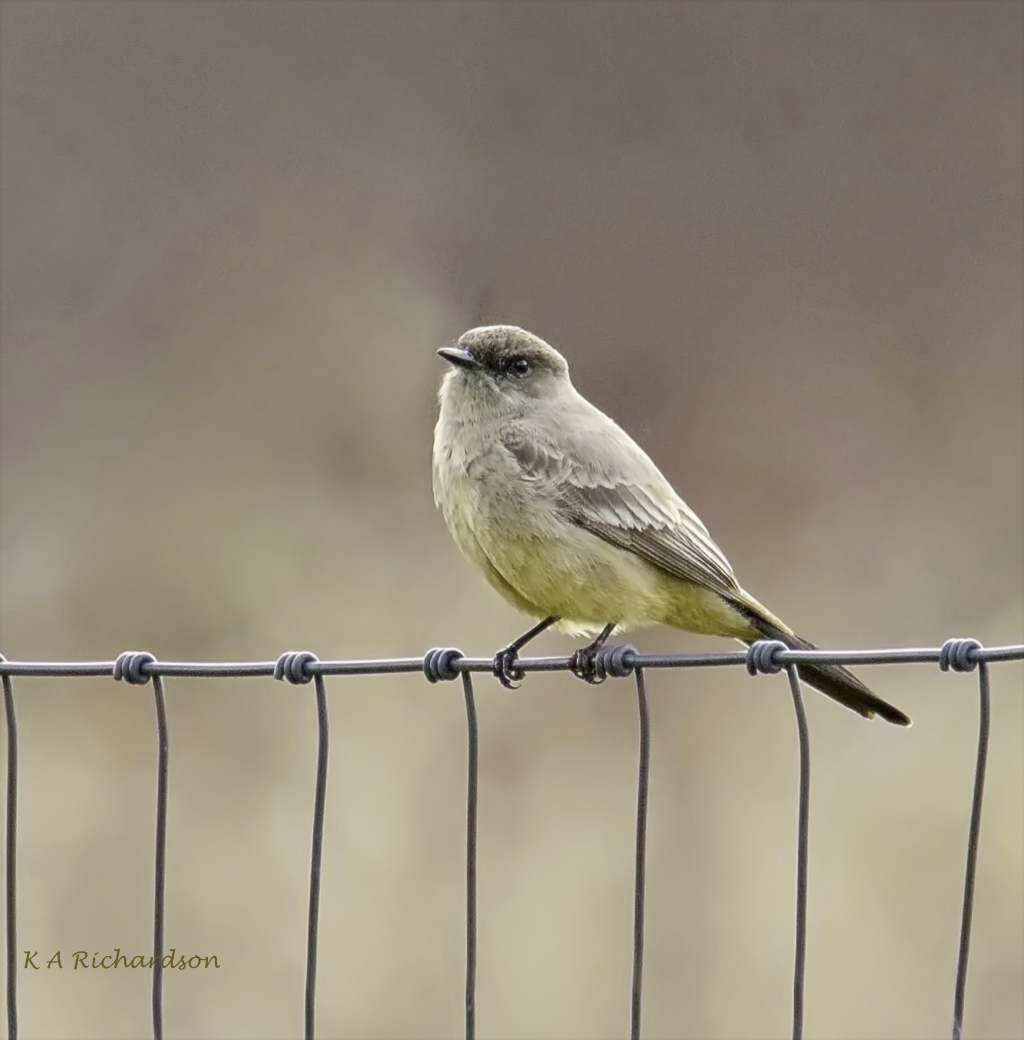
For reasons I find difficult to explain, I love Say’s Phoebes, despite their muted hues.
Perhaps it’s because they’re a western bird and it took me so many years to learn where they hang out. Regardless, I see several every year, now, and, again, why I don’t know, I have trouble getting the quality of image I want.

This bird was one of a pair nesting in the large back yard of a family dwelling near Vernon’s Swan Lake Nature Reserve.

For Part 1 of this series, click here.

For Part 3 of this series, click here.

Out and about or ‘South, for a last time’…

For Navigation Help, click here.

Yes, you are meant to sing this posts’s title’s last five words — à la Johnny Horton!

Okanagan South map.pngApril 11, 2017: With strong assurance that we had a sunny day at last, Nana and I set out for White Lake and Osoyoos hoping to discover whatever we could. There’s less disappointment with such vague objectives, you know….

Truth be told (and shouldn’t it always?), we were looking for Mountain Bluebirds (Sialia curricoides), Western Meadowlarks (Sturnella neglecta), and Nature-willing,  Yellow-rumped Warblers (Setophaga coronata). Won’t keep you in suspense — we found ’em all right, yet came home with not one decent photo of any of ’em. Not the right day. Nice to see, but far too far off to fotograph!

Click the map at left (or any graphic where the cursor turns to a pointing hand) to enlarge it….

Before you start commiserating, however, let me finish. We did not return empty-memory-carded! At White Lake, right off the bat, I got some decent shots of a Western Bluebird (Sialia mexicana). Actually wished later that I’d spent a little more time there, right across from the parking lot, but we had our targets and figured they were down the trail. We had some fun with meadowlarks, but they were smarter than we. As for the warblers, found that we could do better at home….

Click on any photo in the cluster to enlarge them all….

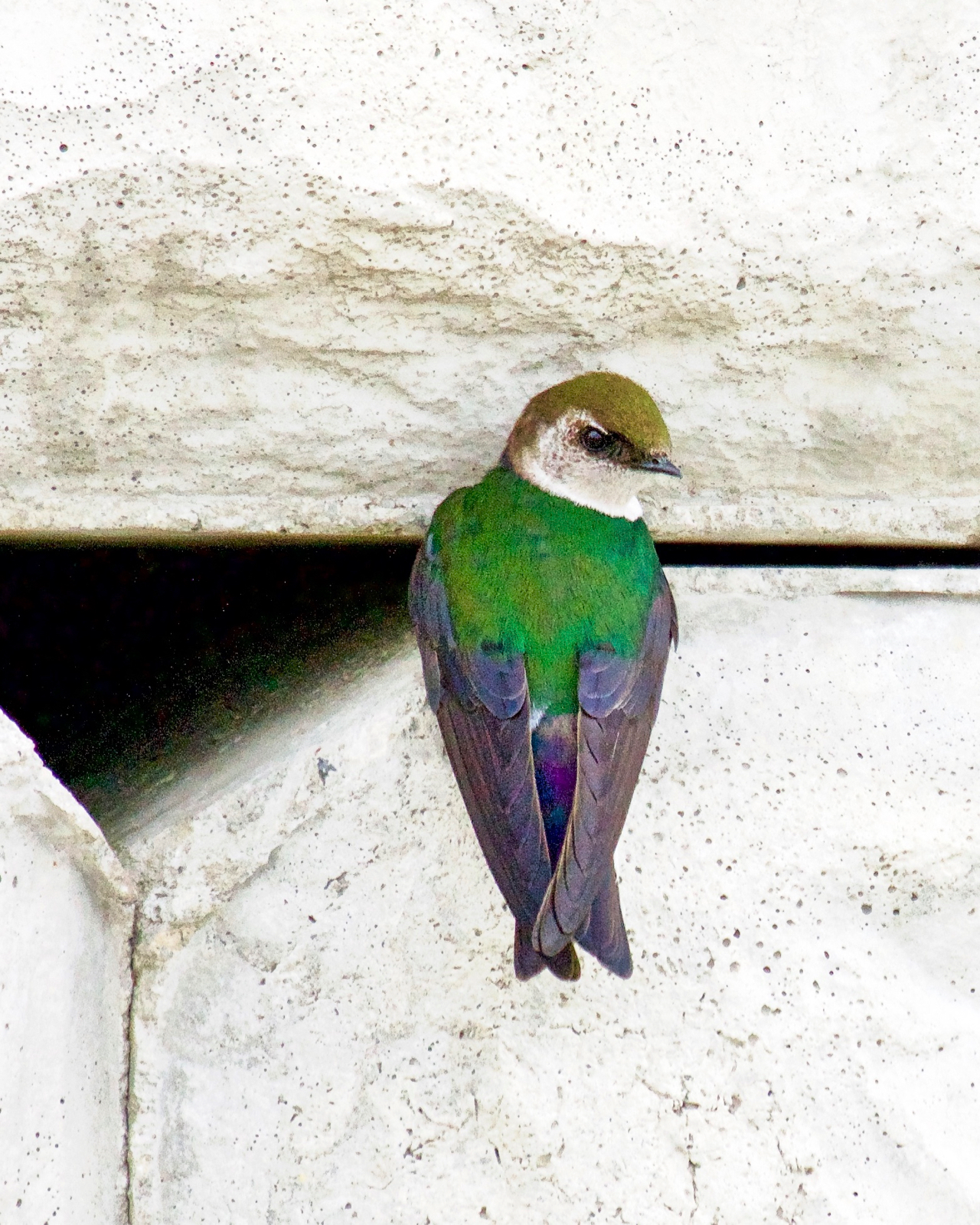
Violet-green Swallow
(Tachychineta thalassina) female in the stone foundation of our condo, Kelowna.

We didn’t linger long at the lake. Instead we headed south to Osoyoos and famous Road 22 which crosses the Osoyoos River floodplain just north of Osoyoos Lake. At this time of year we can expect to see Ospreys freshly returned from their winter homes in the States, as well as a few other migrants navigating northwards. As we crossed the river and turned south onto the dike road, we saw a flight of Violet-green Swallows (Tachychineta thalassina), a couple of hundred I’d guess, swarming around the bridge area. As we have these at home, we didn’t take time to shoot any….

We did enjoy some success with the Ospreys, however. There are three nests in the floodplain that I’m aware of, and pairs occupied each one . We focused on the largest and most colourful nest, perhaps in the whole Okanagan Valley, maybe in BC, maybe even the world, (!) not that it matters. I’ve provided just three Osprey shots here but if you want more, click this link….  To enlarge the photos, below, click on the —oh, you know…!

On our way back to Oliver, we chose to take the Nimkip Road through Osoyoos Indian Band lands (the road is provincial). Near the junction of Rd. 22 and Sage Rd. sits an old barn and, across the road, some other sadly deteriorated ranch buildings. There we enjoyed great looks at some Say’s Phoebes (Sayornis saya), which seem to be in abundance through their BC range this year. Came away with one acceptable photo.

Say's Phoebe (Sayornis saya).jpg

From Oliver, we drove to Vaseux Lake and up McIntyre Rd. (which Google insists on calling Dulton Creek Rd. Apple Maps, for once, gets it right!)  This area is collectively referred to as McIntyre Bluffs (or sometimes Vaseux Bluffs). See map above.

It’s home to a variety of wildlife, both avian and four-legged. We saw (and interacted again) with meadowlarks (still denied the quality shots we got last year).  We saw four mule deer, which, after spotting us, turned their attention to a predator they could see, but we couldn’t. Although they stayed put, the here was giving it undivided attention. As the Mulies were too far away to photograph, we didn’t.

On the way up to the ranch on McIntyre Bluff, we stopped to appreciate a rather thin and tired looking California Bighorn ewe. Nana wanted to go look for the rest of the herd, but that came later on our way home….

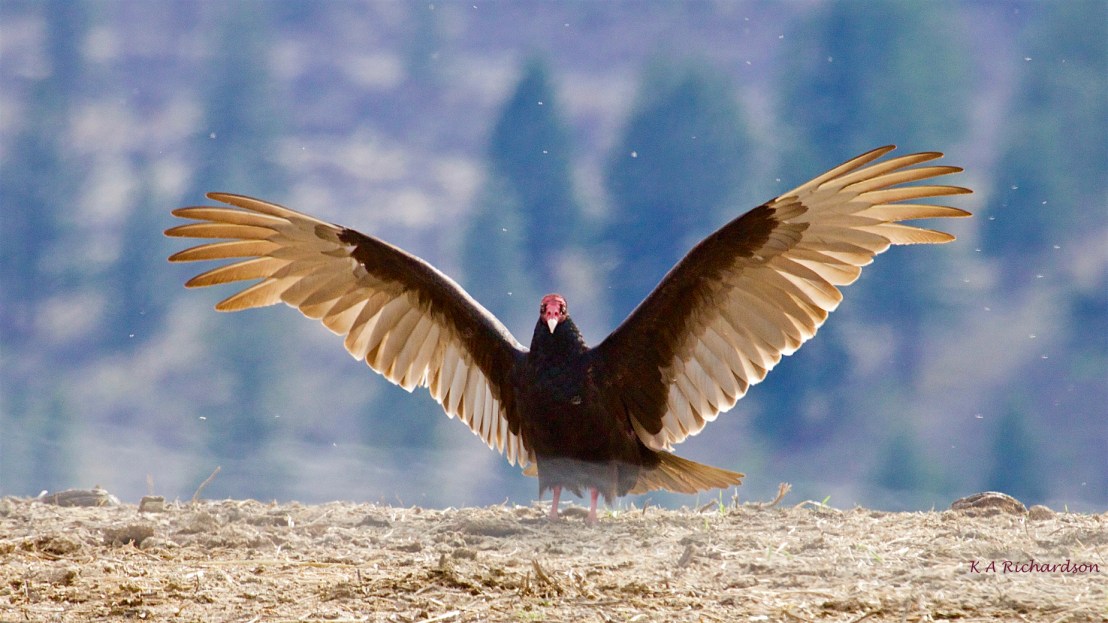
Turkey Vulture (Cathartes aura)
Turkey Vulture at the ranch above Vaseux Lake near Oliver, BC.

After turning around, a km or so past the ranch, we were startled on our way back down, just as we approached the feedlot, to find a wake of Turkey Vultures (nine altogether) mostly on the ground but also flying in and out. Must admit that I was struck with vulture fever! Stopping the car as close as I could on the opposite side of the road (with no traffic, that was a mistake!), I rolled down the window and attempted to shoot between strands of the barbed wire fence. While the opportunity was fabulous, the fence was a foil. To get the results I wanted, I had to get out and hope that in their frenzy, the ol’ buzzards would stay put and let me shoot. Alas, not happening on this day! While I got the closest ever to TUVUs, the images produced are not nearly as good as they should be. Were I doing it again, I’d drive to the wrong side of the road close to the fence; I think the TUVUs were oblivious to the machine but not to the man…. One of those situations where one is seen exulting and beard-muttering at the same time!

Turkey Vulture (Cathartes aura).jpg
Sort of what I felt like doing when I got such a feeble result!

On the way down the highway, located “our Ewe” again, and observed her and 21 others in the herd, by Nana’s count. There may have been more. No rams, however…. To enlarge any photo below, click on it!

Vaseux Lake Bluff.jpg
The view of Vaseux Bluff from McIntyre Bluff. Can you spot “Ewe”?

California Bighorn ewes and lambs.jpg
Ewe is a sweetheart!

California Bighorn ewes and lambs (1).jpg
One dozen of the herd. Nana counted 22 in all….

Finally,  from the new tower-blind at the Vaseux Lake “Important Birding Area” (a lot more on this fraud some other day!), one last look at Vaseux Lake and Bluff.

Vaseux Lake from the IBA blind.jpg
Vaseux Lake from the beautiful new tower-blind. Sadly, the same old lousy birding spot!

For the post on Osoyoos Ospreys only, click this link….