
growing
like a single
organism
inseparable we are
faithful
as only friends can be
total honesty always
just beyond our grasp.
life begins at 70
Author: keikelo
growing
like a single
organism
inseparable we are
faithful
as only friends can be
total honesty always
just beyond our grasp.

July 11, 2017: ~ The spring / summer of 2017 was supposed to be super special for us. And, in many respects, so far, it has lived up to those expectations. We enjoyed sunny, albeit cool weather, car camping (above — something new for us and probably questionable at our age), and fabulous trips across western Canada (May 24 – June 11) and up to BC’s Cariboo region (June 28 – July 3) .
Click any cluster of photos to enlarge them.


But the season has brought mixed blessings. A surprisingly cold spring delayed the melting of winter snow in the hills. In late March the summits received late snowfalls. By mid-May we suddenly had the highest levels in our lakes and streams in years. We headed for the east as scheduled, wondering what we might return to in three weeks. While the flood threat did not materialize to the extent it might have, our tourism-dependent region has suffered considerable disruption and bad publicity.


Our lovely Thomson Marsh overflowed and flooded the southeastern corner of my beat. It’s only now beginning to normalize. While we waited for the water to subside, we planned a trip to visit friends in BC’s Cariboo region around our July 1 national celebrations.
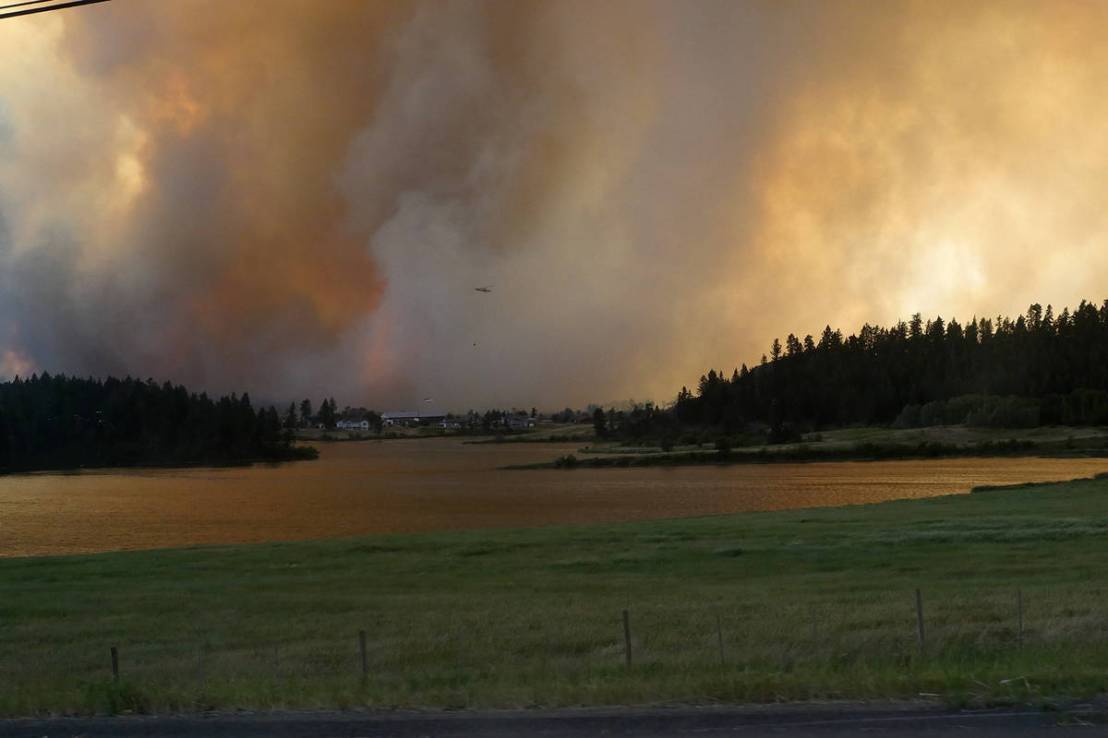
We had just left the 108 and 100 Mile areas after our five-day visit when wildfires broke out across central-northern BC on July 6 and 7. In only two days, the areas we had just been visiting were under evacuation orders. Our good friends at the 108 were forced to grab what they could, including their flock of 12 chickens, and find shelter elsewhere, not knowing whether their home would survive or not…. There no end in sight to this tragic story.


While wildfire was the story elsewhere, only a few blocks from home a five story condo under construction burned to the ground due to human error!
I’ll update the fire stories when we have more certainty about their outcome….
So, for the benefit of family and friends, here are some highlights of our Prairies trip.
Prairie Trip Days 1 and 2: Kelowna to Waterton Lakes, AB.

After stopping at Cranbrook (see caption above), we discovered the next morning, bright and refreshing after the evening shower, the charms of that city’s Elizabeth Lake Bird Sanctuary. A large, marshy lake, its shallow shorelines are great breeding places for ducks and geese, Eared Grebes, and various songbirds including various swallows and warblers like the Common Yellowthroat.
A few photos of what we found:


But the highlight of our short tour, which we nearly missed, was this encounter with a Killdeer defending his nest. Near the end of our walk, we almost ignored the pair, but couldn’t resist taking a closer look. And we’re glad we did. The male Killdeer was one of the bravest I’ve ever seen. We spotted him first in the grass:
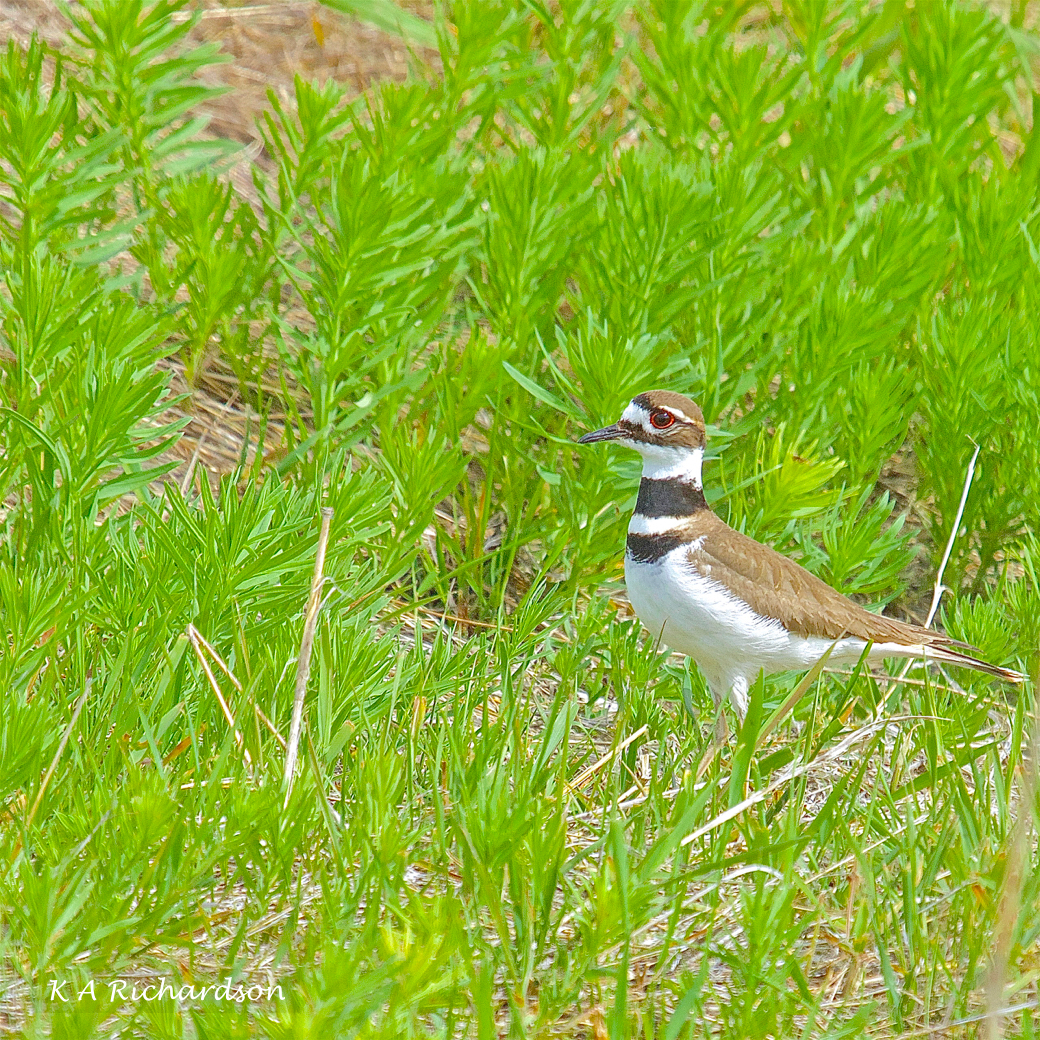
Later he mounted a small knoll in front of us and defiantly stared me down. I advanced a little bit, expecting him to retreat. To my surprise, he moved towards me, as if to say, “No, you don’t! Not one step closer!” In the cluster of photos below, you can trace his trajectory by using the large pebbles as references…. Had never seen this behaviour before.
Click any photos in the cluster to enlarge it.


Eventually, I retreated, and so did he, giving me a great performance of his “broken wing act” to conclude the episode. It was a great way to begin our trip!

!["Totally mangled! Come have a look [heh, heh]!](https://i0.wp.com/birdsandmusings.ca/wp-content/uploads/2017/07/killdeer-8.jpg?w=543&h=330&ssl=1 "Killdeer")
We also encountered some very calm Canada Geese and their progeny:


We also had great opportunities to observe a couple of species we don’t usually get so close to:


The second part of Day 2 saw us drive from Cranbrook to Waterton Lakes: click here!
In my homage to favourite shots from 2016, I touched on Wilson’s Phalaropes only briefly. On May 15, 2017, the middle of another cold Spring month (!), unable to find the Orioles I know have returned to Mill Creek, I drove a little further out to Robert Lake. Despite the exceedingly high water, the viewing area offered good looks at a variety of ducks, as well as a few wading birds. Among these, the WIPHs were most prominent and active. Here are a few of the different looks provided by a handful of birds that were not foraging, but preening and simply relaxing, while their fellows scurried hither and thither in the main pond on the other side of the road.


Phalaropes are actually quite small — about the same size as a Killdeer, especially after their long trip from their wintering areas up north to Kelowna. They will grow considerably larger as they replenish all the calories expended to get here. (See ‘Cool Facts‘ below)
A western bird for the most part, WIPHs can also be found near the Canadian-American border in Ontario, QC, and NB/NS.
These birds travel long distances from South America in winter to western Canada in breeding season!


Unlike most species of birds, female WIPHs display much more vivid colours than their mates. (I’ll add more photos of males as I acquire them. The males were too busy foraging for good shots in the low light of this day….). Cornell’s Lab of Ornithology points out, moreover, that, “Females court and defend male mates—several per season—while males do most of the work of raising the young.”
“Cool Facts (Cornell)

Even smaller than the Wilson’s Phalarope is the Least Sandpiper (Calidris minutilla), which have also been hanging around the same area, looking rather bemused by the high water….

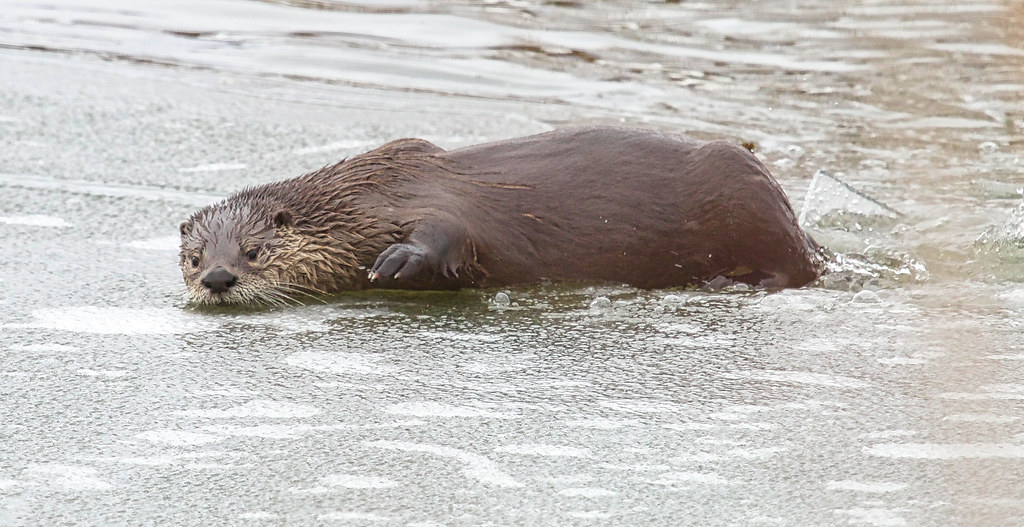
In 2015, January, as we were preparing to move up to this wonderful place, Nana and I were house sitting, ironically, just across the lane from the condo we were purchasing. I had excellent opportunities to familiarize myself with the neighbourhood, especially Thomson Marsh. At the same time, a delightful romp of North American River Otters showed up for a two week stay where the marsh widens into pools, very close to home. Despite the low light, I was able to get some photos and video. Since then, despite reports from others, I have not seen them in numbers.
In March 2017, I caught the back of one swimming upstream away from me, and, a day or so later, just missed seeing several in the same spot they’d visited in 2015. Fortunately, another local fotog was able to get some images.
Recently, I was reminded of the 2015 experience when Angela, one of the folks I frequently encounter on my beat, asked if I’d seen any otters lately. That gave me a chance to share some entertaining (she said) video from two years ago. I promised her links, and finally, here they are!!
The first two links are back to my Flickr site. Below them are links to my Youtube account where the videos, also available via Flickr in rough form, have been enhanced to make them easier on the eyes!
The first set of photos starts here.
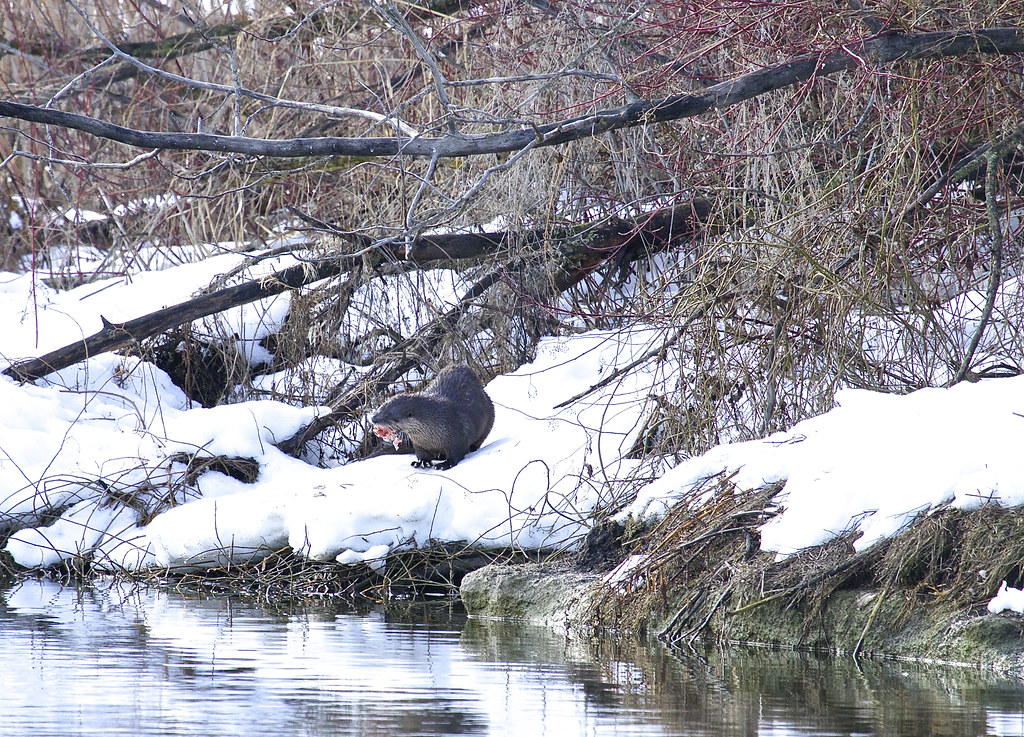
The second set starts here:
Here are the Youtube videos. Click the arrow on the image to view the content. Enjoy!
The first video has two actors; one apparently specializes in photobombing!
Video with music added:
Video with the sound of only the wind….
And one last, relatively unedited vid showing them “breakin’ the ice”!
See a  icon over a photo or link? Click to see an enlarged image or go to another place.
For Woodpeckers Galore, a post based on the same visit to Anarchist Mtn., click here.
May 1, 2016: As promised at the end of the Woodpeckers Galore post, I want to share photos of one of the most industrious Pileated Woodpeckers I’ve the pleasure to observe. We get so see him in dust covered overalls in the midst of his renovations of an existing cavity that is apparently to be reused. His mate sat quietly in a shady nearby tree about 30 meters away. By the way, we know he’s a male by his red malar stripe.
I have watched PIWOs excavate before, chipping away at huge chunks of a tree mainly in search of grubs living in the wood. The shot below was taken Dec. 31, 2015 in Kelowna.

This spring, however, PIWO’s digging reminded me, ironically, of what I saw last year when the smallest of nuthatches, the Pygmy, was working on a nest in a burned Ponderosa stump. There was a steady stream of detritus and dust being flung from the dead tree’s orifice as the shot below shows.

Woody, the subject of this post was in almost constant motion between 12:47 when I took the first shot of him already enlarging the cavity to the last one at 1:05. He had been at it, our ears told us, for some time before we located him, and he wasn’t finished when we withdrew for lunch. Around the time we left, he did take a break to communicate with his mate and to check the area.
Here are the photos. The blurriest betray the constant motion mentioned earlier. In many cases, I had to time my pressing of the shutter button to catch his full profile….

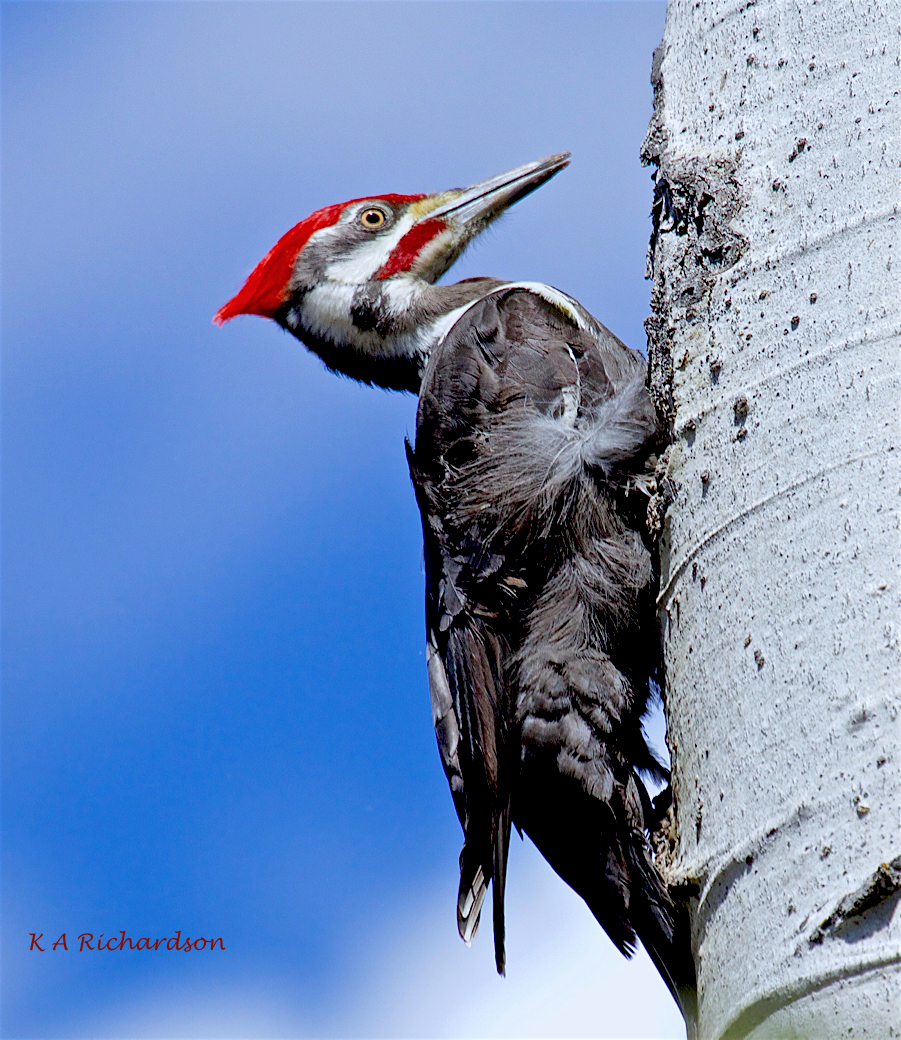

Doing the job! Click any photo in cluster to enlarge them all….


I hope to return from time to time to find out whether Woody and Wimsie are successful in raising another generation of these largest of our many fascinating woodpeckers….
From Cornell’s Lab of Ornithology:
“The Pileated Woodpecker’s primary food is carpenter ants, supplemented by other ants, woodboring beetle larvae, termites, and other insects such as flies, spruce budworm, caterpillars, cockroaches, and grasshoppers. They also eat wild fruits and nuts, including greenbrier, hackberry, sassafrass, blackberries, sumac berries, poison ivy, holly, dogwood, persimmon, and elderberry. In some diet studies, ants constituted 40 percent of the diet, and up to 97 percent in some individuals. Occasionally, Pileated Woodpeckers visit backyard bird feeders for seeds or suet.”
“The male begins excavating the nest cavity and does most of the work, but the female contributes, particularly as the hole nears completion. The entrance hole is oblong rather than the circular shape of most woodpecker holes. For the finishing touches, the bird climbs all the way into the hole and chips away at it from the inside. Periodically the adult picks up several chips at a time in its bill and tosses them from the cavity entrance. Pileated Woodpeckers don’t line their nests with any material except for leftover wood chips. The nest construction usually takes 3-6 weeks, and nests are rarely reused in later years.* Cavity depth can range from 10-24 inches.” * This appears NOT to be the case for our bird….

We need this species in our forests! Thanks to Birding North America for this note:
 For the Pileated portion, click here.
April 30, 2017: Among the birds that determinedly “non-birders” can actually name, woodpeckers are popular. Most will at least recognize a Flicker (but don’t ask them to separate Red-shafted, Yellow-shafted and Intergrades, please), perhaps a Hairy or a Downy (though few can identify the differences), maybe a Pileated (although they probably know it better as Woody Woodpecker). Back east, they may have seen a Red-headed or Red-bellied, the former rather obviously named, the latter clearly not. They’ve likely heard of a Yellow-bellied Sapsucker, yet never seen one, or any of the other sapsuckers — the Red-naped of the BC Interior or the Red-breasted closer to The Coast.
But there are many woodpeckers that “cross the border” into Canada that even regular birders have not seen. Lewis’s were new to me only a few years ago; in a way they helped to bring me to the Okanagan (click here for Lewis’s in another page). Acorn, White-headed, and Williamson’s were on my own list. Two of this group still are. Last week, however, the list shrank by 33%.
 Acting on a hot tip from Richard Kobayashi, a fellow Kelowna birder / photographer, who gave us the exact location we needed, we travelled south to Anarchist Mountain located near the Canada-US border between Osoyoos and Rock Creek, BC. About one kilometre north of Highway 3 on the Sidley Mountain Road, we found our targets right where Richard said they’d be, an engaging pair of Williamson’s, as well as three other species plus the usual bluebirds and wrens and sparrows expected in this region this time of year. We had a fabulous birding experience!
The property belongs to Ed Brouwer, an engaging fellow about whom I’ll no doubt write future posts. Ed was kind enough to allow us onto the property; without that permission, most of these photos would not have been possible. Nana and I are greatly appreciative of his generous sharing of the bounty residing on his land!
Williamson’s are relatively rare in Canada, found only in southern BC. In 2005, in a Species at Risk bulletin, the Government of Canada estimated that only 430 birds crossed the border into our country to breed. The report noted that the species was in decline as habitat became threatened. More on that later in this post. Let’s get to the photos:

Let me say, right off the top, that the male’s wonderful colours are exceedingly difficult to capture with equipment such as mine. I didn’t fully realize this until I returned home and looked at the quality of my images. Trying to photograph both on an Aspen is a terrific challenge from a white balance / black balance standpoint! The good news is that I have more reason to return and try to improve!
Unlike many of our BC woodpeckers, Williamson’s are sexually dimorphic, so different in appearance that many early observers thought the male and female were different species! The image of the female (below) attests to why: (Click cluster images to enlarge.)


As we watched their behaviour, we noticed that both birds kept leaving the big Aspens to visit the bottom five feet of a nearby young Balsam Fir. Closer examination after they left it showed why: (Click cluster images to enlarge.)


We were ecstatic about the opportunity to examine their habitat so closely. But the story doesn’t end here. In fact, it was just the beginning. We also were thrilled observing the other woodpeckers of this small forest.
Having seen Red-naped sapsuckers up close four years ago, I decided not to pursue them this time. I will go back for them another time, I’m sure!
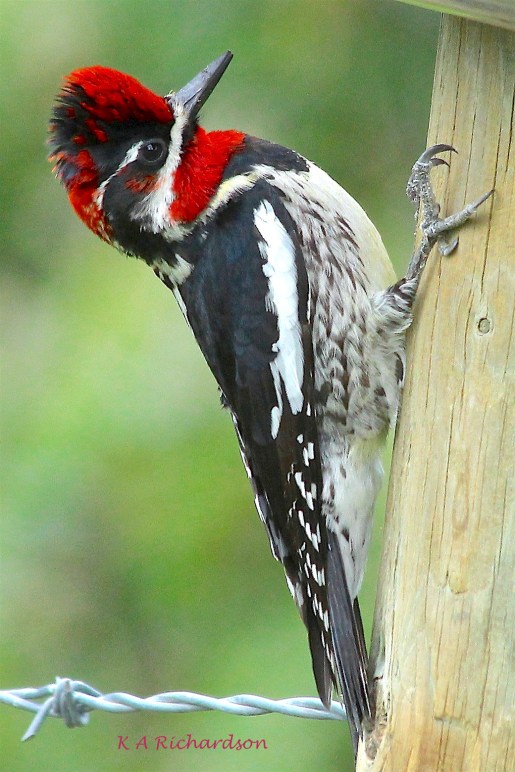
Instead, I focused on a very cooperative and hard-working Hairy that allowed me over a seven-minute span (I departed before he did) to observe him drilling a new hole.
(Click cluster images to enlarge.)


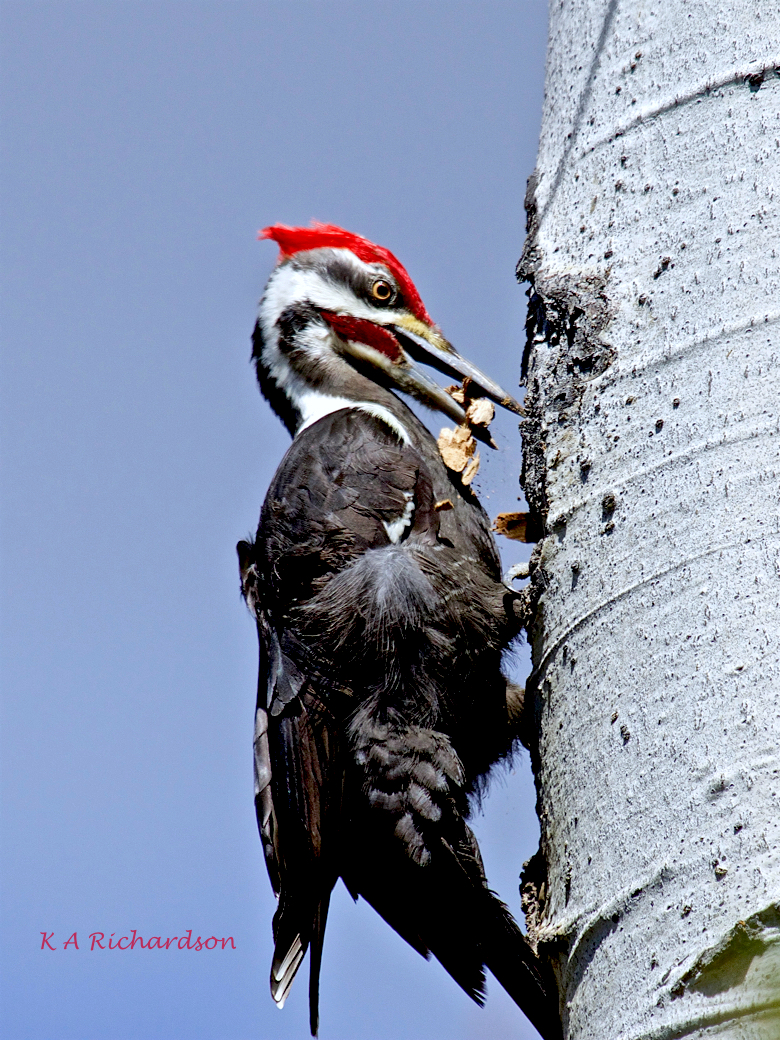
We also got to watch a Pileated male re-excavating a nest hole while his mate observed nearby. That’s covered in a separate post, but here’s a teaser:
For full Navigation Instructions for this blog, click here.

Every spring we look forward to the return of Ruddy Ducks from their wintering grounds to the south and west (jump to maps at the end of this post). Two locations where we have most success are Robert Lake on Kelowna’s northern border, and Birdie Lake at Predator Ridge Resort, a few km. south of Vernon, BC. In May 2015, we were treated to the appearance for a couple of days of a solitary Ruddy drake virtually in our back yard, Belmont Pond, shown above.
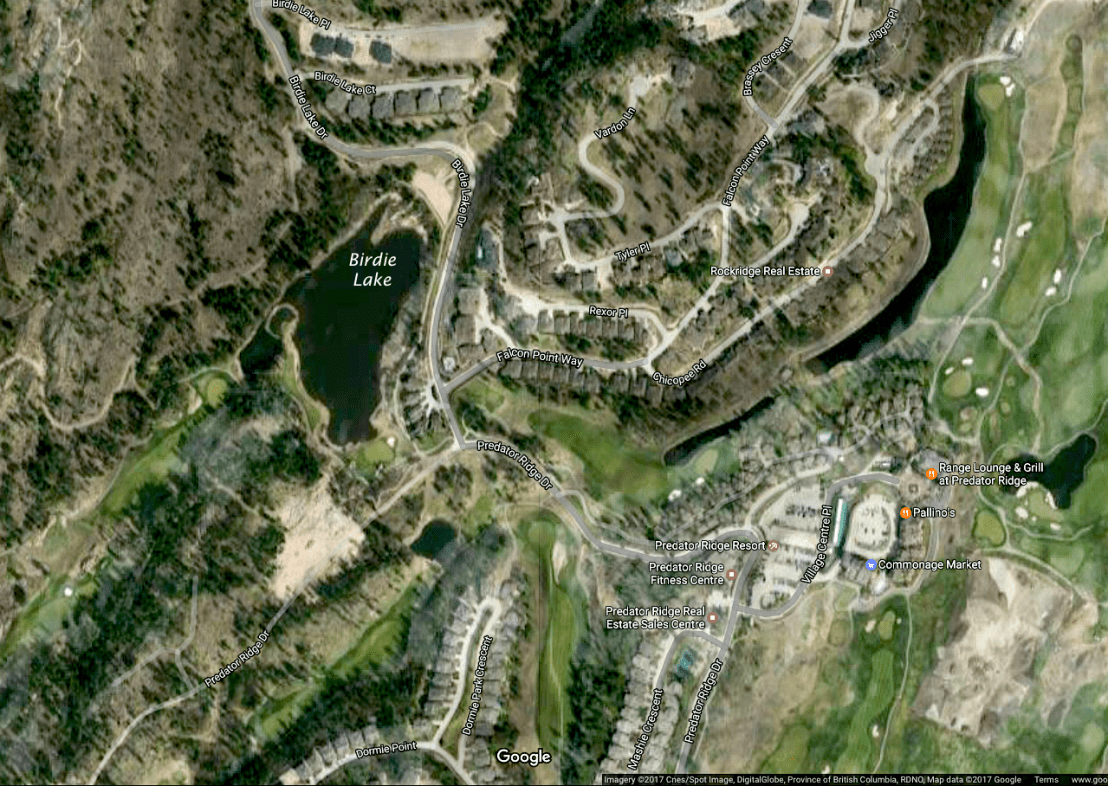
Our most reliable site for these fascinating little narcissists is Birdie Lake. We discovered this gem about 10 years ago when my son was working at the Ridge and staying only a short walk from the ‘pond.’ It’s a great place for a variety of waterfowl and perching birds. This Spring we were even treated to the calls of Great Horned Owls (although, sadly, we did not locate them). While the RUDUs usually are best photographed in the small ponds on the southwest side, they can also be observed from the deck on the peninsula at the northwest end. That’s where we were able to find and photograph them this year: five bemused drakes and a single, amused hen.
We were treated to some very interesting, indeed, entertaining courtship behaviour from the males. The lady offered some encouragement — as the photos show.


Getting the colour balance right with these drakes is always a challenge!

The Audubon Field Guide online, describes our little buddy as: “An odd little diver, the main North American representative of the group of stiff-tailed ducks, with spiky tail feathers that are often cocked up in the air. Usually lethargic, and seems reluctant to fly. On takeoff it must patter across the surface of the water to become airborne, then whirs along on rapidly beating wings. On land it is almost helpless. Flocks of Ruddies wintering on lakes seldom mix freely with other ducks, although they may associate with American Coots.”
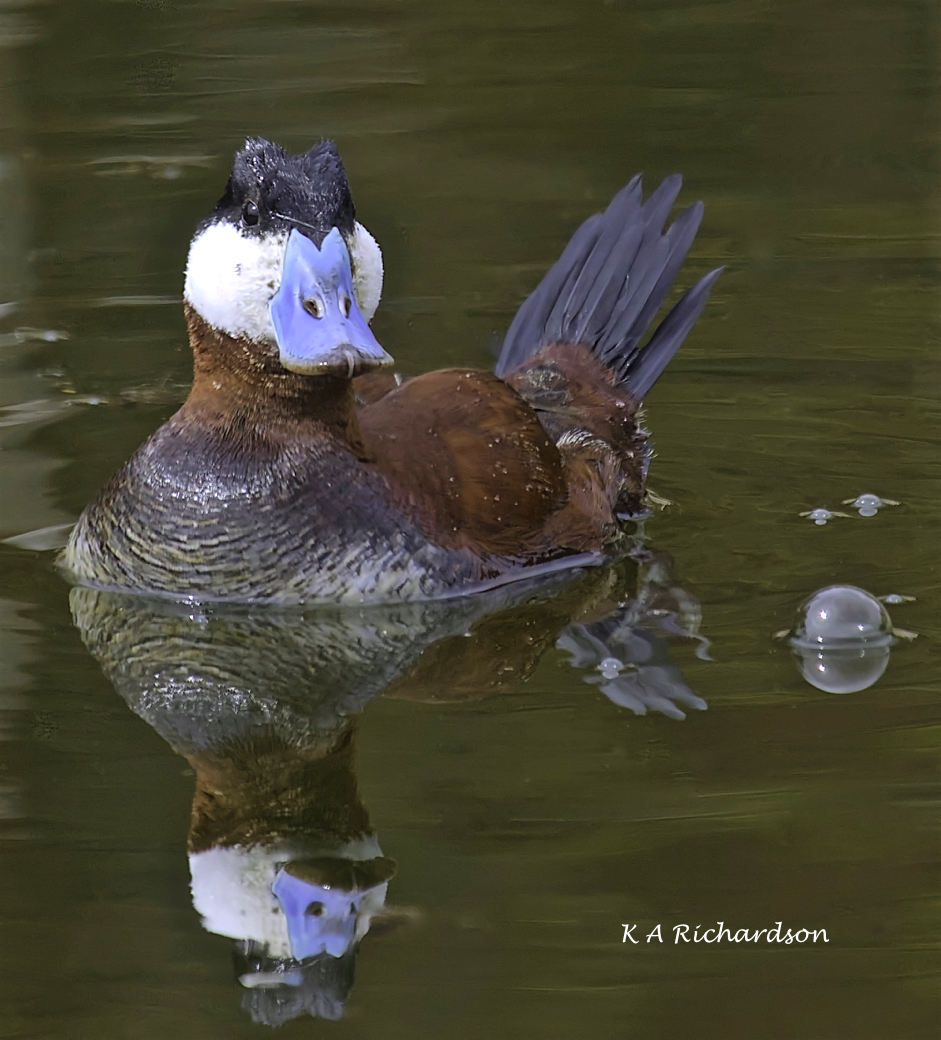
Cornell’s Lab or Ornithology adds this description: “Ruddy Duck[drake]s are compact, thick-necked waterfowl with seemingly oversized tails that [in Spring] they habitually hold upright. Breeding males are almost cartoonishly bold, with a sky-blue bill, shining white cheek patch, and gleaming chestnut body. They court females by beating their bill against their neck hard enough to create a swirl of bubbles in the water.” And here’s what this behaviour looked like in the last week of April 2017 (Sorry about the low quality here):


Last look goes to Her Nibs, who looks marvellously unimpressed by the entire show!

I am the target text.
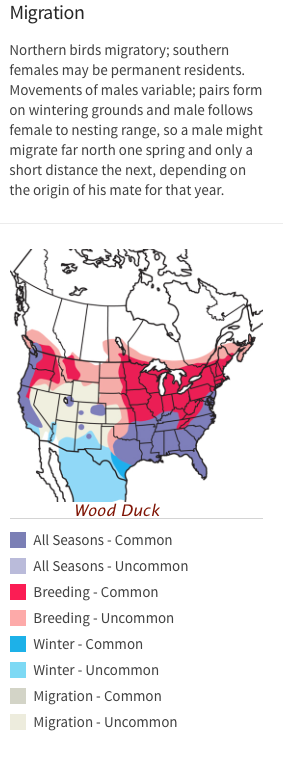
There is some discrepancy in the range maps of the three different sources below. Just goes to show that “The Internet” is not necessarily the arbiter of truth…. Take your pick!


Click to return to introduction
From Cornell, some “Cool Facts“:
And a final note from the Audubon Field Guide website:
| Conservation status | Current population apparently much lower than historical levels, owing to unrestricted shooting early in 20th century and to loss of nesting habitat. |
|---|
Let’s hope that restoration of habitat will help these peculiar and loveable little waterfowl!
I’m known in a few places for my goofy sense of humour — my predilection for anomalies, ironies, childish imagination. So, if you’re not into such silliness, you’re in the wrong place! Run away, NOW!
But if you can tolerate a certain amount of not-so-serious-stuff, here’s a little to snack on:
Remember: if images show a  icon, click to enlarge in a new tab….
Waterfowl who wannabe predators:
Last spring we saw a goose that was roosting on a cleanly topped tree trunk probably 20 feet above Mission Creek. Her mate (it had to be a female, right? It was during breeding season when all kinds of new ideas float in the air….) stood in the creek below, looking up as if to say, “So that’s it? You’ve left me for ‘a room with a view’?” Well, unfortunately, I wasn’t able to capture that situation (we saw it there a couple of times over several days), this year we’ve encountered similar phenomena again, several times in various places with different geese and a female Mallard.
April 13, 2017:

April 21, 2017:
While visiting Robert Lake, I noticed something plopped on top of a post of the white fence at an adjacent horse farm: on closer examination, here’s what I found:


Never did see how she resolved her situation.
Later that afternoon, on a quick visit to Munson Pond around sundown to check out the local North American Beaver, Castor canadensis, we also noticed this rabble rouser; I think her name is Forrest Goose. She spoke with a thick tongue like a great Political Science professor from the Philippines I was enjoyed:


2017: Closer to home, we have the ongoing saga of the Turtle Sitters of Belmont Pond….
Last year (2016), the duties fell to the Wood Ducks. Could be the reason they eventually moved to a different location to raise their own brood. For a bit, the job fell to Mergus Merganser….


And, in 2017, Mergus has a new mate, and guess who’s been handed the Turtle-sitting chores? You got it! Miranda Merganser. And Kilroy’s a year older and bolder….


Hope you found something to chuckle over, or, as the poet asks, “What’s the point?”
Some of you have already seen a large chunk of my Wood Ducks collection on the About this blog page that you’ve accessed from the banner at the top of the website! But, having been obsessed with these gorgeous waterfowl for nearly three decades, and photographing them for several years, now, I have more I’d like to share.
So, fotos first; discussion delivered at de end…
From Belmont Pond 2017: if images show a icon, click to enlarge in a new tab….


Caught them canoodling (WODU- style) recently in the smaller Belmont Pond. One of these photos was very well received on Flickr (Affectionate Wood Ducks).
Click on any photo in the cluster to enlarge all of ’em. Once enlarged, you can scroll down in a photo and click View Full Size to enlarge that image in a new tab…. Close the cluster by clicking the small x in top right corner of enlarged photos.


Single shots of Wilbur, 2017:


And from years past, other WODUs I have known:
From Burnaby Lake, 2016:


From Belmont Pond, 2016, a photo with a twist…taken on a very calm day!

WODU-lings, Burnaby Lake, 2016:

There are more images, but that’s enough for now. Here’s a little background on these wonderful Wood Ducks from a couple of Internet sources.
From Audubon.com: (quotations combined)
“Beautiful and unique, this duck of woodland ponds and river swamps has no close relatives, except for the Mandarin Duck of eastern Asia. Abundant in eastern North America in Audubon’s time, the Wood Duck population declined seriously during the late 19th century because of hunting and loss of nesting sites [due to cutting of large trees, combined with hunting pressure]. Its recovery to healthy numbers was an early triumph of wildlife management. Legal protection and provision of nest boxes helped recovery; many thousands of nest boxes now occupied by Wood Ducks in U.S. and southern Canada. In recent years, apparently has been expanding range in north and west.”
From Cornell Lab of Ornithology (LoO):
“These birds live in wooded swamps, where they nest in holes in trees or in nest boxes put up around lake margins. They are one of the few duck species equipped with strong claws that can grip bark and perch on branches.
Nesting Facts
Nest Description
Nest Placement
Finally, for those who made it this far, when Nana and I purchased a signed print of Robert Bateman’s wonderful “On the pond — Wood Ducks” (below), I had the chance to ask the artist whether he preferred the Wood Ducks or the Mandarin Ducks that he had done in Asia. I explained that I had seen both in the wild, the latter in Japan in my days in Sapporo. He was eager to discuss for a moment as he was about to head off to Hokkaido and wanted to know if I could tell him anything about the marsh he was headed to. (I could and did, but that’s not the story.)


He answered my question without hesitation, partly by avoiding it. He said that “Wood Ducks” was far more memorable because it had become his bête noire — a work he had struggled with off and on for 11 years before he finally declared it was as good as it was ever going to get. The light* was the main issue that he felt he couldn’t quite resolve.
On his affection for Wood Ducks, Bateman has said,
“My admiration does not stop at their appearance. I love the kind of place where they live. I have a soft spot in my heart for swamps with the lushness, the still water, the reflections, the complex light and the abundance of wildlife. Some of my happiest hours have been spent in and around swamps, watching and listening. Perhaps if I am very lucky I will hear a prothonotary warbler. But It is always a thrill to hear the shrill, questioning call of a wood duck as a pair (virtually always a pair) takes off and swiftly, almost miraculously, dashes between the trees and disappears. The glimpse is worth it.”
Now that I’m committed to photography, I believe I know what he means….
The Bateman print hangs in our dining room where we can enjoy it every day!
*In his memoir, Life Sketches (Simon & Shuster Canada, 2015) Bateman discusses light on p.219:
“Light, I tell students, is critical. I love backlit scenes, or scenes lit from the side. I like diffuse light, the kind offered on a cloudy day. I love mist and fog and ambience. But when you paint a scene where there is any kind of light, the key question is this: Where is the light coming from? Every shadow in that painting must be true to the source of light. I tell students: Be a slave, not to the creature you’re depicting, or the feathers on that bird’s body, or the landscape your describing, but to the light source and the form that it reveals.”
Wise words: a challenge I can spend the rest of my days working on….
For Navigation Help, click here.
For Part 1 — Mountain Bluebirds, click here.
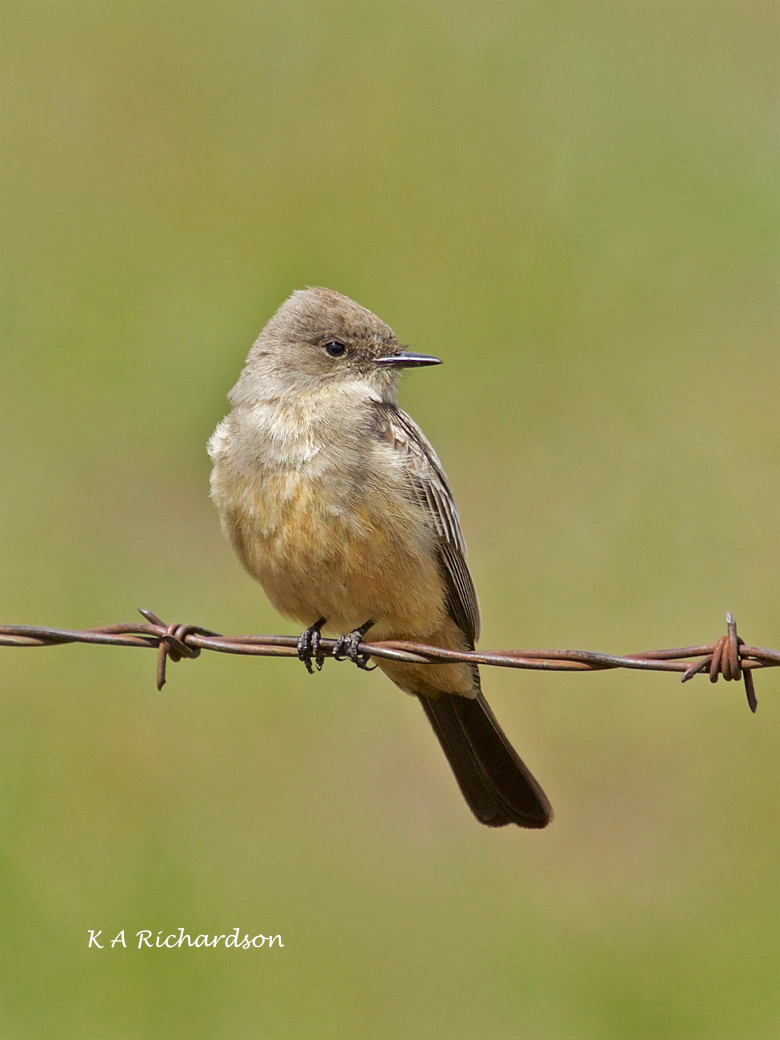
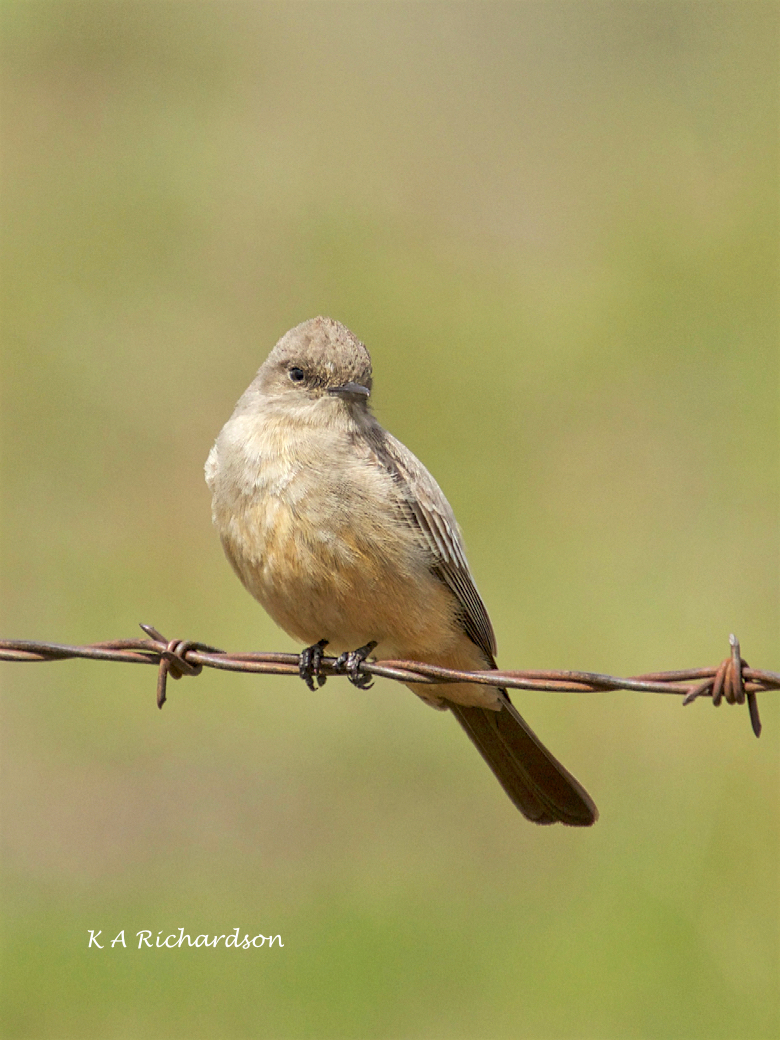
Finally, a bird I’ve been very pleased to see in widespread locations this Spring. I understand they’re even abundant at The Coast this year: the Say’s Phoebe (Sayornis saya). I’ve been fascinated with them for decades, but only starting finding them in the last 7 years or so — always in the Okanagan. The group below could have been put into a cluster, but, as they’re my best shots of this species, so far, I’m giving them full feature treatment!




Thanks to Cornell’s Lab of Ornithology for the maps above and the description below.
“Like other phoebes, the Say’s Phoebe is seemingly undaunted by people and often nests on buildings. These open-country birds have cinnamon-washed underparts and a rather gentle expression. They sally from low perches to snatch insects in midair or pounce on them on the ground. Say’s Phoebes often pump their tails while perched on a wire, fence post, or low bush. They breed farther north than any other flycatcher and are seemingly limited only by the lack of nest sites.” (https://www.allaboutbirds.org/guide/Says_Phoebe/id)
“Cool Facts about Say’s Phoebe (https://www.allaboutbirds.org/guide/Says_Phoebe/lifehistory)
Again, thanks to Cornell LoO for this info. Please be sure to visit their site, too!
 birds & musings