Author: keikelo

On the urban-rural divide in North America

In 1960, in Grade 11, living in a hamlet about 30 miles outside of Winnipeg, I participated actively  in community activities including church. That involvement enabled me as an 16 year-old to attend what was then called the Tuxis and Older Boys Parliament staged annually in the Manitoba legislature building between Christmas and New Year’s.

1960-39th-session
I’m somewhere in the upper right quadrant of this photo.

“The Older Boys’ Parliament program began in Ontario as part of the TUXIS movement (“Training Under Christ In Service”). Its original sponsors included various Protestant churches, such as the United Church of Canada, the Anglican, Baptist, Presbyterian, and Lutheran churches, the Salvation Army, and a variety of service groups such as the YMCA, De Molay and Kiwanis organizations. The movement’s goal was to foster the development of the physical, mental, spiritual and social well-being of the person as inspired by the biblical passage Luke 2:52, which reads: ‘And Jesus increased in wisdom and in years, and in divine and human favour.’ Youth Parliaments, only one of many TUXIS activities, were designed for religious as well as parliamentary training. Though most YPs were at one time part of the TUXIS movement, only the TUXIS Youth Parliament of Alberta retains the name to this day. Notable former Manitoba members from this period include Bill Norrie, Robert Steen, Wally Fox-Decent and Howard Pawley [and, I will add, Lloyd Axworthy].”
(Read about  the evolution of this organization, including its decision to amend its religious and gender restrictions here: http://www.ypmanitoba.ca/about/history/)

Like all members ‘elected’ to this ‘parliament,’ I was required to give a short speech introducing myself and commenting on some issue of importance to me. At first, I had no idea what to talk about. But fairly quickly, I grasped an insight I’d not had before: the deep divide between us who came from the rural areas (“the rubes”) and the “city slickers.” Very nervously, I stood up and spoke my piece about “urban-rural prejudice.” Until our participation at this event, most of the rurals from the Urals, I think, believed we were equal to the urbanites. Discovering that we were seen more as big frogs from small ponds came as a shock, and a cause for concern and even action.

I’m reminded of that time 56 years ago because I’ve been trying to figure out what happened in the US elections of 2016—why the prognostications of so many pundits, and pollsters, and talented, well-educated, broadly informed reporters and editors turned out to be wildly off target. And among the many factors emerging in the post-Trump victory analysis, one element that keeps popping up is that so many of the august predictors simply didn’t know or understand the size, nature, or determination of exurban or rural America. Trump supporters from the Heartland were written off simply as racists and misogynists, “deplorables.”

You know, to just be grossly generalistic, you could put half of Trump’s supporters into what I call the basket of deplorables. Right? The racist, sexist, homophobic, xenophobic, Islamaphobic — you name it. And unfortunately there are people like that. And he has lifted them up. He has given voice to their websites that used to only have 11,000 people—now 11 million. He tweets and retweets their offensive hateful mean-spirited rhetoric. Now, some of those folks—they are irredeemable, but thankfully they are not America.”

The next day Hillary walked back her assertion somewhat: “Last night I was ‘grossly generalistic,’ and that’s never a good idea. I regret saying ‘half’ — that was wrong.”Clinton went on to say [however] that Trump had nevertheless repeatedly engaged in “deplorable” behavior throughout his campaign… “I won’t stop calling out bigotry and racist rhetoric in this campaign….

What many reporters and op-eds failed to give adequate play to, I want to emphasize, was what she stated immediately after the bold faced paragraph above:

But the other basket—and I know this because I see friends from all over America here—I see friends from Florida and Georgia and South Carolina and Texas—as well as, you know, New York and California— but that other basket of people are people who feel that the government has let them down, the economy has let them down, nobody cares about them, nobody worries about what happens to their lives and their futures, and they’re just desperate for change. It doesn’t really even matter where it comes from. They don’t buy everything he says, but he seems to hold out some hope that their lives will be different. They won’t wake up and see their jobs disappear, lose a kid to heroin, feel like they’re in a dead-end. Those are people we have to understand and empathize with as well.

She clearly understood that part of Trump’s supporters, which the urban elite needed to  reach out to and comprehend . I don’t think her supporters heard her either. Clearly, it was that “half” of Trump supporters, especially in the rust belt of Wisconsin, Michigan, Pennsylvania, and Ohio whose support even one-of-their-own Michael Moore couldn’t cajole, folks who were so pissed off with the liberal elite whether in the Democratic or Republican leadership, that they simply refused to listen to anything she had to say.

Incidentally Bill Clinton, who built his presidency on forging a “…New Democrat” Party [that] co-opted the Reagan appeal to law and order, individualism, and welfare reform, and made the party more attractive to white middle-class Americans” (Miller Center) also understood that “basket” of the electorate that urban elites could not fathom:

“The other guy’s base is what I grew up in,” the former president said during a campaign stop in Fort Myers, Fla. “You know, I’m basically your standard redneck.”

The former president also recounted a moment during the 2016 Democratic primary when he went to campaign for Hillary Clinton in West Virginia—a state that they lost and predicted they would lose long before voting even took place.

“[S]he said, ‘There’s no way that we can carry it,’ and I said, ‘No way,'” Clinton said Tuesday, recounting a conversation he had with his wife about campaigning in Mountain State.

“First of all, [West Virginians] only watch Fox News,” he added to laughter. “But to be fair they think we only care our political base and the people that agree with us culturally. And it’s not true, but that’s what they think.”

Clinton said that when he got to West Virginia, he was met by a bunch of pro-Trump protesters. He said he invited them into his rally and encouraged them to reconsider their support for the GOP nominee.

“If you really believe that you can make America great again, knowing I know what it means as a white southerner,” the former president reportedly told the protesters.

Clinton told his audience Tuesday, “what [Trump]s slogan] means is, ‘I’ll give you the economy we had 15 years ago and the society you had.’ In other words, I’ll move you up on the social totem pole and others down,” Clinton said.

His comments came as part of a larger appeal to his audience to reach out to undecided voters and even pro-Trump supporters to tell them the Democratic nominee’s campaign understands them and wants to include them.

“Don’t engage in our version of all this screaming,” Clinton said. “Go out there and look people in the eye who aren’t going to vote for her and tell them we still want them to be part of America. Tell them we need them (my emphasis).”

“I know how they feel,” he added in reference to angry and frustrated voters, many of who have gravitated towards Trump. “And I’m telling you, the older you get, the worse it is if you look in the mirror every day and you think you can’t do anything to change the future.”

Clinton’s campaign stump speeches often include references to his childhood growing up in Arkansas, including his memories of pre-Civil Rights attitudes and the general unpleasantness of using outhouses. (Washington Examiner)

But most of Hillary’s supporters were deaf to these admissions and admonitions, I think. Whether the Democratic Party, and, for that matter, urban elites in other countries including Canada are willing to unstop their ears and open their eyes and realize that the main conflict in modern democracies is not simply between the top 1% and everybody else is anyone’s guess. Better listening is needed, and soon…. And, yes, among those who opposed Trump but voted for him anyway, and who are now capable of listening to some of us on the other side, there needs to be some unplugging and eyes-opening, too.

To be continued….


I was wrong, and confidence in my ability to analyze has been shattered….

Yesterday, I wrote on this blog:

“I have questioned whether or not a large enough number of Americans had the wherewithal to make a rational choice. But this week, as the end drew nigh, I have relaxed, reassured by the polls, particularly Nate Silver’s fivethirtyeight.com which correctly forecast the last two presidential elections. I am confident that Hillary Clinton will be the next president, the first woman president of the US-eh. In about 12 hours (8:00 PT/11:00 ET), we’ll have a much clearer idea.”

And all day long, I reassured the love of my life that things would turn out okay, at least numerically.

It’s clear on the morning after, that as far as the the popular vote is concerned, Trump didn’t win. Latest totals Wednesday morning show Clinton, thanks to large pluralities in heavily populated New York and California, polled more than 59,647,621 votes to Trump’s 59,438,580. Her margin in this measure is likely to increase as absentee and mail-in ballots are finally counted.

Click graphics to enlarge….

CNN graphic on left Politico graphic on right

But where they really count, the numbers in the Electoral college, in the number of states Trump “won,” and in the number of rural Americans persuaded, Clinton trailed badly.
ana-marie-cox-l

As Ana Marie Cox commented on Trevor Noah’s (live) Daily Show—even before Trump’s numbers passed the 270 EC vote threshold, many American “…working class white men… have traded their health care and their economic opportunity for the right to be more a little more explicit in their racism….” (Comedy Central, Nov. 8, 2016).

It’s unlikely that the results can be explained this easily. There will be a great deal of thoughtful analysis devoted, as there was to Mitt Romney’s loss to Obama in 2012, to understanding why Clinton failed to persuade enough Americans that she deserved their support.

I’ll be studying carefully, too.
For the moment, that’s all I can do.

November 8, 2016: day of reckoning

2016-presidential-candidates

The original twenty-two candidates eventually reduced to two….

Finally, Americans go to the polls for the final time in their federal elections, including the choice of a new president of their nation.

We have been following (addicted to) the election race since mid July. For me, the turning point occurred when the Democratic and Republican presidential candidates chose their vice-presidential running mates. On July 23, Hillary Clinton’s choice of Tim Kaine gave me great hope. Of the four candidates at the top of the two major parties’ tickets, I think Kaine is the best hope of the kind of decent, capable, experienced public servant that American has seen in a long time. Not flashy or charismatic, but solidly grounded in service from his days as a Catholic missionary in Honduras through his successful forays into municipal and state politics that saw him become a councilman, then mayor or Richmond, VA, and later lieutenant governor and governor of the state, Kaine has displayed integrity and sound, thoughtful leadership.

the-finalists
Democrats’ Tim Kaine, Hillary Clinton; Republicans’ Donald Trump, Mike Pence

Since July, there have been far too many campaign developments to detail here. My faith in the Clinton-Kaine ticket has certainly been tested, not by anything attractive in the Trump-Pence campaign, but by the behaviour of so many supporters of the latter “team.” I have questioned whether or not a large enough number of Americans had the wherewithal to make a rational choice. But this week, as the end drew nigh, I have relaxed, reassured by the polls, particularly Nate Silver’s fivethirtyeight.com which correctly forecast the last two presidential elections. I am confident that Hillary Clinton will be the next president, the first woman president of the US-eh. In about 12 hours (8:00 PT/11:00 ET), we’ll have a much clearer idea.

161108-who-will-win-the-presidency-538-final

Of course, the conclusion of the election will NOT be the end of the story. Whether the next few weeks represent a denouement in this drama, or simply the third act in a five-act play remains to be seen. Stay tuned….

Media Literacy Matters! Beware Fake News….

UPDATED NOVEMBER 17, 2016: CHECK OUT THIS LINK:

Viral Fake Election News Outperformed Real News On Facebook In Final Months Of The US Election

Last week I wrote, in connection with the US-eh? presidential election, about “news addiction” and the rising spread of “fake news” on the Internet and TV. With only today, tomorrow and 18 hours of Tuesday to go until we learn the outcome of this “unprecedented” democratic exercise, there will be many worried observers biting their nails to the quick.

So, for the record, just a quick followup and an admonition for change.

On November 2, Ahiza Garcia and Justin Lear reported on CNN Money under this headline:

5 stunning fake news stories that reached millions

Each is connected to US politics and the presidential race. Each is well documented. Each shows how vulnerable Americans, and those who follow America’s welfare, are in the face of disinformation presented as fact. Millions of people.

Please read the story above for yourself. Then have a look at this evaluative piece from The Atlantic online that explains as I wrote last week that we desperately need, in the 21st century to become a great deal more media literate, media savvy. Not just kids in school; all of us!

Atlantic Magazine online: 
What CNN Got Right About the Presidential Race

b-stelter-plague-of-fake-news“Last Sunday morning on Reliable Sources, CNN’s Brian Stelter asked his considerable audience to be on guard for one of this election cycle’s most ugly features: fake news sites. He accurately them called “a plague” across the internet. He proposed a new rule for social-media users: “Triple check before you share,” and he offered some useful tips on how to do that.I’m not a fan of CNN’s generally atrocious political coverage in the past 18 months, to put it mildly. But I am a big fan of Stelter’s work; he’s currently the beacon of light at the news channel. His don’t-fall-for-fake-news advice, part of a series of commentaries he’s been delivering, is a key reason why.In pieces like the one that ran on Sunday, Stelter has done what the traditional media have largely failed to do: Leading the way in bringing media-literacy skills to the wider public. Given the size of his audience, on TV and online, it is probably no exaggeration to call him, as I did the other day, “America’s most influential teacher of media literacy in the digital age.” 
Had American journalists at every level made media literacy a core part of their mission for the past 50 years or so, I’m convinced there would have been (at least) two laudable results. First, the nation would have been better prepared to handle the Digital Age’s flood of information, so much of which is false or deceptive. Second, media organizations—at least the ones doing their jobs right—would have fostered much more trust in their own work, which would have helped sustain them through the economic upheaval they’re now enduring.
While the first of those points seems obvious, I’m not saying America could have entirely avoided what some have called the “post-truth” era. Not everyone pays attention to news in the first place. And some people will choose to believe lies no matter what the facts say, as we’ve seen so powerfully this year. But if more of us had been deploying some principles I’ve long recommended—being skeptical; using judgment; asking questions; going outside one’s comfort zone; and understanding how media are created and used to manipulate—we’d individually do a much better job of what Howard Rheingold calls “crap detection.” And we’d do more collective pushback against the lies. Those principles add up to critical thinking, something Americans should value more in our society.
Had American journalists at every level made media literacy a core part of their mission for the past 50 years or so, I’m convinced there would have been (at least) two laudable results. First, the nation would have been better prepared to handle the Digital Age’s flood of information, so much of which is false or deceptive. Second, media organizations—at least the ones doing their jobs right—would have fostered much more trust in their own work, which would have helped sustain them through the economic upheaval they’re now enduring.

While the first of those points seems obvious, I’m not saying America could have entirely avoided what some have called the “post-truth” era. Not everyone pays attention to news in the first place. And some people will choose to believe lies no matter what the facts say, as we’ve seen so powerfully this year. But if more of us had been deploying some principles I’ve long recommendedbeing skeptical; using judgment; asking questions; going outside one’s comfort zone; and understanding how media are created and used to manipulate—we’d individually do a much better job of what Howard Rheingold calls “crap detection.” And we’d do more collective pushback against the lies. Those principles add up to critical thinking, something Americans should value more in our society.

We’d also have more demand for quality journalism, I’m convinced, if journalists had been teaching media-literacy principles and tactics these past few decades….

…Ideally, some members of the audience for my organizations’ journalism would better understand what we do and why—and why it’s worth more support than just a few clicks. They’d be more inclined to pay for the value they derive, and that would give us more resources to provide more value….

…An offshoot of the field called “news literacy” focuses, as you’d guess, on helping people understand current events and issues better. Stelter’s efforts may be a closer fit with the latter, but all variants on the topic are essential in today’s world. But media and news literacies, which should be embedded in every school’s curriculum, have unfortunately been seen more an afterthought than essential parts of education. (And it’s safe to say that teaching real critical thinking would be seen as downright subversive in many parts of the country.)

I [Dan Gillmor of The Atlantic] hope Stelter keeps it up. CNN could recover some of its credibility by filling some of its current wasteland with the help people need to deploy critical thinking when it comes to what they read, listen to, and watch. If that spread widely—to national, regional, and local news organizations of all kinds—we’d beef up our collective critical thinking skills. We’d better, and soon.” I couldn’t agree more!!


US-eh, er, Elections—2016

Okay, let me admit off the top that we don’t need any more opinions about the Trump-Clinton Clash dominating news from our neighbour to the south. This isn’t about the simple horror….

It’s about two related things, however: first, the way this event has grabbed our attention, and second, what it’s revealing about all of us—and the age in which we live.

So, I’ll be brief, and simply point you to a couple of recent articles that got me thinking. Not since September, 2001, have my wife and I been so absorbed by an unfolding news story and had so many discussions about the anxiety and mixed emotions it generates in us. Like most people, we don’t see any end in sight, even when the electoral decisions are made on November 8, or whenever they become “finalized.”

The link below helped us realize that we’re not alone. You may want to give it a look, too.

Is America addicted to this election?

electionaddictionillo
Data, information, misinformation, disinformation, deception and lies….

No doubt, there will be further musings in this blog after the votes are counted next week….

My second focus on is an old pet peeve of mine—Internet hoaxes. In my past life as a computer consultant to seniors, I spent a lot of time trying to teach people how to approach with reasonable skepticism “the stuff they find on the Internet,” or more importantly, “the stuff their friends send them via email,” and increasingly, the stuff they read on social media like Facebook and Twitter and so many other outlets.

All Internet users, and seniors, especially, are subjected to diabolical schemes, such as phishing, designed to hurt them, defraud them, steal their identities, and more. For a refresher, check out this link: Phishing and other ‘Net Phrauds

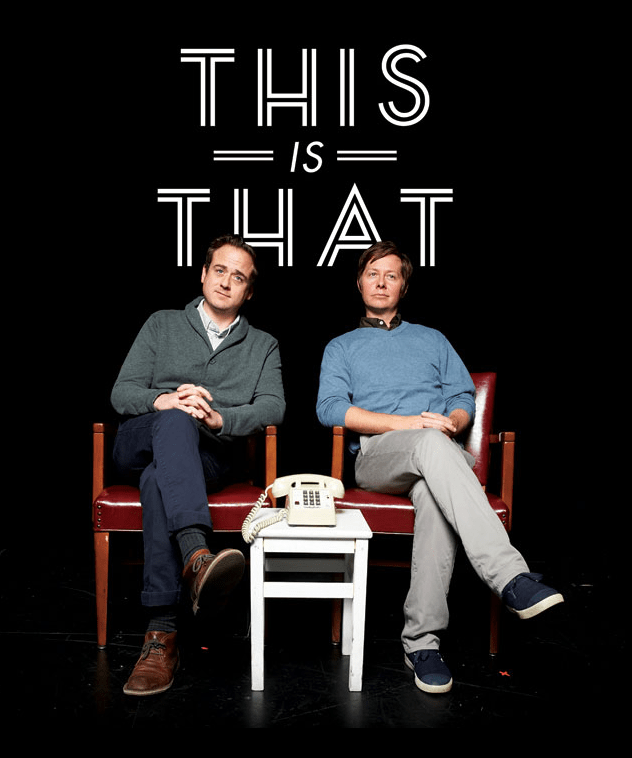
One of the latest threats is called Fake News. For some of us, Fake News that is satirical can be quit entertaining. On CBC (radio and online) there’s a program I love listening to called “This is That.” Here’s how it’s described on that source of all facts holy, Wikipedia:

“The program began as a summer replacement in 2010, returned in the summer of 2011, and was added to the regular schedule in the fall of 2011. It is hosted by Pat Kelly and Peter Oldring, and produced by Chris Kelly.”

this-is-that

 Its “…style has been compared to The Onion, has drawn phone calls from listeners who did not realize that they were listening to a comedy program and took the content seriously; Oldring and Kelly admit to having been surprised that listeners would be fooled.

In June 2010, the National Post reported as fact that CTV purchased the set of the NBC series Friends;[4] this, however, was a satirical story by This Is That.

Two years later, esteemed Canadian journalist Robert Fulford wrote an article for the National Post claiming that the show is “worth tuning in for.”

Also in 2012, Public Radio International reported as fact a This Is That story that dogs in Montreal would have to know commands in both English and French by law.

In early 2013, Harper’s reported as fact a This Is That story in which a Canadian student “sued her university for failing to accommodate her allergies to cactuses, escalators, tall people, and mauve.”

In September of the same year, several media organizations, including USA Today and the Washington Times, reported on a story about an U-11 organization that had decided to play soccer without a ball to remove competition from the game.

In 2014, Jonathan Jones at The Guardian wrote an article analyzing the satire in their story about a New York artist creating invisible art and selling it for millions.[11]

The program has won three Canadian Comedy Awards. Their comedy special “The Christmas Letter” won a gold medal in the category of Best Comedy Special at the 2014 New York Festivals International Radio Awards[14] and their fourth season won a bronze medal in the category of Best Regularly Scheduled Comedy Program at the same awards ceremony.

Clearly a little satire disguised as a news is a dangerous thing…. And this brings me to the second article from the beginning of this week that jolted me to write about it.

Not surprisingly, in view of what I’ve written above, we love to watch Brian Stelter’s Sunday program on CNN, Reliable Sources. It’s great to see a real effort to examine the difficulty in trying to sort out facts from opinions, and opinions based on facts from claims that are pure hyperbole, and the whole gamut in between. Last week’s show, however, included Brian’s highlighting of and warning about Fake News that’s meant not to entertain, but to deceive. Stelter’s Sunday comments were reproduced online in this article on Monday: The plague of fake news is getting worse….

cnn-stelter-fake-news-is-getting-worse-161030

“The rise of social media has had many upsides, but one downside has been the spread of misinformation. Fake news has become a plague on the Web, especially on social networks like Facebook. As I said on Sunday’s “Reliable Sources” on CNN, unreliable sources about this election have become too numerous to count.

So that’s why I recommended a “triple check before you share” rule.

New web sites designed to trick and mislead people seem to pop up every single day. For their creators, the incentives are clear: more social shares mean more page views mean more ad dollars.

But the B.S. stories hurt the people who read and share them over and over again. Many of these fakes reinforce the views of conservative or liberal voters and insulate them from the truth. The stories prey on people who want to believe the worst about the opposition.

A recent BuzzFeed study of “hyperpartisan Facebook pages” found that these pages “are consistently feeding their millions of followers false or misleading information.”

The less truthful the content, the more frequently it was shared—which does not bode well for the nation’s news literacy during a long, bitter election season.”

Stelter goes on to assert:

“Fake news sites and Facebook feeds…traffic in misinformation. My sense is that there are three buckets of these sites:

#1, Hoax sites with totally made-up news headlines that try to trick you;

#2, Hyperpartisan sites that aren’t lying, per se, but are misleading, because they only share good news about your political party and bad news about the other party;

#3, “Hybrids” that purposely mix a little bit of fact and then a lot of fiction.

These sites aren’t going away, so it’s up to Internet users to spot fake news and avoid spreading it.

Fact-checking sites like Snopes can help—they are devoted to ferreting out hoaxes and tricks.

The Sunlight Foundation’s Alex Howard tweeted these tips:

  • Search the source link on Twitter

  • Google it

  • Check Snopes

  • Consider record of source”

So, if you’re addicted, especially to the perils of social media or simply google search results, join the club, and may the force (not the farce) be with us!

Trials at Timmie’s

(October 2016: Having just returned from a three-week bucket-list trip to Atlantic Canada.)

Tim Hortons.jpeg

My line-mate at Timmie’s leans over and rasps, sotto voce, Only in Yarmouth!

I am compelled to observe that, but for three Tim Hortons I can recall, these breadlines inching towards the humourless cashier are the norm, not the exception.

In my daily life, I won’t even enter a TH if there’s a lineup. I’d rather look for coffee elsewhere, or simply go without, than endure the TH shuffle and the inevitable ordering dance when I finally get to the cashier/server. If I am in TH, there’s a special reason, like the one that had me in line in Yarmouth, NS.

My wife and I were just beginning the last leg of a three-week bucket list trip to Quebec and Atlantic Canada, and, with THs popping up everywhere we travelled, it had seemed like a good idea to put prejudice aside and give this venerated Canadian institution another chance to win our support.

“Seemed,” I say.

At Yarmouth, on day 14, and still resorting to Tim’s (or preferably Wendy’s—paired with TH in many places and providing much better service and choices), we were counting the days until we wouldn’t need to.

And it was here that I determined to write something about why my hackles rise whenever I think about my TH experiences—er—biases. To be fair, not everything about TH sucks (as some observers would have us believe). Their Dark Roast coffee (black, unsweetened, if you please) is a huge upgrade on the stuff that most Canadians continue to adulterate with double cream and double sugar. Some of Tim’s baked goods are as tasty as they are unhealthy, and some of their sandwiches and non-pastry items actually contain a modicum of nutrition. But I digress….

What annoys me most is that so many Canadians seem oblivious to TH’s longstanding faults. To begin with, the assembly line approach that turns workers into cheerless, hair-netted robots delivering the same questions, for the most part with little or no recognition that one customer is even a little bit different from the next. Again, to be fair, there are rare exceptions to whom I am immensely grateful for reminding me that biases need always be challenged. The company’s “system” appears designed to create lines as slow as traffic at a horrific accident site, but the fact remains than we can’t have lineups without folks willing to participate in them….

The staple of the takeout side of the business is the paper-cupped coffee with its plastic lid that hasn’t changed in design in thirty years. The flip top “drinking hole,” capable of slicing lips, is worse than any other takeout lid from a dozen different competitors. I once collected lids from various shops for comparison purposes, and TH’s ranked at the very bottom (Subway’s, when the sliding opening still worked, were the most ingenious and efficient; sadly, no longer so).

Then there’s the interrogation game at the cashier.

“I’d like two medium Dark Roast, black, coffees to go, please.”

“What would you like in it?
For here, or to go?
Would you like fries with that?
How many did you say?”

Or something like that…. I don’t blame the cashiers so much as I do the process design or lack of one. Ugly/inefficient design is a great pet peeve of mine. Lines in Starbucks or Waves, in my experience, occur much less often, and, when they do, move much quicker; there’s much greater flexibility among workers, and most of the time a noticeably more enthusiastic and personal touch to service. I’ve often taken the moment in those establishments to compliment workers who have then confirmed, because I asked them, that they were hired in the first place largely for their engaging personalities.

So, now that I’m home again, will I be going to the local Tim Horton’s for the occasional coffee and treat?

Not likely….

For a more humorous take on Timmies, be sure to check out this link:

http://www.macleans.ca/society/okay-canada-its-time-for-the-hard-truth-about-tim-hortons/
Among the many witty observations that columnist Scott Feschuk made in Macleans online 2014, there is this three-paragraph riff:

“…Tim Hortons is not a defining national institution. Rather, it is a chain of thousands of doughnut shops, several of which have working toilets.

Tim Hortons is not an indispensable part of the Canadian experience. Rather, it is a place that sells a breakfast sandwich that tastes like a dishcloth soaked in egg yolk and left out overnight on top of a radiator.

Tim Hortons is not an anti-Starbucks choice that makes you a more relatable politician or a more authentic Canadian. Rather, it is a great place to buy a muffin if you’ve always wondered what it would be like to eat blueberry air.”

If you can stomach language far rougher than anything you’ll read on “Birds and Musings,” you may want to look at this site from 2015, too:

Update on Kelowna’s Celebration Tree…

My second post for this blog discussed a special place that we Lower Missioners held dear on the south side of the Greenway…. Read about the Celebration Tree here: Celebration Tree post 1 .

NOTE: There’s an update to this update at the bottom of this post…. HAPPY MOTHERS DAY!

Well, the winter is over, and Spring brings with it all kinds of changes. The little tree(s) that gave us so much joy are no longer deemed accessible, but as of this writing, it appears that our anonymous Celebrators of Special Occasions have found a new location. Whether it is intended as permanent or not, I don’t know, but here are a couple of shots of the new location on the east side of the Mission Dog Park off Lexington and just east of the Gordon Bridge over Mission Creek:

Thanks, ladies for keeping up the tradition! May others continue to value your contribution as much as I!

Update to the update:
And the latest decoration is for Mothers Day, May 9, 2016. These decorations went up near before the 25th 0f April:

Waxwings bring out my Bohemian side….

As Spring, my favourite season here in the Okanagan (see my discussion of “favourites” in the previous post, ha-ha!), slowly eases Winter out of the way and ushers in the migration season, birders enter a special limited time frame for looking for the last of the Winter birds. A priority for me this year were Bohemian Waxwings, a species I had never seen before the winter of 2014-15, even though they are considered a circumpolar group. I knew before we moved here that BOWAs came down annually to our elevation near lake level, and that chances of seeing them in their large flocks was good but getting close to them was not so certain. There’s plenty of food here in the city for the entire winter, especially berries of Mountain Ash or Rowan trees that are very popular in our neighbourhood. As well, Mission Park’s Arboretum is well stocked with a diversity of trees that could attract BOWAs. Last year, the Park’s Russian Olives and Callery miniature pear fruit fed Robins well into February, and it was on the “pears” that I attained my first shots of these bright and busy gorgers.


This season, I couldn’t wait! I had done what research I could. In late November I chatted with Mike, a neighbour who told me that every February, the BOWAs came by to clear out the berries on his Virginia Creeper. On December 10, late in the afternoon, they swept down into the great Weeping Willows near his home at the west end of Belmont Park. I had parked nearby and, with such poor light, had left my camera in the car while I walked along the Pond’s path to Park where I hoped to do a spot check for activity. Suddenly the flock erupted from the Willows and attacked Mike’s Mountain Ash on the street corner 50 meters away. I hurried back for my camera, and returned to find the Rowan berries that had been abundant on that tree were gone—even the ones that had been knocked to the ground in the initial frenzy. When the birds retreated to the Willows, I was at least able to capture their numbers.

Over the next few days, I assumed that they would return for the Rowan berries in adjacent back yards, but November passed, then December and January, and while I occasionally saw the flock either flying or perching high above Mission Creek Greenway, completely out of camera range, I kept hoping that I would get lucky either in Belmont Park (BP) or Mission Rec Park (MRP). On the 26th of February, Mike and I crossed paths and spoke about the BOWAs’ absence this season. His VC fruit was gone, but the neighbours’ Rowans were still pretty much intact. The pear and olive trees in MRP had been picked clean early in the winter, whether by BOWAs or not, I’m not sure, but in February, there was very little left even for Robins. I began to fear that I’d missed my chance for this year. Bohemian numbers decline in March when their cousins, Cedar Waxwings, begin to reappear.

By a combination of the good luck of being out for a walk with my lucky charm, Nana, and of having had our plans disrupted several times that afternoon, we were returning home so late that I had packed up the camera, the light having fled behind clouds. When we reached Belmont Park, we had to choose whether to take a shortcut or to walk through the park and around the pond. It was a tossup, but the shortcut option was discarded, and we took the longer way round. Good choice, it turned out!

As we neared the west end of BP, we noticed a flurry of activity in the Sycamores but couldn’t be sure what we were seeing. Starlings, probably, we thought. The light was improving rapidly as the clouds gave way to the late sun when suddenly it became clear— the BOWAs were back for the Rowan berries, just as I’d hoped, though the beggars had left their visit to nearly the last minute! Nana was impressed with her first look at BOWAs. As we were going out for dinner that evening, she needed to hurry on home, but I remained to get what shots I could….

On March 3, I saw the BOWAs in a tree on the edge of our condo property, but couldn’t get shots, although, in my walk through BP earlier in the day I had seen a handful occupying a tree next to an even smaller flock of Cedar Waxwings. I wasn’t too concerned because I already had my BOWA images for 2016. The next morning, however, when the Bohemians showed up in the condo trees again, I suspended my exercise plans, and hustled out to see what I could get. This time, they were gorging themselves on Cotoneaster berries at ground level, and washing them down at the neighbouring condo’s fountain. I’ll let you judge how well the photos turned out….

Suffice to say, in my world, getting Bohemian Waxwing images is truly a matter of luck (with a certain degree of preparation and awareness), and this year, thank the BOWAs, the Force was with me. Sometimes, you can only watch and wait and hope for the best….

Favourites‚ part one of a series

favouritesPeople sometimes ask me, “What’s your favourite bird?” Sounds like a simple enough question. Makes me wonder, though, why we ask each other about favourites—birds, food, movie or musical genre, places, people, games, forms of exercise, you name it.
Maybe we’re hoping to learn something, perhaps about a category we don’t know all that well, or even about the person we’re asking. Anyway, we ask.

Like many of the folks I question, I usually require more clarification before answering. Do you mean “of all time,” “anywhere in the world, or locally,” including “those I may have seen or heard only once,” or are you asking about “ones that I encounter regularly,” those that I find most “colourful,” “curious,” “surprising,” or “powerful,” or some other endearing or otherwise outstanding quality?

“Look,” they reply. “What first comes to mind when you’re asked this question? Surely that’s your favourite!”

Truth be told (and it should almost always, should it not?), I don’t think I think that way most of the time, and even when, for a moment, I’m wildly enthusiastic about some particular “thing,” something else inevitably pops up to distract me. Of course, I do acknowledge favourites within categories, but my focus of categories is constantly shifting. Tomorrow’s choice could be different from today’s.

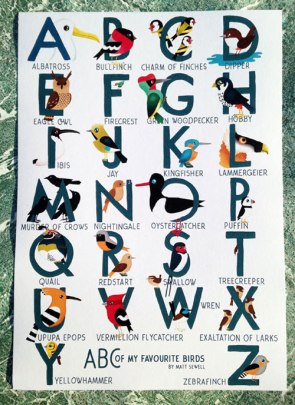
abc-favourite birds posterThat said, with regard to birds, for me, “favourite” should apply to birds that I regularly, over the course of a season or a year, have a chance to encounter, am likely to feel excited about seeing and/or hearing, and, probably, have some kind of history with (“most impressive” might yield different results from “favourite”). Birds that have sat in my hand, voluntarily, or even permitted me to get very close, either out of some sense of trust or merely a lack of fear are likely to top my list. The more I’m out in nature, the more I have intimate encounters with its denizens. Now that photographing birds is such a big part of my life, interaction has become increasingly satisfying and an objective to pursue.
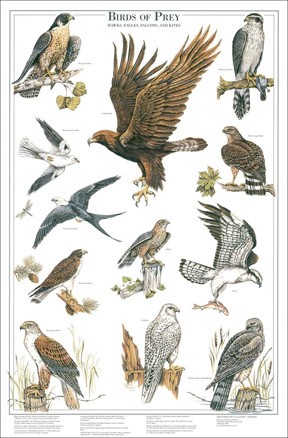
So, to get on with answering the question, I’m going to focus on birds in the past year with which I’ve had close encounters, and I’ll separate them into four groups: small songbirds, bossy birds, waterfowl and other birds that live off the water, and raptors. And to make it easier for myself, I’ll start with the last group.

Raptors North AmericaIn Kelowna, the main raptors include two species of eagles, a couple of hawks, falcons, owls, and, finally, Ospreys (which, of course, are also  included among birds that live off the water). Yes,  an Osprey is a hawk, but it’s unique, yet distributed world wide (except in Antarctica); I have vivid memories of a pair hunting spectacularly, diving repeatedly, over the Teshio River in Northwestern Hokkaido, as well as many I’ve observed in various parts of western Canada. The Okanagan Valley offers wonderful access to these birds. A great spot where several Osprey nests can be found within sight of each other is the estuary of the Osoyoos River near the BC—US border, about an hour and a half south of our home. The image below shows a parent, likely the male on the left, and a juvenile still in the nest on a platform erected specifically for Ospreys. Apparently they love the bale twine from the nearby hayfields!
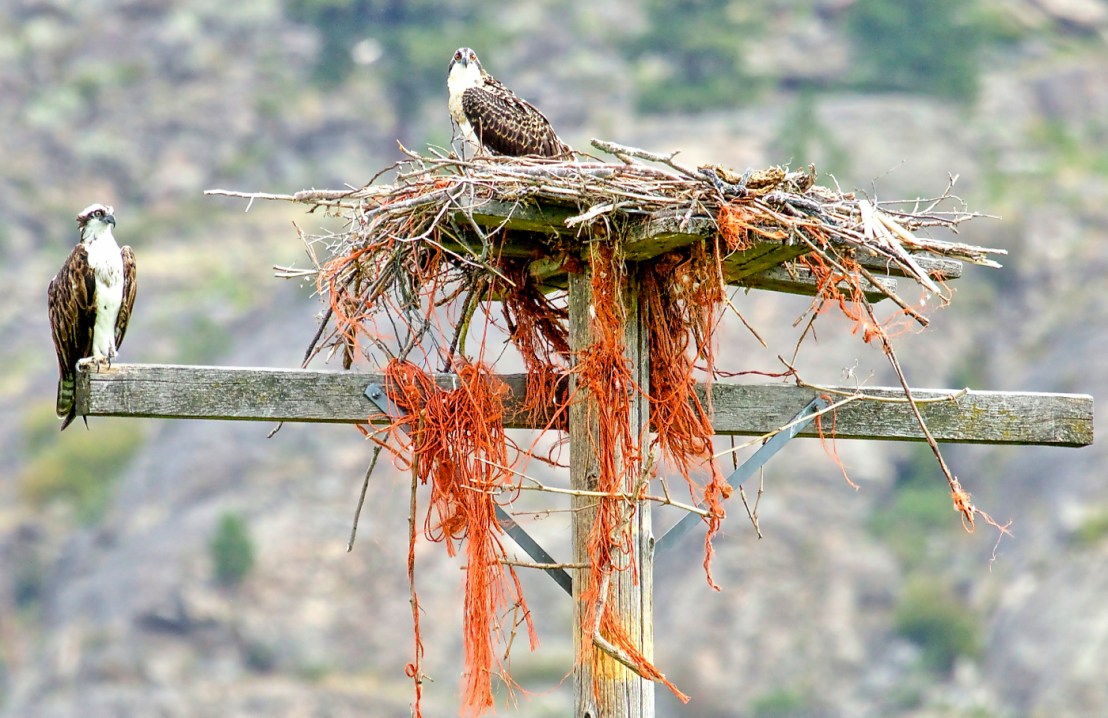
Ospreys' nest Osoyoos - 1
A parent tending to a fully fledged offspring in a colourful if not so tidy nest.

In the Kelowna area, we are also blessed with many Ospreys that have long staked out particular habitats for themselves and are well observed by people who may only know one particular location well. (I must add, that, unfortunately, in my experience, many people think they’re eagles, and others often mistake other hawks for Ospreys. I’m doing what I can to help those I encounter become better informed.)

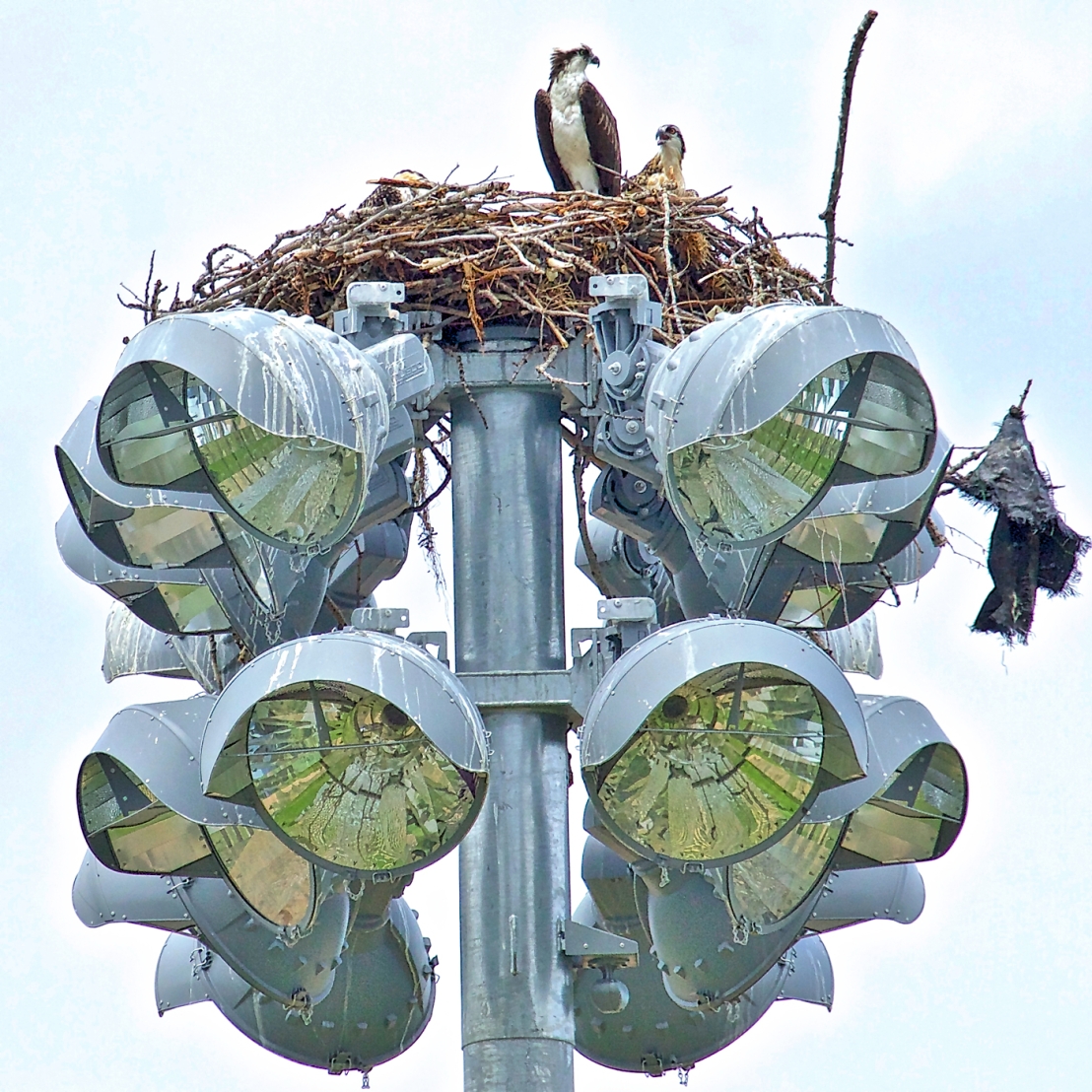
My favourite Osprey family annually nests at the top of one of the great lights above the Mission Recreation Field, which I can see from home and hike to in a very few minutes. In our first year here (just ending this month), I had the privilege to watch the parent birds successfully raise two offspring that I was able to study at fairly close range. While I’ve had many wonderful close encounters with several other birds from the categories listed in the previous paragraph, those I had in mid summer 2015 with the newly fledged Ospreys rank extremely high in my memory, and I will write about those encounters separately.

Osprey - "Mom said to ask you! Can I fly?"
Mom said to ask you. Am I ready to fly yet?

This post, then, is a celebration of the Osprey, aka the fishhawk, river hawk, fish eagle, and sea hawk. What follows are several photos taken in various places at various times over the past year and a half of this amazing predator.

In spring 2014, I got my first set of an Osprey diving, at Iona Beach, just north of Vancouver International Airport, in Richmond, BC. To enlarge them click on photos in groups.
To close the enlargements, click the small x in the top left  corner of the image.

A well-known British website, listing “21 Facts about Ospreys” presents this as #1:

“…the osprey lives on fish that it catches by snatching them in a shallow dive from the surface of the water.” 21 Facts about Ospreys

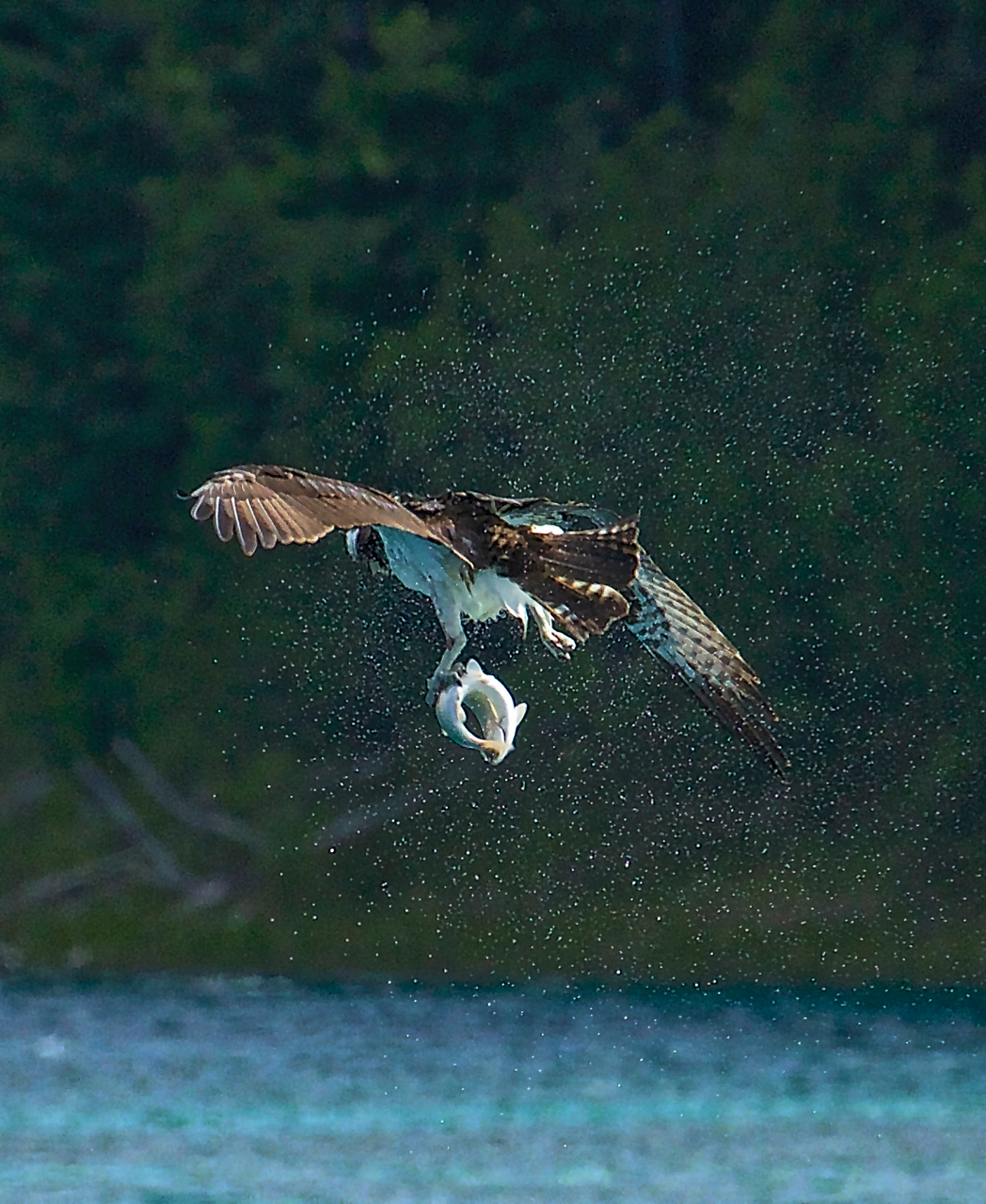
In my experience, Ospreys, as eagles do, in some places, will strike from a low angle, but far more impressive are Osprey predations where, after hovering into the wind, the hunter drops almost straight down on top of its prey with a great splash, driving its talons into the fish and nearly submerging before lifting off, often with great difficulty, with a prize that seems too large to carry. It’s an amazing sight—guaranteed to take your mind off the game when you’re on a golf course beside a lake that affords you a ringside seat as I used to have years ago in the Cariboo….

Osprey with catch - 2
This bird hovered briefly, and I had time only to grab the camera to record its departure with its prize at Kentucky Lake, BC.

While I knew about Ospreys in the Okanagan long before we moved here, my most significant encounter with one up to that time happened in September 2014, early in the period when we were preparing to move here from The Coast. As my wife and I walked west along Mission Creek Greenway to where it intersects with Lakeshore Drive, we suddenly spotted,  atop a hydro pole not far in front of us, a recently fledged juvenile preparing to dine on a Kokanee spawner it had just snagged from the creek. Within the year, I came to realize that this is a regular phenomenon to watch for in late summer/early autumn. I don’t think I’ll ever tire of watching these great fishers perform!

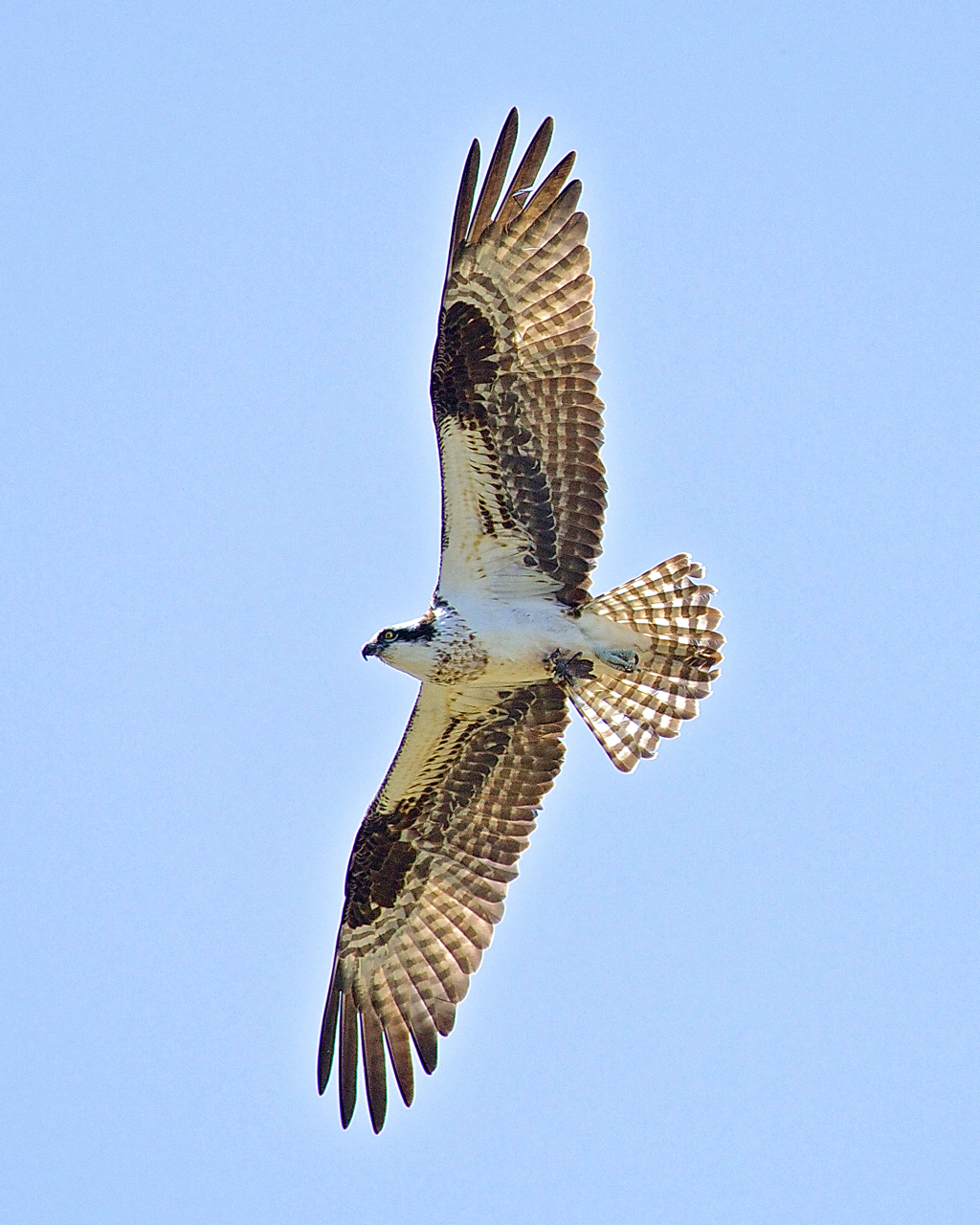
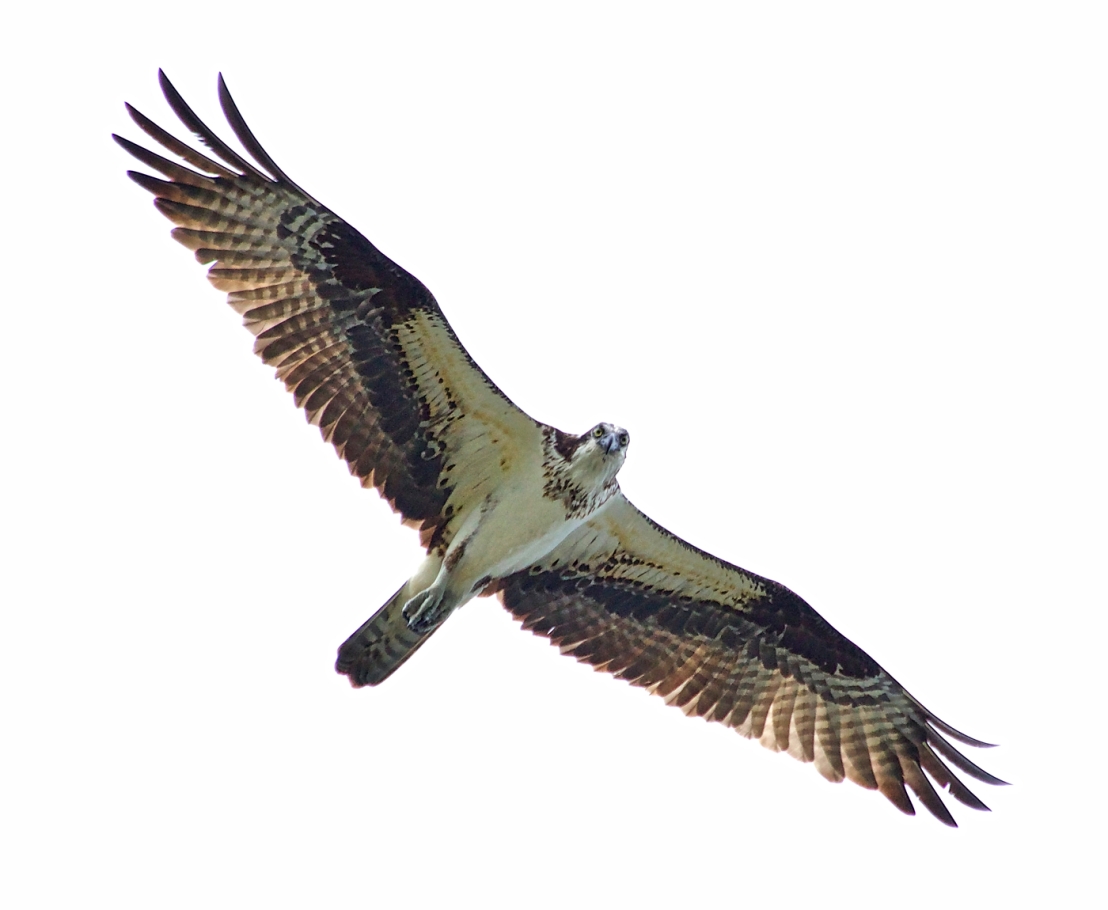
Seeing an Osprey soaring is especially moving as I hope the next three photos of different female birds indicate. According to the Cornell Lab of Ornithology, an adult female is characterized by a “distinctive facial pattern with bold black stripe through eye,  sharply hooked black bill,  glowing yellow eye, and [a] dark necklace across [her] white breast.”Osprey - 2a

Osprey, female

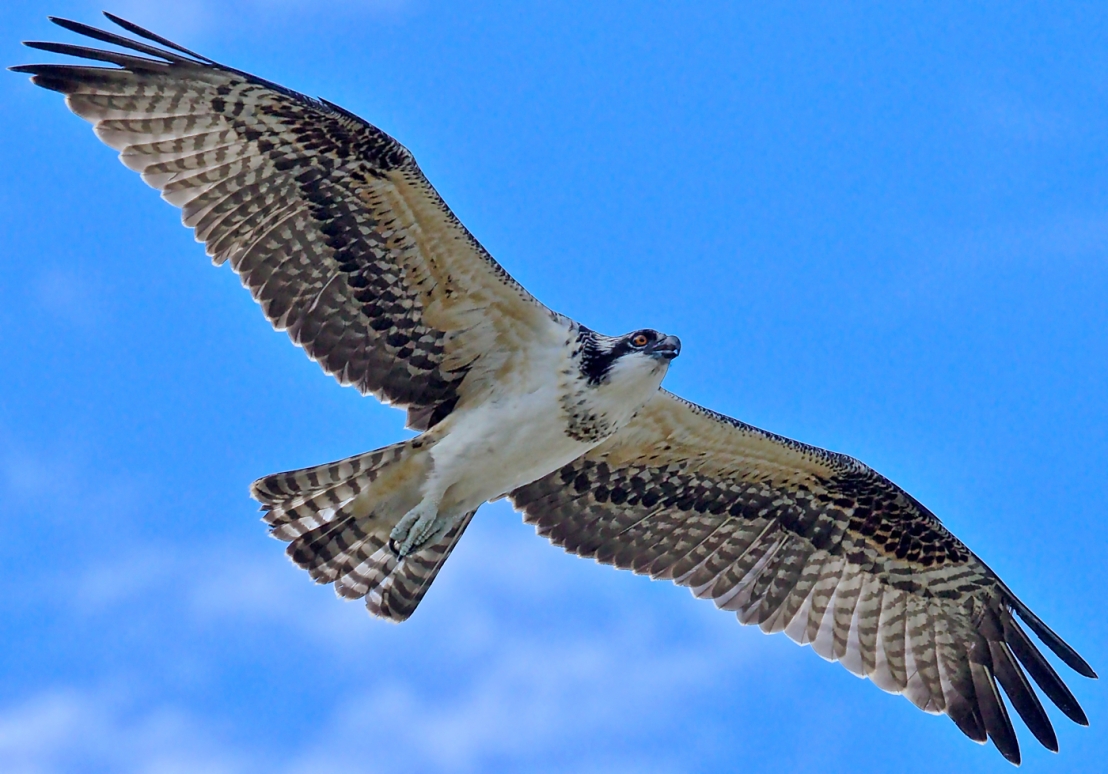
Juvenile birds like the one below have an orange eye, and pale scaling on the back and wings that fades to dark as they age. Osprey in flight - 13

As mentioned earlier, I’ll prepare a special on the young Ospreys of the summer of 2015 that I enjoyed so much. Here’s a look at the one I dubbed Railbird; for more on this exciting experience, click this link….

For more on Ospreys, here’s a link to their Wikipedia entry: Osprey, Wikipedia


Duck springs to flight

(Flight of Spring Ducks?)

Okay, it’s a bit much to mix the wonderful sonnet below, or at least part of it, with photographs of a Mallard drake taking flight, but has “a bit much” ever been much of a restraint for me?

From John G. Magee’s wonderful sonnet, High Flight, 1941….
“Oh! I have slipped the surly bonds of Earth
And danced the skies on laughter-silvered wings;
Sunward I’ve climbed, and joined the tumbling mirth
of sun-split clouds, — and done a hundred things
You have not dreamed of….
(For the rest of this inspiring piece, and more on the 19 year old RCAF pilot from the USA who wrote it not long before his death in combat, see this link:
Magee High Flight

And now for the “Mallard takes to the skies” images….
Click photos to enlarge them; click the x (top right of images) to close a set.
You can enlarge a single photo even more, and in a new tab, by
finding and clicking on the photo data box bottom left of each image.


These 11 images represent my first success in trying to capture this action. I was very fortunate with the light, and am surprised that the shutter speed was adequate to capture the action. What I’m happiest about, with this hand-held photography, is that I was able to keep the duck in the middle of each frame during the two seconds (according to my camera’s date/timer) that it took to shoot this content….

Here are all 11 photos in one tiled group: