Updated February 2022 and March 2024 and 2026
Note: You may have to wait a bit for the images to load.
Also, on your Mac, you can see enlargements of any single images
by right clicking on the photo and choosing ‘Open image in a new tab’.
Gallery images can be enlarged just by clicking on any one of them.
If you’re using an iPad, it’s best to turn it sideways to landscape view….
Also, try viewing in Reader Mode! Available only with Safari web-browser as far as I know….
In an earlier post (November 2021) I wrote that Homher the Intersex Mallard (Anas platyrhynchos) had ‘magically’ reappeared after being ‘away’ for the summer from both Belmont Pond and Thomson Marsh. I was overjoyed to see her again.
Well, I’m happy to report that the other two iDucks I first identified in the January 2021 have also showed up again in their separate locations in November 2021. First, Muncie on November 13 at Munson Pond/Park, and then on November 19 near Teal Pond in the SE sector, Thomson Marsh, the one I call Socratease showed up.
As well, another duck I am able to eyedentifye — er, identify — by her blondness and beige ‘beads’ at the back of each eye and below the eye-line, a ‘regular’ female I call Molly also graced us with her presence!
(Added 2024: Homher, Muncie, and Socratease all have ‘beads’ similar to ones Molly sports!)

First, then, Muncie at Munson Park about 3.6 km northeast of TMarsh where her ‘cousins’ reside.


just like the second and third ducks in this post, especially Molly the blonde hen.
You can enlarge the images by right clicking and choosing to Open image in a new tab.
Then (below) Socratease, as she appears now, on the left, and as she did a year ago, on the top right.

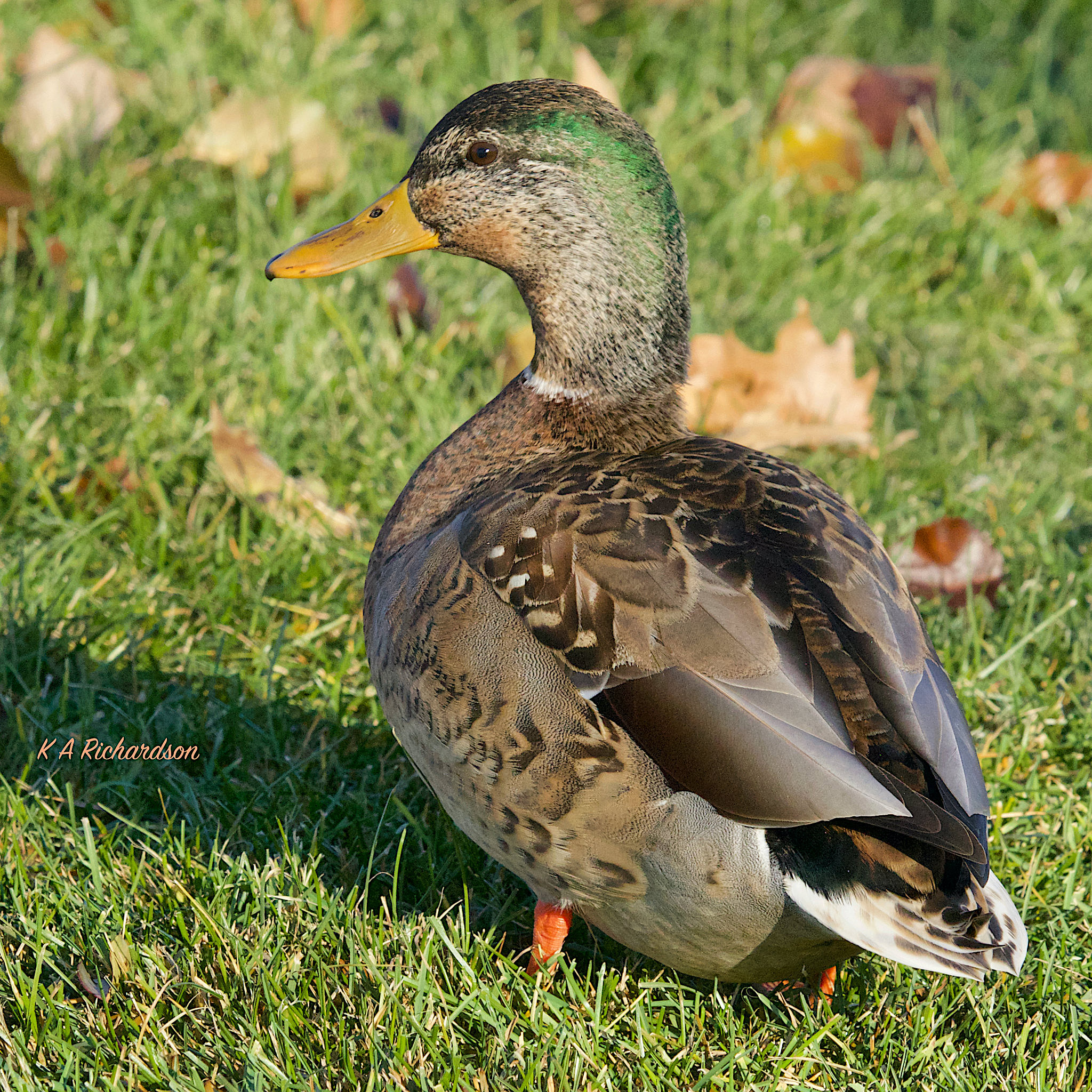

Above: The bottom right image shows her foraging in December 2021.
While her bill is less like a Mallard hen’s than Homher’s and Muncie’s, there’s no doubt that
Socratease is an Intersex Mallard, too. Click on any gallery image to see the photos enlarged.
Finally, Molly Mallard, who despite hanging out in a wintering flock of more than 100 ducks, stands out first as one of the blonde hens, and then because of a unique white ‘bead’ behind each eye. Below the photos of Molly are some further observations about this detail.

Here’s Molly from her other side, with the ‘bead circled’:

Now that snow covers our area, it will be more difficult to keep track of these individuals, but you can be sure I’ll try….
Below, Homher, the iDuck that started all my research: December 2021 after an early snowfall:
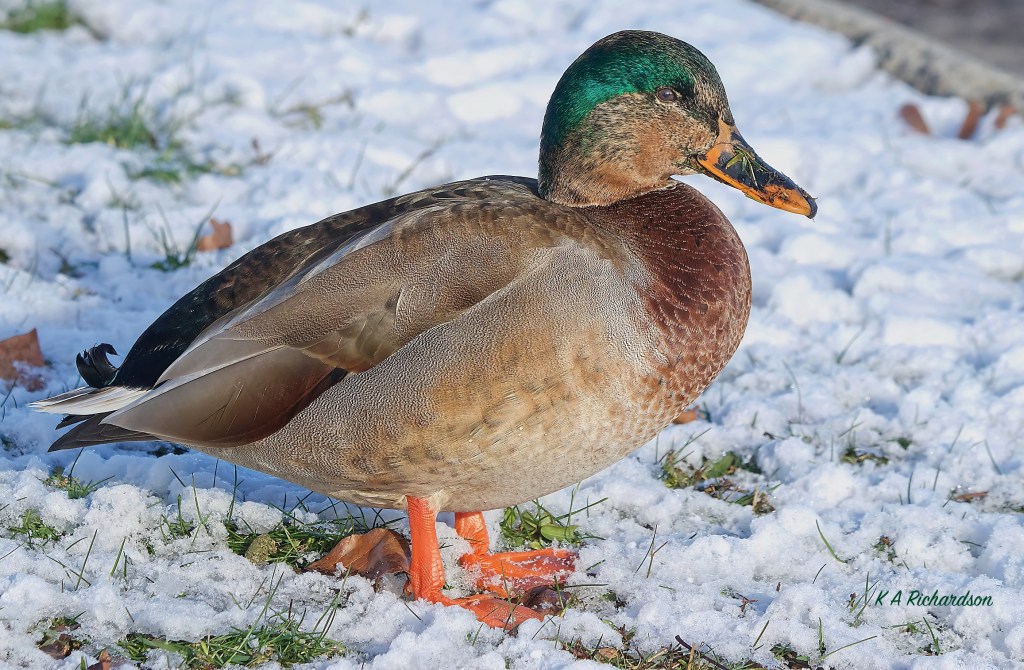
Here’s another photo of Homher with Molly (taken February 7, 2021):

It’s nearly impossible to differentiate “normal Mallards” by appearance.
Molly is an exception! Her creamy complexion and the “bead” at the back of each eye enable me to pick her out of the large flock quite readily….
In progress: Added February 2022. I am working on the blonde Mallard hens in the large flock wintering in
the SE sector, Thomson Marsh, Kelowna, BC. A coming post illustrates what I’ve ‘discovered’.
 birds & musings