In the last year or so, I’ve been working at becoming a naturalist — one who studies and attempts to learn from the world of “nature,” which I’ll define as “the phenomena of the physical world collectively, including plants, animals, the landscape, and other features and products of the earth, as opposed to humans or human creations.” (Macintosh Dictionary app).
Like most of you who visit this site, I’m deeply interested in wildlife, especially birds. I enjoy what I perceive as their beauty, and am fascinated with their behaviours, especially interactions with each other, ranging from competitive, even predatory, to cooperative, even symbiotic.
Here we have the first family of Mallard ducklings on Belmont Pond for 2016….


But, like you, I also recognize that not everything in “nature” is pretty or inspiring or even easy to witness, let alone study. In fact, that’s the focus of this post….
It’s impossible not to be tempted to dwell upon wholly “unnatural” interaction between wildlife and civilized humans, which often gives rise to anthropomorphism (“the attribution of human characteristics or behaviour to a god, animal, or object), and which, while it may make for entertaining fantasy, needs to be controlled or even avoided if understanding nature is really the goal….
So, the appearance of new life in Belmont Pond annually raises some interesting internal conflicts in my aging mind. No matter how hard I try to see the sudden appearance of ducklings as a mere “natural phenomenon,” I find myself attaching human attributes to natural creatures and processes that I have no right doing. As a naturalist, I need to strive for an “objective understanding” of the forces at work without being judgmental (definitely not something I’ll ever succeed at—because I don’t believe full objectivity is ever possible! Subjectivity trumps! But that dilemma is for another day…).
This comment from Emily Nagoski, (quoted online at http://www.washingtoncitypaper.com/blogs/sexist/2010/04/22/is-duck-rape-rape-rape/) is one that I’d like readers/viewers to keep in mind as they look at the photos that follow:
“It’s not so easy to avoid imposing human moral standards on [primates like] orangutans (sic) and chimps; they’re so like us, they’re so close to human. But we must avoid it. It’s not appropriate to overlay moral meaning on animal behaviour; chimps commit infanticide, but that’s just part of being a chimp. It’s not immoral or wrong, it’s just…chimpanzeedom.
There’s something in us, some apparently innate tendency, to find lessons and moral standards in nature. This is, in part, the naturalistic fallacy—the conclusion that if something is nature it must be right or good. Just as mistaken is the conclusion that something in nature is bad or wrong because it violates a human moral standard.”
All of which brings me to the issue at hand—the activities on the pond, particularly the breeding behaviours of Mallard ducks….

From Wikipedia:
“Mallards usually form pairs (in October and November in the Northern hemisphere) only until the female lays eggs at the start of nesting season which is around the beginning of spring, at which time she is left by the male who joins up with other males to await the moulting period which begins in June (in the Northern hemisphere). During the brief time before this, however, the males are still sexually potent and some of them either remain on standby to sire replacement clutches (for female Mallards that have lost or abandoned their previous clutch) or forcibly mate with females that appear to be isolated or unattached regardless of their species and whether or not they have a brood of ducklings….

The drake is nowhere to be seen as the mother duck does her best with the 14 after moving them from the larger pond into this smaller one. To be fair, he did fly in shortly after I took the shot….
“The nesting period can be very stressful for the female since she lays more than half her body weight in eggs. She requires a lot of rest and a feeding/loafing area that is safe from predators. When seeking out a suitable nesting site, the female’s preferences are areas that are well concealed, inaccessible to ground predators, or have few predators nearby. This can include nesting sites in urban areas such as roof gardens, enclosed courtyards, and flower boxes on window ledges and balconies more than one story up, which the ducklings cannot leave safely without human intervention. The clutch is 8–13 eggs [apparently someone forgot to inform the duck in my study—KAR], which are incubated for 27–28 days to hatching with 50–60 days to fledgling. The ducklings are…fully capable of swimming as soon as they hatch. However, filial imprinting compels them to instinctively stay near the mother not only for warmth and protection but also to learn about and remember their habitat as well as how and where to forage for food. When ducklings mature into flight-capable juveniles, they learn about and remember their traditional migratory routes (unless they are born and raised in captivity). After this, the juveniles and the mother may either part or remain together until the breeding season arrives (citation needed).
“During the breeding season, both male and female mallards can become aggressive, driving off competitors to themselves or their mate by charging at them. Males tend to fight more than females, and attack each other by repeatedly pecking at their rival’s chest, ripping out feathers and even skin on rare occasions.” There was one occasion on a pond in New Westminster where human observers witnessed the mother of the first of three broods systematically drown all nine of the second family within the first day of their lives….
“When they pair off with mating partners, often one or several drakes end up left out. This group sometimes targets an isolated female duck, even one of a different species, and proceeds to chase and peck at her until she weakens, at which point the males take turns copulating with the female. Lebret (1961) calls this behaviour ‘Attempted Rape Flight’ and Cramp & Simmons (1977) speak of ‘rape-intent flights’.”
What happened in Belmont Pond….
“Male mallards also occasionally chase other male ducks of a different species, and even each other, in the same way. In one documented case of “homosexual necrophilia”, a male mallard copulated with another male he was chasing after the chased male died upon flying into a glass window. This paper was awarded with an Ig Nobel Prize* in 2003.”
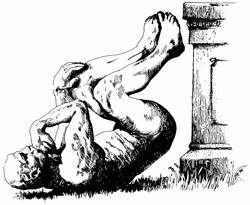
* “The Ig Nobel Prizes honor achievements that make people LAUGH, and then THINK. The prizes are intended to celebrate the unusual, honor the imaginative — and spur people’s interest in science, medicine, and technology.
Every September, in a gala ceremony in Harvard’s Sanders Theatre, 1100 splendidly eccentric spectators watch the new winners step forward to accept their Prizes. These are physically handed out by genuinely bemused genuine Nobel Laureates. Thousands more, around the world, watch our live online broadcast. “(https://www.improbable.com/ig/ )
But the question that needs to be asked is whether or not the behaviour I’ve documented is something about which we, as “naturalists,” not simply caring humans, should become emotionally responsive. It’s so hard not to feel that nature is “wrong” when we see animals acting “cruelly” towards one another, but, and you may not like my saying so, I think we have to restrain such sensibilities….
From the previously cited website, again:
“Forced copulation is a regular feature of sexual activity among ducks [especially Mallards]. In the phenomenon known as “rape flight,” several Mallards will aggressively peck at a female duck until she submits to sex (or dies). There’s reason to believe that female ducks very much do NOT enjoy this; the duck vagina has developed in a “rape-specific way” which allows female ducks to prevent pregnancy from this forced sexual contact*. But can we compare this animal behavior to the human conception of rape? Nagoski argues that there’s no such thing as “duck rape” for the same reason that meat isn’t murder—animals are incapable of consenting (or not consenting) to sex….”
Now the site cited below and several others that I looked at go much deeper into this issue than most of us would like to, and I don’t want to upset anyone, let alone ruin their day. Still, as an observer, I want to share with you what so many of us witness around breeding seasons, and if the content only makes you take a moment to think or reflect on a deeper level about “nature” and “human nature,” I’ll be satisfied….
*See this 2007 article from the website New Scientist: https://www.newscientist.com/article/dn11764-female-ducks-fight-back-against-raping-males/
 birds & musings