As promised in the previous post on late winter ducks, here’s a look at some ducks that usually arrive a little further into spring: mergansers (Common and Hooded) and Wood Ducks.
To enlarge single photos after the one below, just click the photo.
Heron checks out Belmont Ponds and signals an alternative use for the new nest boxes….
But first, a look at some encouraging signs that we may have some of the COGOs with us a bit longer than usual this year. Over the winter, some of the lads who live along the east side of Belmont Pond got together and built three Wood Duck nesting boxes, or at least that was their intent. Such boxes, however, are also used occasionally by cavity nesters such as Buffleheads, Hooded Mergansers and COGOs. Now that the ice is finally off the pond, all of us duck watchers in the neighbourhood are curious to see which species, if any, make use of the new nesting facilities!
Some birds will use them for their own purposes, do doubt….
Among the first to show up in Belmont Pond Main, now that it’s is no longer a ‘hard water reservoir,’ were a pair of COGOs. The young drake below seemed eager to practise his moves before his lady came by:
(NOTE: IN MULTI-PANE ILLUSTRATIONS, JUST CLICK TO ENLARGE!)
“I’m feelin’ somethin’ comin’ over me…..”
“Oh, what a feelin’!”
“Oh yeah!”
“Hoo—whee!”
“Makes my nictitating membrane just twitch!” (170318)
Keeping Loverboy company was a pair of Hooded Mergansers.
(Lophodytes cucullatus) Belmont Pond, Kelowna, BC. First of the year, still lots of ice on our little pond….
The object of his affection….
And this lad was also showing signs of spryness appropriate for springtime shenanigans!
Yoga workout…:
The Bowling Pin…
The Flippy Flap…
The SlowMo…
and Breathe….
Meanwhile, back at the Fish Pond on the other side of town, where we last watched the Canvasbacks beginning to sense their own need to start preparing for the season, another kind of merganser had found the pond en route to its own rendezvous.
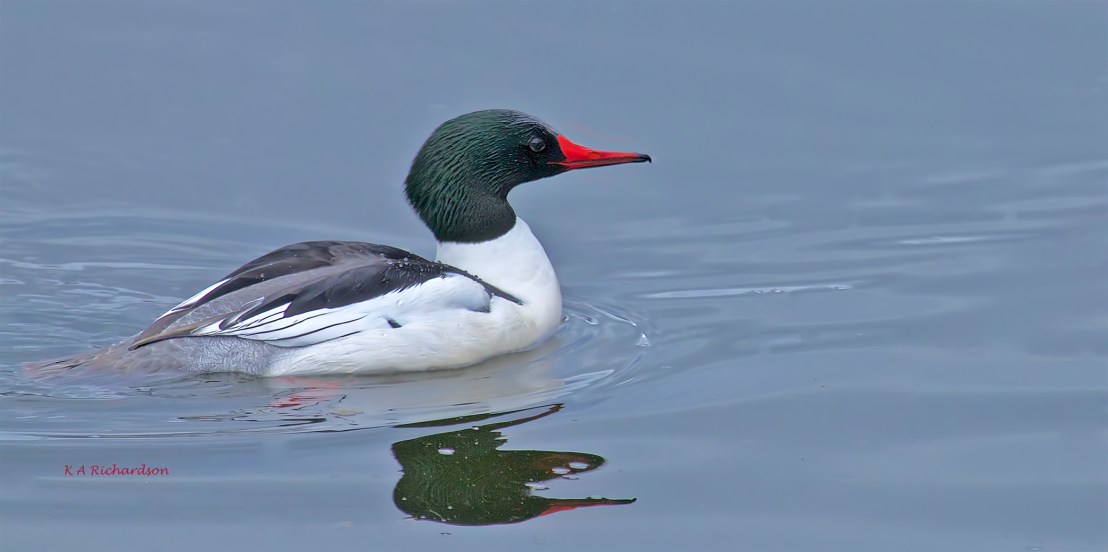
In the Fish Pond….
Green, black, white, and, oh yeah, ORANGE!
In this light, black and white…not really….
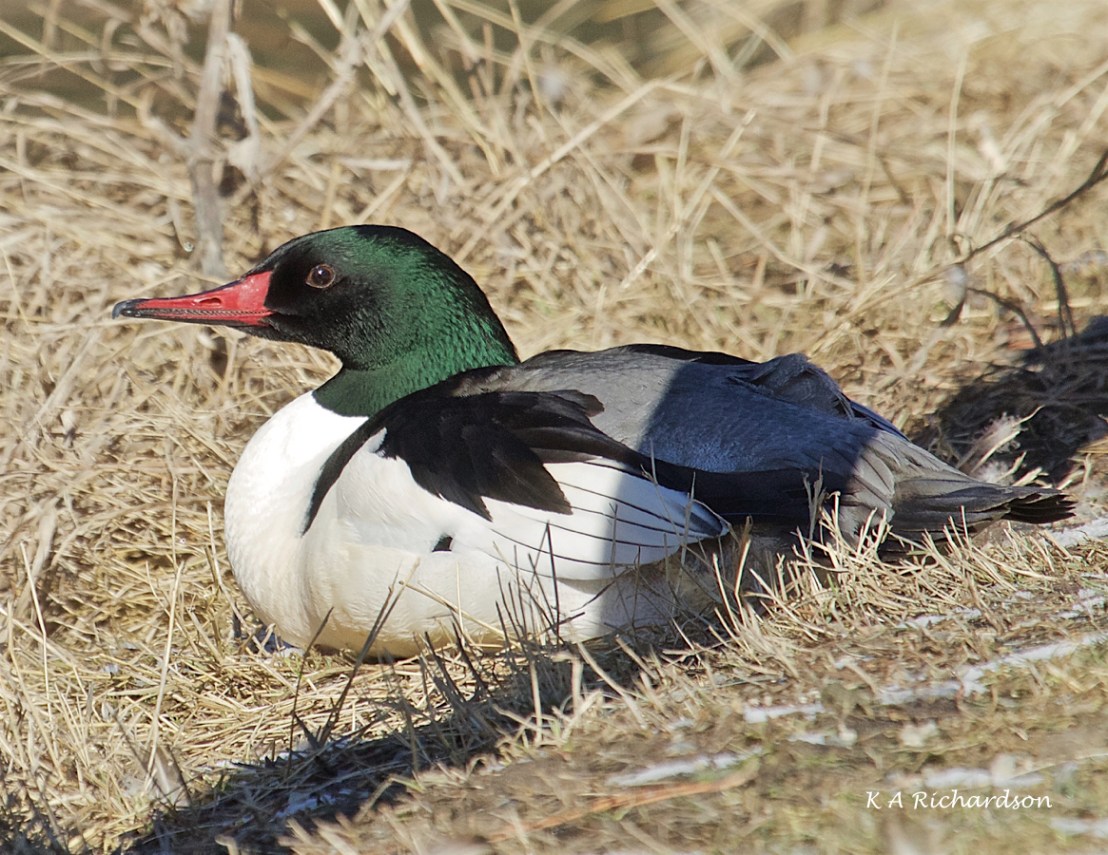
Not one for mixing with the other ducks on the pond, and at this point, the only COME to be seen, he later swam to the south end and pulled up onto the bank for a little sunshine:
Enjoying the sun on the last day of February 2017.
He stayed around for several more days and was eventually joined by another of his kind:
Common Merganser drake buddies, 170328
On March 23, I found yet another COME, this time in Munson Pond where it’s usually impossible to get a closeup shot. However, because that pond was still frozen except for a narrow channel around the shore, I was able to snag a shot of this guy working along the shoreline from 250 meters away towards me. He didn’t see me until after I had captured his soul. Here he has turned around and retreated from my intrusion….
On his way back to less interaction with Homo sapiens….
Mergansers do nest in the area, and I will cover them again, I’m sure! I can hear some folks asking, “But where are the females?” Well that’s covered in a different post, to some extent, but I will offer this group of shots of a female COME taken in February while there was still a considerable amount of ice on lower Mission Creek. The two genders are getting together as I write this and will stay together until the merganserlings hatch….
Kelowna is a wonderful location for people who love waterfowl, especially ducks. You can read all about ’em in Parts 3, 4, and 5 of my 2016 highlights —just click the Ducks tab in the menu to the right (and down a bit) of this post…. Most of the quackers (actually, most of them don’tquack, but that’s too fine a point right now!) in those posts are spring and summer residents. A few stay all year ’round, or most of it anyway. This post is dedicated to the ones who are most prominent in late winter / early spring, including a species that seems to be popping up in many new spots around BC in 2017, the Canvasback. Until this year, I’d seen them only at a distance. It was a great joy to find them close to home in a pond where photographing them is reasonably easy.
Canvasback pair, Hall Road Fish Pond.
Cornell’s Lab of Ornithology describes the species: “A large diving duck, the Canvasback breeds in prairie potholes and winters on ocean bays. Its sloping profile distinguishes it from other ducks.” In coloration, it’s similar to the Redhead (a close cousin of the Eurasian Pochard), which has a round head. Both species, especially in winter, can be found in sizeable flocks or rafts on fairly large bodies of water.
While Canvasbacks are found in all regions west of Atlantic Canada, they can be a challenge to find and get close to.
Cornell offers a couple of interesting facts about CANVs. The second one I find really amazing!
The species name of the Canvasback, Aythya valisineria, comes from Vallisneria americana, or wild celery, whose winter buds and rhizomes are its preferred food during the nonbreeding period.
The oldest recorded Canvasback was a male and at least 22 years, 7 months old when he was shot in California in 1991. He had been banded in the same state in 1969.
Good buddies….
Displaying….
Intelligent, prudent, and confident….
So glad to have these guys around for more than three weeks 2017.
For comparison purposes, here’s some images of Redheads from 2015 and 2016. You can see that the similarities and differences are about equally balanced. Click images to enlarge.
We’ll see this species in a month or so at a ‘secret location’ north of Kelowna.
Redheads’ range is similar to Canvasbacks’ but not identical.
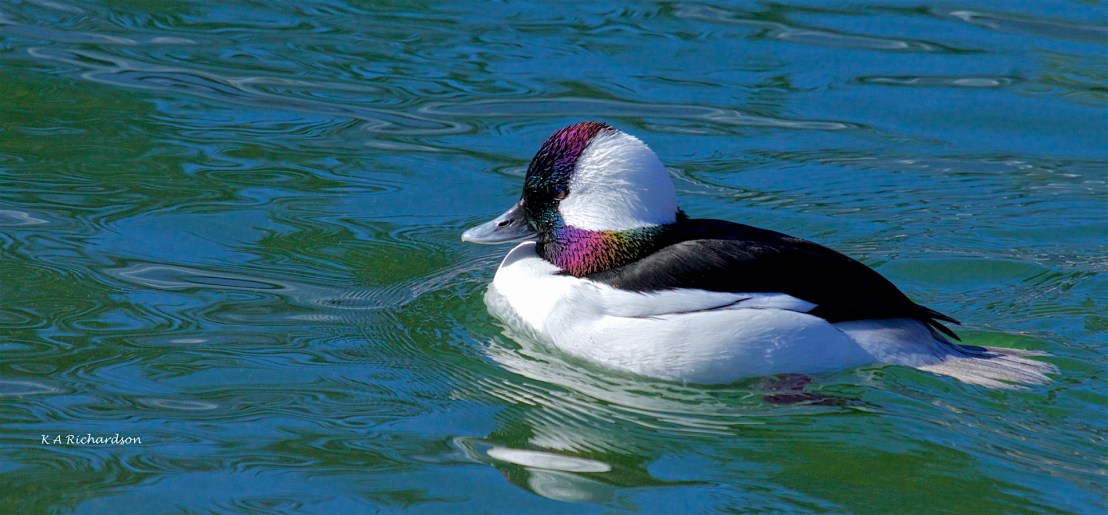
I discovered the Canvasbacks at a kids’ fishing pond beside Hall Road when I went there to observe Buffleheads. I’d seen BUFFs there the previous two late winters where they are confined sufficiently to let a photographer get close…. While the CANVs were a great bonus, I wasn’t disappointed by the wee ones, either.
On a cloudy day, he looks black and white with a hint of colour…. Hall Rd. Fish Pond.On a brighter day, we get a very different impression!
Click on any of the images below to enlarge it.
Bufflehead range is widespread — well done, little ones!
The Bufflehead nests almost exclusively in holes excavated by Northern Flickers and, on occasion, by Pileated Woodpeckers.
Unlike most ducks, the Bufflehead is mostly monogamous, often remaining with the same mate for several years.
Bufflehead fossils from the late Pleistocene (about 500,000 years ago) have been found in Alaska, California, Florida, Illinois, Kansas, Texas, and Washington. One California fossil that resembles a modern Bufflehead dates to the late Pliocene, two million years ago.
Bufflehead normally live only in North America, but in winter they occasionally show up elsewhere, including Kamchatka, Japan, Greenland, Iceland, the British Isles, Belgium, France, Finland, and Czechoslovakia. In some of these cases, the birds may have escaped from captivity.
The oldest Bufflehead on record was at least 18 years and 8 months old. It was caught and re-released by a bird bander in New York in 1975.
One more group that we see mainly in the winter and that leaves us around the same time the Canvasbacks return are the Goldeneyes, both Common and Barrows. You’ll find images and further information on Common Goldeneys, near the bottom of this post: Waterfowl Part 3. Here are some photos from 2017: Click on any photo to enlarge them all.
The COGO raft in Mission Creek, February
Handsome is as…
handsome does… (whatever that means!).
COGOs make underwater art!
Thanks to Cornell, again, for these fascinating facts about COGOs….
Hunters dubbed the Common Goldeneye the “whistler” for the distinctive whistling sound of its wings in flight. Cold weather accentuates the sound.
A female Common Goldeneye often lays eggs in the nest of another female, especially in nest boxes. She may lay in the nests of other species of ducks as well. Common and Barrow’s Goldeneyes lay in each other’s nests, and Wood Ducks and Hooded Mergansers often lay in the goldeneye’s nest too.
Like Wood Ducks, Common Goldeneyes readily use nest boxes as a stand-in for naturally occurring tree cavities. Some return to the same box year after year.
Goldeneye chicks leave the nest just one day after they hatch. The first step can be a doozy, with nests placed in tree cavities up to 40 feet high. As the female stands at the base of the tree and calls, the downy chicks jump from the nest hole one after the other and tumble to the ground.
After the ducklings leave the nest they can feed themselves and require only protection. Some females abandon their broods soon after hatching, and the young will join another female’s brood. Such mixed broods, known as “creches,” may also occur when a female loses some ducklings after a territorial fight with another female. Young scatter and mix when females fight, and not all of them get back to their mother when the fight ends. Some or all of the ducklings may be transferred to one brood, usually that of the territory owner.
The eyes of a Common Goldeneye are gray-brown at hatching. They turn purple-blue, then blue, then green-blue as they age. By five months of age they have become clear pale green-yellow. The eyes will be bright yellow in adult males and pale yellow to white in females.
In winter and early spring, male Common Goldeneyes perform a complex series of courtship displays* that includes up to 14 moves with names like “masthead,” “bowsprit,” and “head throw kick,” in which the male bends his head back to touch his rump, then thrusts forward and kicks up water with his feet. *I hope to cover this in future posts….
The oldest known Common Goldeneye was a male, and at least 20 years, 5 months based. He was banded and found in Minnesota.
Look for Spring mergansers and Barrows Goldeneyes in a post coming soon….
Published first in March 2017
and updated several times up to April 2024.
One of the great natural mysteries for me is how two species (sometimes more) can evolve to look so similar and yet not be an offshoot of the other. Take Cooper’s and Sharp-shinned Hawks, for example. If I see one or the other in the wild,
I really can’t be sure which it is, even though I’m familiar with many of the indicators that pros use to differentiate them.
I’m not alone!
For what the Cornell Lab of Ornithology tells us look for,
go to their website. The images are NOT very good,
but the table summarizing the differences is helpful. Click on items in their list for extra illustrations / details:Cooper’s vs Sharpies – Cornell
And from another site (info seems no longer visible unfortunately, comparative images copied below):
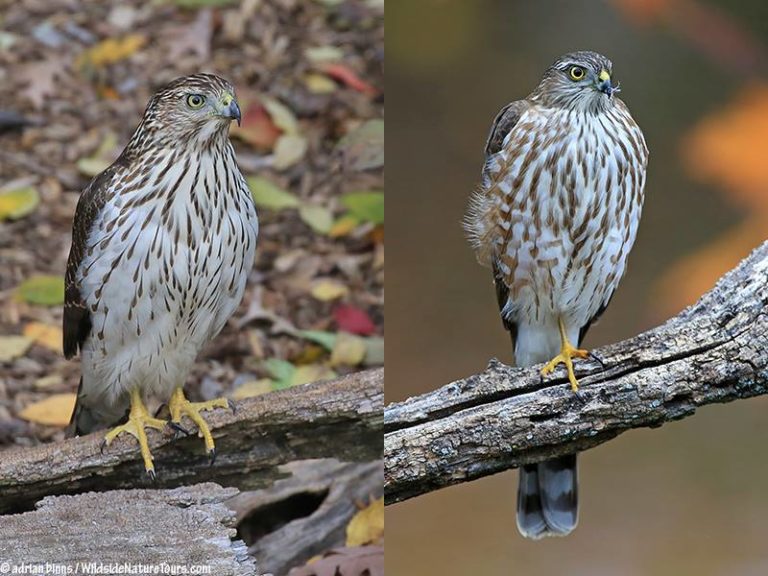
Cooper’s juvenile (left) and Sharp-shinned juvenile (right) from Notes from the Wildside.
I’ve edited, for improved clarity, the description from Notes from the Wildside below:
“In the above composite image we can compare a juvenile Cooper’s Hawk ( left) with a juvenile Sharp-shinned Hawk (right). When they are shown side by side, it easier to work out which is which, even though they are in slightly different postures.
The eye looks larger and more foreward in the head on the smaller headed Sharpie. NOTE: CORNELL’S SITE SAYS THE OPPOSITE! “Eyes appear to be close to half way between front and back of head [of the Sharpie].” Just keeping life interesting…. [To this, I’d add, from the Cornell site, that a Cooper’s head seems larger and less rounded than a Sharpie’s, and that the Cooper’s head appears ‘capped’ while the Sharpie’s appears ‘hooded’ with a shadowy patch down the nape. This may not be obvious with juvies, however….]
The Cooper’s head is typically less ‘tucked in’ than a Sharpie’s. There is a noticeable dark stripe on the throat of the Cooper’s.
The breast pattern is ‘ dark brown’ on the Cooper’s, and, ‘warm brown’ on the Sharpie.
Cooper’s display narrower and cleaner tear drop markings, thinning out on the belly,
whereas the Sharpie has heavier, or coarser, ‘blurrier’ markings.
On the Sharpie Broad note the broad barring on the flanks.
Cooper’s have thick sturdy legs (tarsi), while Sharpies’ are delicate and pencil-thin.
Though we can’t see the tail on the Cooper’s in this image, it is usually rounded compared to the Sharpies’ squared-off tail. While tail shape can be easier seen in flight, when posing upright with the tail fanned, a Cooper’s tail feathers get shorter towards the outer feather” giving it a rounded look when spread in flight.” (edited by KAR from the Wildside)
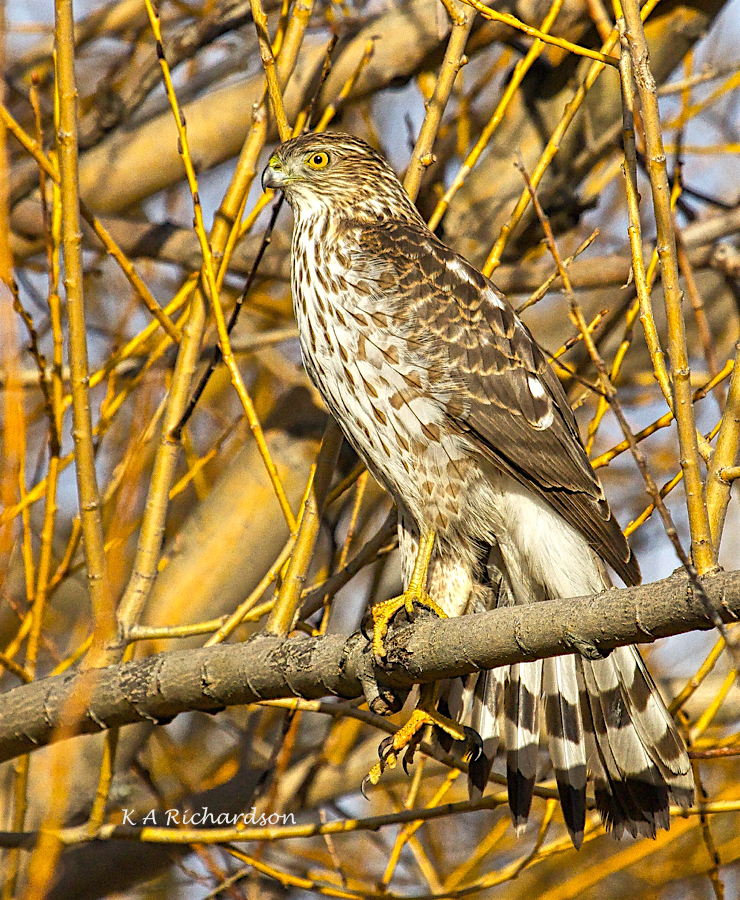
So what’s the one below, then?
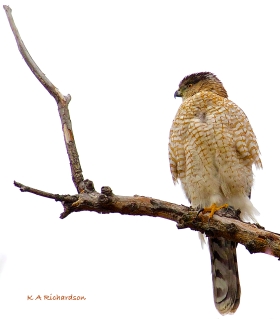
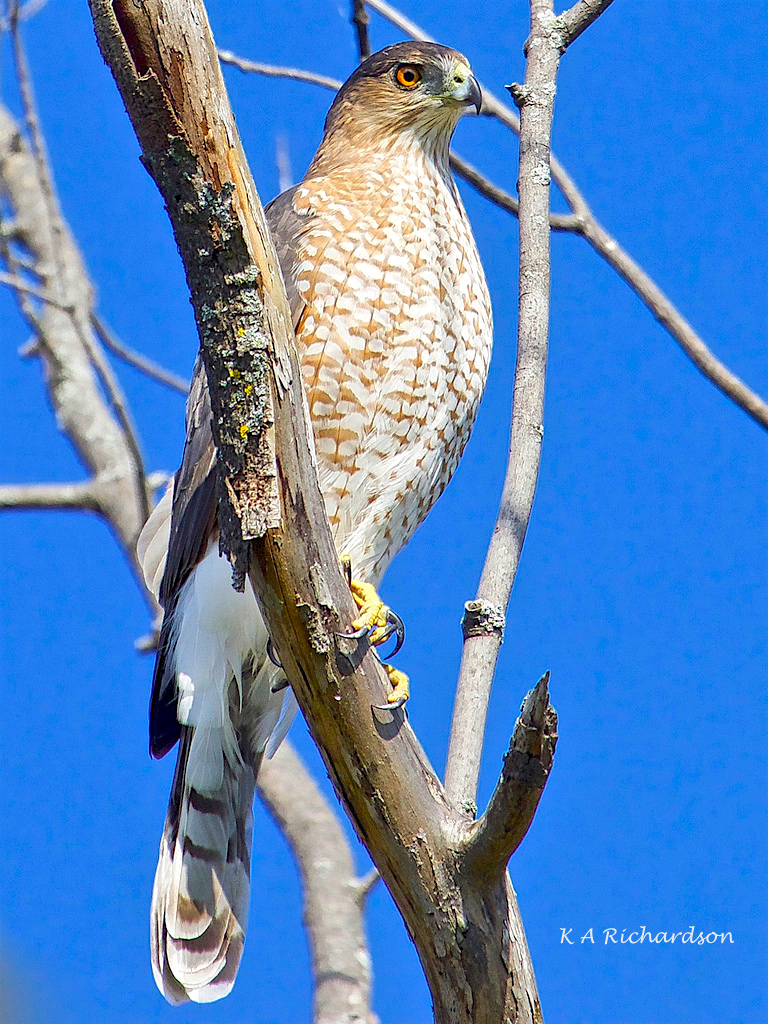
I’m going to go with Cooper’s juvenile emerging into adulthood….
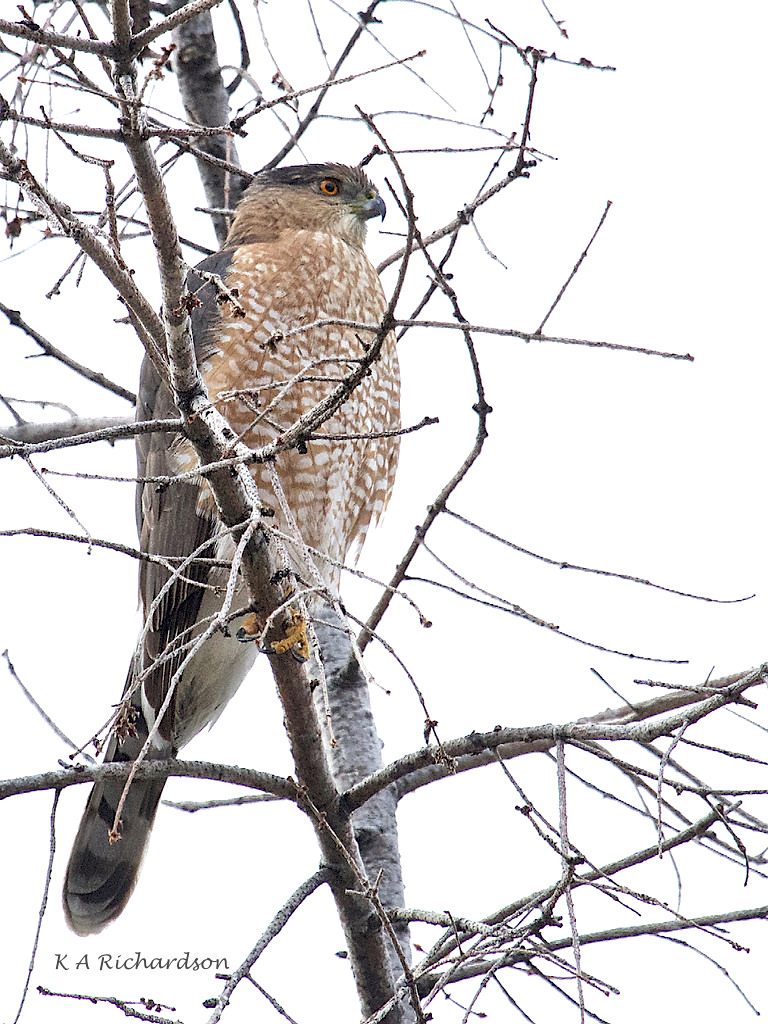
This one has my Flickr friends giving me opposing labels. I think it’s an adult Cooper’s, but I’m still not sure….
Not a great perch, but with enough details to offer ammo to both Sharpie & Coops fans….
From these lists, items that are easiest to examine are tail feathers, eye position, and head shape and cap, and in juveniles, breast markings. Size, it turns out, isn’t very reliable, as male Cooper’s are relatively small and female Sharpies are relatively large, so even though we know that Sharpies are generally noticeably smaller than Coops when comparing the same gender, it’s a problem when we can’t be sure which gender we’re looking at, and there’s no reliable way in the field to differentiate the males from their mates.
So, even knowing a few identifiers, I often have to wait until I get home and look at the images to make my guess — and then wait until after I’ve posted and real experts weigh in….
Sharpies range through more of Canada than Cooper’s do. Despite their larger range, it seems that there are more Cooper’s in total for the continent than their smaller lookalikes. Click either image below to enlarge it.
Cooper’s range – CLoO
Sharp-shinned range – CLoO
It’s always exciting for most of us to come across either species. While not rare, they’re not a bird that I can expect to see on a regular basis, or at least, they weren’t until I moved to Kelowna. Here, their territories are a little easier for me to pin down than they were at The Coast. This winter, J L Cummins, a birder-photog colleague in Washington State, has enjoyed having a Sharpie in his backyard, and it has become as familiar to him as Kessie, the female American Kestrel has become for me. Perhaps the Cooper’s / Sharp-shinned that I observed several times each winter and spring in our neighbourhood will become as identifiable as Jim’s…. (Update 2024: I haven’t seen either species in the neighbourhood for the past two years!)
So, I’ll wrap up this discussion of uncertainty with some photos taken in the neighbourhood:
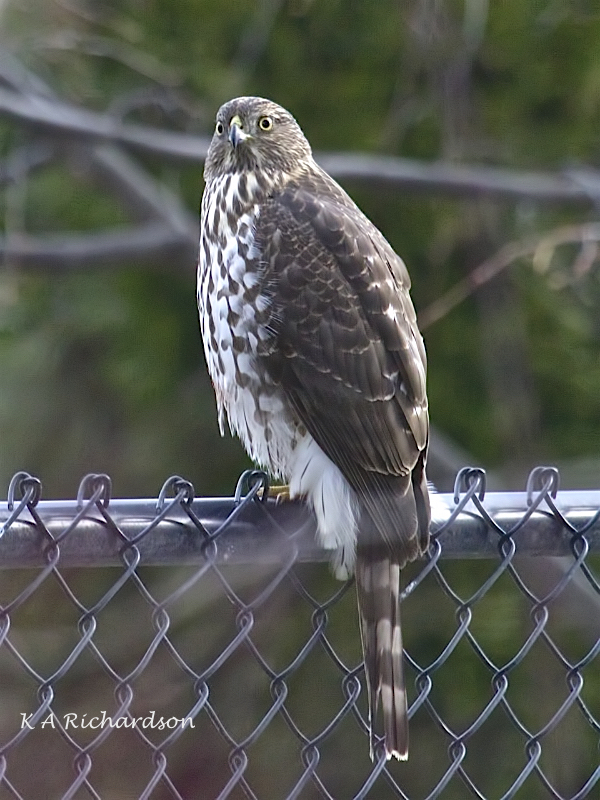
I now think it’s a Sharp-shinned juvenile, after first calling it a Cooper’s, based mainly on plumage details, but I’m still 100% not sure….While I think this is the same bird as the one above, I’m less than certain. The breast marks seem to suggest a Sharp-shinned…. …..It’s entirely possible that both species visit this park! Click photo above to enlarge in new tab.
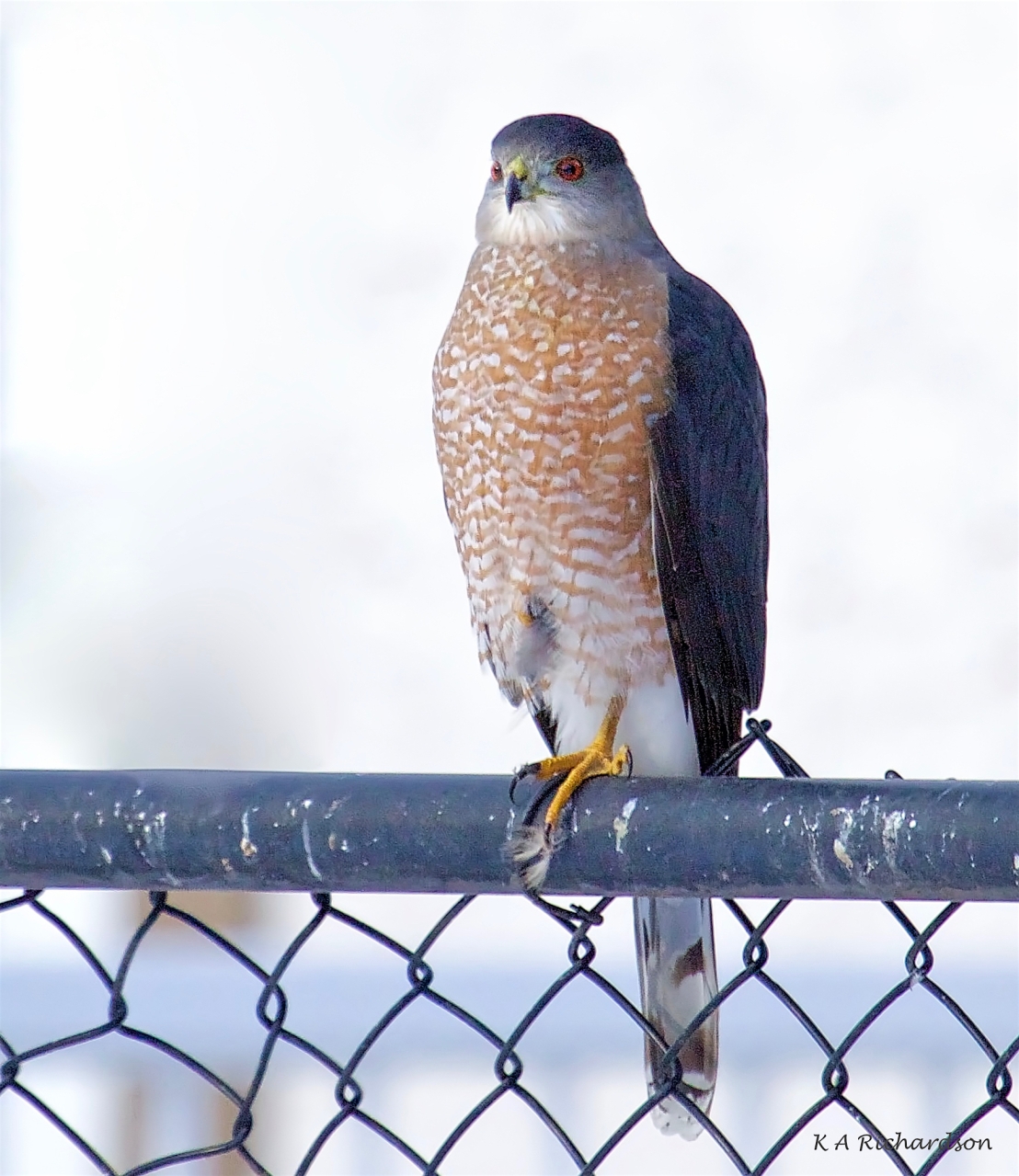
The photo, below, of an adult bird has been identified by expert friends as a Cooper’s. To me it seemed large enough, and the tail is rounded, but I see a hood, not a cap on its rounded head and nape, which are more indicative of a Sharpie!
This one, taken on our trip to Ottawa in October 2016 is, I’m told, is certainly an adult Cooper’s…. To me the tail definitely says Coop, but the rounded head and grey-black down the nape make me wonder….
In January 2017 I had a great but unexpected opportunity to photograph the hawk below. Sadly, my camera settings were right for a previous photo I’d taken of a distant Red-Tail, and woefully wrong for this guy/gal. Surprisingly, when I posted it on Flickr anyway, it got far more hits and positive comments than it deserves. It’s here simply because, at the time, I promised myself that if I got another chance, I’d do much better…. See the next one….
Cooper’s or Sharpie? Belmont Park, Kelowna, BC. I’m betting on the former!
So finally, on March 8, 2017, I did get my “another chance.” Guided by instinct, at about 10 AM I entered Belmont Park from the east so I’d have the light behind me. The Park was extremely quiet, as it often is when there’s a hawk about. Just after I passed a small fir on my left, I heard a flapping of wings and figured I’d flushed one of the Mourning Doves that frequents the area. Then I saw the hawk as it veered to perch on a pine about 20 meters ahead of me. I got the shot, and, right or not, am calling it a Sharp-shinned, based largely on the one shot of the tail and the two shots of the head and nape. Click on any of the photos to enlarge it.
Sharp-shinned with Quail breakfast – 1
Sharp-shinned with Quail breakfast – 2
Sharp-shinned with Quail breakfast – 3
Hope you got this far and that you enjoyed looking at these powerful and handsome hawks!
I have seen more owls since we moved up here in 2014 than I had seen in my lifetime before that. On the other hand, I have yet to see several species that I’m told are not unusual to come across — in other words, I have lots to look forward to. In this section, I’m including some photos from my days at The Coast, where it’s much easier, I think to find the diversity of this special, highly sought after genus.
The two species I have had a chance to observe in Kelowna are the Great Horned and the Long-eared. Let’s start with the latter, which I saw only recently and briefly.
While on my beat around Thomson Marsh, I was alerted by a young gentleman walker that there was an easy-to-see owl only 100 yards away. Here’s what (s)he showed me: my first ever Long-eared Owl. Usually, this species is found in thick cover; I was exceptionally lucky. Gone next day, (s)he left no forwarding address!
Click on any photo to enlarge it….
LEOW Thomson Marsh 170212
As I saw it first….
One profile…
… and the other.
Great Horned Owls, on the contrary, are frequently found in the Okanagan, and close to where we live. This winter, we had the pleasure of listening to them hoot from an unseen perch very close by at 12:30 AM! Here are a few shots I’ve managed so far. I’ve learned a lot about capturing them in the process — looking forward to better capitalizing on future opportunities.
The first group of photos are the best to date, and the earliest! These owls were easy to find in the woods near Munson Pond (once I was shown their location!). They are no longer resident there; some homeless people set up a camp that summer in the very spot I took these shots.
November 15, 2014 – 1
November 19, 2014: the mate
November 19, 2014: the boss!
Folks frequently report owls much closer to home both near the Lower Mission Greenway where we have observed them for the past three winters, and even in various parts of Thomson Marsh. Unfortunately, the perches these closer GHOWs choose are not ideal for photography!
GHOW just below the Greenway, 151004
160108 in a perch (s)he has favoured for many years apparently.
Same perch above the Greenway, 170129
(S)he wanted to sleep, but let me know (s)he knew I knew….
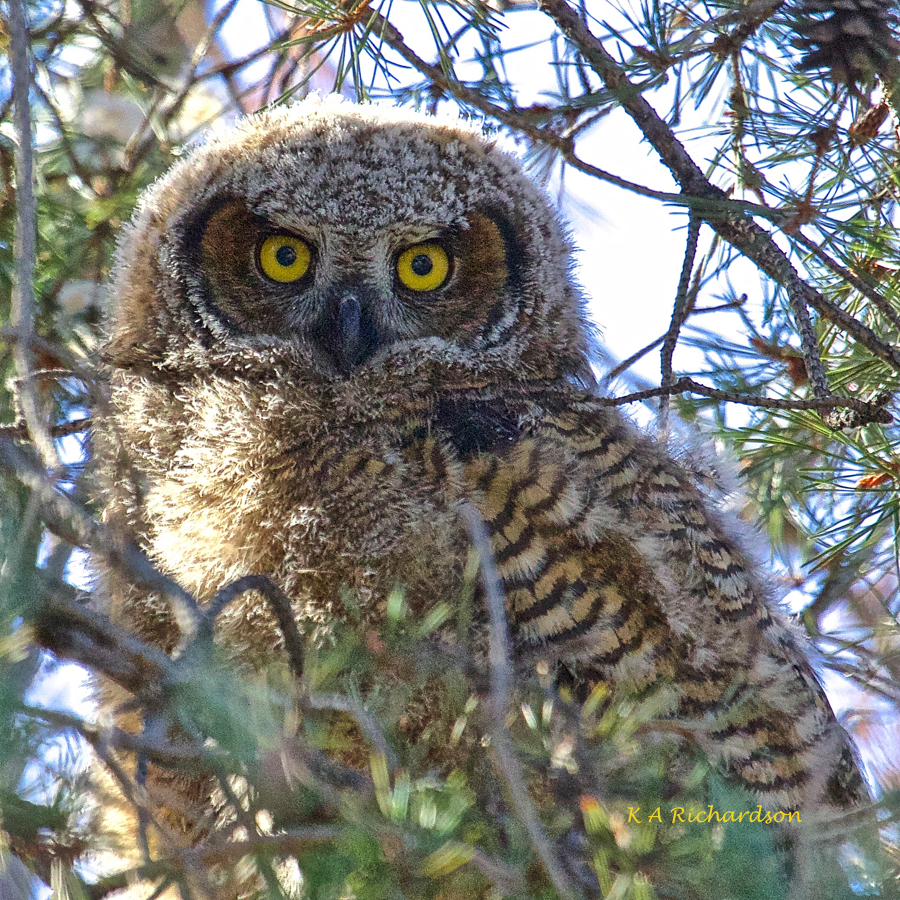
In March of 2016, birders, photographers, and the general public were treated to watching a family of three owlets fledge in uptown Kelowna — in a tall, old pine tree on the grounds of the Courthouse. Here’s my best shot of one of the wee ones (or not so wee by this time!). They all fledged successfully, but we’re not sure what happened to them later on:
It may appear that we were on the same level; we were not! Cropped photos can lie!!
As for the owls we have yet to see such as the Northern Pygmy, Northern Saw-whet, Western Screech, Barred, Barn, and Snowy, Short-eared, and if we’re really lucky, a Northern Hawk-owl, we keep our fingers crossed. Of these I’ve seen all but the first three elsewhere…. The owls below were all found in different location in BC’s Lower Mainland.
WARNING to all who venture here: this is a VERRRRY looong, very image heavy post…!
RTHA harassed by gull, Oct. 2015 (Click to enlarge in new tab)
I am very grateful that our area is served by dozens of raptors, especially Red-Tailed Hawks. In what I call “my beat,” shown on the map below, each winter presents several different individuals. 2015-16 provided four RTHAs and one very friendly female American Kestrel. (UPDATE: she has found her mate and is frequently copulating.) I’m pretty sure I’d be UNable to differentiate so well at The Coast, given that I had to drive to find hawks and kestrels. Here, they’re only five minutes’ walk away, or, in many cases, a glance outside the window from my computer. We also see Bald Eagles frequently, and I’ll include them at the end….
We’ll start with the maps: first, the area, then the birds’ territorial map:
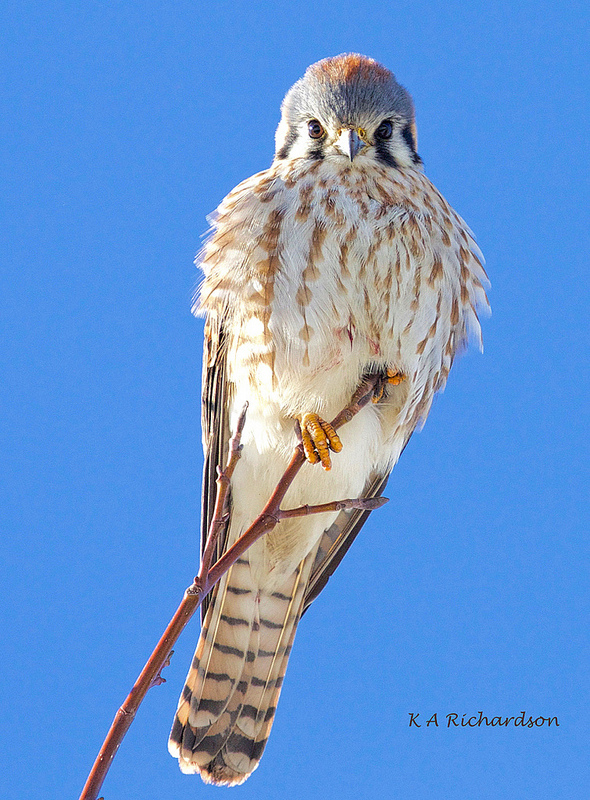
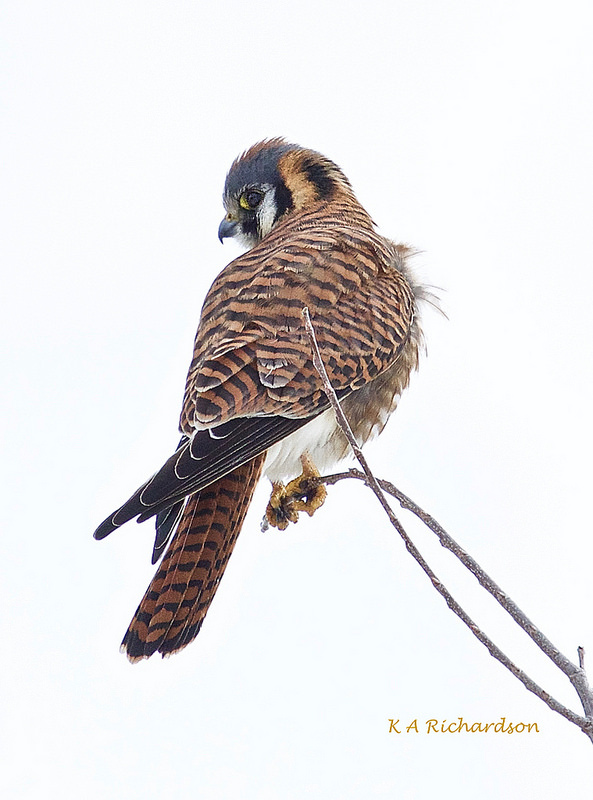
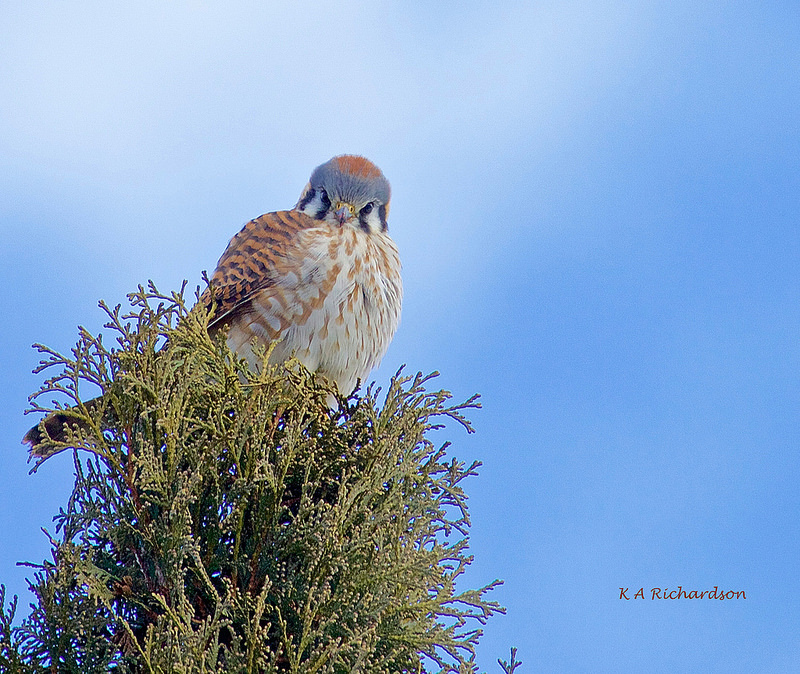
Kessie, the female AMKE covers the territory of all the hawks west of the creek that is the basis of Thomson Marsh (and east of Gordon Road, and south of Mission Creek). I’ve been interacting with her since January 2015; she’s very friendly, of her own accord (i.e. no one’s baiting her or doing anything to entice her). She’s simply comfortable around people and cameras, and will often fly with me and others on our walks. She’s quite willing to look right at me when I whistle, and on lots of occasions has flown from distant locations to much closer perches almost as if she wants to be photographed. I’ve featured her before on this blog; here are a couple of new photos from the late winter of 2017 that I’m very happy about:
I thought the first one below was a pretty good look, but then I realized that I wasn’t pleased with the branches and told her so, telepathically. So she backed up to a better perch, gave me time to stagger up through the crusty snow and take more than 50 shots.
The first shot:
Kessie against a cerulean sky….
and the improved perch on a different tree:
Kessie makes my day….
Several days later, I watched and worked with her for twenty minutes while she scanned the area searching for lunch. Eventually, she caught a vole, flew up to one of her lamp post perches, and took her time dining, before retiring to a Cedar shrub….
Kessie looking for lunch….
Kessie enjoys a lite lunch…. (Click image above to enlarge in new tab.)
Resting after lunch…. (Click image above to enlarge in new tab.) Interaction like this would be enough to make any day special!
But I promised you RTHAs, so let’s begin with a newcomer and my favourite, and a familiar greeter of so many of the folks who walk their dogs and their kids and spouses ’round the perimeter of the Rec Fields. I credit Mel Hafting (aka Birdergirl) with identifying Whitey as a Buteo jamaicensis harlani—a Harlan’s subspecies or possibly separate species depending on whose authority you accept. Whitey arrived sometime in December. I didn’t realize that he was here for the winter until December 22, when I got a series of shots as he perched on a large dirt pile behind the Capital News Centre Rec Facility about 300 meters from home. He allowed me to walk up to within 30 meters, and we’ve been good friends ever since. (Note: I say he, but I have no way to know the gender!)
Whitey on the dirt bank behind the Capital News Centre (CNC)….
I have many precious images of him, whether at a distance in the Raptor Tree across the Marsh or in various parts of his southern and eastern range as shown on the map we started with. Here are some of my favourites:
Whitey grooming in the Thomson Marsh Raptor Tree….Whitey on the other side of the Thomson Marsh Raptor Tree on another day….
and some close ups near the entrance to Mission Rec Fields, just south of the CNC arena:
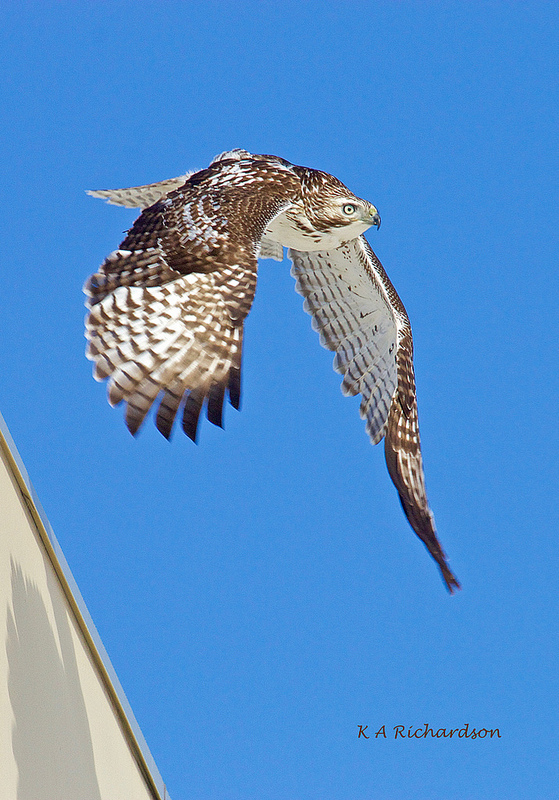
Whitey leaves the edge of the CNC roof in an attempt to harvest a quail….
On this day, he hunted the same area from his lamppost:
Whitey on his favourite lamppost. Oddly, he uses only the path lights, never the giant field lights favoured by Ready Eddy (Re’ddy)….
and was successful:
Whitey catches a vole – 1Whitey catches a vole – 2. Can you see it?
Whitey can spot competition a couple of hundred meters away. It seems that the only threat he really cares about is at the eastern fringe of his territory. When Harri or Sunny dare to cross the invisible boundary, Whitey is likely to fly over and let them know who’s boss. I’ve not seen actual combat, but its always the other birds that retreat to their own territories. On the other hand, Re’ddy, who encroaches from the north, usually by roosting on one of the giant field lights that illuminate the Rec Fields, is never challenged by W, nor does R challenge W. (Actually, Re’ddy is a bit of a chicken hawk, it seems to me). R and W simply ignore each other.
A long shot of Whitey on a lamppost watching his rival Harri who has crossed the line. Eventually, Harri retreated.
Recently, as it appears that Harri has left the area (more on him in a moment), I see Whitey exploring more of the the eastern side of the territory, even perching occasionally on the fence posts that Harri had called his own….
Whitey on a delicate perch at the eastern edge of his territory. I’ve seen none of the other hawks I study attempt this; Whitey often does….
A better indication of Whitey’s perching skills on his eastern perimeter….
And one more low branches closeup….Whitey takes control, now sitting where Harri used to reign….
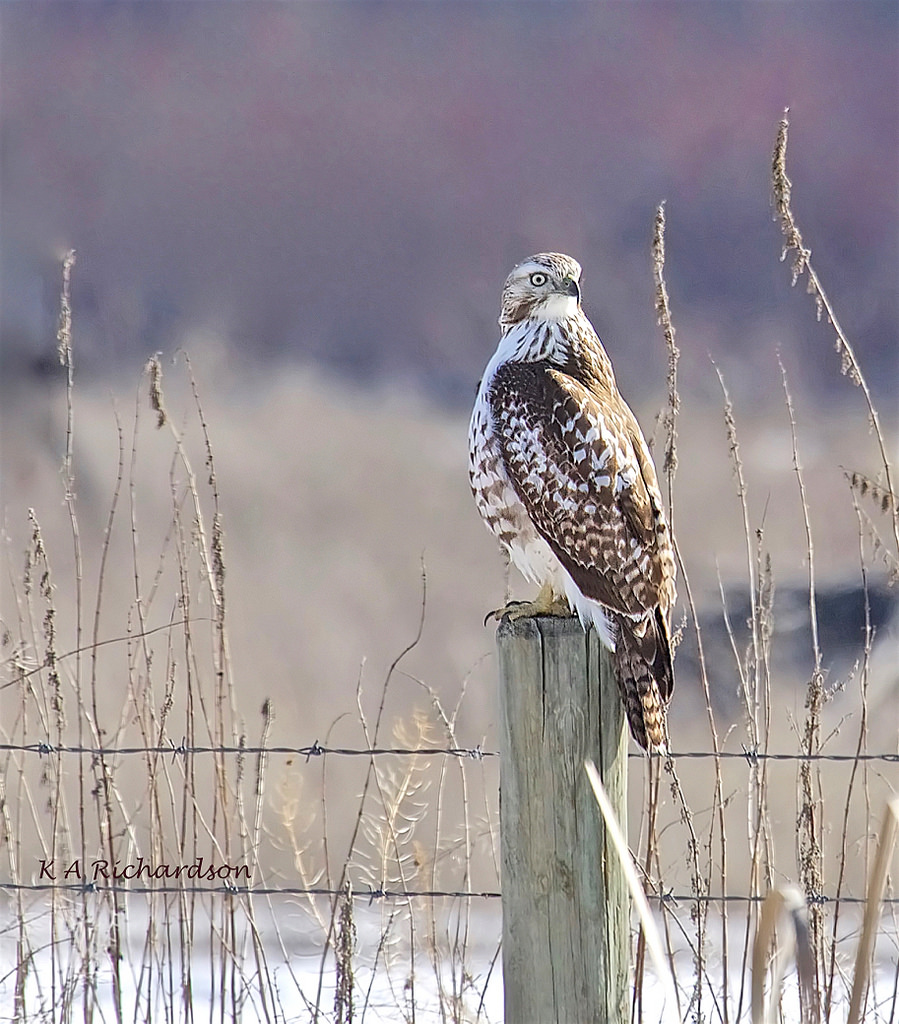
Now, I expect most of you can see that Whitey’s colouration and territorial range make him easy to identify, and I suspect that many are wondering how I can be so sure about the other three…. Turns out there are both physical features and, more importantly, behavioural idiosyncrasies for each one that make the job fairly easy. Keep in mind, too, that I can often see all four hawks at the same time!
I’ll start with Harri, because I really don’t have decent photos of him. He rarely crosses the marsh into the Rec Fields. Instead, he cruises, Harrier-like (hence the nickname) along the fence line and through the great field on the east side of the Marsh, usually five to ten feet off the ground. When he does perch on a post, he takes flight as soon as he senses a camera being raised in his direction. He has a beautiful red tail (though it’s white underneath), and a light front that makes him a very desirable subject. On a scale of 1—10 for accessibility, where ‘1’ is “wrapped in the cloak of invisibility,” he’s a 3! Here’s the best I’ve been able to do with him so far:
Harri on a fence post of the east side of Thomson Brook (Marsh). He may have already departed for his spring and summer hunting grounds…. Can you spot some obvious ways he differs from Whitey?
Reddy Eddy is a different character! He has been around for the past two winters. Like Harri, he hates to see a piece of glass, especially if it’s a camera lens; he’s even nervous about binoculars. He has three preferred roost locations, two in the Raptor Trees on opposite sides of Michaelbrook Marsh, and several of the giant field lights). I can see Re’ddy almost every day, but it’s usually a lot of work to chase him around and get a photo although he’s slowly adjusting to birder-paparazzi. He used to simply fly away; now, he’s more willing to fly up and find a thermal or even fly over me to a distant perch. Like Harri, and unlike Sunny, he has, besides a quite light breast, a white throat, and this spring, a red tail. These features, together with his intense need for privacy, makes him a character easy to ID.
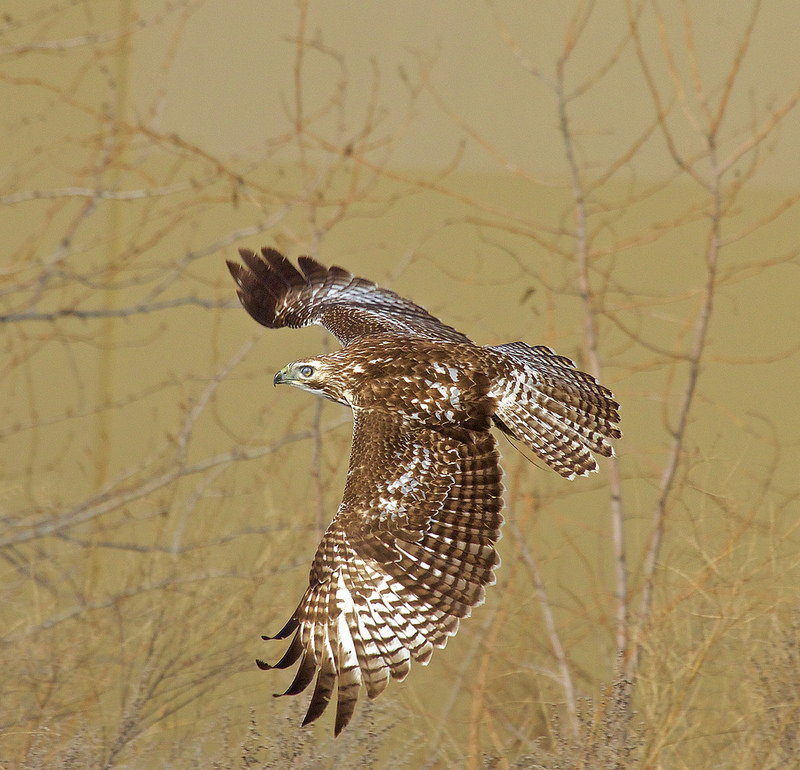
Re’ddy in the south Michaelbrook Raptor Tree.Re’ddy in the Big Willow southeast of the Dog Park.Re’ddy in the northwest Michaelbrook Raptor Tree.
This is Re’ddy being attacked by a Red-winged Blackbird on March 25, 2016 — before he acquired his red tail. Click on the photos for captions and to enlarge. To close the expanded window, click on the small x in the top right corner.
RWBL chases Re’ddy away from the Big Willow
Closing in….
Contact imminent….
The RWBL has landed!
All I wanted was a shot of Re’ddy in flight (after he’d eluded me all winter), and what I got was so surprising and much better! You can’t wish for opportunities like this!
Finally, allow me to present Sunny, a newcomer last autumn who occupies the northeast quadrant of the map. On that 1-10 scale mentioned above, I rate him a 7.5. He’s camera tolerant but doesn’t really care to be stalked. When hunting, however, he maintains his focus pretty well and tolerates the yelps of dogs and people from the Dog Park while he hunts in the fields and mounds to the east. Recently, he seems to have expanded his territory, especially towards the Casorso Bridge and the Trapalanda Farm. Sunny has a darker head than Re’ddy, a dark throat, and dark eyes.
Why Sunny? Because my first photo of him was this one in early November 2016; click to enlarge these photos:
Sunny welcomes us to his new home!
Sunny in the Big Willow – 1
Sunny in the Big Willow – 2
He’s handsome and he knows it; clap your hands!
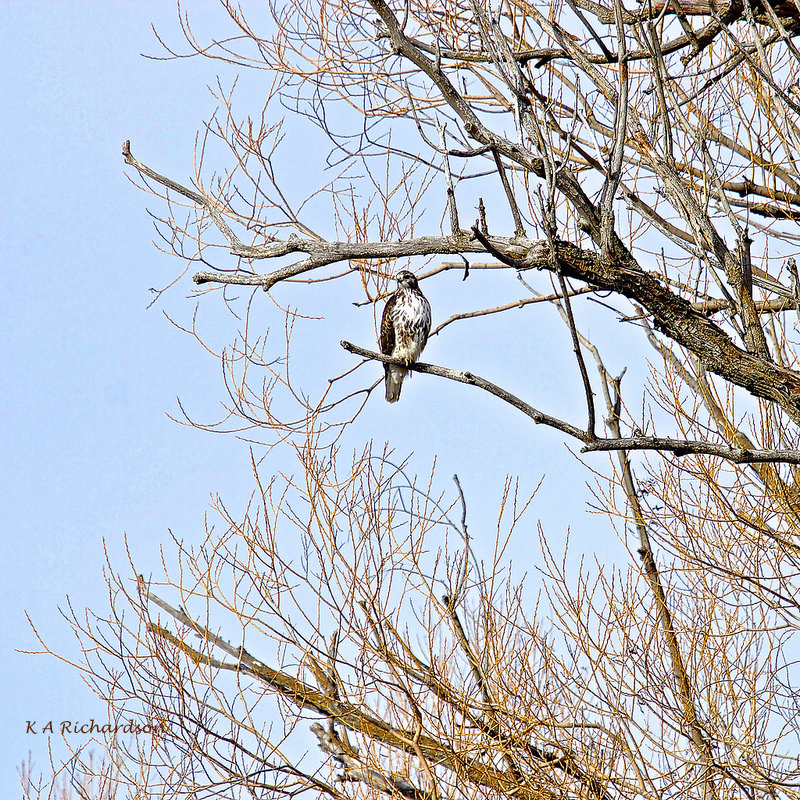
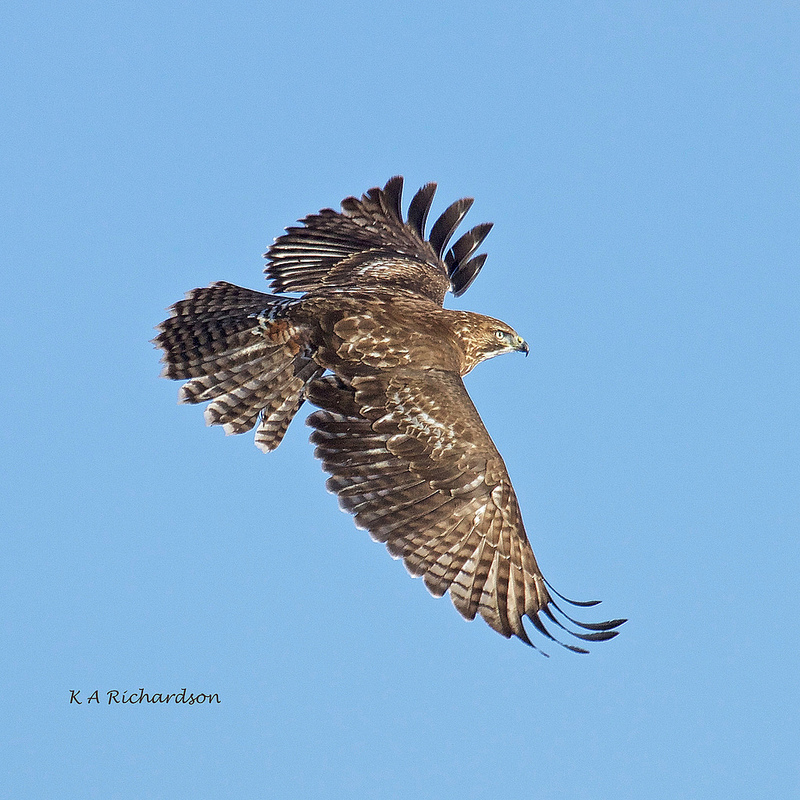
And then we get the occasional interloper that just doesn’t quite fit. I used to think this was Sunny, but the flight photos clearly show a white throat and a dark tail just beginning to turn red.
Who is this handsome dude? (January 4, 2017)
He can’t be Re’ddy (he didn’t behave like R. at all!) and the white throat doesn’t fit Sunny either (although I realize that there are plumage changes as juveniles age). As well, he’s way out of Harri’s range, and doesn’t fly like him. So, for all my certainty, there are still mysteries to be explored….
A lot of photos and explanation. For the few who took the time to read to the end, I hope you enjoyed the tour of my Red-tailed Beat….
Cheers! 😃
Oops! Almost forgot I’d promised eagles. Here’s a couple of shots I waited all winter to get:
Bald Eagle, likely male, on an exposed branch on the north side of Mission Creek.
This one and its mate were hanging out near the old nests just north of Mission Creek. Sadly, no sign that they’ll use them this spring.
I love every bird who takes the time to scope me back!
To all who stayed in for the whole show, thanks for your patience!


























 birds & musings