Almost done with ducks and their cousins, but this is a very long post!
You may have noticed that I’ve skipped over geese and swans, which I’ll cover separately….

First up is a duck that I had enormous difficulty getting close to at The Coast, with one notable exception at Piper Spit, Burnaby. Up here, however, especially at Robert Lake, despite its tiny viewing area, I’ve been able to do much better with Northern Shovelers. I was also able to observe them in a more natural setting in Michaelbrook Marsh.
While predominantly a western duck during breeding season, the NSHO can be seen in other parts of Canada and North America in other seasons.
“Perhaps the most outwardly distinctive of the dabbling ducks, the Northern Shoveler inhabits wetlands across much of North America. Its elongated, spoon-shaped bill has comblike projections along its edges, which filter out food from the water.” Cornell Lab of Ornithology
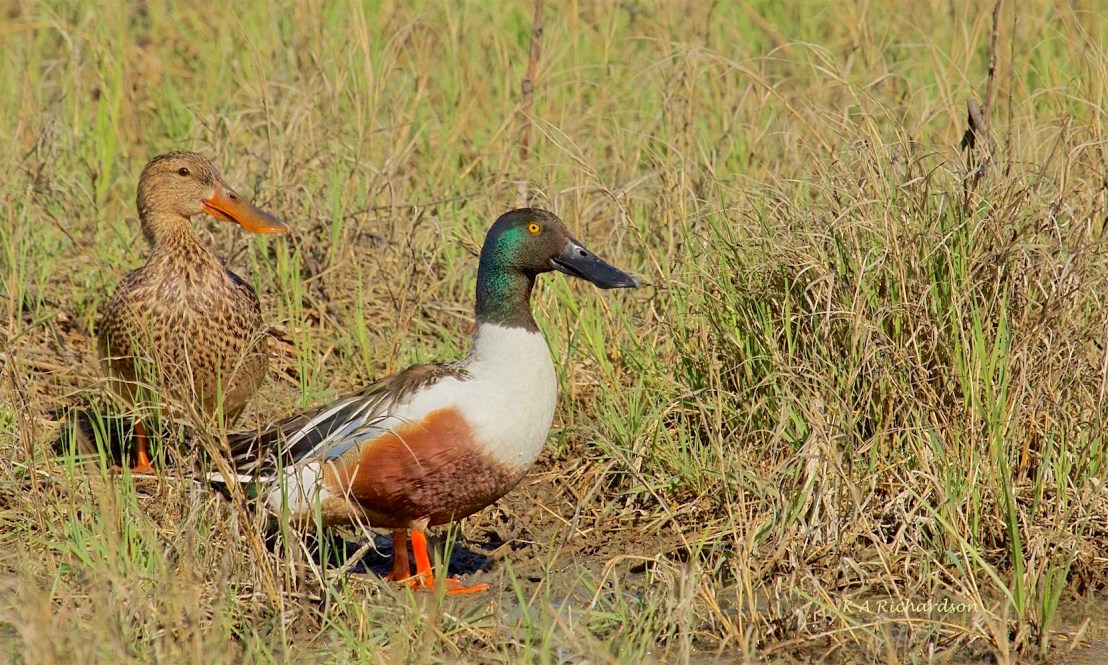

“The bill of the Northern Shoveler is about 6.5 cm (2.5 inches) long. The bill has has about 110 fine projections (called lamellae) along the edges, for straining food from water.
Northern Shoveler pairs are monogamous, and remain together longer than pairs of other dabbling duck species.
When flushed off the nest, a female Northern Shoveler often defecates on her eggs, apparently to deter predators.
The oldest recorded Northern Shoveler was a male, and at least 16 years, 7 months old when he was found in Nevada. He had been banded in California.” (Cornell)


NSHOs in mid May. To enlarge the images above, just click on them….
A month after the photos posted above were taken, the NSHO has evolved into this guy below:

Turning away from ducks for a moment, I must give some space to one of the smaller members of our local menagerie, the Pied-billed Grebe.
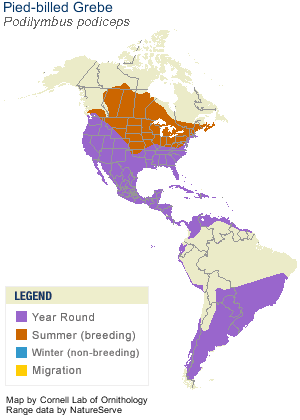 “Part bird, part submarine, the Pied-billed Grebe is common across much of North America. These small brown birds have unusually thick bills that turn silver and black in summer. These expert divers inhabit sluggish rivers, freshwater marshes, lakes, and estuaries. They use their chunky bills to kill and eat large crustaceans along with a great variety of fish, amphibians, insects, and other invertebrates. Rarely seen in flight and often hidden amid vegetation, Pied-billed Grebes announce their presence with loud, far-reaching calls.”
In our neighbourhood, as with so many of the water birds, we see PBGRs in Belmont Pond and Thomson Marsh just before breeding becomes intense. I wish they’d nest where we can observe the chicks, but they don’t. Part of the fun of this avocation, however, is the ongoing effort to learn more about the birds when the heat is turned up….
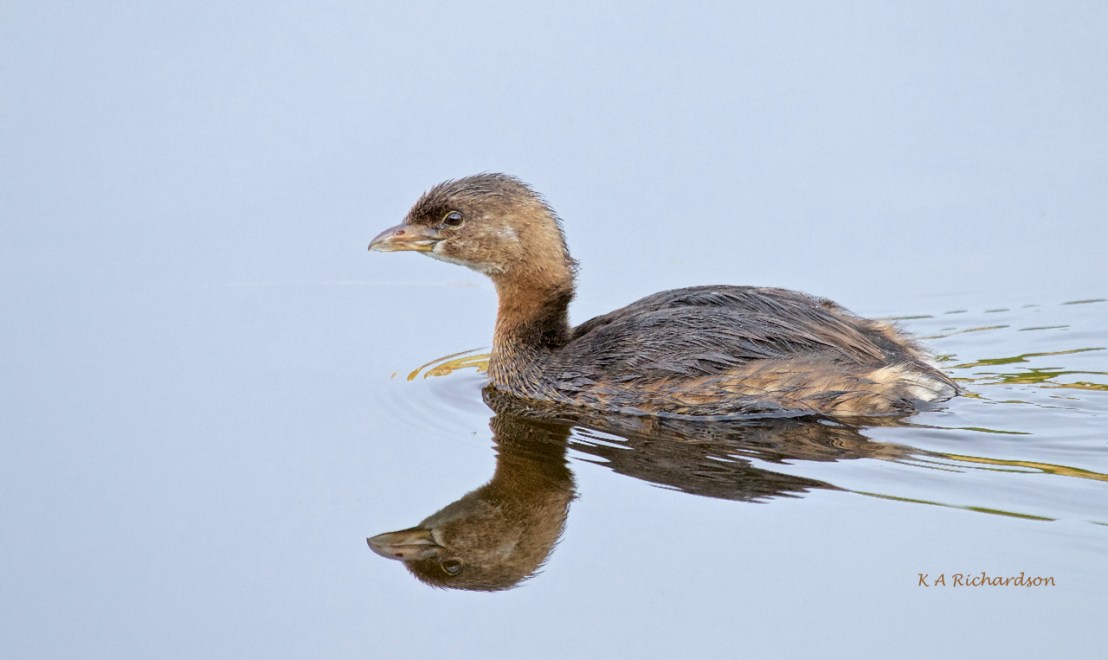

“Part bird, part submarine, the Pied-billed Grebe is common across much of North America. These small brown birds have unusually thick bills that turn silver and black in summer. These expert divers inhabit sluggish rivers, freshwater marshes, lakes, and estuaries. They use their chunky bills to kill and eat large crustaceans along with a great variety of fish, amphibians, insects, and other invertebrates. Rarely seen in flight and often hidden amid vegetation, Pied-billed Grebes announce their presence with loud, far-reaching calls.” (Cornell)

We see other grebes as well, but so far I haven’t built up a very strong library of the Eared, Horned, Red-necked, and Western varieties. Another project for 2017!
Click to enlarge these record shot images:


And one shot of a Horned Grebe in winter plumage:

Two of my favourite spring ducks fall into the “R” category: Redheads and Ruddies.
Ruddy Ducks have a much greater presence in the West; Redheads are seen in more areas of North America. Each is a striking addition to any spring pond!


While 2016 did not provide opportunities as great as the previous two springs, it did not totally disappoint. We travel to Birdie Lake at Predator Ridge Resort south of Vernon each spring where we have been quite lucky with these species. No Ruddy in Belmont Pond this year, but we’re keeping our fingers crossed for a drop-in this year. Surprise us, 2017, just as 2016 did when, for one day, we had Redheads in Thomson Marsh!
The image below was taken through some tall cattails on a cloudy afternoon. While it does not rank as a great image, it marks a noteworthy moment with its diversity of pond mates all crowded onto one heavy log! A most unusual find, unlikely to be replicated….

Click to enlarge images.


Ruddy Ducks, at least the drakes in breeding season are also known as Bluebills:


Another project to work on this spring!
From Cornell’s Lab of Ornithology come these two tidbits:
“The bright colors and odd behavior of male Ruddy Ducks drew attention from early naturalists, though they didn’t pull any punches. One 1926 account states, “Its intimate habits, its stupidity, its curious nesting customs and ludicrous courtship performance place it in a niche by itself…. Everything about this bird is interesting to the naturalist, but almost nothing about it is interesting to the sportsman.” That’s an account from a different era, and one that I would question today. One can only imagine how the writer might describe human behaviour ninety years after he wrote that piece!
Ruddy Ducks are very aggressive toward each other and toward other species, especially during the breeding season. They are even known to chase rabbits feeding on the shore.”
Skipping Snow Geese and Swans, we move to another genus of ducks, Anas —teals comprising three species commonly found in BC. In Part 1 of this series, we met the American Green-winged Teal (and its Eurasian cousin the Green-winged or Common) Teal. In this concluding Part, we’ll look at two of the relatives: the Blue-winged and the Cinnamon. The latter is truly a western waterfowl with an amazing north-south range; the Blue-winged, however, is common across Canada. Here in the Okanagan Valley, I see more CITEs than BWTEs, at least in our two and a half years.


Teal males of all three species are striking. For me, the Cinnamon is most arresting,

and especially beautiful to capture in flight with its combination of reddish brown, teal blue, and green. Not the best flight shot you’ll see, but my best so far. Another one to work on in 2017.
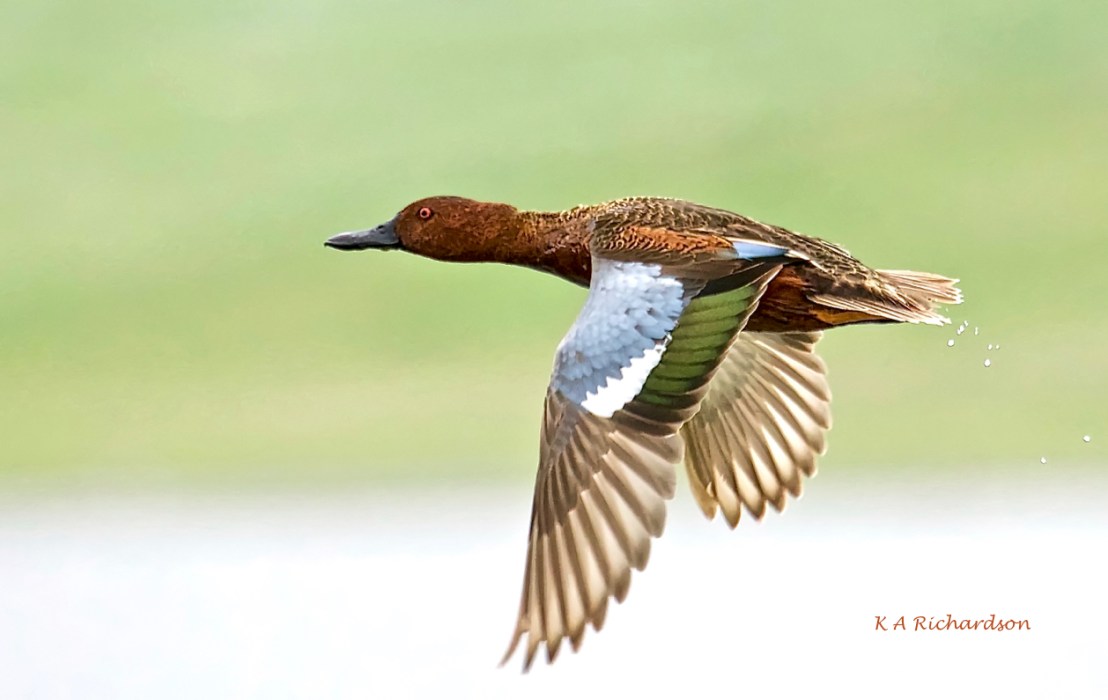
In 2015, I got my best CITE shots close to home. Last year, however, these ducks presented very well near the tiny viewing area at Robert Lake. This is my favourite shot by far.
Click to enlarge in a new tab.

I was very pleased the day that I found CITEs and a BWTE together in Teal Corner in Thomson Marsh. I had never seen a BWTE in this marsh before, and to have the two species together for comparison was a great bonus.


Wondering how I know which drake above the female on the right is mated to?
Good question. For starters, I watched the CITEs work together; the BWTE was clearly the visitor, and I’d seen him alone in the location before (left). Click to enlarge.
Cornell’s Lab of Ornithology online also provides this guideline: …“Female and immature Cinnamon Teal are notoriously difficult to distinguish from Blue-winged Teal. Cinnamon Teal are always larger-billed than Blue-winged. They also have a warmer-toned face, whereas Blue-winged Teal has colder, gray tones and a bolder facial pattern. Green-winged Teal has a slimmer bill and more boxy head. Their overall body color on females is darker brown, with a darker stripe through the eye and darker cap. Green-winged Teal in any plumage lack the pale blue upperwing coverts of Blue-winged Teal, Cinnamon Teal and Northern Shoveler.” (Cornell)
Here’s a shot of a BWTE and a NSHO sharing space at Robert Lake (Click to enlarge in new tab):

And finally, we reach the end of our ducks for 2016 with my all-time favourite, one we are blessed to enjoy both at The Coast and here in Okanagan Valley, the duck whose photo graced the beginning of this five-part series (hey, these guys deserve a fanfare, too!)~
The Wood Duck!

Click to enlarge images.…


And we’ll say goodbye for this post with this triptych from Piper Spit in Burnaby, BC.


For geese and swans, see Part 6.
 birds & musings