If you were looking in Part 3 for ducks or water fowl with “C” in their first names, perhaps Cinnamon Teal or Common Mergansers, you didn’t find them except as a note. You’ll find the latter in this part, along with Gadwalls, Hooded Mergansers, the Common Loon, and, of course, Mallards (on which I did a piece earlier). For Horned (and other) Grebes, check part 5.

Gadwall. Unusual name. Just like the word ‘unusual with its three ‘u’s. I’ve heard them called Gladwells, Gadwells, Godwills, and plain ducks. But to me, they’re a treat, and we have lots of ’em, although I always wonder how that happens. Really. I find Gadwalls are among the most devoted of mates and yet I’ve never seen, to my knowledge, a hatch of Gadwall ducklings! I’ve watched them copulate, so that can’t be the problem. But where do those wee ones go?

According to Ducks Unlimited ,” Gadwall[s] breed near seasonal and semi-permanent wetlands, mainly in the grasslands and mixed Prairie regions of the United States and Canada. Substantial numbers also breed in wetland habitats of the Great Basin. Gadwall tend to begin breeding later than most ducks. Female gadwalls nest in fields and meadows, and on islands and dikes in wetlands, and lay an average of 7-12 eggs.”
In addition, “The North American gadwall population remained stable through the 1970s and early 1980s, while populations of other waterfowl species generally declined. Since the late 1980s, the gadwall population has increased to record levels, with the most recent estimates nearing 3 million, due to improved wetland habitat conditions.”

Many of you in the northeastern US and Atlantic Canada, western Ontario and the high Arctic, and most parts of BC may be unfamiliar with this subtly plumaged (until you really look closely) and almost silent species. We used to have a single pair in our urban pond in New Westminster that I admired for their devotion. But it wasn’t until we moved to the Interior that I really came to appreciate them, especially in early spring and late autumn, when light angles illuminate them best. And, now that I think about it, I don’t see them much in summer, likely because that’s when they’re rearing their young in more remote locations…. Live and learn (OK, and speculate!).
Click on any of the photos in the set below to enlarge them.
To return to this screen, click the small x in the top right corner of the enlarged window.


“The North American gadwall population remained stable through the 1970s and early 1980s, while populations of other waterfowl species generally declined. Since the late 1980s, the gadwall population has increased to record levels, with the most recent estimates nearing 3 million, due to improved wetland habitat conditions.”
In spring and autumn, we occasionally see drakes displaying their hidden colours, above left, when they stretch. In Thomson Marsh, in spring, pairs can be rather shy. In the shot above, top right, the drake and his mate had been swimming north along the brook, keeping an eye out for any snooping paparazzi who might be tracking their whereabouts. The drake, in the lead, decided to move ahead as quickly as possible, but the duck held back, unbeknownst to him. When he finally realized that he and she were now on opposite sides of me, he showed a little consternation as he tried to decide if it was safe to swim back to her. (He could have flown, but chose not to.) Slowly, deliberately, he swam back in her direction, giving me a number of great looks, including the one at the beginning of this Gadwall section….
A much more colourful bird that I’m very pleased makes itself widely available in Okanagan Valley ponds and streams is the Hooded Merganser. Like its Common Merganser cousin, it shows up in Belmont Pond, only steps from home, and in Mission Creek in spring and autumn. Several breed in the area like the family that gave me some of my best images in 2015 at Michaelbrook Marsh.
All of the photos of HOME drakes were taken in Belmont Pond, very close, appropriately, to home. They can be found in many other locations in the Valley, however.
Click on any of the photos in the set below to enlarge them.
To return to this screen, click the small x in the top right corner of the enlarged window.


Mergansers of all species can be problematic to photograph. Some of my Flickr friends envy how approachable Hoodies and COMEs are here. I appreciate their cooperation but still find capturing them to my satisfaction an ongoing challenge. But that’s the fun of it all, isn’t it— the ongoing drive for improvement.
These are two of my favourite Hoodie shots of 2016, both of drakes, but with different lighting….


Click on any of the photos in the set below to enlarge them. To return to this screen, click the small x in the top right corner of the enlarged window. Before you do that, however, what do you mean you already did? I wanted you to note that three of these photos show a female Hooded Merganser, and one does not. It shows a juvenile male. Now which one is the juvie? And I don’t mean all those little ones, especially the one who’s mounting his guard, the Western Painted Turtle because he thinks it’s a pony….


If she has an all black bill, she’s not a she, he’s a he….
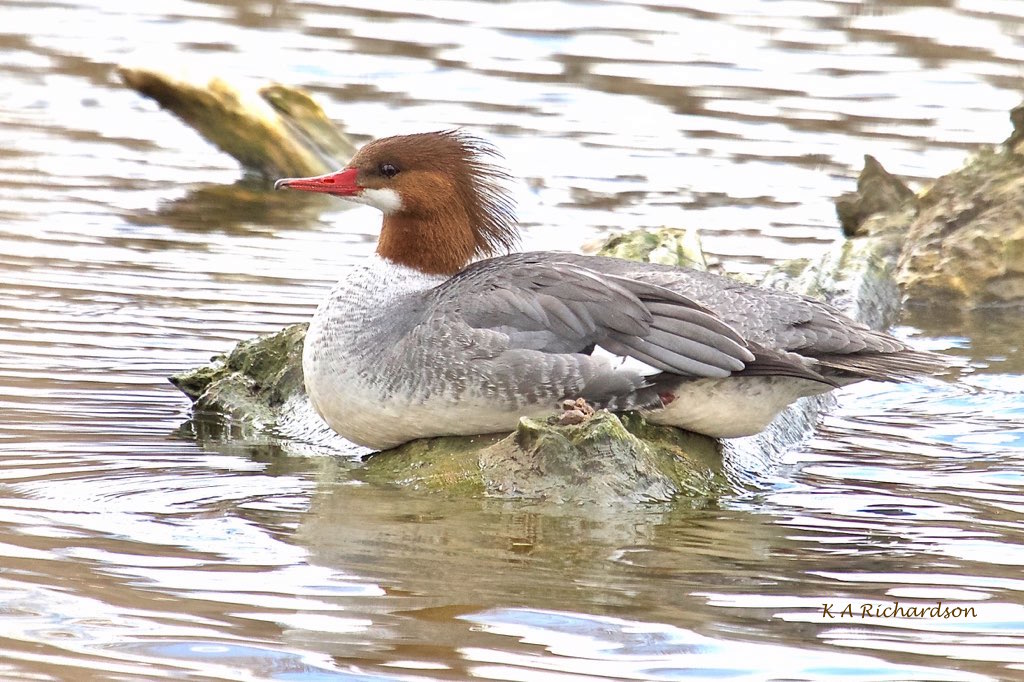
The Common Merganser is a much larger bird. While there are some similarities among the female cousins, we’d never mistake a COME for a HOME. That’s even more true for males. I had few chances to observe COME drakes at the Coast, but only because I didn’t like driving to look for them. Here, they show up in the spring as a pair—in Thomson Marsh or Mission Creek. At this stage, the drake looks a responsible mate. But after breeding, and even more, after the eggs hatch, he abandons his mate and his family.

And, in our neighbourhood, at least ini 2016, he became a regular visitor who spent his summer vacation in Belmont Pond, visiting with other ducks and mergansers, and providing wonderful photo opps for local photogs:

Some interactions were hilarious, at least to me…. Click photos to enlarge.


Poor guy! He’s gets it from everybody who thinks they’re the boss!


BC, including the Okanagan, is also home to the much rarer Red-breasted Merganser. Sadly, I didn’t see any this past year. One was reported on Okanagan Lake, but I couldn’t verify the find. Maybe this year….
Got so carried away with Mergansers that I nearly forgot the Common Loon, which I decided to put into this category. 2016 did not provide me with opportunities like those at 108 Resort in 2014 and 2015, and we did not get back up there this year. Of course we have Loons in the Okanagan-Southern Interior Plateau region, but I didn’t make them a target in 2016. Another species to pay more attention to in 2017. I’ve got some ideas; we’ll see if they materialize.
Click images to enlarge.


Besides its dazzling appearance, the COLO is renowned for its vocalizations. On a big lake like Okanagan L., we don’t get to enjoy that as much as we do in smaller Cariboo Lakes or those in the Kane Valley. I took their calls and chatter too much for granted in the 15 years when I heard them calling in the evenings and sometimes in the dark when it was time for humans to sleep. Now I long for those sounds again….
Well, the “M category” would not be complete without a mention of the Mallard, on which I’ve already posted a set of flight shots. I’m hoping to do a special feature on this species later in the spring. For this post, besides the Mallard above, here’s a couple of shots without comment: click on the photos to enlarge them.


For all the remaining ducks, see Part 5….
 birds & musings