Part 2: More waders and shorebirds: herons—Great Blue and Green
Part 3: Some ducks and coots : American Green-winged Teals, American Coots, American Wigeon, Buffleheads, Goldeneyes: Barrow’s and Common
Part 4: More ducks: Gadwalls, Hooded Mergansers, Common Mergansers, Common Loon, Mallards
Part 5: More ducks: Northern Shovelers, Pied-billed Grebes, Horned and Red-necked Grebes (briefly), Redheads, Ruddy Ducks, Teals—Blue winged and Cinnamon, and finally, Wood Ducks.
Part 6: Geese and swans: Canada Geese, Snow Geese, White-fronted Geese, Tundra Swans.
The Cackling Goose is much smaller than its cousins. There are so many subspecies, even among Cacklers that I can’t tell apart. Click to enlarge in a new tab.
To begin with, let me say that “geese in the Okanagan Valley” is a very controversial subject, with opinions varying from “How nice to have so many of these great Canadian symbols in our back yard” to “Kill off all of these pests fouling [which is different from fowling] our beaches and playing fields!” For a pretty fair assessment of the issue and its debaters, have a look at this article , which explains that, in the first place, Canada Geese are not native to the Okanagan Valley. They were introduced by well-meaning folks in the 1960s and ’70s (according to the article) and have flourished [or dominated] here ever since. Goose management is now a major concern of almost everyone in the Valley.
That said, for birders, there are several varieties of geese, including several subspecies of Canadas, and accidental Snow Geese and Greater White-fronted Geese noted here every year. A few photos will suffice to illustrate what we see….
Snow Goose in autumn
Tundra Swan and Snow Goose share Thomson Farm field.
Greater White-Fronted Geese over Munson Pond in autumn.
Greater White-Fronted Geese, Munson Pond
Snow Goose swims with but is not attached to these Canadas in Munson Pond.
Snow Goose in Spring, Thomson Farm.
Last spring (2016), I was privileged, I felt, to find a Canada Goose nesting just across the brook in Thomson Marsh. Although I kept checking on her, I missed the hatching, and the parents and their offspring either moved to a safer location or suffered predation. One never knows. It was interesting to see the gander a few meters away seemingly keeping watch. He wasn’t there all the time, however, unlike goose pairs I’ve observed in other places. And oddly, one day, there was a Mallard drake stationed only a few meters away from the goose on her nest. Not quite sure what he was looking for…. Click images to enlarge.
Mama CANG on her nest, Thomson Marsh.
She knows I’m there, but not a threat….
The gander takes a gander….
Prying Mallard….
Swans visit the valley in winter, a mix of Trumpeters and Tundras. I didn’t photograph any of the former last year (and not for political reason, I must add, though that might have been a subconscious factor), but got some pleasing images of a young Tundra family in Okanagan Lake near Maude Roxby Sanctuary. Click images to enlarge.
Tundra pair with cygnet in tow….
I like to call this one “Three Eyes”
In the spring, the Snow Goose that stayed for several weeks at the Thomson Farm (just south of the Marsh named for this farm family that donated the land that made the marsh sustainable) was accompanied by this lonely Tundra Swan. It was quite independent yet capable of getting along with the small flock of geese and its white cousin. It will be interesting to see if we have a similar situation this spring…. Click images to enlarge.
Tundra Swan and Snow Goose share Thomson Farm field.
Almost done with ducks and their cousins, but this is a very long post!
You may have noticed that I’ve skipped over geese and swans, which I’ll cover separately….
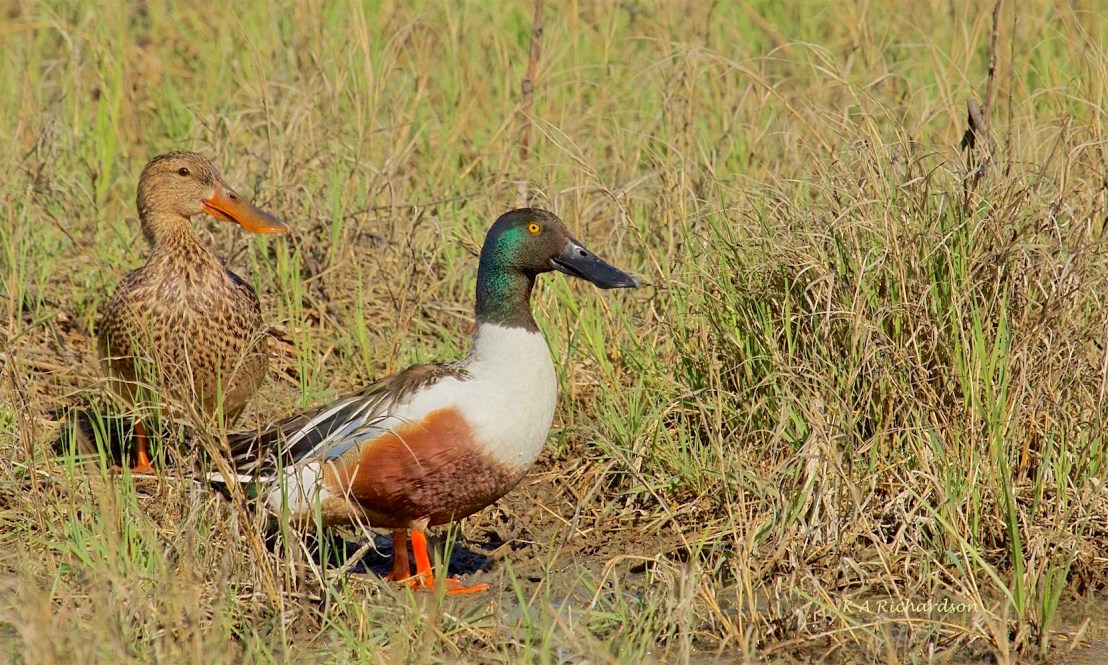
First up is a duck that I had enormous difficulty getting close to at The Coast, with one notable exception at Piper Spit, Burnaby. Up here, however, especially at Robert Lake, despite its tiny viewing area, I’ve been able to do much better with Northern Shovelers. I was also able to observe them in a more natural setting in Michaelbrook Marsh.
While predominantly a western duck during breeding season, the NSHO can be seen in other parts of Canada and North America in other seasons.
“Perhaps the most outwardly distinctive of the dabbling ducks, the Northern Shoveler inhabits wetlands across much of North America. Its elongated, spoon-shaped bill has comblike projections along its edges, which filter out food from the water.” Cornell Lab of Ornithology
Northern Shoveler pair at Robert Lake, May 2016. Click to enlarge.
Magnificent in spring! Click to enlarge.
“The bill of the Northern Shoveler is about 6.5 cm (2.5 inches) long. The bill has has about 110 fine projections (called lamellae) along the edges, for straining food from water.
Northern Shoveler pairs are monogamous, and remain together longer than pairs of other dabbling duck species.
When flushed off the nest, a female Northern Shoveler often defecates on her eggs, apparently to deter predators.
The oldest recorded Northern Shoveler was a male, and at least 16 years, 7 months old when he was found in Nevada. He had been banded in California.” (Cornell)
NSHO drake with Wilson’s Phalaropes, Robert Lake, Kelowna, BC.
Female NSHO, Thomson Marsh, Kelowna, BC.
Love his leathery looking bill!
NSHOs in mid May. To enlarge the images above, just click on them….
A month after the photos posted above were taken, the NSHO has evolved into this guy below:
Our drake in mid June. Click to enlarge in a new tab.
Turning away from ducks for a moment, I must give some space to one of the smaller members of our local menagerie, the Pied-billed Grebe.
“Part bird, part submarine, the Pied-billed Grebe is common across much of North America. These small brown birds have unusually thick bills that turn silver and black in summer. These expert divers inhabit sluggish rivers, freshwater marshes, lakes, and estuaries. They use their chunky bills to kill and eat large crustaceans along with a great variety of fish, amphibians, insects, and other invertebrates. Rarely seen in flight and often hidden amid vegetation, Pied-billed Grebes announce their presence with loud, far-reaching calls.”
In our neighbourhood, as with so many of the water birds, we see PBGRs in Belmont Pond and Thomson Marsh just before breeding becomes intense. I wish they’d nest where we can observe the chicks, but they don’t. Part of the fun of this avocation, however, is the ongoing effort to learn more about the birds when the heat is turned up….
(Podilymbus podiceps) large Belmont Pond, Kelowna, BC. Curiously, this one, an autumn juvenile, does not have the usual “pied” stripe on the bill….(Podilymbus podiceps) small Belmont Pond, Kelowna, BC. Smaller space, different light!
“Part bird, part submarine, the Pied-billed Grebe is common across much of North America. These small brown birds have unusually thick bills that turn silver and black in summer. These expert divers inhabit sluggish rivers, freshwater marshes, lakes, and estuaries. They use their chunky bills to kill and eat large crustaceans along with a great variety of fish, amphibians, insects, and other invertebrates. Rarely seen in flight and often hidden amid vegetation, Pied-billed Grebes announce their presence with loud, far-reaching calls.” (Cornell)
We see other grebes as well, but so far I haven’t built up a very strong library of the Eared, Horned, Red-necked, and Western varieties. Another project for 2017!
Click to enlarge these record shot images:
Horned Grebe in spring plumage (record shot), Okanagan Lake
Red-necked Grebe, Okanagan Lake, summer.
And one shot of a Horned Grebe in winter plumage:
Horned Grebe, (Podiceps auritus) Okanagan Lake near Rotary Marshes, Kellowna. BC.
Two of my favourite spring ducks fall into the “R” category: Redheads and Ruddies.
Ruddy Ducks have a much greater presence in the West; Redheads are seen in more areas of North America. Each is a striking addition to any spring pond!
Redheads’ range is similar to Canvasbacks’ but not identical.
Cornell’s RUDU range map
While 2016 did not provide opportunities as great as the previous two springs, it did not totally disappoint. We travel to Birdie Lake at Predator Ridge Resort south of Vernon each spring where we have been quite lucky with these species. No Ruddy in Belmont Pond this year, but we’re keeping our fingers crossed for a drop-in this year. Surprise us, 2017, just as 2016 did when, for one day, we had Redheads in Thomson Marsh!
The image below was taken through some tall cattails on a cloudy afternoon. While it does not rank as a great image, it marks a noteworthy moment with its diversity of pond mates all crowded onto one heavy log! A most unusual find, unlikely to be replicated….
In Canada, we love diversity!
Click to enlarge images.
Redhead drake, Birdie Lake, Predator Ridge Resort.
REDH pair at Birdie Lake.
Ruddy Ducks, at least the drakes in breeding season are also known as Bluebills:
Ruddy drakes put on great breeding displays….
An iconic pose from this fella!
The object of their affection. Nature works in mysterious ways. ‘Nuff said.
“The bright colors and odd behavior of male Ruddy Ducks drew attention from early naturalists, though they didn’t pull any punches. One 1926 account states, “Its intimate habits, its stupidity, its curious nesting customs and ludicrous courtship performance place it in a niche by itself…. Everything about this bird is interesting to the naturalist, but almost nothing about it is interesting to the sportsman.” That’s an account from a different era, and one that I would question today. One can only imagine how the writer might describe human behaviour ninety years after he wrote that piece!
Ruddy Ducks are very aggressive toward each other and toward other species, especially during the breeding season. They are even known to chase rabbits feeding on the shore.”
Skipping Snow Geese and Swans, we move to another genus of ducks, Anas —teals comprising three species commonly found in BC. In Part 1 of this series, we met the American Green-winged Teal (and its Eurasian cousin the Green-winged or Common) Teal. In this concluding Part, we’ll look at two of the relatives: the Blue-winged and the Cinnamon. The latter is truly a western waterfowl with an amazing north-south range; the Blue-winged, however, is common across Canada. Here in the Okanagan Valley, I see more CITEs than BWTEs, at least in our two and a half years.
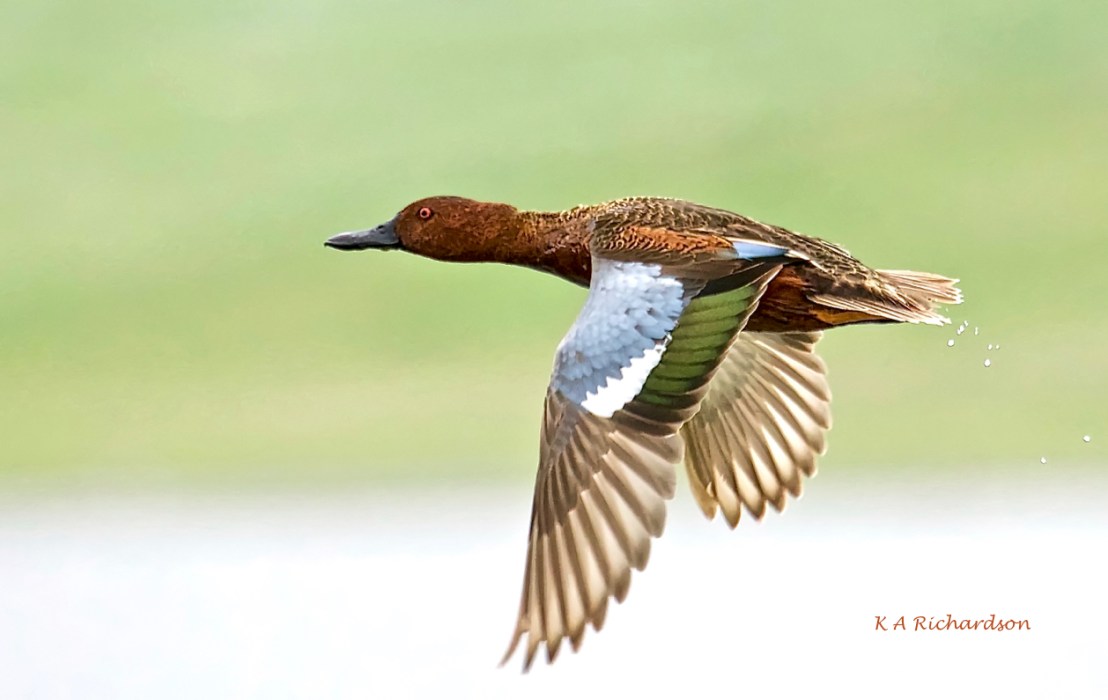
Teal males of all three species are striking. For me, the Cinnamon is most arresting,
Solo Cinnamon drake….
and especially beautiful to capture in flight with its combination of reddish brown, teal blue, and green. Not the best flight shot you’ll see, but my best so far. Another one to work on in 2017.
Cinnamon Teal moving to a preferred spot at Robert Lake near Kelowna. Click to enlarge.
In 2015, I got my best CITE shots close to home. Last year, however, these ducks presented very well near the tiny viewing area at Robert Lake. This is my favourite shot by far.
Click to enlarge in a new tab.
“You’re so vain; you prob’ly think this shot is about you….”
I was very pleased the day that I found CITEs and a BWTE together in Teal Corner in Thomson Marsh. I had never seen a BWTE in this marsh before, and to have the two species together for comparison was a great bonus.
Cinnamon Teal pair in the background; Blue-Winged in front. Click to enlarge.Blue-winged Teal surprise! Photographed through the cattails….
Wondering how I know which drake above the female on the right is mated to?
Good question. For starters, I watched the CITEs work together; the BWTE was clearly the visitor, and I’d seen him alone in the location before (left). Click to enlarge.
Cornell’s Lab of Ornithology online also provides this guideline: …“Female and immature Cinnamon Teal are notoriously difficult to distinguish from Blue-winged Teal. Cinnamon Teal are always larger-billed than Blue-winged. They also have a warmer-toned face, whereas Blue-winged Teal has colder, gray tones and a bolder facial pattern. Green-winged Teal has a slimmer bill and more boxy head. Their overall body color on females is darker brown, with a darker stripe through the eye and darker cap. Green-winged Teal in any plumage lack the pale blue upperwing coverts of Blue-winged Teal, Cinnamon Teal and Northern Shoveler.” (Cornell)
Here’s a shot of a BWTE and a NSHO sharing space at Robert Lake (Click to enlarge in new tab):
Blue-winged Teal and Northern Shoveler in a “twofer shot.”
And finally, we reach the end of our ducks for 2016 with my all-time favourite, one we are blessed to enjoy both at The Coast and here in Okanagan Valley, the duck whose photo graced the beginning of this five-part series (hey, these guys deserve a fanfare, too!)~
The Wood Duck!
Wood Duck pair in Belmont Pond where we enjoyed their presence for several weeks in the Spring of 2016. Sadly, they didn’t breed here, but that may change in 2017 if the newly installed WODU nest boxes impress them sufficiently….
Click to enlarge images.…
WODU pair again…
and again….
Giggle if you get this!
Wood Duck drake high in grass. (I said ‘in’, not ‘on’….)
And we’ll say goodbye for this post with this triptych from Piper Spit in Burnaby, BC.
If you were looking in Part 3 for ducks or water fowl with “C” in their first names, perhaps Cinnamon Teal or Common Mergansers, you didn’t find them except as a note. You’ll find the latter in this part, along with Gadwalls, Hooded Mergansers, the Common Loon, and, of course, Mallards (on which I did a piece earlier). For Horned (and other) Grebes, check part 5.
Gadwall drake, Thomson Marsh, early spring. Click to enlarge in a new tab.
Gadwall. Unusual name. Just like the word ‘unusual with its three ‘u’s. I’ve heard them called Gladwells, Gadwells, Godwills, and plain ducks. But to me, they’re a treat, and we have lots of ’em, although I always wonder how that happens. Really. I find Gadwalls are among the most devoted of mates and yet I’ve never seen, to my knowledge, a hatch of Gadwall ducklings! I’ve watched them copulate, so that can’t be the problem. But where do those wee ones go?
Click to enlarge in new tab.
According to Ducks Unlimited ,” Gadwall[s] breed near seasonal and semi-permanent wetlands, mainly in the grasslands and mixed Prairie regions of the United States and Canada. Substantial numbers also breed in wetland habitats of the Great Basin. Gadwall tend to begin breeding later than most ducks. Female gadwalls nest in fields and meadows, and on islands and dikes in wetlands, and lay an average of 7-12 eggs.”
In addition, “The North American gadwall population remained stable through the 1970s and early 1980s, while populations of other waterfowl species generally declined. Since the late 1980s, the gadwall population has increased to record levels, with the most recent estimates nearing 3 million, due to improved wetland habitat conditions.”
“Okay, maybe this is the angle he’s lookin’ for. Smile, dammit!”….. “I’m smilin’; I’m smilin’!”
Many of you in the northeastern US and Atlantic Canada, western Ontario and the high Arctic, and most parts of BC may be unfamiliar with this subtly plumaged (until you really look closely) and almost silent species. We used to have a single pair in our urban pond in New Westminster that I admired for their devotion. But it wasn’t until we moved to the Interior that I really came to appreciate them, especially in early spring and late autumn, when light angles illuminate them best. And, now that I think about it, I don’t see them much in summer, likely because that’s when they’re rearing their young in more remote locations…. Live and learn (OK, and speculate!).
Click on any of the photos in the set below to enlarge them. To return to this screen, click the small x in the top right corner of the enlarged window.
“The North American gadwall population remained stable through the 1970s and early 1980s, while populations of other waterfowl species generally declined. Since the late 1980s, the gadwall population has increased to record levels, with the most recent estimates nearing 3 million, due to improved wetland habitat conditions.”
In spring and autumn, we occasionally see drakes displaying their hidden colours, above left, when they stretch. In Thomson Marsh, in spring, pairs can be rather shy. In the shot above, top right, the drake and his mate had been swimming north along the brook, keeping an eye out for any snooping paparazzi who might be tracking their whereabouts. The drake, in the lead, decided to move ahead as quickly as possible, but the duck held back, unbeknownst to him. When he finally realized that he and she were now on opposite sides of me, he showed a little consternation as he tried to decide if it was safe to swim back to her. (He could have flown, but chose not to.) Slowly, deliberately, he swam back in her direction, giving me a number of great looks, including the one at the beginning of this Gadwall section….
A much more colourful bird that I’m very pleased makes itself widely available in Okanagan Valley ponds and streams is the Hooded Merganser. Like its Common Merganser cousin, it shows up in Belmont Pond, only steps from home, and in Mission Creek in spring and autumn. Several breed in the area like the family that gave me some of my best images in 2015 at Michaelbrook Marsh.
All of the photos of HOME drakes were taken in Belmont Pond, very close, appropriately, to home. They can be found in many other locations in the Valley, however.
Click on any of the photos in the set below to enlarge them. To return to this screen, click the small x in the top right corner of the enlarged window.
Mergansers of all species can be problematic to photograph. Some of my Flickr friends envy how approachable Hoodies and COMEs are here. I appreciate their cooperation but still find capturing them to my satisfaction an ongoing challenge. But that’s the fun of it all, isn’t it— the ongoing drive for improvement.
These are two of my favourite Hoodie shots of 2016, both of drakes, but with different lighting….
Hoodie drake in special light, Belmont Pond. Click to enlarge in new tab.Less dramatic, perhaps, but special in its own way…. Click to enlarge in new tab.
Click on any of the photos in the set below to enlarge them. To return to this screen, click the small x in the top right corner of the enlarged window. Before you do that, however, what do you mean you already did? I wanted you to note that three of these photos show a female Hooded Merganser, and one does not. It shows a juvenile male. Now which one is the juvie? And I don’t mean all those little ones, especially the one who’s mounting his guard, the Western Painted Turtle because he thinks it’s a pony….
Mother Hoodie and chicks
Baby Hoodie thinks his guard is a horse!
Female Hoodie in Belmont Pond, late February.
Juvenile male hoodie!
If she has an all black bill, she’s not a she, he’s a he….
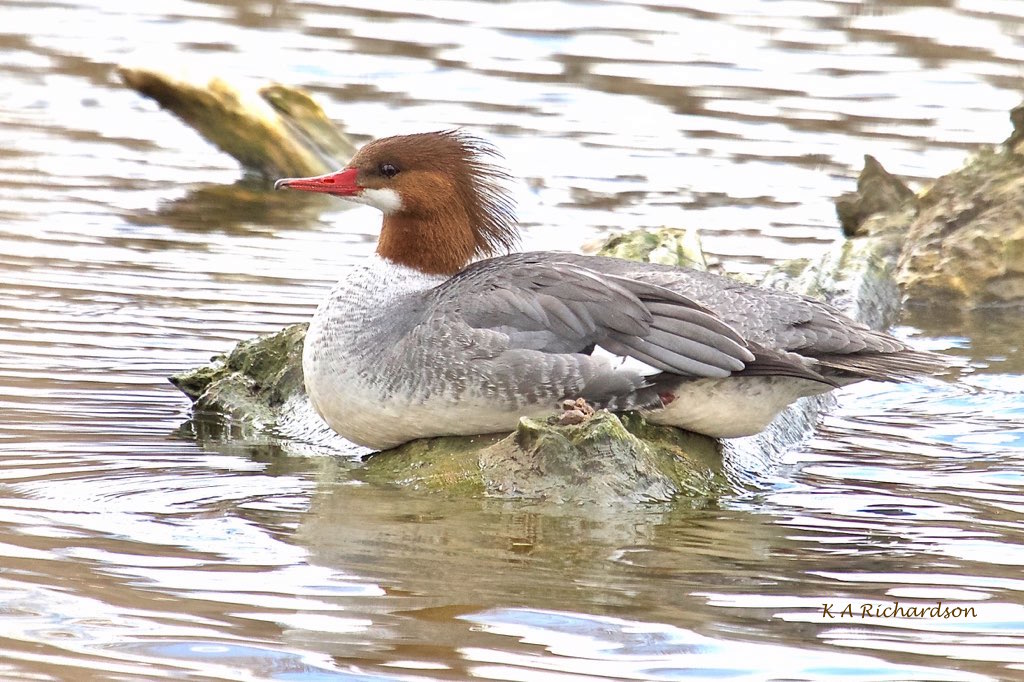
The Common Merganser is a much larger bird. While there are some similarities among the female cousins, we’d never mistake a COME for a HOME. That’s even more true for males. I had few chances to observe COME drakes at the Coast, but only because I didn’t like driving to look for them. Here, they show up in the spring as a pair—in Thomson Marsh or Mission Creek. At this stage, the drake looks a responsible mate. But after breeding, and even more, after the eggs hatch, he abandons his mate and his family.
COME pair in Mission Creek.
And, in our neighbourhood, at least ini 2016, he became a regular visitor who spent his summer vacation in Belmont Pond, visiting with other ducks and mergansers, and providing wonderful photo opps for local photogs:
I love the colour and finery of these magnificent males, even if they are lousy dads! Click to enlarge.Female Common Merganser in Thomson Marsh in Spring, waiting for her mate to arrive.
Some interactions were hilarious, at least to me…. Click photos to enlarge.
“Hey, hey, hey!”
“Excuse me’s the word!”
“Sheesh! What was all that about?”
Poor guy! He’s gets it from everybody who thinks they’re the boss!
“OK! Got this log all to m’self!”
“Oh-oh!”
“Not again! What is it with this pond?”
BC, including the Okanagan, is also home to the much rarer Red-breasted Merganser. Sadly, I didn’t see any this past year. One was reported on Okanagan Lake, but I couldn’t verify the find. Maybe this year….
Got so carried away with Mergansers that I nearly forgot the Common Loon, which I decided to put into this category. 2016 did not provide me with opportunities like those at 108 Resort in 2014 and 2015, and we did not get back up there this year. Of course we have Loons in the Okanagan-Southern Interior Plateau region, but I didn’t make them a target in 2016. Another species to pay more attention to in 2017. I’ve got some ideas; we’ll see if they materialize.
Click images to enlarge.
Common Loon offshore at Okanagan Lake South Provincial Park, 2016
This Common Loon at 108 Lake, May 2015, put on a marvellous show at close range.
Besides its dazzling appearance, the COLO is renowned for its vocalizations. On a big lake like Okanagan L., we don’t get to enjoy that as much as we do in smaller Cariboo Lakes or those in the Kane Valley. I took their calls and chatter too much for granted in the 15 years when I heard them calling in the evenings and sometimes in the dark when it was time for humans to sleep. Now I long for those sounds again….
Well, the “M category” would not be complete without a mention of the Mallard, on which I’ve already posted a set of flight shots. I’m hoping to do a special feature on this species later in the spring. For this post, besides the Mallard above, here’s a couple of shots without comment: click on the photos to enlarge them.
Mallard Duckling, Belmont Pond.
Mallard Ducklings in formation, Okanagan Lake Park South
Wood Duck-lings, Piper Spit.
Piper Spit, Burnaby Lake, BC.
(Anas platyrhynchos) small Belmont Pond, Kelowna, BC.




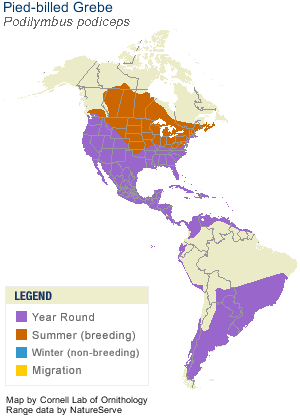 “Part bird, part submarine, the Pied-billed Grebe is common across much of North America. These small brown birds have unusually thick bills that turn silver and black in summer. These expert divers inhabit sluggish rivers, freshwater marshes, lakes, and estuaries. They use their chunky bills to kill and eat large crustaceans along with a great variety of fish, amphibians, insects, and other invertebrates. Rarely seen in flight and often hidden amid vegetation, Pied-billed Grebes announce their presence with loud, far-reaching calls.”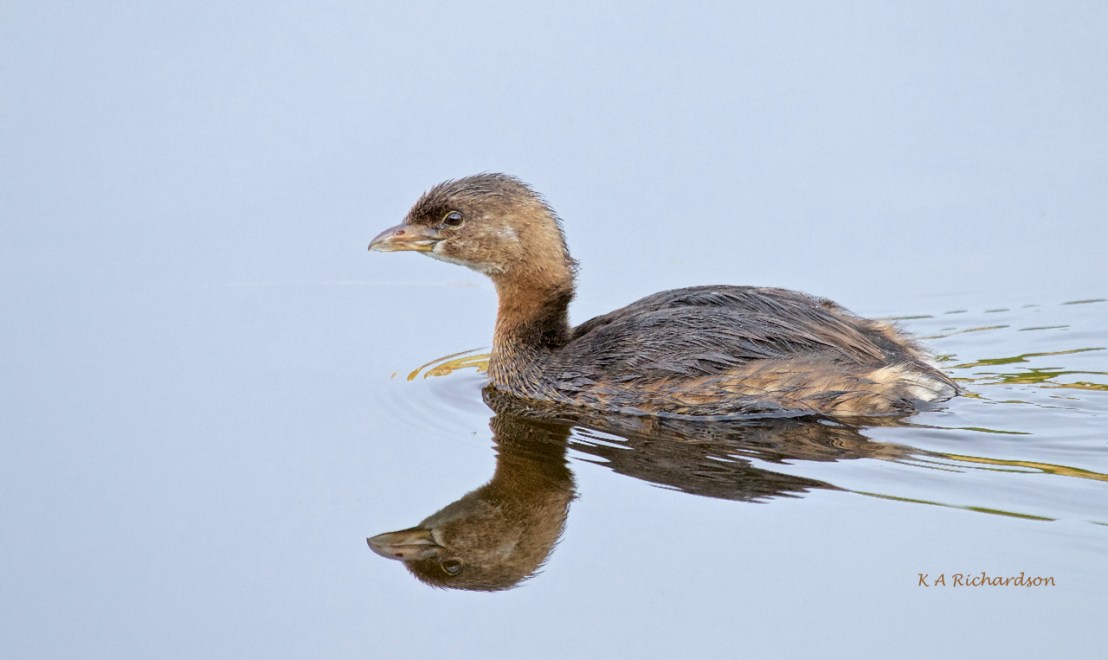






 birds & musings