Month: November 2016

Time to observe and wait….

Last week, I thought I wanted to continue my musings about the role of urban-rural divide both in the US-eh, and here in Canada. There’s plenty of evidence available now that the inadequate response to rural discontent by Democratic strategists played a very large part in Clinton’s failure to win the presidency. Together with complacency about just how close the polls were—often within the “margin of error”—Clinton’s supporters badly misjudged how narrow their path of victory was.

This week, to my surprise, I just want to park the whole issue until after the inauguration of President TrumpFor anyone who still cares, however,  some links to reports & assessments that I’d like to share.

“…it’s been the perception of white, working class people, poor people, that liberal America has basically ignored them for a really long time, and that’s part of what happened here too. There was a blind spot. They [liberal Americans] counted those people [folks in flyover country] out a long time ago. They either think they’re never going to win with those people, or they don’t want them on their side, even. Because of the stereotypes of rednecks, or working class white people, I don’t think the left has made much of an effort to court them or care about them for a while.”
Trae Crowder, ‘Liberal Redneck’ comedian
.

And this from the writer being widely quoted for her assertion that, “….the press takes [Trump] literally, but not seriously; his supporters take him seriously, but not literally”:

“Republican media strategist Bruce Haynes challenges his Republican and Democratic DC- based peers who are knee-deep in their drinks over Trump’s win to take a step back and look at the map of what Clinton won Tuesday night. “She won the biggest metropolitan areas in the country and a couple of Southwestern states that have seen a huge influx of Mexican immigrants,” he said.

“And that is all she won and not a damn thing else.”

That is, she won the top 10 populations centers where most of the wealth, commerce and power is located — and lost the bulk of America.

This great populist election was all a big pushback against elitism on both sides of the aisle.” Selena Zito, New York Post.

From Chris Cillizza at the Washington Post this assessment entitled,
One of Hillary Clinton’s top aides nailed exactly why she lost”:

“Why did Clinton lose, then? Because no one understood just how much people wanted change and how big a risk they were willing to take to put someone way outside of the political system into the White House.

Consider this:

* Just 38 percent of voters said that Trump was “qualified” to be president (52 percent said the same of Clinton).

* Just 35 percent said Trump had the “temperament to serve effectively as president” (55 percent said Clinton had the right temperament to be president).

* One in three voters said Trump was honest and trustworthy (36 percent said the same of Clinton).

Numbers like those in almost any other election would ensure a Trump loss. If the goal was to disqualify Trump or suggest that he represented too large a risk to take a chance on, numbers like that seemingly prove the Clinton campaign did its job.

But, the desire for change last Tuesday was bigger than any worries Clinton was able to raise about Trump. Four in 10 voters said the most important character trait in deciding their vote was a candidate who “can bring needed change” to Washington. Of that group, Trump won 83 percent to Clinton’s 14 percent — 83 to 14!!!!

Think of it this way: You know a hurricane is coming. You build a 20-foot wall around your property to protect it from the storm surge, believing that the waters have never risen above 14 feet before so you should be plenty safe. Then a 25-foot surge happens.  You’re swamped not because you didn’t see it coming or didn’t plan for it but rather because something ahistoric happened. The past no longer became predictive of the present.

That’s what happened to the Clinton campaign. It was based on the old rules of the road. If your opponent is the change candidate, turn that change against him. Rather than refreshing change, turn it into dangerous change.

That all happened. And Trump still won.

Past is prologue only until it isn’t anymore.”

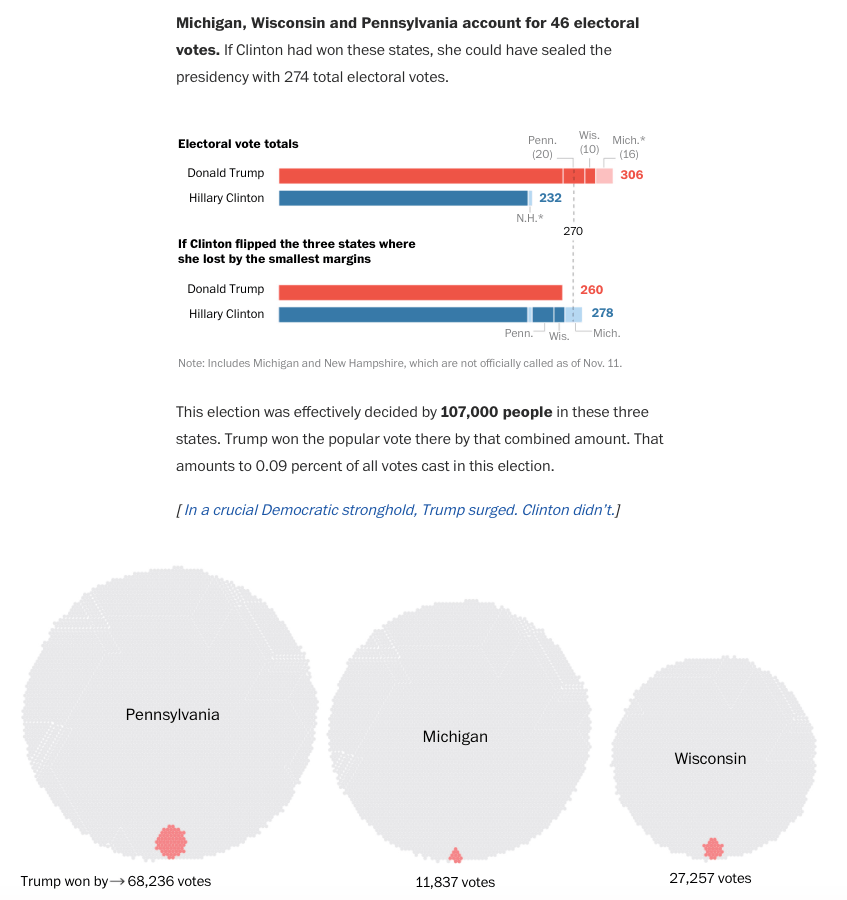
And also from the Washington Post, the graphic below: 107,000 in three states….
(To enlarge, right click on the graphic and choose “Open in a new tab”).
of-the-more-than-120-million-votes-cast-in-the-2016-election-107000-votes-in-three-states-effectively-decided-the-election


On the urban-rural divide in North America

In 1960, in Grade 11, living in a hamlet about 30 miles outside of Winnipeg, I participated actively  in community activities including church. That involvement enabled me as an 16 year-old to attend what was then called the Tuxis and Older Boys Parliament staged annually in the Manitoba legislature building between Christmas and New Year’s.

1960-39th-session
I’m somewhere in the upper right quadrant of this photo.

“The Older Boys’ Parliament program began in Ontario as part of the TUXIS movement (“Training Under Christ In Service”). Its original sponsors included various Protestant churches, such as the United Church of Canada, the Anglican, Baptist, Presbyterian, and Lutheran churches, the Salvation Army, and a variety of service groups such as the YMCA, De Molay and Kiwanis organizations. The movement’s goal was to foster the development of the physical, mental, spiritual and social well-being of the person as inspired by the biblical passage Luke 2:52, which reads: ‘And Jesus increased in wisdom and in years, and in divine and human favour.’ Youth Parliaments, only one of many TUXIS activities, were designed for religious as well as parliamentary training. Though most YPs were at one time part of the TUXIS movement, only the TUXIS Youth Parliament of Alberta retains the name to this day. Notable former Manitoba members from this period include Bill Norrie, Robert Steen, Wally Fox-Decent and Howard Pawley [and, I will add, Lloyd Axworthy].”
(Read about  the evolution of this organization, including its decision to amend its religious and gender restrictions here: http://www.ypmanitoba.ca/about/history/)

Like all members ‘elected’ to this ‘parliament,’ I was required to give a short speech introducing myself and commenting on some issue of importance to me. At first, I had no idea what to talk about. But fairly quickly, I grasped an insight I’d not had before: the deep divide between us who came from the rural areas (“the rubes”) and the “city slickers.” Very nervously, I stood up and spoke my piece about “urban-rural prejudice.” Until our participation at this event, most of the rurals from the Urals, I think, believed we were equal to the urbanites. Discovering that we were seen more as big frogs from small ponds came as a shock, and a cause for concern and even action.

I’m reminded of that time 56 years ago because I’ve been trying to figure out what happened in the US elections of 2016—why the prognostications of so many pundits, and pollsters, and talented, well-educated, broadly informed reporters and editors turned out to be wildly off target. And among the many factors emerging in the post-Trump victory analysis, one element that keeps popping up is that so many of the august predictors simply didn’t know or understand the size, nature, or determination of exurban or rural America. Trump supporters from the Heartland were written off simply as racists and misogynists, “deplorables.”

You know, to just be grossly generalistic, you could put half of Trump’s supporters into what I call the basket of deplorables. Right? The racist, sexist, homophobic, xenophobic, Islamaphobic — you name it. And unfortunately there are people like that. And he has lifted them up. He has given voice to their websites that used to only have 11,000 people—now 11 million. He tweets and retweets their offensive hateful mean-spirited rhetoric. Now, some of those folks—they are irredeemable, but thankfully they are not America.”

The next day Hillary walked back her assertion somewhat: “Last night I was ‘grossly generalistic,’ and that’s never a good idea. I regret saying ‘half’ — that was wrong.”Clinton went on to say [however] that Trump had nevertheless repeatedly engaged in “deplorable” behavior throughout his campaign… “I won’t stop calling out bigotry and racist rhetoric in this campaign….

What many reporters and op-eds failed to give adequate play to, I want to emphasize, was what she stated immediately after the bold faced paragraph above:

But the other basket—and I know this because I see friends from all over America here—I see friends from Florida and Georgia and South Carolina and Texas—as well as, you know, New York and California— but that other basket of people are people who feel that the government has let them down, the economy has let them down, nobody cares about them, nobody worries about what happens to their lives and their futures, and they’re just desperate for change. It doesn’t really even matter where it comes from. They don’t buy everything he says, but he seems to hold out some hope that their lives will be different. They won’t wake up and see their jobs disappear, lose a kid to heroin, feel like they’re in a dead-end. Those are people we have to understand and empathize with as well.

She clearly understood that part of Trump’s supporters, which the urban elite needed to  reach out to and comprehend . I don’t think her supporters heard her either. Clearly, it was that “half” of Trump supporters, especially in the rust belt of Wisconsin, Michigan, Pennsylvania, and Ohio whose support even one-of-their-own Michael Moore couldn’t cajole, folks who were so pissed off with the liberal elite whether in the Democratic or Republican leadership, that they simply refused to listen to anything she had to say.

Incidentally Bill Clinton, who built his presidency on forging a “…New Democrat” Party [that] co-opted the Reagan appeal to law and order, individualism, and welfare reform, and made the party more attractive to white middle-class Americans” (Miller Center) also understood that “basket” of the electorate that urban elites could not fathom:

“The other guy’s base is what I grew up in,” the former president said during a campaign stop in Fort Myers, Fla. “You know, I’m basically your standard redneck.”

The former president also recounted a moment during the 2016 Democratic primary when he went to campaign for Hillary Clinton in West Virginia—a state that they lost and predicted they would lose long before voting even took place.

“[S]he said, ‘There’s no way that we can carry it,’ and I said, ‘No way,'” Clinton said Tuesday, recounting a conversation he had with his wife about campaigning in Mountain State.

“First of all, [West Virginians] only watch Fox News,” he added to laughter. “But to be fair they think we only care our political base and the people that agree with us culturally. And it’s not true, but that’s what they think.”

Clinton said that when he got to West Virginia, he was met by a bunch of pro-Trump protesters. He said he invited them into his rally and encouraged them to reconsider their support for the GOP nominee.

“If you really believe that you can make America great again, knowing I know what it means as a white southerner,” the former president reportedly told the protesters.

Clinton told his audience Tuesday, “what [Trump]s slogan] means is, ‘I’ll give you the economy we had 15 years ago and the society you had.’ In other words, I’ll move you up on the social totem pole and others down,” Clinton said.

His comments came as part of a larger appeal to his audience to reach out to undecided voters and even pro-Trump supporters to tell them the Democratic nominee’s campaign understands them and wants to include them.

“Don’t engage in our version of all this screaming,” Clinton said. “Go out there and look people in the eye who aren’t going to vote for her and tell them we still want them to be part of America. Tell them we need them (my emphasis).”

“I know how they feel,” he added in reference to angry and frustrated voters, many of who have gravitated towards Trump. “And I’m telling you, the older you get, the worse it is if you look in the mirror every day and you think you can’t do anything to change the future.”

Clinton’s campaign stump speeches often include references to his childhood growing up in Arkansas, including his memories of pre-Civil Rights attitudes and the general unpleasantness of using outhouses. (Washington Examiner)

But most of Hillary’s supporters were deaf to these admissions and admonitions, I think. Whether the Democratic Party, and, for that matter, urban elites in other countries including Canada are willing to unstop their ears and open their eyes and realize that the main conflict in modern democracies is not simply between the top 1% and everybody else is anyone’s guess. Better listening is needed, and soon…. And, yes, among those who opposed Trump but voted for him anyway, and who are now capable of listening to some of us on the other side, there needs to be some unplugging and eyes-opening, too.

To be continued….


I was wrong, and confidence in my ability to analyze has been shattered….

Yesterday, I wrote on this blog:

“I have questioned whether or not a large enough number of Americans had the wherewithal to make a rational choice. But this week, as the end drew nigh, I have relaxed, reassured by the polls, particularly Nate Silver’s fivethirtyeight.com which correctly forecast the last two presidential elections. I am confident that Hillary Clinton will be the next president, the first woman president of the US-eh. In about 12 hours (8:00 PT/11:00 ET), we’ll have a much clearer idea.”

And all day long, I reassured the love of my life that things would turn out okay, at least numerically.

It’s clear on the morning after, that as far as the the popular vote is concerned, Trump didn’t win. Latest totals Wednesday morning show Clinton, thanks to large pluralities in heavily populated New York and California, polled more than 59,647,621 votes to Trump’s 59,438,580. Her margin in this measure is likely to increase as absentee and mail-in ballots are finally counted.

Click graphics to enlarge….

CNN graphic on left Politico graphic on right

But where they really count, the numbers in the Electoral college, in the number of states Trump “won,” and in the number of rural Americans persuaded, Clinton trailed badly.
ana-marie-cox-l

As Ana Marie Cox commented on Trevor Noah’s (live) Daily Show—even before Trump’s numbers passed the 270 EC vote threshold, many American “…working class white men… have traded their health care and their economic opportunity for the right to be more a little more explicit in their racism….” (Comedy Central, Nov. 8, 2016).

It’s unlikely that the results can be explained this easily. There will be a great deal of thoughtful analysis devoted, as there was to Mitt Romney’s loss to Obama in 2012, to understanding why Clinton failed to persuade enough Americans that she deserved their support.

I’ll be studying carefully, too.
For the moment, that’s all I can do.

November 8, 2016: day of reckoning

2016-presidential-candidates

The original twenty-two candidates eventually reduced to two….

Finally, Americans go to the polls for the final time in their federal elections, including the choice of a new president of their nation.

We have been following (addicted to) the election race since mid July. For me, the turning point occurred when the Democratic and Republican presidential candidates chose their vice-presidential running mates. On July 23, Hillary Clinton’s choice of Tim Kaine gave me great hope. Of the four candidates at the top of the two major parties’ tickets, I think Kaine is the best hope of the kind of decent, capable, experienced public servant that American has seen in a long time. Not flashy or charismatic, but solidly grounded in service from his days as a Catholic missionary in Honduras through his successful forays into municipal and state politics that saw him become a councilman, then mayor or Richmond, VA, and later lieutenant governor and governor of the state, Kaine has displayed integrity and sound, thoughtful leadership.

the-finalists
Democrats’ Tim Kaine, Hillary Clinton; Republicans’ Donald Trump, Mike Pence

Since July, there have been far too many campaign developments to detail here. My faith in the Clinton-Kaine ticket has certainly been tested, not by anything attractive in the Trump-Pence campaign, but by the behaviour of so many supporters of the latter “team.” I have questioned whether or not a large enough number of Americans had the wherewithal to make a rational choice. But this week, as the end drew nigh, I have relaxed, reassured by the polls, particularly Nate Silver’s fivethirtyeight.com which correctly forecast the last two presidential elections. I am confident that Hillary Clinton will be the next president, the first woman president of the US-eh. In about 12 hours (8:00 PT/11:00 ET), we’ll have a much clearer idea.

161108-who-will-win-the-presidency-538-final

Of course, the conclusion of the election will NOT be the end of the story. Whether the next few weeks represent a denouement in this drama, or simply the third act in a five-act play remains to be seen. Stay tuned….

Media Literacy Matters! Beware Fake News….

UPDATED NOVEMBER 17, 2016: CHECK OUT THIS LINK:

Viral Fake Election News Outperformed Real News On Facebook In Final Months Of The US Election

Last week I wrote, in connection with the US-eh? presidential election, about “news addiction” and the rising spread of “fake news” on the Internet and TV. With only today, tomorrow and 18 hours of Tuesday to go until we learn the outcome of this “unprecedented” democratic exercise, there will be many worried observers biting their nails to the quick.

So, for the record, just a quick followup and an admonition for change.

On November 2, Ahiza Garcia and Justin Lear reported on CNN Money under this headline:

5 stunning fake news stories that reached millions

Each is connected to US politics and the presidential race. Each is well documented. Each shows how vulnerable Americans, and those who follow America’s welfare, are in the face of disinformation presented as fact. Millions of people.

Please read the story above for yourself. Then have a look at this evaluative piece from The Atlantic online that explains as I wrote last week that we desperately need, in the 21st century to become a great deal more media literate, media savvy. Not just kids in school; all of us!

Atlantic Magazine online: 
What CNN Got Right About the Presidential Race

b-stelter-plague-of-fake-news“Last Sunday morning on Reliable Sources, CNN’s Brian Stelter asked his considerable audience to be on guard for one of this election cycle’s most ugly features: fake news sites. He accurately them called “a plague” across the internet. He proposed a new rule for social-media users: “Triple check before you share,” and he offered some useful tips on how to do that.I’m not a fan of CNN’s generally atrocious political coverage in the past 18 months, to put it mildly. But I am a big fan of Stelter’s work; he’s currently the beacon of light at the news channel. His don’t-fall-for-fake-news advice, part of a series of commentaries he’s been delivering, is a key reason why.In pieces like the one that ran on Sunday, Stelter has done what the traditional media have largely failed to do: Leading the way in bringing media-literacy skills to the wider public. Given the size of his audience, on TV and online, it is probably no exaggeration to call him, as I did the other day, “America’s most influential teacher of media literacy in the digital age.” 
Had American journalists at every level made media literacy a core part of their mission for the past 50 years or so, I’m convinced there would have been (at least) two laudable results. First, the nation would have been better prepared to handle the Digital Age’s flood of information, so much of which is false or deceptive. Second, media organizations—at least the ones doing their jobs right—would have fostered much more trust in their own work, which would have helped sustain them through the economic upheaval they’re now enduring.
While the first of those points seems obvious, I’m not saying America could have entirely avoided what some have called the “post-truth” era. Not everyone pays attention to news in the first place. And some people will choose to believe lies no matter what the facts say, as we’ve seen so powerfully this year. But if more of us had been deploying some principles I’ve long recommended—being skeptical; using judgment; asking questions; going outside one’s comfort zone; and understanding how media are created and used to manipulate—we’d individually do a much better job of what Howard Rheingold calls “crap detection.” And we’d do more collective pushback against the lies. Those principles add up to critical thinking, something Americans should value more in our society.
Had American journalists at every level made media literacy a core part of their mission for the past 50 years or so, I’m convinced there would have been (at least) two laudable results. First, the nation would have been better prepared to handle the Digital Age’s flood of information, so much of which is false or deceptive. Second, media organizations—at least the ones doing their jobs right—would have fostered much more trust in their own work, which would have helped sustain them through the economic upheaval they’re now enduring.

While the first of those points seems obvious, I’m not saying America could have entirely avoided what some have called the “post-truth” era. Not everyone pays attention to news in the first place. And some people will choose to believe lies no matter what the facts say, as we’ve seen so powerfully this year. But if more of us had been deploying some principles I’ve long recommendedbeing skeptical; using judgment; asking questions; going outside one’s comfort zone; and understanding how media are created and used to manipulate—we’d individually do a much better job of what Howard Rheingold calls “crap detection.” And we’d do more collective pushback against the lies. Those principles add up to critical thinking, something Americans should value more in our society.

We’d also have more demand for quality journalism, I’m convinced, if journalists had been teaching media-literacy principles and tactics these past few decades….

…Ideally, some members of the audience for my organizations’ journalism would better understand what we do and why—and why it’s worth more support than just a few clicks. They’d be more inclined to pay for the value they derive, and that would give us more resources to provide more value….

…An offshoot of the field called “news literacy” focuses, as you’d guess, on helping people understand current events and issues better. Stelter’s efforts may be a closer fit with the latter, but all variants on the topic are essential in today’s world. But media and news literacies, which should be embedded in every school’s curriculum, have unfortunately been seen more an afterthought than essential parts of education. (And it’s safe to say that teaching real critical thinking would be seen as downright subversive in many parts of the country.)

I [Dan Gillmor of The Atlantic] hope Stelter keeps it up. CNN could recover some of its credibility by filling some of its current wasteland with the help people need to deploy critical thinking when it comes to what they read, listen to, and watch. If that spread widely—to national, regional, and local news organizations of all kinds—we’d beef up our collective critical thinking skills. We’d better, and soon.” I couldn’t agree more!!


US-eh, er, Elections—2016

Okay, let me admit off the top that we don’t need any more opinions about the Trump-Clinton Clash dominating news from our neighbour to the south. This isn’t about the simple horror….

It’s about two related things, however: first, the way this event has grabbed our attention, and second, what it’s revealing about all of us—and the age in which we live.

So, I’ll be brief, and simply point you to a couple of recent articles that got me thinking. Not since September, 2001, have my wife and I been so absorbed by an unfolding news story and had so many discussions about the anxiety and mixed emotions it generates in us. Like most people, we don’t see any end in sight, even when the electoral decisions are made on November 8, or whenever they become “finalized.”

The link below helped us realize that we’re not alone. You may want to give it a look, too.

Is America addicted to this election?

electionaddictionillo
Data, information, misinformation, disinformation, deception and lies….

No doubt, there will be further musings in this blog after the votes are counted next week….

My second focus on is an old pet peeve of mine—Internet hoaxes. In my past life as a computer consultant to seniors, I spent a lot of time trying to teach people how to approach with reasonable skepticism “the stuff they find on the Internet,” or more importantly, “the stuff their friends send them via email,” and increasingly, the stuff they read on social media like Facebook and Twitter and so many other outlets.

All Internet users, and seniors, especially, are subjected to diabolical schemes, such as phishing, designed to hurt them, defraud them, steal their identities, and more. For a refresher, check out this link: Phishing and other ‘Net Phrauds

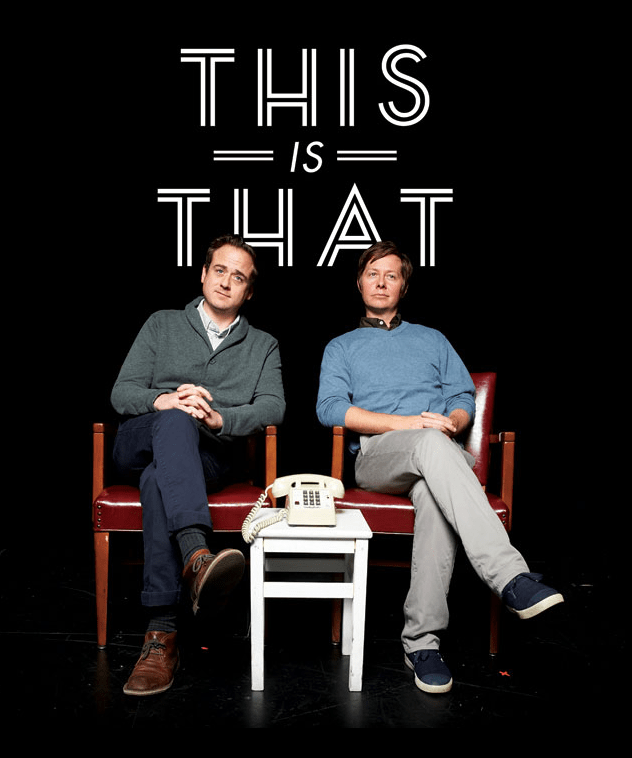
One of the latest threats is called Fake News. For some of us, Fake News that is satirical can be quit entertaining. On CBC (radio and online) there’s a program I love listening to called “This is That.” Here’s how it’s described on that source of all facts holy, Wikipedia:

“The program began as a summer replacement in 2010, returned in the summer of 2011, and was added to the regular schedule in the fall of 2011. It is hosted by Pat Kelly and Peter Oldring, and produced by Chris Kelly.”

this-is-that

 Its “…style has been compared to The Onion, has drawn phone calls from listeners who did not realize that they were listening to a comedy program and took the content seriously; Oldring and Kelly admit to having been surprised that listeners would be fooled.

In June 2010, the National Post reported as fact that CTV purchased the set of the NBC series Friends;[4] this, however, was a satirical story by This Is That.

Two years later, esteemed Canadian journalist Robert Fulford wrote an article for the National Post claiming that the show is “worth tuning in for.”

Also in 2012, Public Radio International reported as fact a This Is That story that dogs in Montreal would have to know commands in both English and French by law.

In early 2013, Harper’s reported as fact a This Is That story in which a Canadian student “sued her university for failing to accommodate her allergies to cactuses, escalators, tall people, and mauve.”

In September of the same year, several media organizations, including USA Today and the Washington Times, reported on a story about an U-11 organization that had decided to play soccer without a ball to remove competition from the game.

In 2014, Jonathan Jones at The Guardian wrote an article analyzing the satire in their story about a New York artist creating invisible art and selling it for millions.[11]

The program has won three Canadian Comedy Awards. Their comedy special “The Christmas Letter” won a gold medal in the category of Best Comedy Special at the 2014 New York Festivals International Radio Awards[14] and their fourth season won a bronze medal in the category of Best Regularly Scheduled Comedy Program at the same awards ceremony.

Clearly a little satire disguised as a news is a dangerous thing…. And this brings me to the second article from the beginning of this week that jolted me to write about it.

Not surprisingly, in view of what I’ve written above, we love to watch Brian Stelter’s Sunday program on CNN, Reliable Sources. It’s great to see a real effort to examine the difficulty in trying to sort out facts from opinions, and opinions based on facts from claims that are pure hyperbole, and the whole gamut in between. Last week’s show, however, included Brian’s highlighting of and warning about Fake News that’s meant not to entertain, but to deceive. Stelter’s Sunday comments were reproduced online in this article on Monday: The plague of fake news is getting worse….

cnn-stelter-fake-news-is-getting-worse-161030

“The rise of social media has had many upsides, but one downside has been the spread of misinformation. Fake news has become a plague on the Web, especially on social networks like Facebook. As I said on Sunday’s “Reliable Sources” on CNN, unreliable sources about this election have become too numerous to count.

So that’s why I recommended a “triple check before you share” rule.

New web sites designed to trick and mislead people seem to pop up every single day. For their creators, the incentives are clear: more social shares mean more page views mean more ad dollars.

But the B.S. stories hurt the people who read and share them over and over again. Many of these fakes reinforce the views of conservative or liberal voters and insulate them from the truth. The stories prey on people who want to believe the worst about the opposition.

A recent BuzzFeed study of “hyperpartisan Facebook pages” found that these pages “are consistently feeding their millions of followers false or misleading information.”

The less truthful the content, the more frequently it was shared—which does not bode well for the nation’s news literacy during a long, bitter election season.”

Stelter goes on to assert:

“Fake news sites and Facebook feeds…traffic in misinformation. My sense is that there are three buckets of these sites:

#1, Hoax sites with totally made-up news headlines that try to trick you;

#2, Hyperpartisan sites that aren’t lying, per se, but are misleading, because they only share good news about your political party and bad news about the other party;

#3, “Hybrids” that purposely mix a little bit of fact and then a lot of fiction.

These sites aren’t going away, so it’s up to Internet users to spot fake news and avoid spreading it.

Fact-checking sites like Snopes can help—they are devoted to ferreting out hoaxes and tricks.

The Sunlight Foundation’s Alex Howard tweeted these tips:

  • Search the source link on Twitter

  • Google it

  • Check Snopes

  • Consider record of source”

So, if you’re addicted, especially to the perils of social media or simply google search results, join the club, and may the force (not the farce) be with us!